Introduction
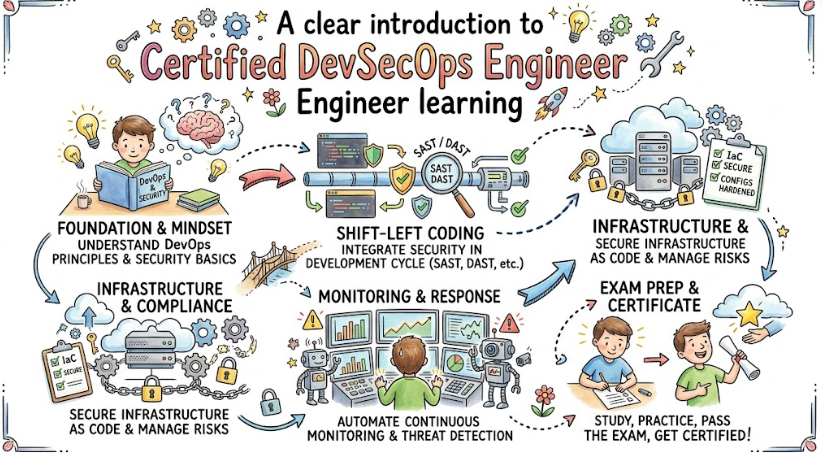
In the modern era of rapid software delivery, the speed of deployment is often prioritized. However, security is frequently left as a final, isolated step. This old-fashioned approach often leads to vulnerabilities being discovered too late in the process. To solve this, the DevSecOps movement was created. Security is now integrated into every stage of the software development life cycle. This guide explores how a professional can transition into this specialized field. The core focus is placed on automation, continuous monitoring, and the cultivation of a security-first culture.
What is Certified DevSecOps Engineer?
The Certified DevSecOps Engineer is a professional designation given to individuals who have mastered the art of securing automated pipelines. It is not merely a title; it is a validation of the ability to use security tools within CI/CD workflows. The focus is placed on ensuring that code is secure from the moment it is written until it reaches the production environment.
Why it matters today?
Data breaches and cyber-attacks are occurring with greater frequency. When security is treated as an afterthought, the cost of fixing bugs increases significantly. By implementing security early, risks are mitigated, and compliance is maintained without slowing down the development teams. The demand for experts who can bridge the gap between development, operations, and security is higher than ever before.
Why Certified DevSecOps Engineer certifications are important
Certifications are utilized as a benchmark for technical competence. A structured learning path is provided through these programs, ensuring that no critical security gaps are missed. Industry-standard tools are mastered, and a mindset of continuous security improvement is developed. For employers, a certified professional is seen as a reliable asset who can protect the organization’s digital infrastructure.
Why choose DevSecOpsSchool?
A hands-on approach to learning is offered by DevSecOpsSchool. Real-world scenarios are simulated to ensure that theoretical knowledge is translated into practical skills. The curriculum is constantly updated to reflect the latest industry trends and security threats. Expert mentorship is provided, and a community of like-minded professionals is built to support long-term career growth.
Certification Deep-Dive: Certified DevSecOps Engineer
What is this certification?
This certification is a comprehensive program designed to validate an engineer’s ability to integrate security practices into DevOps workflows. The use of automation for vulnerability scanning, compliance checks, and secret management is emphasized.
Who should take this certification?
This program is ideally suited for Software Engineers, DevOps Professionals, Cloud Architects, and Security Analysts. It is also highly recommended for Engineering Managers who wish to understand the technical depth of secure delivery.
Certification Overview Table
| Track | Level | Who it’s for | Prerequisites | Skills Covered | Recommended Order |
| DevOps | Intermediate | DevOps Engineers | Basic Linux & CI/CD | Pipeline Automation | 1 |
| DevSecOps | Advanced | Security & DevOps | DevOps Basics | Automated Security | 2 |
| SRE | Advanced | Ops Engineers | Python/Go & Cloud | Reliability & Security | 3 |
| AIOps | Expert | Data Scientists | Math & DevOps | ML-driven Security | 4 |
| DataOps | Advanced | Data Engineers | SQL & Pipelines | Data Privacy | 5 |
| FinOps | Intermediate | Finance/Eng Managers | Cloud Billing | Cost Security | 6 |
Skills you will gain
- Security automation within CI/CD pipelines is mastered.
- Vulnerability assessment and penetration testing tools are integrated.
- Container security and Kubernetes hardening techniques are learned.
- Compliance-as-code and infrastructure-as-code security are implemented.
- Secret management and encryption at rest and in transit are managed.
Real-world projects you should be able to do
- A fully automated DevSecOps pipeline is built using Jenkins and GitLab.
- Static Analysis Security Testing (SAST) is integrated into a Java/Python project.
- Dynamic Analysis Security Testing (DAST) is performed on a live web application.
- Security auditing for a Kubernetes cluster is conducted.
- An automated compliance report generator for AWS/Azure environments is created.
Preparation plan
7–14 days plan:
The core concepts of DevSecOps are reviewed. The official curriculum is scanned, and basic security tools like SonarQube or Snyk are installed in a local lab environment.
30 days plan:
Daily lab sessions are performed. Each stage of the CI/CD pipeline is secured one by one. Practice exams are taken to identify weak areas in knowledge.
60 days plan:
Complex, multi-tool security workflows are built. Real-world case studies are analyzed. Advanced topics like cloud-native security and serverless protection are mastered.
Common mistakes to avoid
- The “shift-left” philosophy is ignored in favor of late-stage testing.
- Manual security checks are prioritized over automated solutions.
- The importance of soft skills and cultural change is underestimated.
- The focus is placed only on tools instead of underlying security principles.
Best next certification after this
- Same track: Advanced Certified DevSecOps Professional.
- Cross-track: Certified SRE Practitioner.
- Leadership / management: Certified DevOps Manager.
Choose Your Learning Path
DevOps Path:
This path is best for those focusing on delivery speed and infrastructure automation. Core CI/CD principles are mastered here.
DevSecOps Path:
This is designed for individuals who want to specialize in security. It is the natural progression for DevOps engineers seeking higher responsibility.
Site Reliability Engineering (SRE) Path:
Reliability and uptime are the primary goals. This path is suitable for those who enjoy troubleshooting complex distributed systems.
AIOps / MLOps Path:
This path is best for data-driven professionals. Artificial intelligence is used to automate operations and security monitoring.
DataOps Path:
The flow of data within an organization is secured and optimized. This is ideal for data engineers and architects.
FinOps Path:
Cloud financial management is combined with operational excellence. It is perfect for those managing large cloud budgets.
Role → Recommended Certifications Mapping
| Role | Recommended Certification |
| DevOps Engineer | Certified DevOps Engineer |
| Site Reliability Engineer | Certified SRE Practitioner |
| Platform Engineer | Certified Kubernetes Professional |
| Cloud Engineer | Certified Cloud Security Specialist |
| Security Engineer | Certified DevSecOps Engineer |
| Data Engineer | Certified DataOps Professional |
| FinOps Practitioner | Certified FinOps Associate |
| Engineering Manager | Certified DevOps Leader |
Next Certifications to Take
For the DevSecOps Learner:
- Same-track: Advanced Security Automation Specialist.
- Cross-track: Certified SRE Practitioner to manage system health.
- Leadership-focused: Certified Engineering Lead for managing secure teams.
For the SRE Learner:
- Same-track: Chaos Engineering Specialist.
- Cross-track: Certified DevSecOps Engineer to secure reliable systems.
- Leadership-focused: Director of Platform Engineering.
Training & Certification Support Institutions
DevOpsSchool
Complete training for various DevOps tracks is provided. Extensive lab access and mentor support are offered to every student.
Cotocus
Professional consulting and training services are delivered. The focus is placed on bridging the gap between industry requirements and candidate skills.
ScmGalaxy
A vast repository of tutorials and community resources is maintained. Practical knowledge sharing is encouraged through blogs and forums.
BestDevOps
Curated content for modern engineering roles is available. The platform is designed to help professionals stay updated with emerging technologies.
devsecopsschool.com
A dedicated focus on security in DevOps is maintained. Specialized courses for engineers and managers are offered here.
sreschool.com
Reliability engineering concepts are taught with a practical focus. The curriculum is designed by working SRE professionals.
aiopsschool.com
The intersection of AI and operations is explored. Training on machine learning models for infrastructure management is provided.
dataopsschool.com
Data management and pipeline security are emphasized. It is the go-to place for data engineering certifications.
finopsschool.com
Cloud cost optimization techniques are shared. Financial accountability in cloud computing is the core subject.
FAQs Section
1. Is the Certified DevSecOps Engineer exam difficult?
The exam is considered challenging as it requires both theoretical knowledge and practical application. Preparation is essential for success.
2. How much time is required to prepare for this certification?
Approximately 30 to 60 days are usually required for a thorough understanding. This depends on the prior experience of the individual.
3. Are there any prerequisites for this program?
A basic understanding of DevOps principles and CI/CD tools is recommended. Familiarity with at least one cloud platform is beneficial.
4. In what sequence should these certifications be taken?
The DevOps certification is often taken first, followed by DevSecOps and SRE for a well-rounded career path.
5. What is the career value of this certification?
Significant salary increases are often reported by certified individuals. Higher-level responsibilities in security-focused roles are also gained.
6. Which job roles can be applied for after certification?
Roles such as DevSecOps Engineer, Security Automator, and Cloud Security Architect are commonly pursued.
7. Is the certification recognized globally?
Yes, the standards followed by the program are aligned with global industry requirements.
8. Is hands-on practice included in the training?
Yes, real-world labs are a core part of the training program provided by the institutions mentioned.
9. How long is the certification valid?
The certification is usually valid for two to three years, after which renewal or advanced certification is recommended.
10. Can a developer take this certification?
Yes, it is highly encouraged for developers who want to write more secure code and understand deployment security.
11. Is cloud security covered in this course?
Major cloud platforms like AWS and Azure are often used in the lab exercises to demonstrate security practices.
12. Does this certification help in landing leadership roles?
The technical depth gained from this certification provides a strong foundation for moving into Engineering Management or CISO roles.
Additional FAQs: Certified DevSecOps Engineer
1. What tools are covered in the Certified DevSecOps Engineer program?
Tools for SAST, DAST, SCA, and container security are typically included in the curriculum.
2. Is Kubernetes security part of the syllabus?
The hardening of Kubernetes clusters and the securing of containerized applications are major components of the study material.
3. How are labs conducted during the training?
Cloud-based environments are provided where students can practice security integration in real-time.
4. Are secret management techniques taught?
The use of tools like HashiCorp Vault for managing sensitive information is explained in detail.
5. Is the exam objective or descriptive?
The exam usually consists of multiple-choice questions and scenario-based problems to test practical logic.
6. Can an entry-level professional take this course?
While possible, it is more beneficial for those with at least some experience in software development or operations.
7. How does this certification differ from a general security course?
The focus is placed specifically on the automation and integration of security within the DevOps pipeline, rather than just general security concepts.
8. What kind of support is provided after the training?
Community access and career guidance are often provided to help graduates find suitable job opportunities.
Testimonials
Aarav
The ability to automate security scans was gained through this program. The career path became much clearer after completing the labs.
Priya
Real-world application of security tools was learned. The confidence to lead security initiatives in the team was developed.
John
A deep understanding of the “shift-left” approach was acquired. Complex vulnerabilities are now identified and fixed much faster than before.
Elena
The gap between development and security was bridged. Technical skills were significantly improved, leading to a promotion shortly after.
Sanjay
The practical scenarios provided in the training were very useful. A security-first mindset is now applied to every project.
Conclusion
The Certified DevSecOps Engineer certification is a vital asset for any modern engineering professional. Long-term career benefits are gained as security becomes the center of the software development process. Strategic learning and careful certification planning are encouraged for those who wish to stay relevant in the industry. By mastering these skills, not only is an individual’s career protected, but the integrity of the entire organization’s digital infrastructure is also ensured.