Introduction
The shift toward data-driven decision-making has transformed how modern organizations handle their digital assets. In this landscape, the management of data pipelines is no longer viewed as a secondary task but as a core operational requirement. To address these complexities, the CDOM – Certified DataOps Manager program has been established as a premier standard for excellence. This certification is designed to bridge the gap between data engineering and operational reliability, ensuring that data is treated with the same rigor as production software.
Understanding the CDOM – Certified DataOps Manager
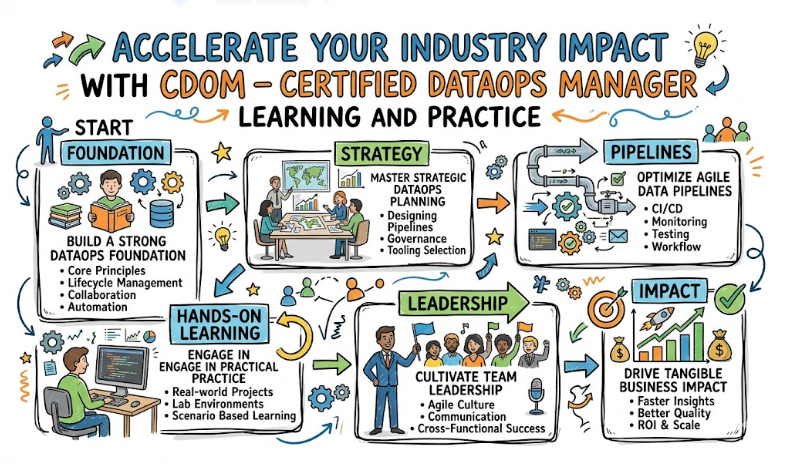
The CDOM – Certified DataOps Manager is a professional designation that focuses on the intersection of data management, agile methodologies, and DevOps principles. It is centered around the concept of “DataOps,” which seeks to improve the quality and cycle time of data analytics. Through this program, a deep understanding of how to automate data delivery and implement governance at scale is developed.
Traditional data management often suffers from silos and manual bottlenecks. These challenges are addressed by the CDOM curriculum, where the focus is shifted from theoretical data storage to active data orchestration. By mastering this domain, the ability to build resilient pipelines that support business-critical applications is validated.
Why CDOM Matters in Today’s?
In the current technological era, the volume and velocity of data have outpaced traditional handling methods. Fragile pipelines and “data debt” often lead to delays in decision-making and loss of stakeholder trust. The CDOM certification is considered vital because it introduces a systematic approach to these problems.
Automation is no longer an option; it is a necessity for survival. When data is managed through a DataOps framework, manual errors are reduced, and the speed of innovation is increased. This matters today because organizations require real-time insights to remain competitive. The CDOM program ensures that professionals are equipped to lead this transformation, moving away from reactive troubleshooting to proactive pipeline management.
The Importance of CDOM – Certified DataOps Manager Certifications
Certifications in the DataOps domain are recognized as high-value credentials for several reasons:
- Validation of Practical Skills: Unlike general courses, the CDOM focuses on production-ready skills. Competency in building automated, observable, and quality-gated pipelines is proven.
- Standardization of Workflows: A common language is established between data engineers and operations teams. This leads to better collaboration and reduced conflict during deployments.
- Career Longevity: As enterprises move toward cloud-native architectures, the demand for managers who understand data orchestration is surging. This certification provides a clear path for professional growth.
- Operational Excellence: The emphasis is placed on reliability and observability. This ensures that data issues are detected and resolved before they impact the end-user.
Why Choose DataOpsSchool?
When selecting a partner for professional development, DataOpsSchool is often preferred due to its industry-aligned approach. The curriculum is curated by experts who have navigated real-world data challenges at scale. Practical labs and scenario-based assessments are utilized to ensure that learning is not limited to theory.
At DataOpsSchool, a comprehensive ecosystem is provided. This includes access to modern tooling, lifetime updates to course materials, and a focus on the “Data Journey First” philosophy. The success of candidates is prioritized through a structured learning environment that matches the demands of global markets.
CDOM – Certified DataOps Manager: A Deep-Dive
What is this certification? The CDOM – Certified DataOps Manager is a professional assessment program that validates the ability to orchestrate, monitor, and govern data pipelines. It focuses on the practical application of CI/CD, automated testing, and observability within the data lifecycle.
Who should take this certification? This program is ideally suited for:
- Data Engineers and Architects
- DevOps and Site Reliability Engineers (SREs)
- Engineering Managers and Technical Leads
- Cloud and Platform Engineers
- Data Scientists looking to operationalize their models
Certification Overview Table
| Track | Level | Who it’s for | Prerequisites | Skills Covered | Recommended Order |
| DataOps Core | Foundation | Junior Engineers & Analysts | Basic IT Knowledge | Pipeline Basics, Culture, Git | 1st |
| Data Engineering | Professional | Data & DevOps Engineers | 2+ Years Experience | CI/CD for Data, Orchestration | 2nd |
| SRE & Ops | Professional | SREs & Cloud Architects | Infrastructure Knowledge | Observability, Reliability, SLIs | 3rd |
| Leadership | Advanced | Managers & Senior Leads | Lead Experience | Governance, Strategy, ROI | 4th |
| Cloud DataOps | Intermediate | Platform Engineers | Cloud Fundamentals | Cloud-Native Workflows, Scaling | Parallel |
Skills You Will Gain
- Implementation of continuous integration and deployment for data.
- Mastery of workflow orchestration using tools like Airflow.
- Designing automated data quality and validation checks.
- Application of observability and alerting for complex data flows.
- Managing “Infrastructure as Code” (IaC) for data platforms.
- Strategic planning for data governance and compliance.
- Improving reliability through incident handling and recovery patterns.
- Collaboration across cross-functional data and ops teams.
Real-World Projects Post-Certification
- Automated Pipeline Design: A full-scale data ingestion and transformation pipeline will be built with integrated testing.
- Observability Dashboard: A centralized monitoring system for data health and performance metrics will be created.
- Governance Framework: A policy-driven access control and data masking system will be implemented for a mock enterprise.
- Migration Orchestration: A plan for moving legacy data workflows to a containerized, cloud-native environment will be executed.
Preparation Plan
7–14 Days Plan (Quick Start) Focus is placed on the DataOps Manifesto and core vocabulary. The foundational concepts of agile development for data are reviewed. Case studies of successful DataOps transformations are analyzed to understand common patterns.
30 Days Plan (Technical Deep-Dive) Hands-on practice with orchestration tools and version control for data is conducted. Automated testing frameworks are explored. Mock assessments are utilized to identify gaps in technical knowledge.
60 Days Plan (Expert Mastery) Complex architectural scenarios are studied. Emphasis is shifted toward leadership, financial modeling, and organizational change management. A capstone project is completed to demonstrate full competency in DataOps management.
Common Mistakes to Avoid
- Treating DataOps as just a set of tools rather than a cultural shift.
- Neglecting monitoring and alerting until after a pipeline failure occurs.
- Skipping automated testing to save time during initial deployment.
- Over-engineering the architecture before defining clear business value.
- Failing to include stakeholders from the security and compliance teams early on.
Best Next Certification After This
- Same Track: Advanced DataOps Engineering (for deeper technical mastery).
- Cross-Track: Certified FinOps Manager (to handle cloud data costs).
- Leadership / Management: Certified DevOps Architect (for broader infrastructure design).
Choose Your Learning Path
Structured learning paths are essential for aligning certification goals with career objectives.
- DevOps Path: This is best for engineers who support data platforms. The focus is placed on extending traditional CI/CD to data artifacts.
- DevSecOps Path: This is designed for security-conscious professionals. It emphasizes automated data masking, encryption, and compliance within pipelines.
- Site Reliability Engineering (SRE) Path: This path is curated for those responsible for uptime. It focuses on observability, incident management, and data reliability.
- AIOps / MLOps Path: This is best for data scientists and engineers. It ensures that machine learning models are supported by reliable, automated feature pipelines.
- DataOps Path: This is the primary path for data professionals. It covers the entire lifecycle from ingestion to delivery with a focus on agility.
- FinOps Path: This is intended for professionals managing data costs. It teaches how to implement financial governance and cost-efficiency in cloud data systems.
Role → Recommended Certifications Mapping
| Role | Recommended Certifications |
| DevOps Engineer | CDOM Foundation, Professional DataOps Engineering |
| SRE | CDOM Foundation, Data Reliability Engineering |
| Platform Engineer | Cloud Data Operations, CDOM Professional |
| Cloud Engineer | Cloud-Native DataOps, Foundation level CDOM |
| Security Engineer | DataOps Governance & Security specialized track |
| Data Engineer | CDOM Foundation, Professional Engineering Track |
| FinOps Practitioner | CDOM Foundation, Certified FinOps Professional |
| Engineering Manager | Enterprise DataOps Leadership, CDOM Advanced |
Next Certifications to Take
Same-Track Certification The Advanced DataOps Engineering program is a natural progression. It allows for a deeper exploration of enterprise-scale orchestration and complex data transformations.
Cross-Track Certification A transition into the Certified DevSecOps Professional track is recommended. This enables the integration of advanced security protocols into the existing DataOps framework.
Leadership-Focused Certification The Certified DevOps Architect (CDA) is a valuable addition for those moving into strategic roles. It provides the big-picture perspective needed to design cross-departmental systems.
Training & Certification Support Institutions
DevOpsSchool This institution is known for its extensive range of IT certifications and hands-on training methodology. Support is provided through live sessions and an industry-recognized syllabus that covers all aspects of modern operations.
Cotocus Practical skill development is the hallmark of this organization. Their training programs are designed to be production-focused, ensuring that learners are ready for the challenges of global tech environments immediately after certification.
ScmGalaxy A strong emphasis on community and collaboration is maintained here. Extensive resources and mentoring are provided to help professionals master software configuration and data management practices.
BestDevOps Simplified learning paths for complex technologies are offered by this provider. They focus on making advanced concepts accessible to beginners while providing the depth required by seasoned experts.
devsecopsschool.com This platform is dedicated to the intersection of security and operations. Training is centered on building secure-by-default systems and integrating compliance into the automation lifecycle.
sreschool.com Reliability and observability are the primary focuses of this institution. Their programs are curated to help engineers build systems that are resilient, scalable, and easy to maintain.
aiopsschool.com The application of artificial intelligence to operational tasks is explored here. Professionals are trained to use data and machine learning to automate troubleshooting and performance tuning.
dataopsschool.com As the primary provider for CDOM, this site offers the most direct and comprehensive path to mastering data operations. Their focus remains strictly on the data lifecycle and pipeline excellence.
finopsschool.com Financial transparency in the cloud is the core mission of this platform. They provide the tools and training needed to manage and optimize the costs associated with modern data infrastructure.
FAQs Section
What is the difficulty level of the CDOM – Certified DataOps Manager program? The program is structured to be accessible yet challenging. While the Foundation level is beginner-friendly, the Professional and Advanced levels require a solid grasp of technical concepts and real-world experience.
How much time is required to complete the certification? Completion time varies based on the individual’s background. Generally, a dedicated period of 30 to 60 days is sufficient to cover the curriculum and prepare for the assessment thoroughly.
Are there any specific prerequisites for the Foundation level? No strict prerequisites are mandated for the Foundation level. A basic understanding of data concepts and familiarity with general IT workflows is considered beneficial.
In what sequence should these certifications be taken? The Foundation level is always started first to establish a strong conceptual base. This is followed by a Professional track that aligns with the individual’s current role, ending with the Advanced level for leadership roles.
What is the career value of becoming a Certified DataOps Manager? Significant career growth is often observed after certification. It positions a professional as an expert in a high-demand niche, leading to increased responsibilities and higher compensation packages.
Which job roles are most impacted by this certification? Roles such as Data Engineer, SRE, and Engineering Manager see the most immediate impact. The certification provides the tools needed to streamline their daily operations and lead larger teams.
Is there a focus on specific tools like Airflow or Jenkins? While core principles are emphasized, practical application using industry-standard tools like Airflow and Kubernetes is included. This ensures that the skills gained are immediately applicable in a professional setting.
How does this certification address data governance? Governance is integrated into the automation process. Methods for implementing data quality checks, masking, and compliance as part of the pipeline are taught.
Can this certification be taken by professionals outside of India? Yes, the CDOM program is designed for a global audience. The curriculum and assessment standards match international industry requirements, making it valuable in any market.
Is the assessment purely theoretical? No, the assessment approach is strictly practical. Candidates are required to demonstrate their proficiency through hands-on labs and scenario-based problem-solving.
Does DataOpsSchool provide post-certification support? Lifetime access to updated course materials and a community of professionals is provided. This ensures that knowledge remains current even as the technology landscape changes.
How does CDOM help in reducing operational costs? By automating manual tasks and reducing errors, operational overhead is lowered. Financial management principles are also covered to help optimize cloud data expenditures.
FAQs Focused Specifically on CDOM – Certified DataOps Manager
- What distinguishes CDOM from traditional data management certifications? CDOM is focused on the “how” of delivery and automation rather than just the “what” of storage. It treats data as a dynamic product that requires continuous integration.
- Is hands-on lab work a mandatory part of the CDOM exam? Yes, practical competency is verified through labs. The ability to build and troubleshoot a data pipeline is a core requirement for passing.
- Does the CDOM curriculum cover multi-cloud data environments? Yes, strategies for managing data across different cloud providers like AWS, Azure, and Google Cloud are included to ensure architectural flexibility.
- How is “Data Reliability” addressed within the CDOM framework? Reliability is built through observability and automated recovery patterns. The program teaches how to set up meaningful alerts and SLIs for data health.
- Is the CDOM certification recognized by large enterprises? The program is designed to meet enterprise-scale requirements. It is increasingly recognized as a standard for those managing complex, mission-critical data systems.
- Does CDOM focus on any specific industry, such as finance or healthcare? The principles taught are industry-agnostic. However, the focus on governance and security makes it particularly valuable for highly regulated sectors.
- How often is the CDOM certification content updated? The curriculum is reviewed and updated regularly to reflect the latest trends and tool releases in the DataOps ecosystem.
- Can an Engineering Manager benefit from CDOM even if they don’t code daily? Absolutely. The strategic and decision-maker perspective provided in the Advanced track is designed to help managers lead technical teams effectively.
Testimonials
Aarav A complete shift in perspective was experienced through this program. The ability to treat data pipelines with the same discipline as software code has transformed our team’s delivery speed.
Priya Confidence in managing complex data architectures was significantly boosted. The focus on practical labs ensured that the knowledge could be applied to real production issues immediately.
John Clarity on the career path for a data professional was provided. The structured levels allowed for a natural progression from foundational concepts to high-level strategic planning.
Sofia The observability techniques learned here have drastically reduced our time-to-recovery. Silent failures in our data pipelines are now a thing of the past.
Yuki Skill improvement in automation and orchestration was remarkable. This certification has established a new standard of operational excellence within our organization.
Conclusion
The CDOM – Certified DataOps Manager certification cannot be overstated in a world where data is the primary driver of value. Through this program, a master-level understanding of how to manage the data lifecycle with agility and reliability is gained. Long-term career benefits include not only improved technical proficiency but also the ability to lead organizational change. Strategic learning and certification planning are encouraged for anyone looking to secure their place in the future of data operations.