Introduction
In the fast-paced digital landscape, modern enterprises often find themselves caught in a paradox: they have the resources to scale but are held back by fragmented processes. Imagine a scenario where a global retailer attempts to push a simple website update, only to find that the development team and the operations team are working in silos, leading to bugs, downtime, and massive delays. This is the “silo effect,” and it is the primary reason why many large organizations struggle to keep up with agile startups.
This guide serves as a beacon for decision-makers who recognize that technology is not just about writing code—it is about the culture and the pipeline that delivers that code to the end user. DevOps consulting is the bridge between chaotic, manual workflows and a streamlined, automated future. Whether you are a CTO, an IT manager, or a digital transformation lead, understanding the nuances of DevOps is crucial. This blog provides a roadmap to help you navigate the complexities of enterprise-level software delivery. By focusing on culture, automation, and continuous improvement, you can transform your technical debt into a competitive advantage. Let’s dive into how you can effectively leverage professional guidance to modernize your enterprise.
What Is DevOps Consulting?
DevOps consulting is a professional service where specialized experts analyze an organization’s existing software development and IT operations processes to suggest and implement improvements. It isn’t just about adopting new tools; it is a holistic approach that merges software development (Dev) with IT operations (Ops) to shorten the systems development life cycle.
In a financial or enterprise context, this connects directly to “time-to-market.” Every day an application remains in a testing queue is a day of lost potential revenue or increased operational costs. By leveraging DevOps, companies treat their infrastructure like code—predictable, scalable, and auditable.
Why This Topic Matters for Enterprise Growth
The shift toward DevOps is essential for long-term survival in an era where software quality dictates customer loyalty. Without a clear strategy, enterprises often fall victim to “tool sprawl”—buying expensive software without a process to support it.
Effective consulting helps you:
- Reduce Operational Costs: By automating redundant manual tasks.
- Increase Security: Implementing DevSecOps ensures security is “shifted left” or integrated early in the process.
- Improve Reliability: Standardized workflows reduce human error, which is the leading cause of downtime.
Detailed Breakdown of the Topic
Enterprise DevOps is not a “one-size-fits-all” solution. It requires a deep dive into three core areas:
- Cultural Transformation: Moving away from a “blame culture” to one of shared responsibility.
- Automation Strategy: Identifying which parts of the pipeline (build, test, deploy) provide the highest ROI when automated.
- Measurement and Feedback: Using metrics like DORA (DevOps Research and Assessment) to track performance.
Step-by-Step Practical Guide to DevOps Adoption
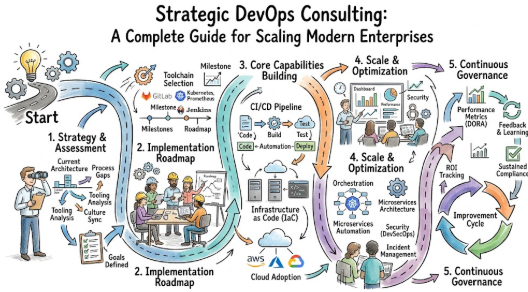
- Assessment of Current State: Map out existing workflows.
- Define Business KPIs: Establish clear goals (e.g., reduce deployment frequency).
- Toolchain Consolidation: Eliminate redundant software and adopt industry-standard platforms.
- Pilot Project Execution: Start with a non-critical application to test the new methodology.
- Upskilling Teams: Provide training for staff on new tools and mindsets.
- Infrastructure as Code (IaC) Implementation: Move toward version-controlled environments.
- Continuous Monitoring: Implement real-time performance dashboards.
- Scaling and Review: Apply successful patterns to the rest of the organization.
Practical Real-Life Examples
- Situation: A company faced constant deployment failures. Mistake: Manual deployment steps. Better Action: Implemented automated CI/CD pipelines. Result: Deployment failure rate dropped by 60%.
- Situation: Server configuration was inconsistent across teams. Mistake: Hand-configured environments. Better Action: Adopted Terraform for infrastructure management. Result: Environment consistency ensured.
- Situation: Security patches were neglected. Mistake: Annual security audits. Better Action: Integrated automated vulnerability scanning. Result: Proactive threat mitigation.
- Situation: Development teams were slowed by manual testing. Mistake: Over-reliance on manual QA. Better Action: Automated regression testing. Result: Faster release cycles.
- Situation: Poor communication between teams. Mistake: Information silos. Better Action: Shifted to cross-functional “Squads.” Result: Improved team alignment.
Common Problems Readers Face
- Resistance to Change: Existing teams often fear losing their autonomy.
- Underestimating Culture: Many view DevOps solely as a set of tools.
- Lack of Executive Support: Without top-down backing, initiatives stall.
- Over-Engineering: Trying to automate everything at once without a priority list.
Mistakes to Avoid
- Ignoring Team Culture: Never force new tools without training and buy-in.
- Blindly Following Trends: Do not adopt a tool just because a competitor did.
- Ignoring Security: Security must never be an afterthought.
- No Feedback Loop: Failing to measure results leads to wasted effort.
Don’t Do This Checklist:
- Don’t implement tools without clear objectives.
- Don’t skip documentation.
- Don’t treat DevOps as a “one-time project.”
- Don’t ignore the needs of your developers for the sake of operations.
| Feature | Legacy IT Approach | Modern DevOps Approach |
| Deployment Frequency | Monthly/Quarterly | Daily/On-demand |
| Error Recovery | Manual/Slow | Automated/Instant |
| Infrastructure | Manual configuration | Infrastructure as Code |
| Team Structure | Siloed (Dev vs Ops) | Cross-functional squads |
| Aspect | Good Practice | Bad Practice |
| Automation | Automated test & deploy | Manual testing & deploy |
| Feedback | Continuous, real-time | Periodic, reactive |
| Security | Integrated throughout (Shift Left) | Tacked on at the end |
| Metrics | Driven by data/DORA | Based on guesswork |
Tools, Methods, or Frameworks
- CI/CD Frameworks: Jenkins, GitLab CI, GitHub Actions.
- Infrastructure Tools: Terraform, Ansible.
- Monitoring Tools: Prometheus, Grafana.
- Collaboration Methods: Agile Scrum, Kanban boards.
Expert Tips
- Start Small: Success in one department builds confidence.
- Embrace Failure: Use outages as learning opportunities, not blame sessions.
- Focus on Flow: Identify and eliminate bottlenecks in your value stream.
- Document Everything: Tribal knowledge is a bottleneck.
- Standardize Environments: Parity between development and production is key.
Case Studies
- Profile: Mid-sized Fintech Company. Problem: Slow release cycles causing customer churn. Approach: Hired consultants to implement a CI/CD pipeline and shift security left. Result: Reduced time-to-market by 40%.
- Profile: E-commerce Enterprise. Problem: Frequent downtime during traffic spikes. Approach: Moved to a containerized microservices architecture with automated scaling. Result: Zero downtime during peak sales.
- Profile: Healthcare SaaS Provider. Problem: Compliance delays. Approach: Automated compliance auditing within the deployment pipeline. Result: Compliance audits completed 70% faster.
Risk Awareness
DevOps transitions carry inherent risks, including platform dependency risk, potential for misconfiguration (which can lead to security vulnerabilities), and the risk of operational disruption during the transition phase. Always ensure your team has a rollback plan and that all changes are tested in a staging environment. Consult with cybersecurity experts when implementing automated security protocols to ensure compliance with relevant industry regulations.
Checklist Before Taking Action
- Define specific business goals for your DevOps adoption.
- Conduct a thorough assessment of existing technical bottlenecks.
- Secure buy-in from all stakeholders, including senior leadership.
- Audit your current security posture to prevent vulnerabilities.
- Create a detailed budget that accounts for training and new tools.
- Establish a clear, written plan for incremental implementation.
- Ensure team capacity for learning new methodologies.
- Protect personal and company data during environment migration.
Key Terms Explained
- CI/CD: Continuous Integration and Continuous Deployment—the practice of automating code testing and delivery.
- Infrastructure as Code (IaC): Managing and provisioning infrastructure through machine-readable definition files.
- Shift Left: The practice of performing testing and security checks earlier in the development process.
- Microservices: An architectural style that structures an application as a collection of small, autonomous services.
- Containerization: Packaging software with its dependencies to ensure it runs consistently across different environments.
- DORA Metrics: A set of four metrics used to measure the performance of software development teams.
- GitOps: An operational framework that takes DevOps best practices used for software development and applies them to infrastructure automation.
- Silos: Organizational divisions that prevent cross-team collaboration.
- Technical Debt: The implied cost of future reworking caused by choosing an easy, limited solution now instead of a better approach.
- Deployment Frequency: How often an organization successfully releases code to production.
Who Should Read This Blog
This guide is essential for CTOs, IT Directors, Software Architects, Engineering Managers, and DevOps engineers who are looking to modernize their enterprise processes. It is also highly useful for business stakeholders who need to understand how technical investments translate into operational efficiency.
Frequently Asked Questions
- What is the primary role of DevOps consulting?
DevOps consulting helps enterprises audit their current software delivery processes, identify bottlenecks, and implement strategies like automation to improve the speed and quality of releases. - How does DevOps consulting benefit modern enterprises?
By unifying development and operations, enterprises can reduce downtime, accelerate time-to-market, and create a more scalable, secure technical environment. - Is DevOps only for software companies?
No. Any modern enterprise relying on digital infrastructure to deliver services, such as retail, banking, or healthcare, can significantly benefit from the Complete Guide to DevOps Consulting for Modern Enterprises. - How long does a DevOps transformation take?
It is a journey, not a destination. Small improvements can be seen in weeks, but a full cultural and operational shift typically takes 6–18 months. - Does DevOps replace the IT team?
No, it empowers the IT team by removing repetitive, manual tasks, allowing them to focus on innovation and high-value strategic work. - What are the biggest challenges in DevOps implementation?
The most significant hurdles are usually cultural—such as resistance to change and lack of communication between departments. - How do I choose the right consultant?
Look for a partner with experience in your specific industry, a focus on cultural transformation, and a proven track record of using DORA metrics. - Can DevOps help with security?
Yes, through DevSecOps, security practices are integrated into every stage of the development process, reducing the risk of vulnerabilities. - What is the first step in starting a DevOps project?
The first step is assessing your current workflow to identify specific pain points and defining the business KPIs you wish to improve. - How does DevOps affect team morale?
By reducing the stress of manual deployments and “firefighting” during outages, DevOps often leads to higher team morale and retention. - Do I need to buy expensive software to do DevOps?
Not necessarily. Many DevOps practices rely on open-source tools; the cost lies in the strategic planning and cultural alignment rather than just software licenses. - Why is the “Complete Guide to DevOps Consulting for Modern Enterprises” relevant today?
As businesses face increasing pressure to innovate faster, the traditional, siloed approach to IT is no longer sustainable, making professional DevOps guidance essential.
Conclusion and Next Steps
Modernizing your enterprise through DevOps is not merely a technical upgrade; it is a fundamental shift in how your organization creates value. As we have explored in this guide, successful integration requires a balanced approach that respects your existing culture while aggressively pursuing automation and efficiency. By following the steps outlined, you can move from a state of fragmented, reactive operations to one of seamless, proactive innovation.
The importance of this transition cannot be overstated. In a global economy driven by digital speed, the ability to release high-quality software reliably is a core competitive advantage. As you move forward, remember that DevOps is an iterative process. Start with a clear assessment of your current bottlenecks, secure commitment from leadership, and focus on empowering your teams.
Your next step should be to conduct an internal audit of your software delivery pipeline. Identify one small process that is currently causing frustration—whether it is a manual deployment step, a lack of automated testing, or poor communication between teams—and make that your pilot project for change. As you document your progress and measure your results, you will build the momentum needed for enterprise-wide transformation. Finally, always keep risk management at the forefront; consult with experts, keep your security protocols robust, and never stop learning. By keeping your long-term goals in sight and maintaining a culture of continuous improvement, you will position your enterprise for lasting success in the digital age.
One area that often determines the success of a DevOps transformation is how well teams manage cultural change alongside technical improvements. New tools and processes can help, but lasting results usually come when collaboration and ownership evolve across the organization as well.