Introduction
Data is described as the new oil, but raw data is useless without a refined process to move it from source to insight. In many organizations, data pipelines are broken, slow, or inconsistent. DataOps was created to solve these exact problems by applying lean manufacturing and DevOps principles to data flows.
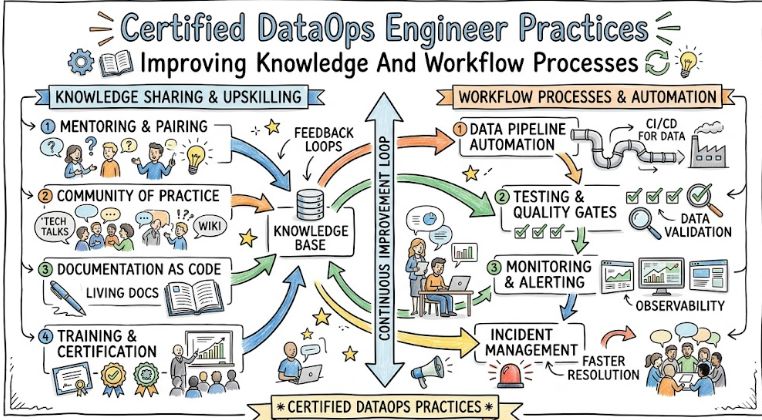
The CDOE – Certified DataOps Engineer designation is recognized as a standard for professionals who wish to automate and streamline data lifecycles. By focusing on communication, integration, and automation, this certification ensures that data is treated with the same rigor as software code.
What is CDOE – Certified DataOps Engineer?
The CDOE is a professional credential that validates an individual’s ability to implement DataOps methodologies. It is focused on the technical and process-oriented aspects of managing data pipelines. Automation of data quality, continuous integration of data models, and the orchestration of complex data workflows are all covered under this umbrella.
Why it matters today?
Business decisions are now driven by real-time analytics. If data is delayed or incorrect, the consequences are significant. Traditional data management is often too slow for the current market. DataOps is required to ensure that data is available, reliable, and secure at all times. The CDOE certification provides the framework needed to meet these high-speed demands.
Why CDOE – Certified DataOps Engineer certifications are important?
A standardized approach to data operations is provided by this certification. It allows teams to speak a common language and follow proven patterns. For the individual, it serves as proof of expertise in a high-demand niche. For the organization, it ensures that data infrastructure is managed by someone who understands how to reduce cycle times and improve data quality simultaneously.
Why Choose DataOpsSchool?
The choice of a training partner is critical when pursuing a specialized field like DataOps. DataOpsSchool is selected by many because of its deep focus on the intersection of data and operations.
- Industry-Aligned Curriculum: The content is developed based on real-world challenges faced by data teams in large-scale environments.
- Practical Lab Access: Theoretical knowledge is supplemented with hands-on environments where data pipelines are actually built and managed.
- Expert Mentorship: Guidance is provided by professionals who have spent decades managing complex infrastructure and data systems.
- Global Recognition: The certifications issued are respected by employers across different continents, making it a valuable asset for global career mobility.
Certification Deep-Dive: CDOE – Certified DataOps Engineer
What is this certification?
The CDOE is a comprehensive program that focuses on automating data delivery and improving data quality. The principles of continuous integration and continuous deployment are applied specifically to data environments.
Who should take this certification?
This program is intended for Data Engineers, DevOps Engineers, and Database Administrators who want to move into specialized data operations. It is also highly beneficial for Engineering Managers who oversee data-driven products.
Certification Overview Table
| Track | Level | Who it’s for | Prerequisites | Skills Covered | Recommended Order |
| DataOps Foundation | Entry | Beginners | Basic IT Knowledge | DataOps Principles, Culture | 1 |
| DataOps Professional | Intermediate | Engineers | 1-2 years experience | Pipeline Automation, CI/CD | 2 |
| Certified DataOps Engineer | Advanced | Senior Engineers | CDOE Foundation/Pro | Orchestration, Governance | 3 |
| DataOps Architect | Expert | Lead Engineers | CDOE Engineer | System Design, Scaling | 4 |
| DataOps Strategy | Executive | Managers | Leadership experience | Change Management, ROI | 5 |
Skills you will gain
- Pipeline Automation: Automated workflows for data movement are designed and implemented.
- Data Quality Testing: Automated checks are integrated into the pipeline to catch errors early.
- Orchestration: Tools like Airflow or Prefect are mastered to manage complex dependencies.
- Version Control for Data: Techniques for versioning datasets and models are learned.
- Monitoring and Alerting: Observability is built into data systems to track performance and health.
Real-world projects you should be able to do after this certification
- End-to-End Automated Pipeline: A system is built that moves data from a source to a warehouse without manual intervention.
- Self-Healing Data Workflows: Logic is implemented to automatically retry or reroute data when a failure is detected.
- Data Quality Dashboard: A real-time monitoring tool is created to show the health and accuracy of incoming data.
- Environment Parity Setup: Identical development, testing, and production environments for data are established.
Preparation Plan
7–14 Days Plan
- Core Concepts: The fundamental principles of the DataOps manifesto are studied.
- Tool Overview: Basic familiarity with orchestration and versioning tools is gained.
- Practice Quizzes: Initial assessment tests are completed to identify weak areas.
30 Days Plan
- Deep Dive into Automation: Time is spent building basic CI/CD pipelines for small datasets.
- Study Guides: Official documentation and recommended reading materials are thoroughly reviewed.
- Hands-on Labs: Weekly labs are performed to reinforce theoretical concepts.
60 Days Plan
- Advanced Orchestration: Complex, multi-stage data workflows are designed and tested.
- Case Studies: Real-world failures and their solutions are analyzed.
- Mock Exams: Full-length practice exams are taken under timed conditions to ensure readiness.
Common mistakes to avoid
- Ignoring Data Quality: Focusing only on the speed of the pipeline while neglecting the accuracy of the data.
- Over-Engineering: Building complex solutions for simple data problems.
- Neglecting Culture: Forgetting that DataOps is as much about team collaboration as it is about tools.
Best next certification after this
- Same Track: Certified DataOps Architect (CDOA)
- Cross-Track: Certified MLOps Engineer
- Leadership / Management: Engineering Management Certification for Data Teams
Choose Your Learning Path
- DevOps Path: This is best for those coming from a software background who want to apply deployment principles to data.
- DevSecOps Path: This is designed for professionals who prioritize data security and compliance within the pipeline.
- SRE Path: This is ideal for those focused on the reliability, uptime, and performance of large-scale data platforms.
- AIOps / MLOps Path: This path is chosen by those working with machine learning models that require continuous retraining and deployment.
- DataOps Path: This is the primary path for data engineers focused on the end-to-end lifecycle of data products.
- FinOps Path: This is best for those who need to manage the cloud costs associated with massive data processing.
Role → Recommended Certifications Mapping
| Role | Primary Certification | Secondary Certification |
| DevOps Engineer | CKA (Kubernetes) | CDOE (DataOps) |
| Site Reliability Engineer | SRE Professional | CDOE (DataOps) |
| Platform Engineer | Cloud Architect | CDOE (DataOps) |
| Cloud Engineer | Cloud Professional | FinOps Practitioner |
| Security Engineer | DevSecOps Professional | Data Security Expert |
| Data Engineer | CDOE (DataOps) | MLOps Engineer |
| FinOps Practitioner | FinOps Professional | Cloud Cost Manager |
| Engineering Manager | Strategic Leadership | DataOps Strategy |
Next Certifications to Take
One same-track certification
The Certified DataOps Architect (CDOA) is the logical progression. Deep architectural patterns for global data distribution are explored in this program.
One cross-track certification
The Certified MLOps Engineer program is highly recommended. The skills from DataOps are extended into the specialized world of machine learning models.
One leadership-focused certification
Strategic Technology Leadership is a great choice. The focus is shifted from technical execution to team building and high-level project management.
Training & Certification Support Institutions
DevOpsSchool
Complete career support is provided here for those entering the DevOps and DataOps fields. A wide range of technical courses is offered with a focus on job readiness.
Cotocus
Specialized training for cloud-native technologies is delivered by this institution. Deep technical dives into Kubernetes and automation tools are frequently conducted.
ScmGalaxy
A vast community-driven platform where resources for software configuration management are found. Expert advice and tutorials on a variety of IT tools are provided.
BestDevOps
Practical, hands-on training sessions are the hallmark of this provider. Real-world scenarios are simulated to ensure that learners can handle production environments.
devsecopsschool.com
A dedicated focus on security within the DevOps lifecycle is maintained here. Security automation and compliance are the core pillars of their curriculum.
sreschool.com
Reliability engineering is taught as a discipline here. Methods for maintaining high availability in complex systems are shared by seasoned professionals.
aiopsschool.com
The intersection of artificial intelligence and IT operations is explored. Training on how to use AI to improve system monitoring and incident response is provided.
dataopsschool.com
This is the primary home for DataOps excellence. All levels of CDOE certification and specialized data engineering courses are hosted here.
finopsschool.com
The financial management of cloud resources is the focus of this institution. Strategies for cost optimization and financial accountability are taught.
FAQs Section
What is the difficulty level of the CDOE exam?
The level is considered moderate to advanced, as it requires both operational knowledge and data engineering skills.
How much time is typically required to prepare?
A period of 30 to 60 days is usually sufficient for a working professional to feel confident.
Are there any strict prerequisites for the CDOE?
A basic understanding of data pipelines and Linux commands is recommended before starting.
In what sequence should these certifications be taken?
The Foundation level is suggested first, followed by the CDOE, and finally the Architect level.
What is the career value of becoming a DataOps Engineer?
High salaries and increased job security are common outcomes due to the shortage of skilled professionals.
Which job roles benefit most from this certification?
Data Engineers and DevOps Engineers find the most immediate career growth after completion.
Is hands-on experience required for the exam?
Yes, the certification is designed to test practical application, so lab work is essential.
Does the certification expire?
Periodic updates or recertification are typically required every few years to stay current with technology.
Is this program recognized globally?
The standards followed are international, making the certification valid in India and across the globe.
Can an Engineering Manager benefit from this?
Strategic oversight is improved when the underlying processes of data delivery are understood.
What tools are covered in the CDOE curriculum?
A variety of orchestration, versioning, and monitoring tools are included in the training.
How does DataOps differ from standard DevOps?
While DevOps focuses on code, DataOps is specifically tailored to the unique challenges of data variability and quality.
CDOE – Certified DataOps Engineer Specific FAQs
1. How is the CDOE exam structured?
A mix of multiple-choice questions and performance-based scenarios is used to evaluate the candidate.
2. Is the exam conducted online?
Yes, the exam is proctored remotely, allowing it to be taken from any location.
3. What is the passing score for the CDOE?
A minimum score of 70% is generally required to be awarded the certification.
4. Are study materials provided by DataOpsSchool?
Extensive guides, video lectures, and lab environments are included in the enrollment package.
5. How does the CDOE help with salary negotiations?
Validation of niche skills allows for stronger positioning during annual reviews or new job interviews.
6. Can this certification help in transitioning from DBA to DataOps?
A clear learning path is provided specifically for database professionals to modernize their skill sets.
7. Is cloud-specific knowledge required?
While not strictly required, a basic understanding of cloud platforms is helpful as most DataOps occurs in the cloud.
8. Are there community forums for CDOE students?
Access to a private group is granted where peers and mentors discuss technical challenges.
Testimonials
Ananya
The transition into a senior data role was made much smoother after completing this program. The concepts of data versioning were applied immediately to my current project.
Rajesh
Greater confidence was gained in managing complex pipelines. The focus on automation helped in reducing the manual errors that were previously plaguing our team.
Vikram
The strategic perspective offered by this certification allowed for better communication with stakeholders. Data delivery is now seen as a reliable service rather than a bottleneck.
Sonia
A much clearer understanding of the data lifecycle was achieved. The practical labs were instrumental in mastering tools that were once intimidating.
Arjun
The gap between the data team and the operations team was finally bridged. This certification provided the framework needed to create a truly collaborative environment.
Conclusion
The journey to becoming a Certified DataOps Engineer is a strategic move for any technology professional. In a world where data volume continues to explode, the ability to manage that data efficiently is a superpower. Long-term career benefits include the ability to lead high-impact projects and the security of working in a specialized, high-demand field.
Strategic learning and certification planning are encouraged for those who wish to remain competitive. By following the roadmap provided by DataOpsSchool, a solid foundation for a successful future in data operations is built.