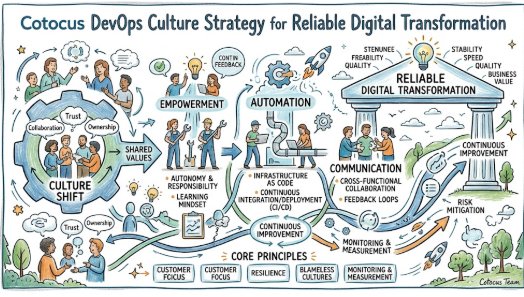
Introduction
Many organizations want faster software delivery, fewer production issues, better teamwork, and stronger customer trust, but they often struggle because development, operations, security, testing, and business teams work in separate directions. This is where understanding How Cotocus Helps Organizations Build Strong DevOps Culture becomes important. DevOps culture is not only about installing tools or creating pipelines; it is about changing how people communicate, share responsibility, solve problems, and deliver value. Beginners may feel confused because DevOps includes automation, cloud, CI/CD, monitoring, security, and agile practices. This blog explains DevOps culture in simple words, showing how Cotocus can guide organizations with practical methods, structured adoption, team enablement, and safer delivery habits.
Understanding How Cotocus Helps Organizations to Build Strong DevOps Culture
DevOps culture means creating a working environment where software development, IT operations, testing, security, and business teams collaborate instead of working in isolated groups. It helps organizations build, test, release, monitor, and improve software more smoothly.
In simple words, DevOps culture is about shared ownership. Developers do not just write code and leave deployment to someone else. Operations teams do not only respond after something breaks. Security teams do not wait until the end to review risk. Everyone works together from planning to production.
Cotocus helps organizations build strong DevOps culture by focusing on people, process, tools, automation, training, consulting, cloud adoption, DevSecOps practices, and continuous improvement. The main idea is to help organizations move from slow, manual, blame-based delivery to faster, safer, and more collaborative software delivery.
People search for this topic because many companies want DevOps but do not know where to start. Some already use DevOps tools but still face delays, team conflicts, failed deployments, unclear ownership, and weak production visibility.
DevOps culture is used in real life wherever software needs to be delivered regularly. This includes IT companies, product startups, banks, healthcare platforms, education technology, e-commerce, cloud-based services, SaaS companies, telecom, manufacturing, and digital transformation teams.
A common misunderstanding is that DevOps means only Jenkins, Docker, Kubernetes, cloud, or automation scripts. Tools are important, but DevOps culture starts with mindset, collaboration, shared responsibility, and continuous learning.
The practical takeaway is simple: organizations should not begin DevOps by buying tools first. They should begin by understanding team problems, delivery bottlenecks, skill gaps, and cultural blockers.
Why How Cotocus Helps Organizations Build Strong DevOps Culture Is Important
A strong DevOps culture affects business performance because software delivery is now connected with customer experience, operational reliability, security, cost control, and business speed. When teams release slowly, fix issues late, or work without visibility, customers feel the impact.
For modern organizations, DevOps culture is important because it improves:
- Collaboration between development, operations, testing, and security teams
- Faster and more reliable releases
- Better automation of repetitive tasks
- Clear ownership of application performance
- Reduced manual errors
- Better cloud usage and infrastructure control
- Stronger security awareness through DevSecOps
- Faster incident response
- Continuous improvement through feedback
- Better alignment between technology teams and business goals
Cotocus helps organizations by making DevOps adoption more structured. Instead of asking teams to randomly adopt tools, Cotocus can help organizations understand their current maturity, identify delivery pain points, plan automation, improve team skills, and create a roadmap.
A practical scenario: A small product company releases updates once a month because testing and deployment are manual. Developers blame operations for delays, and operations blame developers for unstable releases. A DevOps culture approach helps both teams agree on shared pipelines, automated testing, deployment standards, monitoring, and rollback planning. The result is not just faster delivery; it is better teamwork.
The better approach is to treat DevOps culture as a long-term operating model. It should improve how people think, communicate, build, test, deploy, secure, and support software.
The Real Problem Readers Face With DevOps Culture
The biggest problem with DevOps culture is that many organizations understand the word but not the transformation behind it. They may use DevOps tools but still work with old habits.
Common problems include:
- Teams work in silos and avoid shared responsibility.
- Leaders expect faster delivery without changing processes.
- Developers focus only on coding, not production reliability.
- Operations teams are involved too late.
- Security reviews happen at the end instead of during development.
- Manual approvals delay releases.
- Testing is incomplete or inconsistent.
- Teams do not measure deployment frequency, failure rate, recovery time, or customer impact.
- Tool adoption happens without process maturity.
- People resist change because they fear job loss, extra workload, or accountability.
- Organizations copy DevOps practices from others without understanding their own needs.
- Management treats DevOps as a tool project instead of a culture journey.
This creates confusion for beginners. They may ask: Should we start with cloud? Should we use Kubernetes? Should we automate everything? Should we hire DevOps engineers? Should developers handle operations? Should security join the pipeline?
The real answer depends on the organization’s current maturity. A startup may need basic CI/CD and cloud cost control. A large enterprise may need governance, platform engineering, DevSecOps, observability, and standard release models. A legacy organization may need mindset change before automation.
Cotocus helps by bringing structure to this confusion. The better approach is to assess where the organization is today, define where it wants to go, and create a practical roadmap instead of jumping directly into tools.
How Cotocus Helps Organizations Build Strong DevOps Culture Step by Step
Step 1: Assess the Current DevOps Maturity
What it means:
Cotocus can begin by understanding how teams currently plan, develop, test, deploy, monitor, and support software.
Why it matters:
Without assessment, organizations may solve the wrong problem. A tool issue may actually be a communication issue. A deployment delay may be caused by unclear approval flow.
How to apply it:
Review current workflows, team structure, release frequency, manual steps, incident history, automation level, cloud usage, and security practices.
Practical example:
A company believes it needs Kubernetes, but the real problem is that developers do not write automated tests. The maturity assessment reveals that CI/CD basics should come first.
Common mistake:
Buying advanced tools before understanding current gaps.
Better approach:
Start with discovery, interviews, workflow mapping, and delivery bottleneck analysis.
Step 2: Build Leadership Alignment
What it means:
DevOps culture needs support from leaders, managers, architects, security heads, and delivery teams.
Why it matters:
If leadership only demands speed but does not support process change, teams become stressed and DevOps fails.
How to apply it:
Define business goals clearly. Decide whether the organization wants faster releases, fewer failures, better security, lower cloud waste, improved reliability, or better team ownership.
Practical example:
A CTO wants weekly releases, but compliance teams need audit trails. Cotocus can help align both goals through automated approvals, version control, and traceable pipelines.
Common mistake:
Treating DevOps as only an engineering team responsibility.
Better approach:
Make DevOps a shared business and technology transformation.
Step 3: Break Silos Between Teams
What it means:
Teams should stop working as separate departments and start sharing delivery responsibility.
Why it matters:
Silos create delays, blame, repeated rework, and production issues.
How to apply it:
Create cross-functional teams where developers, testers, operations, security, and product owners communicate regularly.
Practical example:
Instead of developers sending code to operations at the last moment, both teams discuss deployment needs during sprint planning.
Common mistake:
Keeping the same old handoff process and calling it DevOps.
Better approach:
Create shared rituals, shared dashboards, shared goals, and shared accountability.
Step 4: Introduce Automation Gradually
What it means:
Automation should reduce repetitive manual work such as builds, tests, deployments, infrastructure provisioning, compliance checks, and monitoring alerts.
Why it matters:
Manual work increases errors, delays, and dependency on specific individuals.
How to apply it:
Start with CI/CD pipelines, automated testing, infrastructure as code, configuration management, and deployment automation.
Practical example:
A team manually deploys code every Friday. Cotocus can help design a pipeline where code is built, tested, scanned, and deployed through controlled automation.
Common mistake:
Trying to automate everything at once.
Better approach:
Automate the most painful and repetitive steps first.
Step 5: Add Security Into the DevOps Flow
What it means:
Security should become part of the software delivery process, not a final checkpoint.
Why it matters:
Late security reviews can delay releases and increase risk.
How to apply it:
Use DevSecOps practices such as code scanning, dependency checks, secret detection, container scanning, access control, and secure pipeline policies.
Practical example:
A developer accidentally commits a secret key. With security scanning in the pipeline, the issue can be detected early before production exposure.
Common mistake:
Thinking security slows down DevOps.
Better approach:
Automate security checks and make secure development a team habit.
Step 6: Improve Monitoring and Feedback
What it means:
Teams should know how applications behave after deployment.
Why it matters:
Without monitoring, teams discover problems only after users complain.
How to apply it:
Use observability practices such as logs, metrics, traces, alerts, dashboards, service-level indicators, and post-incident reviews.
Practical example:
If an application response time increases after release, monitoring alerts the team early.
Common mistake:
Monitoring only server uptime and ignoring user experience.
Better approach:
Monitor application health, user impact, deployment quality, and business-critical flows.
Step 7: Train Teams for New Ways of Working
What it means:
DevOps culture requires skill development in automation, cloud, CI/CD, containers, security, collaboration, and incident handling.
Why it matters:
People resist change when they do not understand the tools, process, or purpose.
How to apply it:
Create structured learning paths, workshops, mentoring, hands-on labs, and role-based training.
Practical example:
Operations engineers may learn infrastructure as code, while developers learn pipeline basics and production logging.
Common mistake:
Expecting teams to adopt DevOps without training.
Better approach:
Build confidence through continuous learning and practical enablement.
Step 8: Create Continuous Improvement Loops
What it means:
DevOps culture improves through regular feedback, measurement, review, and refinement.
Why it matters:
No DevOps model becomes perfect on day one.
How to apply it:
Review incidents, release issues, pipeline failures, team feedback, customer complaints, and performance trends.
Practical example:
After a failed deployment, the team conducts a blameless review and improves rollback steps.
Common mistake:
Blaming individuals instead of improving systems.
Better approach:
Use every failure as a learning opportunity.
Key Factors That Influence DevOps Culture
1. Leadership Support
DevOps culture becomes stronger when leaders support collaboration, learning, and process improvement. If leaders only demand speed, teams may take shortcuts. The better approach is to set clear goals, provide resources, and encourage safe experimentation.
2. Team Collaboration
DevOps depends on developers, operations, testers, security teams, and business stakeholders working together. Collaboration reduces confusion and improves ownership. A common mistake is keeping old silos while expecting modern delivery.
3. Automation Maturity
Automation helps teams reduce manual errors and speed up repetitive tasks. But automation should be meaningful. The mistake is automating broken processes. The better approach is to fix the workflow first, then automate.
4. CI/CD Practices
Continuous Integration and Continuous Delivery help teams build, test, and release software more reliably. Beginners often think CI/CD means only pipeline creation. In reality, it includes code quality, automated checks, version control, testing discipline, and release governance.
5. Cloud Readiness
Cloud platforms can support scalability, flexibility, and automation. But poor cloud usage can create cost, security, and governance problems. Organizations need cloud strategy, access control, architecture standards, and monitoring.
6. Security Integration
DevSecOps helps security become part of daily engineering work. Security should not be treated as a blocker. It should be built into code review, pipeline scanning, access control, secrets management, and compliance checks.
7. Monitoring and Observability
Strong DevOps culture requires visibility. Teams should know what is happening in production. Without monitoring, organizations operate blindly. The better approach is to track application health, infrastructure performance, user experience, and incident patterns.
8. Learning Mindset
DevOps culture grows when people are encouraged to learn, ask questions, improve systems, and share knowledge. A blame-based culture weakens DevOps. A learning culture improves trust and delivery quality.
Detailed Breakdown of DevOps Culture Transformation
DevOps Culture Starts With Mindset
The first layer of DevOps culture is mindset. Teams must move from “my task is complete” to “the service is working well for users.” This shift creates shared ownership.
In traditional teams, developers may say, “The code works on my machine.” Operations may say, “The deployment failed because the code was bad.” Security may say, “This cannot go live.” DevOps culture changes the conversation to, “How do we build, test, secure, deploy, and support this together?”
Cotocus helps organizations understand that DevOps is not a department name. It is a working model.
Process Improvement Comes Before Tool Adoption
Many organizations begin DevOps by selecting tools. They ask which CI/CD tool, cloud platform, container technology, or monitoring system to use. Tools matter, but tools cannot fix unclear ownership or weak communication.
A better approach is to first map the delivery process:
- How does work move from idea to production?
- Where do delays happen?
- Which steps are manual?
- Where do defects enter the system?
- Who approves releases?
- How are incidents handled?
- How is feedback collected?
Once the process is clear, tools can be selected properly.
Automation Makes DevOps Scalable
Automation is one of the strongest parts of DevOps culture. It helps teams avoid repeated manual work and reduce dependency on individual knowledge.
Useful automation areas include:
- Code build automation
- Unit and integration testing
- Security scanning
- Infrastructure provisioning
- Configuration management
- Deployment and rollback
- Monitoring alerts
- Compliance reporting
The common mistake is trying to automate complex systems without standardization. Before automation, teams should define naming standards, environment strategy, branching model, access control, deployment rules, and rollback expectations.
CI/CD Builds Delivery Discipline
CI/CD is more than a pipeline. It is a disciplined way of delivering software in small, tested, and controlled changes.
A strong CI/CD practice includes:
- Frequent code commits
- Automated build checks
- Automated test execution
- Code quality review
- Security scanning
- Artifact management
- Environment promotion
- Deployment approvals where required
- Rollback planning
Cotocus can help organizations create CI/CD practices that match their business needs, team maturity, and compliance requirements.
Cloud DevOps Improves Flexibility
Cloud-based DevOps helps organizations create infrastructure faster, scale services, and manage environments with automation. But cloud adoption without governance can become risky.
Organizations should define:
- Cloud account structure
- Access control
- Cost monitoring
- Infrastructure as code
- Backup and recovery
- Network security
- Environment separation
- Monitoring standards
The better approach is to connect cloud adoption with DevOps culture, not treat it as a separate infrastructure project.
DevSecOps Makes Security Continuous
Security should be part of everyday delivery. In strong DevOps culture, security is everyone’s responsibility, but security experts still guide standards, tools, and policies.
Important DevSecOps practices include:
- Secure coding awareness
- Dependency vulnerability checks
- Secrets detection
- Container image scanning
- Infrastructure policy checks
- Role-based access
- Security gates in pipelines
- Incident response planning
A common mistake is adding too many manual security approvals. This slows delivery and frustrates teams. The better approach is to automate repeatable checks and reserve manual review for high-risk decisions.
Observability Creates Operational Confidence
Observability means teams can understand what is happening inside systems. It helps them detect issues, investigate root causes, and improve user experience.
Useful observability signals include:
- Logs
- Metrics
- Traces
- Alerts
- Dashboards
- Error rates
- Response time
- Resource usage
- Deployment impact
Without observability, DevOps becomes incomplete. Teams may release faster but fail to understand production behavior.
Blameless Learning Improves Reliability
In weak cultures, incidents lead to blame. In strong DevOps cultures, incidents lead to learning.
A blameless review asks:
- What happened?
- What signals were missed?
- Which process failed?
- What can be automated?
- What documentation is needed?
- How can the team prevent repeat failure?
This approach improves trust and encourages people to report problems early.
Common Mistakes Beginners Make With DevOps Culture
Mistake 1: Thinking DevOps Is Only About Tools
This happens because tools are visible and easy to discuss. The risk is that teams may install tools but continue working in silos. What can go wrong is wasted spending, failed adoption, and frustration. The better approach is to start with culture, process, and team ownership.
Mistake 2: Creating a Separate DevOps Team Without Shared Ownership
Some organizations create a DevOps team and expect it to handle all automation, deployment, and operations. This can create another silo. The better approach is to use DevOps specialists as enablers while product teams also take responsibility.
Mistake 3: Ignoring Security Until the End
Late security reviews create delays and risk. Teams may rush fixes or postpone releases. The better approach is to integrate security checks into daily development and pipelines.
Mistake 4: Automating Broken Processes
Automation can make bad processes fail faster. If approvals, environments, testing, and ownership are unclear, automation will not solve the root problem. The better approach is to simplify and standardize first.
Mistake 5: Not Training Teams
DevOps requires new skills. Without training, people may resist change or misuse tools. The better approach is to create learning paths for developers, operations, testers, security teams, and managers.
Mistake 6: Measuring Only Speed
Fast delivery is useful only when quality and reliability are protected. The better approach is to measure speed, stability, recovery, security, customer impact, and team health.
Mistake 7: Blaming People for System Failures
Blame reduces trust and hides problems. The better approach is blameless improvement, where teams fix systems instead of attacking individuals.
Mistake 8: Copying Another Company’s DevOps Model
Every organization has different teams, products, compliance needs, and maturity levels. The better approach is to design a DevOps roadmap based on internal reality.
Don’t Do This Checklist
- Do not buy tools without process assessment.
- Do not treat DevOps as one person’s job.
- Do not ignore security and compliance.
- Do not automate unclear workflows.
- Do not push teams without training.
- Do not measure only deployment speed.
- Do not blame individuals after incidents.
- Do not copy another company blindly.
- Do not ignore monitoring after deployment.
- Do not expect culture change overnight.
Practical Real-Life Examples of DevOps Culture
Example 1: Startup Struggling With Manual Deployment
A startup releases features manually every week. One wrong command breaks production. The better action is to create a basic CI/CD pipeline with automated build, test, and deployment steps. The learning is that automation reduces dependency on memory and improves release confidence.
Example 2: Enterprise Team Working in Silos
A large company has separate development, testing, operations, and security teams. Every release needs long email approvals. The better action is to create cross-functional planning and automated approval evidence. The learning is that collaboration reduces waiting time.
Example 3: Product Team Facing Frequent Production Issues
A product team releases fast but receives many user complaints after deployment. The better action is to add monitoring, logs, alerts, and rollback planning. The learning is that DevOps culture is not only about speed; it is also about reliability.
Example 4: Security Team Joining Too Late
A security team reviews applications only before release and finds serious issues late. The better action is to include security scanning and secure coding practices earlier. The learning is that DevSecOps prevents last-minute risk.
Example 5: Cloud Cost Increasing Without Control
A company moves to cloud but does not monitor usage. Unused resources increase cost. The better action is to use cloud governance, tagging, cost alerts, and review meetings. The learning is that DevOps culture should include cost awareness and ownership.
Two Useful Tables for Better Understanding
Table 1: Traditional IT Culture vs Strong DevOps Culture
| Area | Traditional IT Culture | Strong DevOps Culture |
|---|---|---|
| Team structure | Separate teams with handoffs | Cross-functional teams with shared ownership |
| Release process | Manual and slow | Automated and controlled |
| Security | Checked late | Integrated continuously |
| Monitoring | Reactive | Proactive and visible |
| Failure handling | Blame-focused | Learning-focused |
| Tool usage | Random or isolated | Connected with process goals |
| Business alignment | Limited | Stronger connection with customer value |
Table 2: Beginner Mistake vs Better DevOps Approach
| Beginner Mistake | Better Approach |
|---|---|
| Starting with tools only | Start with maturity assessment and process mapping |
| Ignoring team culture | Build collaboration and shared responsibility |
| Automating everything at once | Automate painful repetitive tasks first |
| Treating security as a final step | Add DevSecOps checks early |
| Measuring only speed | Measure speed, quality, reliability, and recovery |
| Skipping training | Build role-based learning paths |
| Blaming people after incidents | Use blameless reviews and system improvement |
Tools, Methods, and Frameworks Readers Can Use
1. DevOps Maturity Assessment
A maturity assessment helps organizations understand where they stand today. It reviews team collaboration, automation, testing, cloud readiness, security, monitoring, and delivery flow. Beginners can use it by rating each area as basic, improving, mature, or advanced. It prevents the mistake of starting DevOps without knowing the real gaps.
2. Value Stream Mapping
Value stream mapping shows how work moves from idea to production. It helps teams see waiting time, approval delays, rework, and manual steps. Beginners can use it by mapping one real feature from planning to release. It avoids the mistake of improving only one step while ignoring the full delivery flow.
3. CI/CD Pipeline Framework
A CI/CD pipeline framework defines how code is built, tested, scanned, packaged, and deployed. It helps teams reduce manual release effort. Beginners can start with build automation, basic tests, and controlled deployment. It avoids the mistake of depending on manual commands.
4. Infrastructure as Code Method
Infrastructure as Code allows teams to manage infrastructure through version-controlled code. It helps create repeatable environments. Beginners can use it for cloud resources, servers, networks, and environment setup. It avoids the mistake of creating environments manually and inconsistently.
5. DevSecOps Checklist
A DevSecOps checklist helps teams include security in development and deployment. It may include code scanning, dependency checks, secret detection, access review, and container scanning. It avoids the mistake of waiting until the end for security review.
6. Observability Dashboard
An observability dashboard helps teams monitor application health, errors, latency, and infrastructure performance. Beginners can start with basic metrics, logs, and alerts. It avoids the mistake of discovering problems only after users complain.
7. Incident Review Framework
An incident review framework helps teams learn from failures. It documents what happened, why it happened, what was missed, and what should improve. It avoids blame and creates better reliability.
8. Team Learning Plan
A team learning plan helps developers, operations teams, testers, and security professionals build DevOps skills. It may include workshops, hands-on labs, mentoring, and internal knowledge sharing. It avoids the mistake of expecting cultural change without skill development.
Expert Tips to Make Better Decisions
1. Start With Culture Before Tools
Tools support DevOps, but they do not create DevOps alone. This matters because poor teamwork will remain even with expensive tools. Apply it by first reviewing communication, ownership, handoffs, and decision-making.
2. Define Clear Business Goals
DevOps should solve business problems such as slow releases, high failure rates, poor reliability, or weak security. Apply it by connecting every DevOps initiative to a measurable business outcome.
3. Build Shared Ownership
Development, operations, testing, and security teams should own delivery together. This matters because shared ownership reduces blame. Apply it by creating common goals and shared dashboards.
4. Automate Slowly but Consistently
Do not automate everything on day one. Start with frequent manual pain points. Apply it by automating builds, tests, deployments, and monitoring alerts step by step.
5. Treat Security as a Daily Practice
Security should not appear only before release. Apply it by adding code scanning, dependency checks, secret detection, and access reviews into routine work.
6. Improve Visibility With Monitoring
Teams need to see what happens after deployment. Apply it by tracking errors, latency, uptime, user journeys, and deployment impact.
7. Train People Continuously
DevOps culture requires new skills. Apply it through regular learning sessions, practical labs, mentoring, and documentation.
8. Avoid Blame During Incidents
Blame creates fear and hides problems. Apply blameless incident reviews to improve systems, not punish people.
9. Keep Documentation Simple and Useful
Documentation helps teams repeat good practices. Apply it by documenting pipeline steps, rollback plans, environment rules, and incident response actions.
10. Review Metrics Regularly
Metrics show whether DevOps adoption is improving delivery. Apply it by reviewing deployment frequency, change failure rate, recovery time, lead time, and incident patterns.
11. Involve Security and Compliance Early
Late compliance reviews can delay delivery. Apply it by including security and compliance teams during planning and pipeline design.
12. Focus on Small Improvements
Large transformation can feel overwhelming. Apply it by selecting one team, one application, and one delivery problem first.
13. Protect Team Health
DevOps should not mean constant pressure. Apply it by balancing speed with sustainability, realistic planning, and clear responsibilities.
14. Build Feedback Loops
Feedback helps teams improve continuously. Apply it through retrospectives, incident reviews, user feedback, and operational dashboards.
15. Choose Tools Based on Need
Do not select tools only because they are popular. Apply it by matching tools with team skill, architecture, compliance needs, and business goals.
Case Studies: How Better Understanding Changes Decisions
Case Study 1: Mid-Sized SaaS Company Improving Release Confidence
Profile: A growing SaaS company with separate development and operations teams.
Situation: The company wanted faster feature releases but had frequent deployment issues.
Problem: Releases were manual, testing was inconsistent, and rollback steps were unclear.
Wrong approach: The team planned to buy multiple automation tools immediately without reviewing the workflow.
Better approach: A DevOps culture roadmap focused first on value stream mapping, CI/CD basics, automated testing, and shared release ownership.
Result or learning: The team learned that predictable delivery requires process clarity before advanced automation.
Key takeaway: DevOps culture becomes stronger when teams fix workflow gaps before adding more tools.
Case Study 2: Enterprise Team Moving Toward DevSecOps
Profile: A large enterprise application team with strict security and compliance needs.
Situation: Security reviews happened only near release, causing delays and rework.
Problem: Developers saw security as a blocker, while security teams felt ignored.
Wrong approach: The organization tried to speed up release approvals without changing security practices.
Better approach: Security checks were shifted left through secure coding guidelines, dependency scanning, access control review, and pipeline-based evidence.
Result or learning: Teams understood that security can support speed when it becomes continuous and automated.
Key takeaway: DevSecOps culture reduces late-stage surprises and builds trust between engineering and security teams.
Case Study 3: Cloud-Native Startup Building Operational Discipline
Profile: A cloud-native startup scaling its product and customer base.
Situation: Cloud infrastructure was created quickly but not consistently managed.
Problem: Environments were different, costs were unclear, and incidents were difficult to investigate.
Wrong approach: The startup relied on individual engineers to remember cloud setup steps.
Better approach: The team adopted infrastructure as code, tagging standards, access control, monitoring, and incident review practices.
Result or learning: The startup learned that cloud speed must be supported by governance and observability.
Key takeaway: Strong DevOps culture helps startups scale without losing control.
Risk Awareness: What Readers Must Check First
1. Tool Misuse Risk
This means using tools without understanding process needs. It matters because tools can create complexity instead of solving problems. Reduce this risk by assessing current workflows before selecting tools.
2. Security Risk
Security risk appears when teams release software without proper checks. It matters because weak security can expose data, systems, and customer trust. Reduce it through DevSecOps practices, access control, scanning, and secure coding.
3. Cloud Cost Risk
Cloud cost risk happens when teams create resources without ownership or monitoring. It matters because uncontrolled cloud usage can increase spending. Reduce it through tagging, cost alerts, review meetings, and governance.
4. Automation Risk
Automation risk appears when broken processes are automated. It matters because automated mistakes can spread quickly. Reduce it by testing automation carefully and starting with simple use cases.
5. Compliance Risk
Compliance risk appears when audit, policy, or regulatory needs are ignored. It matters for industries like banking, healthcare, insurance, and enterprise software. Reduce it by involving compliance teams early.
6. Data Privacy Risk
Data privacy risk happens when sensitive data is not handled properly in logs, pipelines, test environments, or cloud storage. Reduce this risk through masking, access control, encryption, and review.
7. Operational Risk
Operational risk means systems may fail without proper monitoring, rollback, or incident response. Reduce it through observability, runbooks, alerts, and post-incident reviews.
8. People Resistance Risk
People may resist DevOps if they fear extra workload, job changes, or blame. Reduce this risk through communication, training, mentoring, and leadership support.
9. Misinformation Risk
Teams may follow random advice from social media or copy another company’s model. Reduce this risk by using expert guidance, internal assessment, and practical decision-making.
Readers should verify technical, security, compliance, and business details before major transformation decisions. Where required, organizations should consult qualified DevOps, security, cloud, legal, or compliance professionals.
Checklist Before Taking Action
Before starting DevOps culture transformation, review this checklist:
- The organization understands why DevOps culture is needed.
- Current delivery problems are documented.
- Team silos and handoffs are identified.
- Leadership goals are clear.
- Business, engineering, operations, security, and compliance teams are aligned.
- DevOps maturity has been assessed.
- Automation opportunities are prioritized.
- CI/CD requirements are understood.
- Security and compliance requirements are included early.
- Cloud cost and governance risks are reviewed.
- Monitoring and observability needs are defined.
- Team skill gaps are identified.
- Training and mentoring plans are prepared.
- Incident review and feedback systems are planned.
- Tool selection is based on need, not popularity.
- Roles and responsibilities are clear.
- Rollback and recovery plans are considered.
- Documentation standards are defined.
- Metrics for success are selected.
- Teams are encouraged to improve without blame.
Use this checklist before making major DevOps decisions. It helps organizations avoid rushed tool adoption and focus on practical, safe, and sustainable transformation.
Strategic Insights for Better Decision-Making
1. DevOps Culture Should Support Business Value
DevOps should not be adopted only because it is popular. It should help the business deliver better software, improve customer experience, reduce operational problems, and support growth.
2. Platform Thinking Improves Developer Experience
Organizations can create internal platforms that make it easier for developers to build, test, deploy, and monitor applications. This reduces repetitive work and improves consistency.
3. DevSecOps Builds Trust
Security should be part of engineering culture. When teams include security early, they reduce delays, improve compliance readiness, and protect users better.
4. Cloud Governance Prevents Waste
Cloud gives flexibility, but it also needs discipline. Organizations should use tagging, budgets, access control, infrastructure as code, and regular cost reviews.
5. Observability Helps Teams Learn Faster
Monitoring is not only for production support. It helps teams understand customer impact, performance issues, and release quality.
6. Small Batch Delivery Reduces Risk
Smaller releases are easier to test, review, deploy, and roll back. This helps teams reduce fear around production changes.
7. Blameless Reviews Create Psychological Safety
People share problems earlier when they are not afraid of punishment. This improves transparency and long-term reliability.
8. Metrics Should Be Balanced
Do not measure only speed. Measure reliability, recovery, security, quality, and team health. A fast but unstable system is not a successful DevOps outcome.
9. Standardization Helps Scaling
As organizations grow, every team cannot invent its own pipeline and deployment model. Standard templates, reusable modules, and shared practices help scale DevOps culture.
10. Continuous Learning Keeps DevOps Alive
DevOps culture is never finished. Tools, cloud platforms, security threats, and business needs keep changing. Teams should keep learning and improving.
Key Terms Explained for Beginners
- DevOps Culture: DevOps culture means a collaborative way of working where development, operations, testing, and security teams share responsibility for software delivery.
- CI/CD: CI/CD means Continuous Integration and Continuous Delivery. It helps teams build, test, and release software through automated steps.
- Automation: Automation means using tools or scripts to perform repetitive tasks with less manual effort. It helps reduce errors and save time.
- DevSecOps: DevSecOps means adding security into DevOps practices from the beginning instead of checking security only at the end.
- Cloud DevOps: Cloud DevOps means using cloud platforms with automation, monitoring, security, and delivery practices.
- Infrastructure as Code: Infrastructure as Code means managing infrastructure through code files instead of manual setup.
- Observability: Observability means understanding system behavior through logs, metrics, traces, dashboards, and alerts.
- Pipeline: A pipeline is a series of automated steps that moves code from development to testing and deployment.
- Deployment: Deployment means releasing software changes to an environment where users or testers can access them.
- Rollback: Rollback means returning to a previous stable version when a new release creates problems.
- Monitoring: Monitoring means watching systems, applications, and infrastructure to detect issues early.
- Incident Review: Incident review is a structured discussion after a failure to understand what happened and how to improve.
- Shared Ownership: Shared ownership means teams take responsibility together for delivery, reliability, security, and user experience.
- Value Stream: A value stream shows the full journey of work from idea to production. It helps identify delays and waste.
- Blameless Culture: Blameless culture means learning from problems without attacking individuals. It focuses on improving systems.
Who Should Read This Blog
Beginners
Beginners can use this blog to understand DevOps culture in simple language without getting lost in technical terms.
Students
Students interested in software engineering, cloud, automation, or IT operations can learn how modern teams work.
Salaried Employees
IT professionals working in development, testing, operations, support, or security can understand how DevOps improves career skills and teamwork.
Small Business Owners
Small business owners can learn why software delivery, cloud control, and team collaboration matter for digital growth.
New DevOps Learners
New learners can understand that DevOps is not only tools but also culture, process, automation, and ownership.
Engineering Managers
Managers can use this blog to plan team transformation, reduce silos, improve communication, and create practical DevOps roadmaps.
CTOs and Technology Leaders
Technology leaders can understand how DevOps culture supports business speed, reliability, security, and scalability.
Cloud Teams
Cloud teams can learn why governance, automation, monitoring, and cost awareness should be part of DevOps culture.
Security Teams
Security teams can understand how DevSecOps helps them become part of the delivery flow without blocking progress.
Business Leaders
Business leaders can learn how DevOps culture connects technology delivery with customer experience and business outcomes.
Frequently Asked Questions
1. What is How Cotocus Helps Organizations Build Strong DevOps Culture?
How Cotocus Helps Organizations Build Strong DevOps Culture refers to the way Cotocus can guide teams with DevOps consulting, automation practices, cloud readiness, DevSecOps thinking, and team enablement. The focus is on improving collaboration, delivery speed, reliability, and shared ownership.
2. Why is DevOps culture important for beginners?
DevOps culture helps beginners understand how modern software teams work together. It explains why coding, testing, deployment, security, monitoring, and support should not be treated as separate disconnected activities.
3. Is DevOps only about tools?
No. Tools are important, but DevOps is mainly about culture, process, automation, collaboration, and continuous improvement. A team can use many tools and still fail if ownership and communication are weak.
4. How can an organization start safely with DevOps culture?
An organization should begin with maturity assessment, workflow mapping, leadership alignment, team training, and small automation improvements. Starting small reduces confusion and avoids rushed decisions.
5. How Cotocus Helps Organizations Build Strong DevOps Culture for enterprises?
Cotocus can support enterprises by helping them structure DevOps transformation around collaboration, CI/CD, cloud, DevSecOps, automation, monitoring, and scalable practices. The aim is to improve delivery without ignoring governance and reliability.
6. What is the biggest mistake in DevOps adoption?
The biggest mistake is treating DevOps as a tool installation project. Real DevOps requires team mindset, process improvement, leadership support, and shared responsibility.
7. How does DevSecOps connect with DevOps culture?
DevSecOps adds security into the DevOps flow. It helps teams detect security issues earlier through automation, secure coding, access control, and pipeline checks.
8. Can small businesses benefit from DevOps culture?
Yes. Small businesses can benefit through better release control, fewer manual mistakes, improved cloud usage, and clearer team responsibilities. They do not need to start with complex tools.
9. How often should DevOps practices be reviewed?
DevOps practices should be reviewed regularly through retrospectives, incident reviews, pipeline analysis, monitoring reports, and team feedback. Continuous review helps teams improve gradually.
10. What risks should organizations check before DevOps transformation?
Organizations should check security risk, automation risk, cloud cost risk, compliance risk, skill gaps, data privacy risk, and people resistance. These risks can be reduced through planning and expert guidance.
11. Why is How Cotocus Helps Organizations Build Strong DevOps Culture useful for leaders?
It helps leaders understand that DevOps culture is not only a technical change. It is a business and people transformation that supports better delivery, reliability, collaboration, and customer value.
12. What is the best next step after reading this blog?
The best next step is to assess current delivery challenges, identify team silos, review automation gaps, and create a practical DevOps roadmap. Organizations should avoid rushing into tools without understanding their real needs.
Conclusion and Next Steps
Building strong DevOps culture is not about following trends or installing popular tools. It is about helping people work better together, improving delivery systems, reducing manual errors, integrating security early, and creating a learning-focused environment. How Cotocus Helps Organizations Build Strong DevOps Culture is important because many teams want faster software delivery but do not know how to balance speed, quality, security, cloud control, and team ownership. Beginners should remember that DevOps success starts with mindset, leadership alignment, process clarity, automation maturity, and continuous improvement. The practical next step is to review current workflows, identify bottlenecks, train teams, introduce automation carefully, and build monitoring and feedback loops. Organizations should also check risks related to security, compliance, cloud cost, data privacy, and people resistance. A strong DevOps culture grows through patience, learning, and responsible execution.
One aspect that often strengthens a DevOps culture is creating regular feedback loops between development, operations, and business teams. When everyone can see how their work affects outcomes, it becomes much easier to build shared ownership and sustain long-term improvements.