Introduction
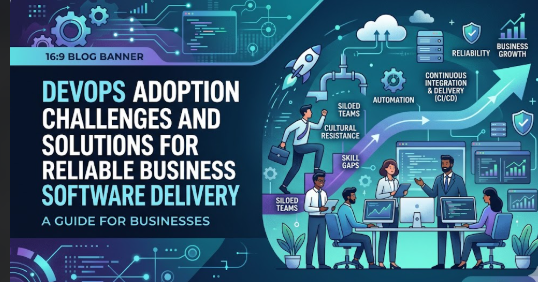
Many businesses start DevOps with excitement because they want faster releases, better software quality, fewer failures, and stronger teamwork. However, beginners often feel confused when DevOps becomes more than tools, automation, and cloud platforms. The real challenge is changing how people plan, build, test, release, monitor, and improve software together. Poor understanding can lead to wasted budgets, tool overload, failed automation, team resistance, security gaps, and delayed delivery. This blog explains DevOps Adoption Challenges and How Businesses Can Solve Them in simple language for founders, managers, engineers, students, and small business owners. Instead of pushing quick decisions, it focuses on practical understanding, careful planning, realistic expectations, risk awareness, and long-term improvement so that businesses can adopt DevOps with confidence and responsibility.
Understanding DevOps Adoption Challenges and How Businesses Can Solve Them in Simple Words
DevOps means bringing development, operations, quality, security, and business teams closer so software can move from idea to production more smoothly. It is not only a toolset. It is a working culture supported by automation, clear processes, shared responsibility, and continuous improvement.
DevOps adoption challenges happen when a business tries to apply DevOps but faces problems such as team resistance, unclear goals, weak automation, poor testing, tool confusion, lack of skills, security concerns, and management pressure. Many companies search for DevOps Adoption Challenges and How Businesses Can Solve Them because they want to improve software delivery but do not know where to begin.
In real life, DevOps is used in software companies, banks, e-commerce platforms, healthcare systems, education portals, logistics apps, cloud services, and internal business applications. It connects with money because slow software delivery can increase operational cost, delay customer value, reduce productivity, and create business risk.
A beginner-friendly example is a company that takes three weeks to release a small website change because developers, testers, and operations teams work separately. With DevOps, the company can create a shared workflow where code is tested automatically, reviewed properly, deployed safely, and monitored after release.
A common misunderstanding is that buying DevOps tools automatically creates DevOps success. The practical takeaway is simple: DevOps starts with people and process first, then tools support the process.
Why DevOps Adoption Challenges and How Businesses Can Solve Them Is Important
DevOps adoption affects real business decisions because software is now connected with customer experience, revenue, internal productivity, data security, and brand trust. When software delivery is slow or unstable, businesses may face missed opportunities, support pressure, customer complaints, and higher operating costs.
For savings, DevOps helps reduce repeated manual work when automation is planned properly. For borrowing or business funding decisions, a company should understand whether DevOps investment will support long-term efficiency or create tool expenses without clear value. For investing in technology, DevOps helps leaders decide where to spend: automation, skills, cloud infrastructure, monitoring, testing, or security.
For risk awareness, DevOps helps businesses identify weak release processes before they become production failures. For better planning, DevOps creates visibility across development, testing, deployment, and operations. For emotional decision-making, DevOps prevents teams from reacting in panic after every production issue.
A practical scenario: a small SaaS company wants to release new features faster. The wrong approach is to buy many DevOps tools immediately. The better approach is to first map the current release process, identify delays, improve testing, automate one important deployment workflow, and then scale gradually.
The Real Problem Readers Face With DevOps Adoption
The real problem is not that businesses do not know the word DevOps. The real problem is that they often misunderstand what DevOps requires. Many teams think DevOps means CI/CD tools, cloud migration, containers, or automation scripts. These are useful, but they are only part of the bigger picture.
Beginners face too much confusing advice online. One article says automation is the answer. Another says Kubernetes is required. Another says DevOps needs a full platform team. This creates pressure, especially for small businesses that have limited budget, limited time, and small technical teams.
Weak comparison also creates confusion. A company may compare itself with large technology firms and assume it needs the same tools and structure. This is risky because every business has different size, maturity, budget, compliance needs, customer expectations, and technical complexity.
Unrealistic expectations are also common. Leaders may expect DevOps to deliver instant speed, instant cost savings, or zero downtime. That mindset creates pressure and poor decisions. DevOps is a journey of improvement, not a one-time switch.
The better next step is to understand current problems, start small, build team trust, automate carefully, measure progress, and improve continuously.
How DevOps Adoption Works Step by Step
Step 1: Understand the Current Software Delivery Process
This means studying how software moves from idea to production today. It includes planning, coding, testing, approval, deployment, monitoring, and support.
It matters because businesses cannot improve what they do not understand. If a team does not know where delays happen, DevOps adoption becomes guesswork.
To apply it, map the current workflow on paper or in a simple document. Identify manual approvals, repeated errors, testing delays, deployment fear, and communication gaps.
For example, a team may discover that releases are delayed because testing starts too late.
The common mistake is jumping directly into tools. The better approach is to diagnose the workflow first.
Step 2: Define Clear DevOps Goals
This means deciding what the business wants from DevOps implementation. Goals may include faster release cycles, fewer deployment errors, better collaboration, stronger monitoring, improved security, or reduced manual effort.
It matters because unclear goals lead to scattered effort. Teams may automate random tasks without solving the main business problem.
To apply it, choose two or three realistic goals. For example, reduce manual deployment steps, improve test coverage, and create better production monitoring.
The common mistake is saying, “We want DevOps,” without defining success. The better approach is to define specific improvement areas.
Step 3: Build a Collaborative DevOps Culture
DevOps culture means developers, operations, testers, security teams, and managers work with shared responsibility instead of blaming each other.
It matters because tools cannot fix mistrust. If teams hide problems, avoid ownership, or work in silos, automation will not create real improvement.
To apply it, create shared meetings, joint incident reviews, common dashboards, and clear ownership rules.
For example, after a failed deployment, the team should ask, “What process failed?” not “Who caused the failure?”
The common mistake is treating DevOps as only an operations task. The better approach is to make DevOps a shared business and engineering practice.
Step 4: Start Automation Carefully
Automation in DevOps means reducing repeated manual work through scripts, pipelines, testing tools, deployment workflows, and monitoring systems.
It matters because manual work can cause delays and mistakes. However, automating a broken process can make mistakes happen faster.
To apply it, start with one high-value area such as build automation, automated testing, or deployment automation.
For example, a team can create a CI/CD pipeline that runs tests whenever new code is added.
The common mistake is automating everything at once. The better approach is to automate the most painful and repeated tasks first.
Step 5: Improve Testing and Quality Checks
Testing ensures that software changes are checked before reaching users. It may include unit tests, integration tests, security checks, performance checks, and manual review where needed.
It matters because faster delivery without quality can create production failures.
To apply it, add automated tests into the development pipeline and make quality checks part of every release.
For example, a payment application should not deploy changes until important transaction flows are tested.
The common mistake is treating testing as the final stage. The better approach is to test early and continuously.
Step 6: Create Safe Deployment Practices
Safe deployment means releasing software in a controlled way. This may include rollback plans, staged releases, approvals, monitoring, and deployment logs.
It matters because even good code can fail in production due to configuration issues, traffic changes, or dependency problems.
To apply it, create a release checklist and define who can approve production changes.
For example, a business can release a new feature to a small group first before making it available to everyone.
The common mistake is deploying without a rollback plan. The better approach is to prepare recovery steps before release.
Step 7: Monitor Systems After Release
Monitoring means watching application performance, errors, logs, uptime, user experience, and system health after deployment.
It matters because DevOps does not end when software is deployed. Real learning happens after users interact with the system.
To apply it, create dashboards and alerts for important services.
For example, an e-commerce company should monitor checkout errors after a new payment update.
The common mistake is noticing problems only after customers complain. The better approach is to detect issues early through monitoring.
Step 8: Review, Learn, and Improve Continuously
Continuous improvement means reviewing what worked, what failed, and what should be improved in the next cycle.
It matters because DevOps adoption is never complete in one phase. It improves through feedback.
To apply it, hold regular reviews after releases and incidents.
For example, if a deployment failed because of missing environment variables, the team can add automated configuration checks.
The common mistake is repeating the same issue again. The better approach is to convert every problem into a process improvement.
Key Factors That Influence DevOps Adoption
Culture and Team Mindset
Culture is the biggest factor in DevOps transformation. If teams do not trust each other, DevOps becomes only a technical label. A strong culture encourages shared ownership, open communication, learning from failure, and respect between teams.
Leadership Support
Management support matters because DevOps often requires time, training, process change, and budget. Leaders should avoid pressuring teams for instant results. They should support realistic improvement and remove blockers.
Skills and Training
DevOps requires knowledge of automation, CI/CD pipeline design, cloud DevOps, scripting, monitoring, testing, security basics, and infrastructure management. Beginners should build skills gradually instead of trying to master everything at once.
Tool Selection
Tools should match business needs. A small team may not need a complex enterprise platform immediately. The better approach is to choose tools that solve current problems and can scale later.
Process Clarity
DevOps works better when teams understand how work flows. Clear processes reduce confusion, repeated work, approval delays, and ownership gaps.
Automation Readiness
Not every process should be automated immediately. Teams should first clean up unclear steps, remove unnecessary approvals, and standardize workflows before automation.
Security and Compliance
Security should not be added at the end. DevOps adoption should include secure coding, access control, secrets management, audit trails, and compliance checks where needed.
Measurement and Feedback
Businesses need practical metrics to understand progress. Useful measurements may include release frequency, failed deployments, recovery time, open defects, manual effort, and team feedback. The goal is improvement, not pressure.
Detailed Breakdown of DevOps Adoption Challenges
DevOps Is Often Misunderstood as Only Tools
Many businesses begin with tools because tools are visible and easy to buy. However, DevOps is not only Jenkins, Git, Docker, Kubernetes, cloud platforms, or monitoring dashboards. These tools help only when the organization has clear goals and processes.
The mistake is assuming tool adoption equals DevOps maturity. The better approach is to first define workflow problems and then select tools to solve them.
Team Silos Slow Down Progress
Traditional teams often work in separate departments. Developers write code, testers check it, operations deploy it, and support teams handle complaints. This separation creates delays and blame.
DevOps solves this by encouraging shared responsibility. Developers should understand deployment impact. Operations teams should be involved early. Testers should help improve quality during development. Security should guide the pipeline instead of blocking at the last minute.
Manual Processes Create Delays and Errors
Manual build, test, deployment, and approval steps may look manageable at first. But as software grows, manual work creates delay, inconsistency, and stress.
Automation can help, but it must be planned carefully. Businesses should first standardize the process, then automate the repeated parts.
Weak Testing Reduces Confidence
DevOps encourages faster releases, but speed without testing is dangerous. If a team releases frequently without quality checks, users may face bugs, downtime, or broken features.
The better approach is to add automated testing, peer review, quality gates, and environment checks into the CI/CD pipeline.
Lack of Monitoring Creates Blind Spots
Some businesses focus only on deployment and ignore monitoring. This means they do not know whether the application is healthy after release.
Monitoring helps teams detect errors early, understand performance, and respond before small issues become major failures.
Security Is Added Too Late
Security gaps appear when teams treat security as a final approval step. This creates delays and risk.
A better DevOps best practice is to include security early through access controls, dependency checks, secret management, code scanning, and secure configuration practices.
Too Much Change Too Quickly
DevOps transformation can fail when businesses try to change everything at once. Teams may feel overwhelmed by new tools, new roles, new processes, and new expectations.
The better approach is phased adoption. Start with one team, one project, or one release process. Learn from it, then expand.
No Clear Ownership
DevOps does not mean “everyone owns everything” in a confusing way. It means shared responsibility with clear accountability.
Every business should define who owns code quality, pipeline maintenance, release approval, production monitoring, incident response, and improvement planning.
Common Mistakes Beginners Make With DevOps Adoption
Following Random Advice
This happens because DevOps has many opinions online. It is risky because advice that works for one company may not work for another. What can go wrong is tool overload, wasted budget, and poor implementation. Businesses should instead evaluate their own problems first.
Ignoring Risk
Some teams focus only on speed. This is risky because faster releases can create faster failures when testing, security, and monitoring are weak. The better approach is to balance speed with stability.
Not Comparing Options
Businesses may choose popular tools without checking fit. This can create cost, complexity, and training problems. The better approach is to compare tools based on team skill, budget, integration, security, and long-term use.
Trusting Fake Productivity Claims
Some vendors or consultants may overpromise instant transformation. This is risky because DevOps requires real work. Businesses should avoid guaranteed results and ask for realistic planning.
Making Emotional Decisions
After a production failure, teams may panic and buy tools or change processes without analysis. This can create more confusion. The better approach is to review the incident calmly and fix the root cause.
Not Reading Terms and Conditions
Cloud platforms, SaaS tools, and automation services may have pricing, usage limits, security rules, and support conditions. Ignoring these can create cost or compliance problems.
Sharing Sensitive Information
DevOps pipelines often handle credentials, tokens, keys, and production access. Sharing them carelessly can create serious security risks. Teams should use proper secret management and access control.
Ignoring Legal or Compliance Responsibilities
Some businesses operate in regulated industries. They must consider audit logs, data protection, user privacy, and access records. DevOps should support compliance, not bypass it.
Depending Only on Social Media Advice
Short posts can be useful but incomplete. Businesses should not build strategy only from social media trends. They should use internal analysis, expert review, and practical testing.
Acting Under Pressure
Pressure from leadership or customers can lead to rushed releases. The better approach is to create safe release rules and communicate clearly about risk.
Don’t Do This Checklist
- Do not buy tools before understanding the problem.
- Do not copy another company’s DevOps model blindly.
- Do not ignore team training.
- Do not automate a broken process.
- Do not release faster without better testing.
- Do not store secrets in plain text.
- Do not skip monitoring after deployment.
- Do not treat security as a final step only.
- Do not measure teams only by speed.
- Do not expect DevOps to succeed without cultural change.
Practical Real-Life Examples of DevOps Adoption
Example 1: Small Business With Slow Website Updates
A small business takes several days to publish minor website updates because every change needs manual upload and approval. The challenge is slow delivery and repeated coordination. The better action is to create a simple version control and deployment workflow. The learning is that DevOps can start small and still create value.
Example 2: Startup Facing Frequent Production Bugs
A startup releases features quickly but customers report issues after every release. The mistake is speed without testing. The better action is to add automated tests and review checks before deployment. The learning is that DevOps should improve both speed and quality.
Example 3: Enterprise Team Working in Silos
A large company has separate development, testing, security, and operations teams. Releases are delayed because each team waits for the other. The better action is to create shared planning, common dashboards, and joint release ownership. The learning is that DevOps culture is as important as technology.
Example 4: SaaS Company With Cloud Cost Confusion
A SaaS company moves to cloud DevOps but does not track resource usage. Monthly bills become difficult to manage. The better action is to monitor cloud usage, set budgets, review unused resources, and plan scaling carefully. The learning is that DevOps should include cost awareness.
Example 5: E-Commerce Platform With Weak Monitoring
An e-commerce platform deploys a checkout update but notices payment errors only after customers complain. The better action is to create alerts for checkout failures, payment errors, and response time. The learning is that deployment is not the end; monitoring is part of DevOps success.
Two Useful Tables for Better Understanding
| DevOps Challenge | Business Impact | Better Approach |
|---|---|---|
| Team silos | Slow communication and delayed releases | Build shared ownership and cross-team planning |
| Tool overload | Higher cost and confusion | Select tools based on actual workflow needs |
| Weak testing | More bugs and lower confidence | Add automated and manual quality checks where needed |
| Manual deployment | Higher error risk | Create controlled CI/CD pipeline automation |
| Poor monitoring | Late issue detection | Use dashboards, alerts, and incident reviews |
| Security added late | Compliance and data risk | Include security checks early in the pipeline |
| No clear goals | Scattered effort | Define measurable and realistic DevOps goals |
| Lack of training | Slow adoption and resistance | Build skill plans for teams gradually |
| Adoption Area | Beginner Action | Common Mistake to Avoid |
|---|---|---|
| Culture | Create shared responsibility between teams | Treating DevOps as one team’s job |
| Automation | Start with one repeated manual task | Automating everything too quickly |
| CI/CD Pipeline | Add build, test, and deployment stages gradually | Creating a pipeline without quality checks |
| Cloud DevOps | Review cost, access, and scaling needs | Moving to cloud without governance |
| Security | Use access control and secret management | Sharing credentials informally |
| Monitoring | Track system health after release | Waiting for users to report issues |
| Training | Build basic DevOps skills step by step | Expecting instant expertise |
| Improvement | Review failures and update process | Repeating the same mistakes |
Tools, Methods, and Frameworks Readers Can Use
DevOps Readiness Assessment
A DevOps readiness assessment helps businesses understand their current maturity. It reviews culture, process, automation, testing, monitoring, security, and skills. Beginners can use it by listing current strengths and weaknesses before choosing tools. It helps avoid the mistake of starting DevOps without knowing the current state.
Value Stream Mapping
Value stream mapping shows how work moves from idea to production. It helps teams find delays, repeated approvals, manual handoffs, and unclear ownership. Beginners can draw the process on a simple board. This method avoids the mistake of improving the wrong part of the workflow.
CI/CD Pipeline Framework
A CI/CD pipeline helps automate build, test, and deployment activities. It supports faster and safer software delivery when planned correctly. Beginners can start with source control, automated builds, basic tests, and controlled deployment. It helps avoid manual release mistakes.
Automation Priority Matrix
This method helps teams decide what to automate first. Tasks that are repeated, time-consuming, and error-prone should receive priority. Beginners can list all manual tasks and rank them by effort and risk. This avoids wasting time automating low-value activities.
Incident Review Method
An incident review helps teams learn from failures without blame. It focuses on what happened, why it happened, how it was detected, and what should change. Beginners can use it after production issues. It avoids repeated failures and emotional decision-making.
Monitoring Dashboard
A monitoring dashboard shows the health of applications, servers, databases, APIs, and user activity. It helps teams detect issues early. Beginners should track only important signals first, such as errors, uptime, response time, and failed transactions. It avoids blind operations.
Security Checklist
A security checklist helps teams review access, credentials, dependencies, secrets, and configurations. Beginners can include it in every release process. It avoids the mistake of treating security as an afterthought.
Release Checklist
A release checklist ensures that deployment steps are clear. It may include testing status, approval, rollback plan, monitoring readiness, and communication. It helps beginners avoid rushed or incomplete releases.
Expert Tips to Make Better Decisions
1. Start With Business Problems, Not Tools
This matters because tools cannot solve unclear goals. Businesses should first identify whether the problem is slow delivery, poor quality, manual work, downtime, or weak collaboration. Apply it by writing three current delivery problems before choosing any DevOps tool.
2. Build DevOps Culture Before Automation
Culture matters because teams need trust to share responsibility. Apply it by creating joint planning sessions between developers, testers, operations, and security teams. This reduces blame and improves problem-solving.
3. Keep Automation Practical
Automation should reduce real pain, not create unnecessary complexity. Apply it by automating repeated tasks first, such as builds, tests, and deployment steps. Avoid automating unclear processes.
4. Use Small Pilot Projects
A pilot project reduces risk. Apply it by choosing one team or one application for the first DevOps implementation. Learn from the pilot before expanding across the business.
5. Measure Improvement Carefully
Measurement matters because teams need to know whether DevOps is working. Apply it by tracking deployment failures, release delays, manual effort, and recovery time. Do not use metrics to create fear.
6. Train Teams Gradually
DevOps skills take time. Apply it by building learning paths for source control, automation, CI/CD pipeline basics, cloud DevOps, testing, monitoring, and security. Avoid expecting instant expertise.
7. Keep Security Inside the Workflow
Security matters because DevOps pipelines often touch sensitive systems. Apply it by adding code checks, secret management, role-based access, and dependency reviews. Do not wait until the final release stage.
8. Review Cloud Costs Regularly
Cloud DevOps can become expensive without governance. Apply it by reviewing usage, removing unused resources, setting alerts, and planning scaling. This helps avoid budget surprises.
9. Create Clear Ownership
DevOps is shared responsibility, but ownership must be clear. Apply it by defining who owns pipeline maintenance, monitoring, production support, incident response, and security reviews.
10. Avoid Copying Large Companies Blindly
Large enterprises may use complex platforms that small teams do not need. Apply it by choosing solutions that match your size, budget, and maturity. Keep the system simple before scaling.
11. Keep Emergency Plans Ready
Failures can still happen even with good DevOps practices. Apply it by creating rollback plans, backup processes, and incident communication rules. This reduces panic during production issues.
12. Improve Continuously
DevOps is not a one-time project. Apply it by reviewing every release and incident. Small improvements over time build strong delivery discipline.
Case Studies: How Better Understanding Changes Decisions
Case Study 1: Small SaaS Company Improving Release Confidence
Profile: A small SaaS company with one product team and limited DevOps experience.
Situation: The team wanted faster releases but often delayed deployment because they feared breaking production.
Problem: Releases were manual, testing was inconsistent, and rollback steps were unclear.
Wrong approach: The company first considered buying multiple expensive DevOps tools without changing the release process.
Better approach: The team mapped the release workflow, created a basic CI/CD pipeline, added automated tests, prepared rollback steps, and monitored key application errors.
Result or learning: The company gained better release confidence. The biggest learning was that disciplined process improvement mattered more than tool quantity.
Key takeaway: Start with workflow clarity and safe deployment practices before expanding tool investment.
Case Study 2: Enterprise Team Breaking Down Silos
Profile: A large organization with separate development, testing, operations, and security departments.
Situation: New software releases were slow because each department worked independently.
Problem: Teams blamed each other when releases failed, and security reviews happened late.
Wrong approach: Management tried to force faster deadlines without changing collaboration habits.
Better approach: The organization created shared release planning, early security involvement, common dashboards, and joint incident reviews.
Result or learning: Communication improved, release planning became clearer, and repeated mistakes reduced.
Key takeaway: DevOps transformation needs cultural change, not only technical change.
Case Study 3: Cloud Migration With Better Cost Awareness
Profile: A growing online service provider moving from traditional hosting to cloud DevOps.
Situation: The company wanted scalability and faster infrastructure setup.
Problem: Cloud resources were created without ownership, cost tracking, or usage review.
Wrong approach: Teams assumed cloud automation would automatically reduce cost.
Better approach: The business added tagging, access control, budget alerts, environment cleanup, and monthly usage reviews.
Result or learning: The company learned that cloud DevOps needs governance, not just speed.
Key takeaway: Automation and cloud adoption should include cost, security, and accountability.
Risk Awareness: What Readers Must Check First
Operational Risk
Operational risk means the chance of process failure, deployment mistakes, downtime, or service disruption. It matters because software problems can affect customers and internal teams. Reduce it with testing, rollback plans, monitoring, and clear ownership.
Security Risk
Security risk means unauthorized access, exposed credentials, insecure code, or weak configurations. It matters because DevOps pipelines may access sensitive systems. Reduce it with access control, secret management, security checks, and regular reviews.
Cost Risk
Cost risk means spending too much on tools, cloud resources, consultants, or unused platforms. It matters because poor planning can waste business budget. Reduce it by starting small, comparing tools, tracking cloud usage, and reviewing value.
Compliance Risk
Compliance risk means failing to follow legal, data protection, industry, or audit requirements. It matters for businesses handling customer data, financial data, health data, or regulated services. Reduce it with audit logs, approval records, access reviews, and professional guidance.
Platform Risk
Platform risk means depending too heavily on one tool, vendor, or cloud service without understanding limitations. It matters because pricing, support, or service changes can affect operations. Reduce it by reviewing terms, backup options, portability, and integration needs.
Skill Risk
Skill risk means teams may not know how to manage new tools or processes properly. It matters because weak skills can create mistakes. Reduce it with training, documentation, mentoring, and gradual adoption.
Emotional Risk
Emotional risk means making rushed decisions under pressure, fear, blame, or excitement. It matters because panic decisions can create long-term problems. Reduce it by using reviews, checklists, and calm decision-making.
Misinformation Risk
Misinformation risk means following incomplete or misleading DevOps advice. It matters because every business has different needs. Reduce it by validating advice, comparing options, and seeking qualified professional support where required.
Readers should always verify technical, financial, legal, and compliance details before making major business decisions.
Checklist Before Taking Action
- Have we clearly understood our current DevOps adoption challenges?
- Have we defined the business problem we want to solve?
- Have we mapped the current software delivery process?
- Have we identified delays, manual work, and risk areas?
- Have we compared tool options properly?
- Have we checked tool cost, support, integration, and security needs?
- Have we reviewed team skills and training requirements?
- Have we kept emergency plans and rollback steps ready?
- Have we protected credentials, secrets, and personal data?
- Have we included testing and quality checks in the workflow?
- Have we planned monitoring after deployment?
- Have we reviewed cloud cost and platform risks?
- Have we checked tax, legal, or compliance impact where relevant?
- Have we avoided fake promises or guaranteed transformation claims?
- Have we prepared a written DevOps adoption plan?
- Have we avoided emotional or rushed decisions?
- Have we considered expert advice where needed?
Use this checklist before selecting tools, changing processes, moving to cloud, creating pipelines, or scaling DevOps across teams. It helps businesses slow down, think clearly, and reduce avoidable mistakes.
Strategic Insights for Better Decision-Making
DevOps Maturity Planning
DevOps maturity means understanding how ready a business is for advanced practices. A beginner team may first need source control, basic automation, and testing. A mature team may focus on platform engineering, advanced monitoring, and security automation.
Platform Thinking
As teams grow, repeated DevOps work can be turned into reusable internal platforms. This helps developers deploy and monitor applications without reinventing the process every time. Beginners should not rush into platform engineering, but they should understand it as a future direction.
Environment Standardization
Different environments such as development, testing, staging, and production should be consistent. If environments are very different, software may work in one place and fail in another. Standardization reduces surprises.
Risk Allocation
Not every application has the same risk. A payment system needs stronger controls than an internal reporting tool. Businesses should apply stricter DevOps practices where customer, security, or revenue impact is higher.
Release Strategy
A good release strategy decides how software changes reach users. Businesses can use staged releases, approval steps, rollback plans, and monitoring. This reduces the risk of large sudden failures.
Avoiding Tool Sprawl
Tool sprawl happens when teams use too many disconnected tools. It increases cost and confusion. Businesses should review whether each tool has a clear purpose and owner.
Continuous Learning
DevOps improves through learning. Teams should document incidents, review releases, share knowledge, and update practices. This creates long-term discipline.
Business and Engineering Alignment
DevOps is most useful when engineering goals support business goals. Faster delivery should connect with better customer experience, safer releases, lower waste, and improved product quality.
Key Terms Explained for Beginners
- DevOps: DevOps is a way of working where development, operations, testing, security, and business teams collaborate to deliver software faster and more safely.
- DevOps Adoption: DevOps adoption means applying DevOps culture, tools, automation, and processes inside a business.
- DevOps Culture: DevOps culture means shared responsibility, trust, learning, and collaboration between teams.
- CI/CD Pipeline: A CI/CD pipeline is an automated workflow that helps build, test, and deploy software changes.
- Continuous Integration: Continuous integration means developers regularly merge code changes so problems can be found earlier.
- Continuous Delivery: Continuous delivery means software is prepared for release through automated checks and controlled workflows.
- Automation: Automation means using tools or scripts to reduce repeated manual work and errors.
- Monitoring: Monitoring means tracking application health, performance, errors, and system behavior after release.
- Rollback: Rollback means returning to a previous stable version when a new release creates problems.
- Infrastructure as Code: Infrastructure as Code means managing servers, networks, and cloud resources through code instead of manual setup.
- Cloud DevOps: Cloud DevOps means using cloud platforms with DevOps practices for automation, scaling, deployment, and monitoring.
- DevSecOps: DevSecOps means adding security into DevOps workflows from the beginning instead of treating it as a final step.
- Incident Review: An incident review is a structured discussion after a failure to understand what happened and how to prevent it.
- Deployment: Deployment means moving software changes into an environment where users or teams can access them.
- Tool Sprawl: Tool sprawl happens when a business uses too many tools without clear purpose, ownership, or integration.
Who Should Read This Blog
Beginners
Beginners should read this blog to understand DevOps in simple language before getting confused by tools and technical terms.
Students
Students can use this blog to understand how DevOps works in real business environments, not only in theory.
Salaried Employees
Salaried employees working in IT, support, testing, development, or operations can learn how DevOps affects daily work and career growth.
Small Business Owners
Small business owners can understand how DevOps may improve software delivery without blindly spending on tools.
New Investors
New investors studying technology businesses can learn why software delivery maturity matters for operational strength.
Traders
Traders who follow technology companies can understand how software reliability and delivery practices may affect business performance.
Loan Seekers
Business loan seekers planning technology investment can use this blog to think carefully about cost, tools, and operational value.
Crypto Learners
Crypto learners can understand the importance of automation, security, monitoring, and operational discipline in digital platforms.
Casino Content Creators
Casino content creators running websites or affiliate platforms can learn how DevOps supports uptime, content delivery, testing, and platform reliability.
Finance Bloggers
Finance bloggers covering technology businesses can use this topic to explain operational efficiency in simple terms.
People Improving Money Awareness
Anyone improving business or money awareness can learn how poor technology decisions may create hidden costs.
People Trying to Avoid Financial Mistakes
This blog helps readers avoid rushed tool purchases, unclear cloud spending, and unrealistic DevOps expectations.
Frequently Asked Questions
1. What is DevOps adoption?
DevOps adoption means bringing DevOps culture, automation, collaboration, testing, deployment, and monitoring into a business. It helps teams deliver software more smoothly. It should be planned step by step instead of treated as a one-time tool purchase.
2. What are the main DevOps adoption challenges?
The main challenges include team silos, lack of skills, unclear goals, weak testing, tool confusion, poor automation, security gaps, and resistance to change. These problems can slow delivery and increase risk if not handled carefully.
3. Why is DevOps Adoption Challenges and How Businesses Can Solve Them important?
DevOps Adoption Challenges and How Businesses Can Solve Them is important because many businesses want faster software delivery but struggle with planning. Understanding the challenges helps teams avoid costly mistakes and build a practical adoption path.
4. Can small businesses adopt DevOps?
Yes, small businesses can adopt DevOps by starting with simple practices such as version control, basic automation, testing, release checklists, and monitoring. They do not need to copy large enterprise systems immediately.
5. Is DevOps only for software companies?
No, DevOps is useful for any business that depends on software, websites, applications, cloud systems, or digital platforms. This includes finance, education, healthcare, e-commerce, logistics, and service businesses.
6. What is the biggest mistake in DevOps adoption?
The biggest mistake is buying tools before understanding the real problem. Businesses should first study their workflow, team structure, delivery delays, quality issues, and security needs before selecting tools.
7. How can beginners start DevOps safely?
Beginners can start by mapping the current process, defining clear goals, improving collaboration, automating one repeated task, adding testing, and setting up basic monitoring. Small steps reduce confusion and risk.
8. How does DevOps affect business cost?
DevOps can reduce repeated manual work and delivery delays when planned well. However, poor tool selection, cloud misuse, and lack of governance can increase costs. Businesses should track spending and value carefully.
9. Does DevOps guarantee faster delivery?
No, DevOps does not guarantee instant speed. It improves delivery when culture, process, automation, testing, and monitoring are handled properly. Unrealistic expectations can create pressure and poor decisions.
10. How often should a business review DevOps progress?
A business should review DevOps progress regularly after releases, incidents, and process changes. Reviews help teams learn what is working, what is failing, and what should improve next.
11. Why do DevOps transformations fail?
DevOps transformations often fail because of weak leadership support, poor culture, tool overload, unclear ownership, lack of training, and unrealistic expectations. A phased and practical approach reduces failure risk.
12. What is the best next step after reading DevOps Adoption Challenges and How Businesses Can Solve Them?
The best next step is to review your current software delivery process and identify the top three challenges. Then create a small improvement plan with clear goals, responsible owners, risk checks, and measurable outcomes.
Conclusion and Next Steps
DevOps Adoption Challenges and How Businesses Can Solve Them is an important topic for any organization that wants faster, safer, and more reliable software delivery. The main lesson is that DevOps is not only about tools, cloud platforms, automation, or pipelines. It is about building a better way of working where teams communicate clearly, share responsibility, test early, deploy carefully, monitor continuously, and improve after every release. Beginners should remember that rushing into DevOps without planning can create cost, confusion, security gaps, and team resistance. The better approach is to start with current problems, define realistic goals, train teams, choose tools carefully, and improve step by step. Businesses should also review risks such as operational failure, cloud cost, compliance issues, data privacy, platform dependency, and skill gaps before making major changes. DevOps can support long-term discipline when it is connected with business goals, customer value, and responsible decision-making. The next step is simple: map your current workflow, identify the biggest bottleneck, create a small pilot, measure learning, and expand only when the process becomes stable. With patience, practical planning, and honest review, businesses can turn DevOps from a confusing idea into a strong foundation for better software delivery.
One challenge that deserves more attention is maintaining momentum after the initial DevOps rollout. Many organizations start strong, but continuous training, leadership support, and regular process reviews are often what keep improvements sustainable over the long term.