Introduction
Data management is changing very fast. Many years ago, moving data from one place to another was a slow and manual job. Errors were common, and teams often worked in silos. Today, businesses need data to be delivered quickly and accurately to make smart decisions. This is where DataOps comes into the picture. It is a modern way of handling data that uses the best parts of DevOps, Agile, and lean manufacturing. If you are a software engineer or a cloud professional, learning how to build these data pipelines is a great way to grow your career.
This guide is written to help you understand the path to becoming a Certified DataOps Architect (CDOA). You will find clear details on what this role is, why the certification is valuable, and how you can prepare for it. Whether you are managing a small team in India or working for a global firm, these skills are becoming essential. Let’s look at how you can master the art of data architecture.
What is CDOA – Certified DataOps Architect
The CDOA – Certified DataOps Architect is a professional designation for those who design and manage automated data environments. It is not just about writing code; it is about creating a system where data flows smoothly from the source to the user. A person with this certification knows how to combine data engineering with DevOps practices. This ensures that data is high-quality, secure, and delivered on time without manual delays.
Why it matters today?
In the past, data was handled by one specific team, and software was handled by another. This caused many bottlenecks. Today, companies rely on real-time data for everything from customer service to financial planning. If the data is late or wrong, the business loses money. DataOps solves this by bringing automation to the data world. Professionals who can build these automated systems are in high demand because they help companies move faster and with fewer mistakes.
Why CDOA – Certified DataOps Architect certifications are important
Getting certified is a way to prove that you have the right skills. It shows that you understand the complex tools and workflows needed for modern data projects. For an engineer, it provides a clear roadmap for learning. For a manager, it provides confidence that the team can handle big data challenges. This certification is recognized globally, making it easier for you to find better job opportunities and earn a higher salary.
Why Choose Dataopsschool?
Dataopsschool is chosen by many professionals because it focuses on practical learning. The courses are designed by people who have spent years working on real data problems. You are not just reading books; you are learning how to solve actual industry challenges. The curriculum is kept up to date with the latest tools and trends. Also, the support provided during and after the training helps students gain the confidence they need to clear the exam and perform well in their jobs.
Certification Deep-Dive
What is this certification?
The CDOA certification is a professional program that teaches you how to design, build, and maintain automated data pipelines. It focuses on bringing the speed of DevOps to the world of data engineering.
Who should take this certification?
This program is perfect for Data Engineers, DevOps Engineers, and Solution Architects. It is also very helpful for Engineering Managers who want to understand how to improve their team’s data delivery speed and quality.
Certification Overview Table
| Track | Level | Who it’s for | Prerequisites | Skills Covered | Recommended Order |
| DataOps Foundation | Beginner | Newcomers to Data | Basic IT knowledge | Data lifecycle, Agile, DevOps basics | 1 |
| DataOps Professional | Intermediate | Data Engineers | Foundation level | Pipeline automation, Data quality | 2 |
| CDOA (Architect) | Advanced | Senior Engineers | Professional level | System design, Security, Scalability | 3 |
| DataOps Lead | Expert | Managers / Leads | CDOA level | Strategy, Governance, Team Lead | 4 |
Skills you will gain
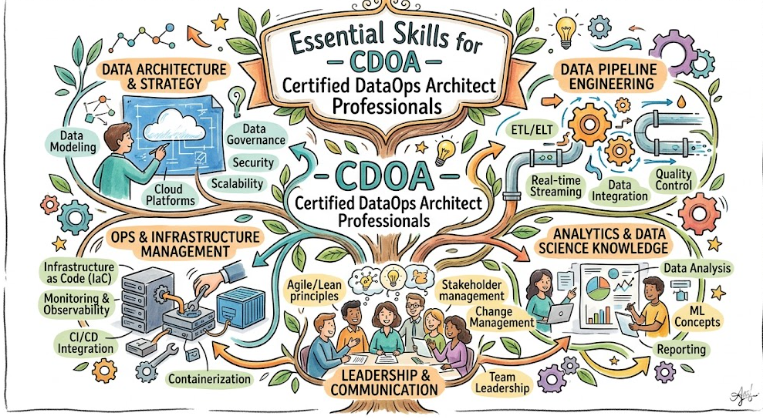
- The ability to design end-to-end automated data pipelines is developed.
- Data quality and testing methods are mastered to ensure accuracy.
- Expertise in using version control for data sets is gained.
- Skills in monitoring and logging for big data environments are built.
- Knowledge of security and compliance in data handling is improved.
Real-world projects you should be able to do after this certification
- A fully automated CI/CD pipeline for data warehouse updates is built.
- A real-time data monitoring dashboard using modern tools is created.
- An automated data testing framework to catch errors early is designed.
- A scalable data infrastructure on the cloud is deployed and managed.
Preparation plan
7–14 days plan
The core concepts of DataOps and Agile are reviewed. The official documentation is read daily. Basic pipeline tools are practiced in a lab environment to understand the flow.
30 days plan
Detailed study of data architecture patterns is conducted. Weekly practice tests are taken to identify weak areas. Real-world case studies are analyzed to understand design choices.
60 days plan
A full-scale project is built to apply all learned skills. Advanced topics like data security and governance are deeply explored. Multiple mock exams are completed to ensure readiness for the final test.
Common mistakes to avoid
- Skipping the fundamental concepts of DevOps is a common error.
- Focusing only on tools instead of the overall process is avoided.
- Ignoring the importance of data quality testing is a mistake made by many.
- Not practicing enough with real-world scenarios can lead to failure.
Best next certification after this
- Same track: DataOps Expert or Lead certification.
- Cross-track: MLOps Architect to handle machine learning models.
- Leadership / management: Engineering Management or CTO certification.
Choose Your Learning Path
DevOps
This path is best for those who want to focus on software delivery. It teaches how to automate the building, testing, and deployment of applications. It is ideal for System Administrators moving into coding.
DevSecOps
This is for professionals who want to make security a part of the automation process. It is best for Security Analysts who want to work in an automated environment.
Site Reliability Engineering (SRE)
This path is chosen by those who love stability and performance. It focuses on making sure large systems stay up and run fast. It is great for those with a strong background in Linux and networking.
AIOps / MLOps
This is best for engineers working with Artificial Intelligence and Machine Learning. It teaches how to manage the lifecycle of models and handle large-scale AI data.
DataOps
This path is designed for data-focused engineers. It is perfect for those who want to bridge the gap between traditional data management and modern automation.
FinOps
This is for those who want to manage cloud costs. It is ideal for Finance Managers or Cloud Architects who need to ensure that the cloud budget is used efficiently.
Role → Recommended Certifications Mapping
| Role | Primary Certification | Secondary Certification | Leadership Focus |
| DevOps Engineer | Certified DevOps Prof. | DevSecOps Engineer | DevOps Manager |
| SRE | SRE Practitioner | Cloud Architect | SRE Director |
| Platform Engineer | Kubernetes Expert | DataOps Architect | Platform Lead |
| Cloud Engineer | Cloud Professional | FinOps Associate | Cloud Manager |
| Security Engineer | DevSecOps Architect | Ethical Hacker | CISO |
| Data Engineer | CDOA (Architect) | MLOps Engineer | Data Engineering Manager |
| FinOps Practitioner | FinOps Certified | Cloud Economist | Head of FinOps |
| Engineering Manager | Management Prof. | Strategic Lead | CTO / V.P. |
Next Certifications to Take
Same-track Certification
A more advanced expert-level certification in the same field is recommended. This helps in becoming a top-tier specialist in one specific domain. It ensures that deep technical knowledge is maintained.
Cross-track Certification
A certification in a related field like MLOps or FinOps is suggested. This makes a professional more versatile and valuable to the company. It allows for better collaboration across different teams.
Leadership-focused Certification
A management or strategy-focused program is recommended for those wanting to lead teams. It teaches how to handle budgets, people, and business goals. This is essential for moving into senior executive roles.
Training & Certification Support Institutions
DevOpsSchool
This platform provides extensive training in DevOps and cloud technologies. It is known for its hands-on approach and expert instructors who help students master complex tools.
Cotocus
A leading provider of technical training that focuses on modern IT roles. They offer personalized support and a wide range of courses to help professionals upskill quickly.
ScmGalaxy
This community-driven site offers great resources and training for Source Code Management and DevOps. It is a go-to place for learning about automation and version control.
BestDevOps
A highly rated training institute that focuses on delivering quality education in the DevOps space. They provide real-world project experience to all their students.
devsecopsschool.com
This school is dedicated to teaching security within the DevOps lifecycle. It provides the tools and knowledge needed to protect automated systems from threats.
sreschool.com
A specialized institution for Site Reliability Engineering. The curriculum is focused on system uptime, performance, and reliability using modern engineering practices.
aiopsschool.com
This platform focuses on the intersection of AI and IT operations. It helps engineers learn how to use machine learning to improve system management and monitoring.
dataopsschool.com
The primary destination for learning DataOps. It offers certifications like CDOA and provides a clear path for data professionals to become architects.
finopsschool.com
This site is dedicated to cloud financial management. It teaches professionals how to balance the speed of the cloud with the need for cost control.
FAQs Section
1. What is the difficulty level of the CDOA exam?
The exam is considered moderate to challenging because it requires a good understanding of both data and automation.
2. How much time is required to prepare for the certification?
Most professionals find that 30 to 60 days of consistent study is enough to be fully prepared.
3. Are there any strict prerequisites for taking the CDOA?
A basic understanding of data engineering and DevOps is helpful, though foundational courses are available for beginners.
4. What is the recommended certification sequence?
It is best to start with the Foundation level, move to Professional, and then complete the Architect certification.
5. How much career value does this certification add?
It adds significant value by making you a specialist in a high-growth field, often leading to better salary packages.
6. Which job roles can I apply for after getting certified?
You can apply for roles like DataOps Architect, Senior Data Engineer, or Lead Automation Engineer.
7. Is the certification recognized globally?
Yes, it is recognized by top companies all over the world as a mark of quality and expertise.
8. Can I take the exam online?
Yes, the exam is usually conducted online, allowing you to take it from any location.
9. Does the certification expire?
Most certifications recommend a refresher or an upgrade every few years to keep up with new technology.
10. Is there a community for support during learning?
Yes, platforms like DataOpsSchool provide access to forums and mentors for guidance.
11. Are there practical labs included in the training?
Yes, practical labs are a key part of the training to ensure real-world skills are gained.
12. What is the growth potential in the DataOps field?
The field is growing very fast as more companies move their data operations to the cloud.
CDOA Specific FAQs
1. What is the main focus of the CDOA program?
The main focus is on building and managing automated data delivery systems that are reliable and fast.
2. Will I learn about cloud tools in this course?
Yes, the program covers how to implement DataOps practices using major cloud platforms.
3. How does CDOA differ from traditional Data Engineering?
CDOA focuses more on automation, testing, and the speed of delivery rather than just database management.
4. Is coding required for this certification?
A basic understanding of scripting and coding is very helpful for the automation parts of the course.
5. Are real-world projects part of the exam?
The exam tests your knowledge of how to handle real-world scenarios and architectural challenges.
6. Does the course cover data security?
Yes, security and compliance are important parts of the architect curriculum.
7. Can an Engineering Manager benefit from this?
Yes, it helps managers understand the technical requirements for building a modern data team.
8. Is the CDOA certification worth the investment?
Given the high demand for data automation skills, it is considered one of the best investments for a career in data.
Testimonials
Aarav
My skills in data automation were greatly improved after this course. I now feel much more confident in designing complex pipelines for my company.
Vikram
Real-world applications were taught in a very simple way. This training gave me the clarity I needed to move from a basic engineer to an architect role.
Suresh
My career path is now very clear. The hands-on projects helped me understand how to solve the daily data bottlenecks we faced at work.
Ananya
Confidence growth was the biggest benefit for me. I can now lead technical discussions about data architecture with my senior management.
Ishaan
The simple language used in the training made difficult concepts easy to grasp. It was a great experience that helped me get a better job role.
Conclusion
A successful career in the modern data landscape is built on more than just understanding databases; it is about mastering the flow and reliability of information. By becoming a Certified DataOps Architect, a professional is equipped with the exact skills needed to bridge the gap between engineering and operations. This certification serves as a long-term investment that keeps you relevant as technology shifts toward full automation. Taking this step now ensures that you are prepared for the high-level responsibilities and leadership roles that top companies are hiring for right now.