Introduction
In a world where software delivery speed and system reliability determine business success, the bridge between development, security, and operations has become the most critical component of the modern enterprise. DevOps is no longer just a methodology; it is the fundamental architecture of modern digital infrastructure. As industries across the globe embrace cloud-native technologies, artificial intelligence, and automated pipelines, the path to a high-impact career often feels obscured by an overwhelming number of tools and certifications. A strategic approach to certification is the difference between being a generalist struggling to keep up and a specialized engineer leading the next wave of technological innovation. This guide provides the clarity you need to navigate this landscape, align your skills with market demand, and select the credentials that will most effectively accelerate your career.
What is a DevOps Certification?
A Best DevOps certification is a formal recognition of your proficiency in the tools, practices, and cultural philosophies that define the DevOps movement. It goes beyond theoretical knowledge; it validates your capability to perform tasks such as automating infrastructure, managing service meshes, orchestrating containers, and maintaining robust security postures. These programs provide a structured learning environment, often involving hands-on labs and simulations, ensuring that you don’t just know what DevOps is—you know how to do it in a production-ready enterprise environment.
Why DevOps Certifications Matter
Certifications serve as a tangible differentiator in a competitive job market. They demonstrate to recruiters and hiring managers that you have invested the time to master specific technologies and adhere to industry best practices.
Step-by-Step Process to Leverage Certifications:
- Self-Assessment: Identify your current skill gap (e.g., lack of cloud knowledge or CI/CD experience).
- Goal Mapping: Choose a certification that aligns with your target role (e.g., SRE, Cloud Engineer, or DevOps Lead).
- Structured Learning: Enrol in a reputable program that offers instructor-led training and comprehensive materials.
- Hands-On Execution: Apply what you learn by building actual projects in a sandbox or cloud lab environment.
- Certification Achievement: Sit for the exam to earn your credential.
- Continuous Upskilling: Use the foundation from your first certification to pursue advanced, niche credentials.
Who Should Take DevOps Certifications?
Whether you are starting your journey or looking to pivot your existing IT career, these certifications are designed for professionals who want to stay relevant in the age of automation.
- Students & Freshers: Building a strong foundation for entry-level engineering roles.
- Software Engineers: Shifting toward full-stack or platform engineering.
- System Administrators: Transitioning into SRE or cloud infrastructure roles.
- Cloud & Platform Engineers: Validating expertise in multi-cloud environments.
- Security Professionals: Moving into DevSecOps to integrate security into the pipeline.
- Data & ML Engineers: Learning to operationalize data pipelines (MLOps).
- IT Managers: Understanding the technical requirements to lead DevOps transformations.
Core Skills Covered
DevOps certifications provide a multi-faceted skill set essential for modern software delivery.
- Continuous Integration/Continuous Deployment (CI/CD): Mastering tools to automate code testing and deployment.
- Infrastructure as Code (IaC): Writing code to provision and manage cloud resources.
- Containerization & Orchestration: Packaging applications and managing massive clusters.
- Cloud Platforms: Navigating the ecosystem of AWS, Azure, or Google Cloud.
- Monitoring & Observability: Using metrics and logs to maintain system health.
- Security Automation (DevSecOps): Shifting security left to prevent vulnerabilities early.
Table 1: Best DevOps Certifications
| Certification Name | Best For | Skill Level | Career Direction |
| DevOps Certified Professional (DCP) | Foundations | Beginner | DevOps Engineer |
| DevSecOps Certified Professional (DSOCP) | Security | Intermediate | DevSecOps Engineer |
| Site Reliability Engineering (SRE) Certified Professional | Reliability | Intermediate | SRE Engineer |
| Master in DevOps Engineering (MDE) | Advanced | Advanced | Lead DevOps Architect |
| Master in Azure DevOps | Azure Cloud | Intermediate | Cloud Engineer |
| AWS Certified DevOps Professional | AWS Cloud | Advanced | Cloud Architect |
| Master in Python Programming | Automation | Beginner | DevOps/MLOps |
| Hashicorp Certified Terraform Associate | Infrastructure | Intermediate | Platform Engineer |
| Certified Kubernetes Administrator (CKA) | Orchestration | Intermediate | K8s Expert |
| Docker Certified Associate (DCA) | Containers | Beginner | DevOps Engineer |
| Envoy ISTIO Certification Training | Service Mesh | Advanced | Cloud Engineer |
| MLOps Certification Training Course | ML Pipelines | Advanced | MLOps Engineer |
| Google Cloud Professional Cloud DevOps Engineer | GCP Cloud | Advanced | DevOps Architect |
| Master in Machine Learning | Data/AI | Intermediate | ML Engineer |
| Master in Artificial Intelligence | AI Systems | Advanced | AI Developer |
| Master in AppDynamics | Monitoring | Intermediate | SRE/Ops |
| Master in Data Science | Analytics | Intermediate | Data Engineer |
| Master in Deep Learning | AI/Deep Tech | Advanced | AI Researcher |
| Prometheus with Grafana | Observability | Beginner | SRE/Ops |
| GitOps Certified Professional (GOCP) | Workflow | Intermediate | Platform Engineer |
Certification Deep Dive
To succeed in any of the certifications listed above, you must approach your studies with a focus on practical application.
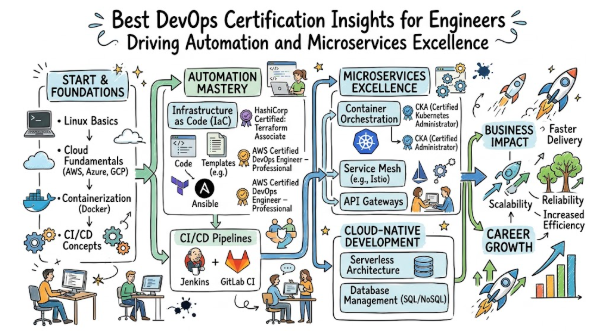
- Real-World Use Case: Imagine automating the deployment of a microservices application to a Kubernetes cluster using Terraform for provisioning and a CI/CD tool for pipeline management, ensuring the system remains secure and observable.
- Skills You Will Learn: Proficiency in version control (Git), infrastructure provisioning (Terraform), container management (Docker/Kubernetes), automation scripting, and cloud service management.
- Career Scope: DevOps, SRE, and Cloud roles remain among the highest-paid and most stable positions in the IT industry, with significant demand for multi-cloud and security-focused expertise.
- Difficulty Level: Ranges from foundational (Beginner) to complex architectural certifications (Advanced).
- Best Career Fit/Who Should Take It: Ideal for system administrators, software developers, and cloud engineers seeking to modernize their skill set.
- Hands-On Projects: Building a full-stack CI/CD pipeline, configuring a Kubernetes cluster from scratch, setting up Prometheus/Grafana monitoring, and automating infrastructure with IaC.
DevOps Certification Roadmap
Navigating your career path requires choosing certifications that build upon each other.
| Career Goal | Recommended Certification Path | Why It Fits |
| Junior DevOps Engineer | DCP → Docker → CKA | Establishes core foundation and container skills. |
| Security Specialist | DCP → DSOCP | Focuses on securing pipelines from the start. |
| Cloud/Platform Architect | MDE → Terraform → Cloud-Specific (AWS/Azure) | Provides end-to-end infrastructure mastery. |
| MLOps Specialist | Python → ML → MLOps | Bridges software engineering and data science. |
Common Mistakes to Avoid
- Ignoring Fundamentals: Don’t rush into advanced certifications without understanding OS, networking, and Git basics.
- Collecting Badges Only: Never focus solely on passing the exam; prioritize building projects that you can demonstrate in interviews.
- Choosing Too Many Domains: Focus on a path (e.g., Cloud vs. MLOps) rather than trying to learn everything at once.
- Skipping Hands-On Labs: Theoretical knowledge is useless in a DevOps interview; practice on cloud sandboxes.
Real-Life Examples
- Migration Success: A junior admin used CKA certification skills to migrate a legacy monolith to Kubernetes, reducing deployment time by 80%.
- Security Integration: A software developer transitioned into a DevSecOps role by applying DSOCP concepts to patch security leaks in a retail giant’s production pipeline.
- ML Scaling: An ML engineer used MLOps training to automate model training, enabling the team to ship updates daily instead of monthly.
- Infrastructure Efficiency: A sysadmin mastered Terraform to eliminate manual server provisioning, saving the company hours of work per week.
- Reliability Boost: An SRE utilized Prometheus and Grafana training to implement proactive alerting, cutting site outages from hours to minutes.
FAQs
How long does it take to get a DevOps certification?
Depending on the level, it usually takes between 4 to 12 weeks of structured study, including hands-on labs and exam preparation.
Are these certifications enough to get a job?
Certifications are excellent for passing screening processes, but they work best when combined with a strong portfolio of hands-on projects and practical experience.
Which certification should I start with?
If you are new to the field, the DevOps Certified Professional (DCP) is the best starting point to build a strong, foundational understanding.
Can I learn DevOps without a certification?
Yes, but certifications provide a structured, industry-recognized pathway that saves time compared to random, unguided self-learning.
Is experience better than certification?
They are not mutually exclusive. Experience is vital for senior roles, but certifications help you unlock those roles and demonstrate baseline proficiency in specific technologies.
Are these certifications valid for my country?
Yes, DevOps certifications provided by reputable institutions are globally recognized and highly valued by international IT organizations.
Do I need to know coding for DevOps?
While you don’t need to be a software developer, learning a language like Python is essential for automating infrastructure tasks and writing scripts.
What if I fail the exam?
Most certification programs provide retake options and practice exams that help you identify your weak spots before the actual attempt.
Can I pursue DevSecOps without DevOps knowledge?
It is highly recommended to learn core DevOps principles first, as DevSecOps is essentially DevOps with a strong emphasis on security.
Does this roadmap include cloud-specific paths?
Yes, we cover major cloud platforms like AWS and Azure, which are critical for most modern enterprise DevOps roles.
Conclusion
The path to becoming a DevOps expert is a journey of continuous improvement. By choosing the right certification based on your current role and long-term ambitions, you can build a robust technical foundation that commands respect in the industry. Remember that the value of a certification lies not just in the certificate itself, but in the hands-on projects you build along the way.
One thing that often makes a certification truly valuable is the quality of hands-on projects behind it. Employers may notice the certificate, but being able to explain real automation, CI/CD, or microservices challenges you’ve solved is usually what leaves the strongest impression during interviews.