Introduction
In modern technology, keeping a website or app running 24 hours a day is a massive challenge. Millions of users click, buy, stream, and send data every second. If a service goes down, businesses lose money and customers lose trust.
To solve this, the software industry created new ways of working. Two of the most popular terms you will hear today are DevOps and SRE.
At first glance, they look almost identical. Both try to make software delivery faster and systems more reliable. Because of this, managers and engineers often use the words interchangeably.
However, they are not the same thing. Mixing them up can lead to confused teams, failed projects, and burnt-out engineers. This article cuts through the buzzwords to explain the real, practical differences between DevOps and SRE, how they work in the real world, and how to know which one your team actually needs.
What Is DevOps?
DevOps is a portmanteau of “Development” and “Operations.”
- Simple Meaning: DevOps is a culture and way of working where the people who write code (developers) and the people who run the software on servers (operations) work together closely as a single team, rather than in separate groups.
- Why It Matters: Traditionally, developers threw code “over the wall” to operations teams, who then had to figure out how to run it without breaking things. This caused endless arguments and slow releases. DevOps fixes this by sharing responsibility across the entire lifecycle of the software.
- Example: Instead of a software update taking six months of stressful planning, a DevOps team uses automated tools to test and ship small updates safely every single day.
Core Goals of DevOps
- Speed: Deliver features to users faster.
- Collaboration: Remove blame and build shared goals between teams.
- Automation: Use software tools to build, test, and release code without manual effort.
What Is SRE (Site Reliability Engineering)?
Site Reliability Engineering (SRE) was pioneered by Google in the early 2000s.
- Simple Meaning: SRE is an engineering discipline where you apply software engineering skills (like writing code and building automated tools) to IT operations and infrastructure problems.
- Why It Matters: Instead of hiring system administrators to manually fix broken servers, SRE hires programmers to build software that prevents servers from breaking in the first place, or fixes them automatically.
- Example: If a server crashes every Tuesday, a traditional system admin might manually restart it every week. An SRE will write a program that finds out why it crashes, fixes the underlying code, and sets up an automated alert system.
Core Concepts of SRE
- Error Budgets: A mutually agreed-upon limit on how much downtime or failure is acceptable, balancing the speed of new features with system stability.
- Toil Reduction: Measuring repetitive, manual operational work (“toil”) and writing software to eliminate it.
- SLIs, SLOs, and SLAs: Clear, measurable definitions of system health (Service Level Indicators, Service Level Objectives, and Service Level Agreements).
Key Differences: DevOps vs. SRE
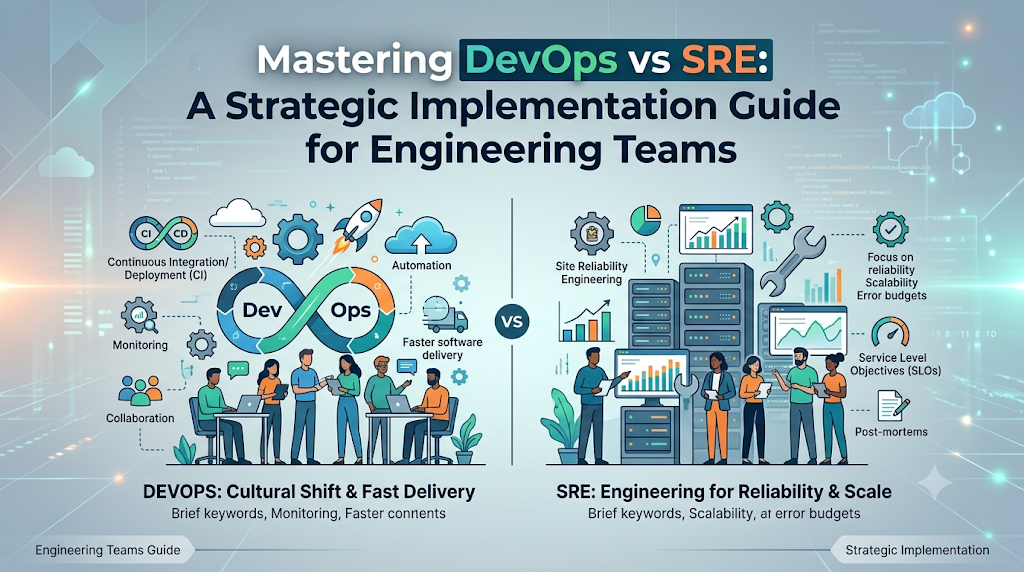
While DevOps and SRE share the same ultimate goal—delivering reliable software quickly—they approach the problem from different angles.
| Feature | DevOps | SRE |
| Core Nature | A culture, philosophy, and set of guiding practices. | A specific job role and implementation of DevOps principles. |
| Main Focus | Breaking down silos, speeding up delivery pipelines, and improving collaboration. | System uptime, reliability, performance, and reducing manual operational work. |
| Who Does It? | Everyone on the engineering team (developers, testers, operations). | Dedicated engineers (SREs) with strong programming and systems skills. |
| How Problems Are Solved | Through better teamwork, automated deployment, and shared workflows. | By writing code, building software tools, and managing error budgets. |
How They Work Together
A helpful way to understand the relationship is this: SRE is a specific way to do DevOps.
Think of DevOps as a large umbrella philosophy. It tells you how your organization should think and collaborate. SRE provides a concrete blueprint for how to handle reliability under that umbrella.
- An organization adopts DevOps culture to align developers and operations.
- The same organization hires SREs to build the automated monitoring and incident response systems that keep the production environment stable.
They do not compete with each other; they reinforce one another.
Common Mistakes Teams Make
When companies try to adopt DevOps and SRE, they often fall into predictable traps.
1. Treating DevOps as a Job Title
- What People Do: Companies hire a “DevOps Engineer” and expect that person to magically fix all deployment problems while developers keep writing code the old way.
- Why It Fails: DevOps is a company culture, not a single person’s job. If the culture doesn’t change, adding a job title changes nothing.
- What to Do Instead: Treat DevOps as a cultural shift for the entire engineering department.
2. Treating SRE as Fancy System Administration
- What People Do: Companies rename their traditional IT support or server admin team to “SREs” without changing what they actually do day-to-day.
- Why It Fails: SRE requires software engineering skills. If your “SREs” are just manually clicking buttons in a cloud console all day, you are not doing SRE.
- What to Do Instead: Ensure SREs spend at least 50% of their time writing code and building automation tools.
3. Ignoring Error Budgets
- What People Do: Setting a goal of “100% uptime,” which is impossible and paralyzes development teams.
- Why It Fails: Fear of downtime stops teams from releasing new features, defeating the entire purpose of modern engineering.
- What to Do Instead: Accept that bugs happen. Use an error budget (e.g., 99.9% uptime) so teams have room to innovate safely.
Decision-Making Framework: Which Does Your Team Need?
If you are trying to decide where to invest your team’s energy, walk through these steps:
- Check Your Deployment Speed: If your team takes months to release a simple software update because of broken communication and manual testing, you need DevOps practices first. Focus on collaboration, continuous integration, and automated testing.
- Check Your System Stability: If your app is constantly crashing, waking up engineers in the middle of the night, and lacking clear tracking metrics, you need SRE principles. Focus on defining error budgets, improving monitoring, and reducing manual toil.
- Check Your Team Size: Small startups usually cannot afford a dedicated SRE team. Instead, they adopt DevOps principles where developers share operational duties. Larger enterprises with massive scale often need dedicated SRE teams to manage complex infrastructure.
Key Terms
- Continuous Integration (CI): The practice where developers frequently merge their code changes into a central repository, after which automated builds and tests run.
- Continuous Delivery (CD): The practice of automating the release of software updates to test or production environments safely.
- Error Budget: The amount of downtime a service is permitted to experience in a given period before new feature releases are paused.
- SLI (Service Level Indicator): A metric that measures system performance, such as request latency or error rate.
- SLO (Service Level Objective): The target level for a service level indicator, agreed upon by the team (e.g., 99% of requests must succeed).
- Toil: Manual, repetitive work required to run a service that offers no long-term value and scales linearly with service growth.
- Silo: An isolated group or department that refuses or fails to communicate effectively with other departments.
- Telemetry: The automated collection and transmission of data from remote sources (like server logs and metrics) for monitoring health.
FAQs
Is SRE a replacement for DevOps?
No. SRE is a specific implementation of DevOps principles. You can practice DevOps without having a dedicated SRE team, but an SRE team relies entirely on DevOps cultural foundations to succeed.
Do I need to know how to code to do SRE?
Yes. SRE is fundamentally rooted in software engineering. If you cannot write code to automate tasks, fix bugs in infrastructure code, or build reliability tools, you are doing traditional system administration, not SRE.
Which one should a small startup adopt first?
A startup should adopt DevOps culture first. Small teams rarely have the resources for dedicated SRE roles, but every team benefits from automated pipelines and shared operational responsibility.
Can developers do SRE work?
Yes. In many modern engineering organizations, developer rotations or platform engineering teams handle SRE duties to keep developers close to the operational realities of their code.
Why do SREs cap manual operational work at 50%?
If an SRE spends more than half their time on manual tasks (like fixing broken alerts or restarting servers), they have too much toil. The 50% rule forces teams to write automation software to solve those operational burdens permanently.
Conclusion
Both DevOps and SRE exist to solve the same fundamental human problem: building great software without breaking the systems it runs on. DevOps changes how your entire organization collaborates and delivers code, while SRE applies rigorous software engineering to keep those systems stable and reliable at scale.
By understanding their practical differences, you can stop chasing trendy job titles and start implementing the specific practices your engineering team actually needs to grow.