Introduction
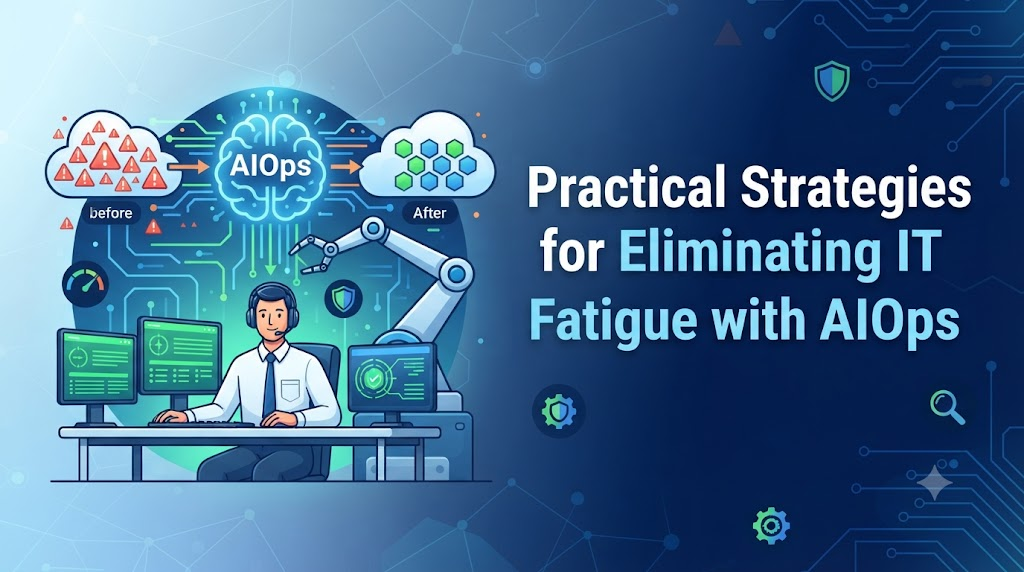
Imagine working in a room where a hundred smoke detectors start beeping at the exact same time. You run around checking every single room, only to find that someone just burned a piece of toast in the breakroom. After this happens fifty times a day, you stop reacting. You might even ignore the alarms completely.
This exact scenario happens every day inside modern digital companies. Computer systems generate thousands of warning messages, called alerts, whenever a tiny thing changes or stutters. When IT staff drown in these constant notifications, they suffer from alert fatigue. They become exhausted, numb to warnings, and prone to missing the one alert that actually matters.
This article explores how AIOps tackles this problem. You will learn what causes alert fatigue, how smart technology separates real issues from noise, and how organizations use these tools to protect their teams and systems.
What Is AIOps?
AIOps stands for Artificial Intelligence for IT Operations. It is a combination of big data analytics and machine learning applied to infrastructure and software management.
Think of traditional monitoring tools as basic watchdogs. They bark loudly whenever a leaf blows past the window. AIOps acts like a trained security guard who looks at the big picture, realizes the leaf is harmless, and stays quiet until someone actually tries to open the door.
Why It Matters
Traditional monitoring creates millions of data points every day. Human brains cannot read, sort, and connect millions of log files fast enough to prevent website crashes. AIOps processes this mountain of data instantly, spotting patterns that humans would easily miss.
Example
An e-commerce website slows down. A basic monitoring tool sends out five hundred separate alerts because five hundred different pages are loading slowly. An AIOps platform looks at all five hundred alerts, recognizes that they all trace back to a single broken database connection, and sends one clear notification to the database team.
How Alert Fatigue Destroys IT Efficiency
To understand why AIOps is valuable, you must first understand the damage that noisy systems cause to human workers.
IT teams manage complex webs of servers, cloud databases, and software code. Whenever something tiny goes wrong—like a server using two percent more memory than usual—monitoring systems scream for attention.
The Cost of Constant Noise
- Missed Warnings: When alerts fire all day and night, workers start ignoring them. A critical warning about a failing payment gateway can easily hide underneath thousands of unimportant notifications.
- Burnout and Turnover: Constantly waking up to middle-of-the-night pages for minor issues drains energy. Skilled engineers quit companies where their phones never stop buzzing for useless reasons.
- Slower Response Times: Instead of fixing actual code bugs or hardware failures, engineers waste precious hours clicking through dashboards just to close false alarms.
How AIOps Reduces Alert Fatigue
AIOps platforms use advanced data pipelines and machine learning algorithms to calm the storm of notifications. They transform chaotic warning systems into clear, actionable insights through several core steps.
Raw System Data --> Noise Filtering --> Pattern Correlation --> Root Cause Analysis --> Single Smart Alert
1. Noise Reduction and Deduplication
Systems often send the exact same warning fifty times in a row as a server struggles. AIOps groups identical or closely related events into a single incident ticket, cutting the total volume of alerts down by up to ninety percent.
2. Event Correlation
When a network switch fails, it might trigger alerts for every single computer connected to it. AIOps understands the dependency map of the network. It knows that the switch is the parent problem and all the connected computers are just victims. Instead of sending hundreds of alerts, it sends one alert pointing to the broken switch.
3. Dynamic Thresholds
Old monitoring tools use static rules. If CPU usage goes over eighty percent, it triggers an alarm—even if that server always runs at eighty-five percent every Tuesday afternoon. AIOps learns normal patterns over time. It only alerts the team when behavior is unusually abnormal for that specific time and day.
Why Does This Matter for Business Leaders?
For business owners and managers, alert fatigue is not just an IT annoyance. It is a financial risk.
When engineers are exhausted and slow to respond, customer-facing applications stay broken longer. This leads to lost sales, angry customers, and damaged brand reputation. By clearing out the noise, AIOps ensures that technical talent spends time building new features and improving products rather than playing digital whack-a-mole with false alarms.
Common Mistakes When Implementing AIOps
Many organizations buy expensive AIOps tools hoping for an instant fix, only to watch them fail. Knowing common pitfalls helps teams avoid wasted time and money.
- Mistake: Turning on the software with zero configuration.
- Why it happens: Companies expect artificial intelligence to magically understand their unique custom applications on day one.
- Result: The system creates weird correlations or misses custom warning signs.
- What to do instead: Feed the platform clean historical incident data and manually map critical business services during setup.
- Mistake: Ignoring human workflows.
- Why it happens: Teams buy new tools without updating how their on-call schedules or escalation paths work.
- Result: Smart alerts arrive, but nobody knows who owns the responsibility to fix them.
- What to do instead: Align alert routing rules with the actual engineering teams responsible for each service.
- Mistake: Treating AIOps as a one-time project.
- Why it happens: Leaders think software runs itself forever once installed.
- Result: As cloud environments change and new code deploys, machine learning models drift out of date.
- What to do instead: Review model accuracy and adjust alert thresholds on a regular monthly schedule.
Risks and Limitations of AIOps
While AIOps offers powerful relief, it is not a magic wand. Understanding its limits helps teams use it safely.
- Risk: Blind trust in machine learning.
- Why it matters: If an algorithm misidentifies a root cause, the team might fix the wrong component and leave the real problem running.
- How to reduce it: Keep human engineers in the loop for major decisions until the team builds deep trust in the platform’s accuracy.
- Risk: Data privacy and security concerns.
- Why it matters: AIOps tools ingest massive amounts of system logs, which can accidentally include sensitive user data or passwords.
- How to reduce it: Scrub logs to remove personal information before sending data to external monitoring platforms.
Decision Framework: Is Your Team Ready for AIOps?
Before spending budget on AIOps software, organizations should walk through a simple evaluation checklist:
- Measure Current Noise: How many total alerts does your team receive per week, and what percentage of them require actual human action?
- Calculate Downtime Costs: How much money does your business lose every time an outage runs long because engineers were sorting through noisy dashboards?
- Audit Data Quality: Are your existing logs, metrics, and tracing tools clean and organized, or is your baseline telemetry chaotic?
- Evaluate Team Skills: Does your staff have the bandwidth to learn and configure a new machine learning operations platform?
- Start Small: Choose one noisy application or database cluster for a pilot project before rolling AIOps across the entire enterprise infrastructure.
Checklist for Reducing Alert Fatigue
Use this quick verification guide to track your progress toward a quieter, healthier IT environment:
- Audit and turn off old, unused monitoring rules that never result in action.
- Group related server and network warnings into single parent incidents.
- Replace rigid static thresholds with dynamic, behavior-learned baselines.
- Review on-call rotation schedules to ensure humans get proper rest between shifts.
- Measure response times before and after implementing noise reduction to prove value.
Key Terms
- Alert Fatigue: Mental exhaustion and desensitization experienced by IT workers due to an overwhelming volume of system warnings.
- Event Correlation: The process of connecting multiple separate alerts that share a single underlying root cause.
- False Positive: An alert that indicates a system failure when the system is actually operating normally.
- Machine Learning: A branch of artificial intelligence where software learns from past data patterns to make smart predictions without human programming.
- Root Cause: The fundamental underlying fault or trigger that causes a system failure or performance drop.
- Telemetry: The automated collection and transmission of data from remote servers and software applications.
- Deduplication: The process of combining identical duplicate warnings into a single notification entry.
- Dynamic Thresholds: Warning limits that automatically adjust based on historical time-of-day or seasonal usage patterns.
Frequently Asked Questions
Does AIOps completely eliminate human engineers?
No. AIOps automates the boring, repetitive work of sorting data and filtering noise. It leaves complex problem-solving, code fixes, and strategic architectural decisions safely in the hands of human engineers.
How long does it take for an AIOps tool to learn a system?
Most platforms require between two to four weeks of steady data ingestion to build accurate baseline models of normal network and application behavior.
Can small businesses benefit from AIOps, or is it only for large enterprises?
While large enterprises with thousands of servers feel the pain most acutely, smaller companies using complex cloud environments can also benefit from streamlined alert configurations and reduced noise.
What is the difference between traditional monitoring and AIOps?
Traditional monitoring tells you when a metric crosses a static line. AIOps analyzes why it crossed that line, connects it to related events across the entire stack, and predicts future failures before they disrupt users.
How do we measure if our alert fatigue reduction is working?
Track metrics such as total weekly alert volume, mean time to acknowledge (MTTA), mean time to resolve (MTTR), and engineer survey feedback on burnout levels.
Does AIOps replace our existing monitoring tools?
Usually, no. AIOps sits on top of your existing tools—such as log collectors, metric monitors, and ticketing systems—to pull their data together and filter out the noise.
What happens if an AIOps platform misses a critical alert?
Properly configured systems use fallback rules. If an absolute hard limit is crossed (such as complete disk storage depletion), safety rules ensure an emergency page goes out regardless of machine learning models.
Is AIOps secure to use with sensitive company data?
Yes, provided you choose reputable vendors, use proper data encryption, and scrub logs to remove sensitive information like passwords or customer data before analysis.
Conclusion
Alert fatigue burns out talented engineers and leaves digital systems vulnerable to real outages. By cutting through the endless stream of false alarms, AIOps transforms chaotic notification lists into clean, prioritized insights. Technical teams regain their focus, respond to true emergencies faster, and build stable systems that keep businesses running smoothly without burning out their workforce.