Introduction
A rental that suits a ten-minute commute may be wrong for a family holiday, and a bike that is perfect for a weekend ride may be a poor choice for a business visit. The vehicle matters, but the trip matters more. When you start from the purpose of the journey, the choice usually becomes much clearer.
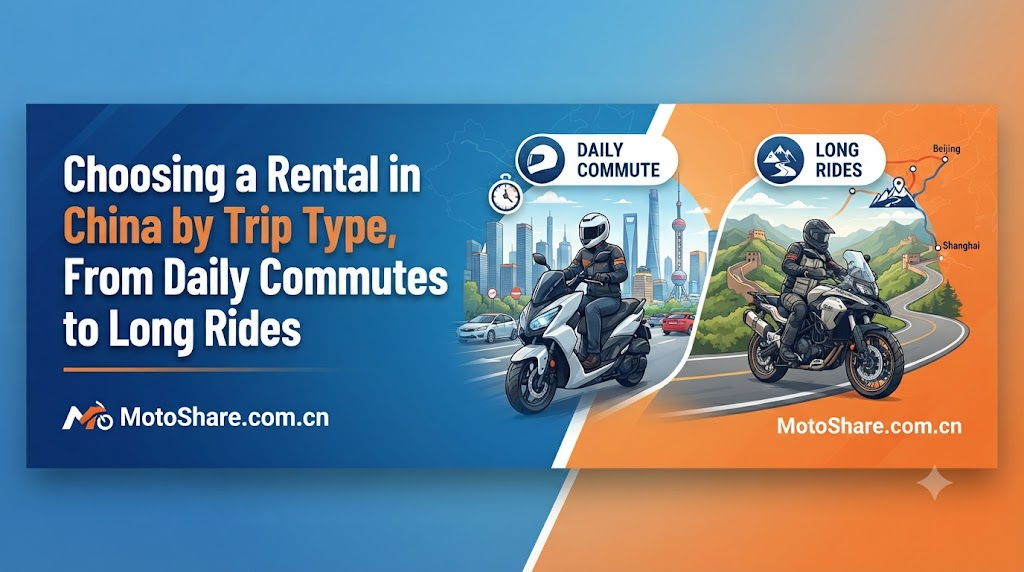
In China, people rent bicycles, scooters, motorcycles and cars for daily commuting, holidays, business travel and longer journeys. This article goes through four kinds of trips, the commute, the family holiday, the business visit and the long ride, and shows how each one changes what you should look for. It also explains where MotoShare, a vehicle-rental platform for China, fits in.
Understanding MotoShare and the Need It Serves
MotoShare is a China-focused platform for discovering and booking rental vehicles. Its description names international travellers, local residents, commuters, road-trip fans and riders who want flexible transport.
The listings include motorcycles, scooters, bicycles and cars. Rental periods can be hourly, daily, weekly or longer. The vehicles come from local rental providers, so the platform acts as a marketplace between renters and those providers. The description also mentions clear pricing, no booking fee added by the platform itself, CFMOTO and Benelli motorcycles, listings in places such as Beijing and Lanzhou, and city pages for locations like Shanghai and Shangri-La.
Every rental passes through three moments. In the first you search, which shows what exists in a place on your dates. In the second you compare, which shows how the options really differ. In the third you confirm, which means accepting one final set of terms. The moment that deserves the most time depends on the trip: a commuter may spend it on the rental period, a family on space and safety, a business visitor on timing and a rider on the route. No platform can promise that every vehicle is available in every city, so the listing for your own dates is what counts.
Why Different Trips Call for Different Vehicles
Think of four common journeys.
A commute repeats every day, so it rewards something simple, cheap to run and easy to park. A family holiday has passengers and bags, so it rewards space and shelter. A business visit has meetings and schedules, so it rewards reliability and exact timing. A long ride is about distance and enjoyment, so it rewards comfort and the right motorcycle.
Some travellers have more than one kind of trip in a single visit, such as city days followed by a countryside weekend. In that case it is often wiser to compare vehicles for each part separately than to find one vehicle that does everything. In every case, the choice depends on the journey, the budget, your experience, the local rules and what is free on your dates.
Detailed Content for Every Kind of Trip
Understanding the Motorcycle Types Available
Each motorcycle type suits a different kind of outing.
- Commuter motorcycles fit daily travel. They are light, simple and easy to handle, though they have little room for bags.
- Sports bikes fit a short, spirited ride on good roads. They are fast and sharp, and their forward-leaning seat becomes tiring over long distances.
- Touring motorcycles fit multi-day journeys with luggage. They are comfortable and roomy, but heavier at low speed.
- Adventure motorcycles fit long rides on mixed roads. They sit tall and handle changing surfaces, but the seat height can challenge shorter riders.
- Premium models fit riders who want more power and features, usually at a higher price and with more skill required.
In each case your experience, route, comfort and luggage should lead the decision. The MotoShare description mentions CFMOTO and Benelli, but a brand name does not prove that a particular model is free on your dates. Only the listing can confirm it.
Looking Into Motorcycle Options in Chinese Cities
Start with what you plan to do in the city. A commute needs a vehicle for weeks. A weekend ride needs one for two days. An afternoon outing may need only a few hours. That purpose tells you which rental period to look for.
Then compare the usual details for each option: where the vehicle is, which dates are open, what models are shown, the total price, how pickup works and what the provider requires. Searches for motorcycle rental Beijing and motorcycle rental Shanghai may produce different results for the same dates, so never assume that one city mirrors the other. Local traffic rules may limit where two-wheelers can go, and registration rules can differ, so check them with the local authority or the provider before you rely on a listing.
A general search for motorcycle rental China can give you a first picture. The rental itself is always decided by one specific listing.
Choosing Between Bikes, Scooters and Cars for Your Trip
Here is how the four kinds of trip tend to match the four kinds of vehicle.
For a daily commute, a bicycle or scooter is often the first idea. People who explore bike rental China options usually want a slow, simple way to cover short distances. A scooter is lighter and smaller than a motorcycle and often has an automatic gearbox, and many people searching for scooter rental China have this kind of city travel in mind. For a long commute or bad weather, a small car may make more sense.
For a family holiday, a car usually fits best, because it carries people and bags and keeps everyone dry. Scooters and bicycles carry very little. Anyone comparing car rental China options should remember that the biggest car is not automatically right, since a smaller one can be easier to park.
For a business visit, a car gives shelter and a predictable schedule, as long as the driving paperwork is settled first.
For a long ride, a motorcycle gives range and enjoyment, but only if the rider has the skill and the legal permission to ride it.
Understanding Vehicle Discovery and Online Booking
An online marketplace gathers many vehicles in one place and lets you filter by city and date. It saves time, but each trip type should pay attention to different details.
A commuter should look hard at the rental period and the total price. A family should check seats, luggage space and insurance. A business visitor should check pickup and return times and any late return fee. A rider should check the mileage limit, the fuel arrangement and the condition in which the bike must come back.
All travellers should also read the deposit and the cancellation rules. Providers can have different terms, even on the same platform, so never assume that two listings work alike. Read the final terms before you confirm.
Renting a Car in China as a Visitor From Overseas
For family holidays and business visits, a car is often the natural choice. For visitors, the legal side comes first. Four short moves keep it clear.
Start with the rule. Official Chinese government pages say that Chinese law does not recognise international driving licences, and an international driving permit alone is not accepted. A visitor who wants to drive generally needs a Chinese temporary driving permit. This is the heart of car rental China for foreigners.
Gather the papers. The Chongqing government lists the usual documents for the permit: a passport with a valid visa or entry stamp, the original foreign licence, an official Chinese translation of it and a white-background photo. A short traffic-safety video is part of the process, and some airports offer help with applications. For short stays the permit is commonly valid for about three months, though the length can depend on visa status. Procedures can differ by city, so confirm them locally.
Match the vehicle type. The official Chongqing FAQ says that for people renting vehicles in China, the temporary permit it describes covers only small automatic vehicles. A permit that works for a car should not be assumed to work for a motorcycle, so ask the authority and the provider which vehicle types apply.
Carry the set. Official guidance says to keep the permit, your foreign licence with its translation and the rental contract with you while you drive.
Separately, the rental company will have its own requirements, such as identification, a deposit and insurance rules. Those let you rent. The permit lets you drive. They are different things.
Understanding Self-Drive Options for Cars
Self-drive means that the customer rents the car and drives it personally, within the law and the rental terms. A driver is not provided.
People choose it for family trips, business travel, sightseeing and journeys with a lot of luggage. Interest in self drive car rental China options usually comes from wanting to set your own timetable.
To compare cars, look at the number of seats and the size of the boot. Then compare the total cost, the insurance, the mileage limit, the fuel policy and the pickup and return arrangements. A family may care most about space, and a business visitor about timing. A smaller car is easier to park in a crowded city, so bigger is not always better.
Preparing for a Motorcycle Adventure Journey
A long ride works best when the plan is built around the hardest part of the route. If part of the road is rough, choose a bike that suits that part. If the weather may turn cold or wet, pack for that, not for the best day. If a stretch has few fuel stops, plan for it before you leave.
Choose the motorcycle by route, distance, weather, luggage and your own experience. A very powerful bike is not always the safest or most suitable choice, and one you can handle calmly is usually better. Wear a good helmet, gloves, a jacket and boots, and check the tyres, brakes, lights and chain before you set out. Plan rest breaks, carry a way to navigate and know whom you would call in an emergency.
If you are comparing adventure motorcycle rental China options, remember that not every road or destination is open to motorcycles, so check access first.
Planning a Motorcycle Tour Across China
A long tour is easier to manage in legs. For each leg, write down the distance you expect, the likely weather, the fuel stops, the place to sleep and the rules of the area. Leave a spare day, because delays happen.
For any motorcycle road trip China plan, check local traffic rules, vehicle limits and whether the places on your route allow motorcycles. Take distances, travel times and road conditions from reliable local sources, and do not guess. Before all of that, confirm that you are legally allowed to ride the type of motorcycle you want, because that answer may reshape the whole tour.
Understanding Costs and the Conditions Attached
The advertised daily rate is only the start, and different trips feel different costs.
For a commute, the rental period and the total price matter most. For a family holiday, insurance and the deposit matter. For a business visit, a late return fee can cost more than expected if a meeting runs long. For a long ride, fuel, mileage charges and cancellation terms can add up.
Prices in China are shown in Chinese yuan (RMB or CNY), and amounts and terms can differ by vehicle, city, provider and date. Add every possible cost for each option and compare totals instead of daily rates. A listing with a low rate and strict conditions can cost more than a clearer one that looks slightly dearer.
Preparing for a Trouble-Free Rental Experience
Whatever the trip, a few habits remove most of the confusion. Check your documents before you travel. Read the whole rental agreement. Confirm the pickup time and place. At pickup, walk around the vehicle and photograph every scratch, dent and worn tyre, and ask the provider to write down any damage that is already there. Know how to report a problem, and keep your photos until the deposit is settled. These are general habits and not confirmed MotoShare procedures.
A Simple Vehicle-Rental Planning Routine
- Name the trip. Decide the place, the dates and the type of vehicle, and note whether it is a commute, a holiday, a business visit or a long ride.
- Compare the totals. Put two or three listings side by side with their full costs, so the headline price does not decide for you.
- Check the rules. Find out about licences, identification and provider terms before you get attached to one option.
- Read the details. Look at the insurance, deposit, pickup arrangements and vehicle condition, which is where surprises usually hide.
- Confirm last. Book only when you understand the whole agreement.
This is general advice and not a description of how any one platform’s booking system works.
Rental Mistakes That Are Easy to Avoid
Different travellers tend to make different slips.
Visitors planning to drive often assume that a licence from home is accepted, or they overlook the permit. Avoid both by reading the official rules before travelling and starting the permit early.
Commuters and budget-minded renters often look only at the advertised price. Avoid this by adding the deposit, fuel and extra charges to every option. They also sometimes skip the insurance and deposit details, so read what is covered and how the deposit returns.
Families and business visitors sometimes forget pickup and return arrangements. Confirm the place, the time and the required condition. They may also assume that a vehicle is free without checking the dates, so look at the exact dates on the listing.
Riders sometimes choose a motorcycle that is too hard to handle, so pick one that fits your real experience. On long trips they may plan without checking restrictions and roads, so research local limits and road conditions first.
One Realistic and Hypothetical Trip
Kofi is a business visitor spending a week in a Chinese city. His meetings fill the weekdays, but he has a free weekend and wants to see a scenic area nearby. He flies home early on Monday morning.
He names his two trips first: a weekday commute between hotel and meetings, and a weekend outing. For the weekday trips he decides that taxis or a short bicycle ride will do, so he only compares vehicles for the weekend. A scooter would not carry his bag and tripod comfortably, and when he reads the official guidance he learns that a visitor’s temporary permit may cover only certain vehicle types. A small automatic car fits both his needs and the permit description.
Next he compares two car listings for Saturday and Sunday. He checks the deposit, the insurance, the mileage limit, the fuel rule and the late return fee. Because his flight is early on Monday, he pays special attention to the return time and place. He chooses the car that can be returned on Sunday evening at a convenient location.
Kofi gets his licence translated, applies for the temporary permit, photographs the car at pickup, saves the agreement and books. The decision was driven by the shape of his trip, not by the most exciting vehicle.
Frequently Asked Questions
Which vehicle suits a daily commute?
A bicycle, scooter or small car may fit, depending on distance, weather and local rules. Compare the total cost for the whole rental period.
Is a car or a scooter better for a family holiday?
A car usually fits better, because it carries passengers and luggage and gives shelter. Scooters carry very little.
What should a business visitor check about timing?
Check the pickup and return times, the return place and any late return fee, so that a delay does not turn into an extra charge.
How long can I rent a vehicle for?
The MotoShare description mentions hourly, daily, weekly and longer rental periods, but availability depends on the vehicle, the provider and your dates.
How do I choose between an hourly and a daily rental?
Match the period to the trip, then compare the total cost, not just the rate.
What if my trip has two different parts?
Compare vehicles for each part separately. A city commute and a countryside weekend may need different vehicles.
Does one permit cover every vehicle type?
Do not assume so. Official guidance says the permit it describes covers only small automatic vehicles for rentals, so ask about motorcycles separately.
Conclusion
The best rental in China is the one that matches the trip. A commute asks for simplicity, a family holiday for space and safety, a business visit for reliable timing and a long ride for the right motorcycle and a careful route. Whatever the journey, the same habits protect you: compare the full totals, read the terms, check what you are allowed to drive and photograph the vehicle before you leave. Visitors in particular should settle the permit question early, since a licence from home does not decide it. MotoShare can help you find and compare options in one place, while knowing what your own trip needs remains your part of the work. Start from the trip, and the right vehicle tends to appear.