Introduction
Two travellers land in Colombia on the same day. One wants to hop between cafés in a single neighbourhood. The other wants to cross mountain passes toward a small town. Both say they need a rental, yet they should not take the same vehicle.
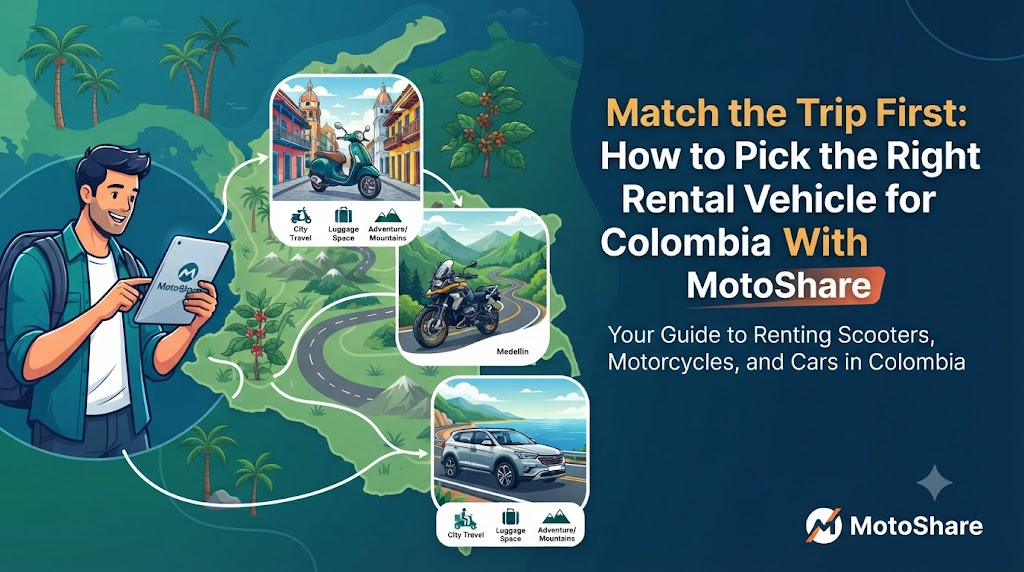
That is the idea behind this guide: match the trip first and the vehicle second. Colombia has dense cities, warm coasts and long mountain roads, so the right wheels change from one plan to the next. Below you will find a simple way to think about motorcycles, scooters and cars, a set of questions to ask any provider and a short list of rules to confirm before you ride or drive. Along the way you will see how MotoShare, an online vehicle-rental marketplace, helps people begin the search.
What MotoShare Does and How a Search Unfolds
MotoShare is an online marketplace for vehicle rentals with a focus on Colombia. It does not rely on its own fleet. It links people who need a vehicle with local providers who offer motorcycles, scooters and cars. Its audience includes international tourists, local travellers, commuters, backpackers and adventure riders.
Type motorcycle rental Colombia into a search bar and you will see shops, private owners and platforms all mixed together. A marketplace tidies that pile. You pick a location and rental dates, look through the vehicles listed, see pricing information and compare providers in one place.
It helps to keep three moments apart:
- Discovery. You look around. Nothing is promised yet.
- Comparison. You narrow the list to two or three vehicles and study the price, the rental period and the terms.
- Booking. You commit, and the provider’s terms now apply to you.
A listing is a starting point for questions, not a promise that every feature exists in every city. Treat availability, prices and conditions as things to confirm for your own dates.
Start With the Trip, Not the Vehicle
Before you open a single listing, write down four answers:
- Where will I ride or drive, and what are the roads like?
- How many days do I need the vehicle?
- Who and what is coming along?
- How much riding or driving experience do I honestly have?
Those answers sort most travellers quickly:
- A tourist who wants viewpoints and villages at a relaxed pace often leans toward a motorcycle.
- A commuter who needs temporary transport for a work block cares about cost per week and easy parking.
- A visitor making short city hops may find a scooter is plenty.
- A family counts seats and suitcases first, so a car usually wins.
- An experienced rider planning many days on the road may want a bike built for distance.
Budget and comfort matter too, and so do local rules, which later sections cover.
Five Common Trips and the Wheels That Tend to Fit
- The city week. You visit cafés, museums and markets in one area. A scooter or a light commuter bike is easy to park and easy to place in traffic. Travellers who look up scooter rental Colombia are usually planning this kind of trip.
- The weekend escape. You head for a town a couple of hours away. A mid-size motorcycle gives you more steadiness on faster roads without too much weight.
- The long ride. You spend many days on the road with luggage. A touring bike or an adventure bike can suit an experienced rider.
- The family or group outing. Seats, bags and shelter matter most, so a car is the natural choice.
- The work month. A commuter needs reliable daily transport. Distance and weather decide between a scooter, a commuter bike and a small car.
A short guide to the bike types
- Commuter motorcycles are simple, economical and forgiving. They suit daily riding and relaxed trips.
- Scooters have a step-through frame and, in most cases, an automatic gearbox. Short trips are their home ground.
- Sports bikes are quick and put the rider in a leaning position. That is tiring on long or bumpy rides and unfriendly to beginners.
- Premium motorcycles offer stronger engines and extra features, and may come with bigger deposits and tighter terms.
- Touring bikes carry riders and luggage comfortably over distance, but feel heavy when you crawl through traffic.
- Adventure bikes stand tall, with long suspension for mixed surfaces. They reward experience and punish overconfidence.
Scooter or motorcycle: a side-by-side feel
- Size and weight: a scooter is lighter to push, turn and park.
- Handling: a scooter feels calm at walking pace, while a motorcycle feels more settled at speed and on rough ground.
- Comfort: a motorcycle is kinder to the body over long distances.
- Luggage: many scooters have a storage box under the seat, while motorcycles often need bags fitted.
- Best use: errands and short hops suit the scooter, and open roads suit the motorcycle.
More power does not equal more skill. Weight and height can make a big bike hard to hold at a stop on a wet hill. Match the bike to your experience, the roads ahead and the local rules, and remember that your licence has to cover the vehicle class.
Reading Medellín, Bogotá and Cartagena Like a Planner
A city decides what easy means. Each of these three asks a different question of a rental, and none of them guarantees that a given vehicle is on offer. Always check a listing for your own dates.
Medellín: will the hills be a problem?
Medellín climbs the sides of a valley. Anyone weighing motorcycle rental Medellin should picture steep, sometimes wet streets with a passenger and bags on board. A light bike is fine for flat stretches, while hills favour an engine with some reserve.
The city also uses pico y placa, a rule that bans certain plate numbers from the roads on certain days. Local news reports in 2026 say it applies to motorcycles as well as cars. Confirm the current schedule with your provider and the city’s mobility office.
Bogotá: how will weather and traffic behave?
Bogotá is a big capital high in the Andes, where mornings can be cold and afternoons rainy. For motorcycle rental Bogota, think about layers, a waterproof jacket and gloves, and expect dense traffic. Ask where the vehicle can sleep safely at night. The city has pico y placa rules for private cars, so ask whether anything applies to the vehicle you choose.
Cartagena: how much heat and how tight are the streets?
Cartagena is hot and humid, with a walled old town and narrow lanes. When you compare motorcycle rental Cartagena options, plan for sun protection, water and shaded parking, and remember that distances in the centre are short. A lighter vehicle may be all you need for a few days of wandering.
Comparing across all three
Whatever the city, line up the same items: availability on your dates, the pickup place, the rental period, the total price and the provider’s terms.
Questions to Ask Any Provider Before You Book
Online discovery lets you compare many options from home, but the listing rarely tells the whole story. Terms differ between providers, vehicles, places and rental periods, so a short list of questions is your best tool.
- What is the full price? Ask for the total for your dates, including taxes, fees and extras. Ask whether longer rentals cost less per day.
- How big is the deposit, and when does it come back? The deposit is money held until the vehicle returns safely.
- What other charges could appear? Late returns, cleaning, damage, fines and missing fuel are common examples.
- What does the insurance cover, and what does it leave out? Ask how much you would pay if the vehicle were damaged or stolen.
- Is there a distance limit, and how does fuel work? Some rentals cap kilometres. Many expect the tank to be as full as when you left.
- What happens if I cancel? Learn the deadline and whether you get cash, partial cash or credit.
- Where and when do I collect and return it? Ask about opening hours, late arrivals and drop-off at another address.
- Which licence, age and documents do you need? The next section explains why this deserves extra care.
Write the answers down or keep the messages.
Pickup-day routine
Walk around the vehicle with the provider and photograph every scratch. Check tyres, brakes, lights and mirrors. Ask for the contact number you should call if something goes wrong, and confirm the return time before you leave.
Colombian Rules to Confirm Before the Wheels Turn
Traffic laws change, and they are not identical for every traveller or vehicle. Treat the list below as questions to settle, not as legal advice. Confirm each point with the Colombian Ministry of Transport, Migración Colombia and your provider.
- Licence. Colombian law accepts a valid foreign licence for tourists during their authorised stay. Guides quote different periods, from 90 days to six months, so check yours against your entry stamp. The licence must cover the class you rent, and a car licence does not allow you to ride a motorcycle or scooter.
- SOAT. This is Colombia’s mandatory basic accident insurance. Every vehicle on the road needs an active policy, so ask to see proof for your dates, and ask separately about the rental’s own cover.
- Papers at checkpoints. Police checks are common. Keep your passport, licence, rental agreement and the vehicle’s registration with you.
- Riding gear. A helmet is required. Current guidance asks riders and passengers to wear a reflective vest or jacket between 6 pm and 6 am and in poor visibility. Authorities have said a plate number on the helmet or vest is no longer required, but confirm locally.
- Age and payment. Some providers require a minimum age, often 21, and some hold the deposit on a credit card. Others may differ.
- Plate-based driving limits. Bogotá and Medellín use pico y placa. Rental vehicles follow the same rules as private ones, and fines can reach the renter.
Riding Further: Gear, Fuel, Rest and Guided Rides
Pick the bike for the road, not the photo
If you are browsing adventure motorcycle rental Colombia, ask yourself whether the route really includes gravel and long climbs or mostly paved highway. A tall adventure bike looks impressive, yet a mid-size bike may be less tiring and easier to control. Weigh the surface, the number of days, your luggage, the weather and your own experience.
Before you leave each morning
- Gear. Wear a helmet that fits, a jacket, gloves, boots and a rain layer.
- Navigation. Download offline maps. Bring a phone holder and a power bank.
- Fuel. In mountain and rural areas petrol stations can be far apart, so top up before leaving a town.
- Vehicle check. Look at the tyres, brakes, lights, chain, mirrors and oil.
- Emergency plan. Save the provider’s number and local emergency contacts, and tell someone where you are headed.
On the road
Stop for a short break every couple of hours. Tired riders misjudge bends and distances. Unfamiliar areas deserve extra care because you do not yet know where the next fuel stop, repair shop or hospital is.
Mapping the whole journey
A motorcycle road trip Colombia works best when the plan counts distance, daylight, weather, road condition, fuel, places to sleep and things you want to see. Allow more time than the map suggests.
Each kind of road asks for its own habits:
- Mountain roads bring tight bends, fog and slow trucks.
- City streets bring dense traffic, pedestrians and parking limits.
- Rural roads may bring potholes, loose gravel and animals.
No route suits every rider. Ask local people and your provider about current road and weather conditions.
Joining a guided group
Some riders prefer company and local knowledge. When you look at motorcycle tours Colombia offers, ask about the route, the group size and pace, who the guide is, what is included (bike, fuel, gear, lodging, backup vehicle) and which safety rules the group follows. Check the cancellation terms as well. Routes and prices change, so confirm everything directly with the organiser.
When a Car Solves the Problem Better
A search for car rental Colombia usually aims to fix one of four problems:
- Seats. Everyone travels together instead of being split across vehicles.
- Bags. Suitcases, camera gear or a pushchair need real space.
- Weather. A roof matters in cold rain, and air conditioning matters on the hot coast.
- Distance. After many hours, a comfortable seat means less fatigue.
Business travellers add a fifth: arriving dry and presentable at meetings in several places. Many trips end up mixing modes, with a car for the outing and walking or taxis for the city.
Three body shapes in plain words
- Hatchback: short and compact. It slips into small parking spaces and suits one to three people with modest bags.
- Sedan: a classic shape with a separate boot, so bags stay apart from the passengers. It rides smoothly on highways.
- SUV: tall, with a high seat, more room inside and more clearance under the body. It is thirstier and harder to park.
If your base is Medellín, compare car rental Medellin listings when your plan reaches beyond the city limits.
Comparing two cars fairly
Put two cars side by side on seats, bag space, total cost, insurance cover, deposit, mileage rule and pickup arrangement. Then add what the price leaves out: fuel, highway tolls and parking. In pico y placa cities a rental is treated like any other private car, so ask about its plate before you plan your days.
Why Preparation Saves Money and Stress
Guesswork is expensive on the road. A rushed decision at a counter can mean the wrong vehicle, a surprise charge or a day lost to a missing document.
The night before pickup, run through five quick checks. Look at the weather for every stretch, because rain or fog changes how long a day takes. Ask whether the vehicle still fits the people and bags. Reread the deposit, insurance and cancellation lines while you are calm. Put your passport, licence, rental agreement and proof of insurance in one place, with copies on your phone. Finally, add a time buffer, especially on the day you return the vehicle before a flight or a bus.
Five Steps to Plan a Rental, and Slip-Ups to Skip
These steps are general advice for any rental, not a description of how one platform’s booking works.
Step 1: Settle the basics. Decide the place, the dates and the kind of vehicle. Every later choice depends on them.
Step 2: Compare, do not just browse. Set two or three listings side by side with their rental periods and total prices.
Step 3: Read the provider’s terms. Insurance, deposit and cancellation rules decide how much risk you carry.
Step 4: Check the paperwork and the practical details. Confirm your licence, documents, safety gear and pickup arrangements.
Step 5: Review before you confirm. Names, dates, times and addresses are easiest to fix before you pay.
Seven slip-ups and their fixes
- A bike too hard to handle. Fix it by choosing the lightest vehicle that suits the trip and your skill.
- Staring at the daily price. Fix it by comparing the total, with deposit, fuel and extras included.
- Skipping exclusions and deposit rules. Fix it by asking what is not covered and when the deposit returns.
- Vague pickup and return plans. Fix it by confirming addresses, hours and any late fee.
- A long ride with no weather check. Fix it by reading the forecast and asking local people about the roads.
- Assuming a vehicle is free. Fix it by checking your exact dates first.
- Ignoring the cancellation policy. Fix it by noting the deadline and refund rule before payment.
A Hypothetical Rider’s Week Near Bogotá
Imagine Jonas, an experienced rider visiting Colombia for ten days. He plans a week of day rides from Bogotá to small towns and a nature reserve, then a few relaxed days in the capital. He is travelling alone with one backpack.
He first weighs a motorcycle against a car. The car is warm and dry but he would spend the week looking for parking in busy town centres, and he wants to stop at lookouts. The motorcycle suits the plan, so he looks at two models. One is a large adventure bike. The other is a mid-size bike that is lighter and cheaper.
He reads the forecast for the ride days and sees afternoon rain. He studies the route and finds long wet climbs. That tips the choice toward the lighter bike, which he can hold up and control more easily, and he reads its terms. The deposit is moderate, the insurance excludes tyre damage, and the distance limit fits his routes. He confirms that his licence covers motorcycles, asks to see proof of SOAT and checks the pickup hours against his arrival time.
Jonas rents the mid-size bike for the ride days and uses transit in the capital. His choice came from the weather, the route and his own experience, not from the most impressive model on the page.
Quick Answers to Common Questions
Is a scooter enough for a few days in Cartagena?
Often yes, if you stay mostly in the city and ride at a gentle pace. Longer or faster trips suit a motorcycle better.
Can I ride a motorcycle on a car licence?
No. Your licence must cover the class of vehicle. Confirm the rule with your provider and the official sources.
What is SOAT and should I ask about it?
SOAT is Colombia’s mandatory basic accident insurance. Ask the provider to show that it is active for your rental dates.
Is a bigger bike safer on mountain roads?
Not automatically. A bike you can control in rain and on steep bends is safer for you than a larger one you struggle with.
When should I check availability?
As soon as your dates are fixed. Popular vehicles may be taken first, and a listing does not guarantee a vehicle is free on your dates.
Which costs hide outside the daily rate?
Deposits, fuel, tolls, parking, fines and charges for late returns or damage can all change the final amount.
What should I carry while riding or driving?
Keep your passport, licence, rental agreement, the vehicle’s papers and proof of SOAT within reach.
Final Thoughts
Choose the trip before the vehicle. Be honest about your experience, compare total prices and terms, and confirm the Colombian rules with official sources. A little preparation does more for a journey than any single clever tip.
MotoShare is one place to explore motorcycles, scooters and cars from local providers by location and rental period. Whichever platform you use, confirm the current details with the provider before you book.