Introduction
Large corporate IT systems are massive and complex. They feature hundreds of microservices running across multiple cloud providers, heavy customer traffic, and strict uptime requirements. When something breaks in this environment, finding the root cause can feel like searching for a needle in a haystack.
Many organizations try to fix this by hiring more system administrators and forcing them to work late nights. However, manual firefighting does not scale. As systems grow, human effort alone cannot keep up with the complexity.
This is where Site Reliability Engineering comes in. SRE treats infrastructure and operations as software problems. It brings developers and operations teams together to build robust, automated systems.
However, jumping straight into advanced SRE practices without a plan often leads to confusion and pushback from engineering teams. Building an enterprise SRE roadmap gives your organization a clear path forward. It helps you move from reactive firefighting to proactive system design without overwhelming your staff.
What Is SRE?
Site Reliability Engineering (SRE) is a discipline that incorporates aspects of software engineering and applies them to infrastructure and operations problems.
- Simple meaning: SRE uses coding and automation to keep computer systems running smoothly and prevent crashes.
- Why it matters: Modern businesses lose money and customer trust every minute their applications are down. SRE minimizes this downtime.
- Example: Instead of having an engineer manually restart a crashed server every morning, an SRE writes an automated script that detects the crash, restarts the service safely, and alerts the team only if the problem happens repeatedly.
Why an Enterprise SRE Roadmap Matters
In a small startup, adopting SRE can happen organically through a small group of engineers. In a large enterprise, change is much harder. Large IT environments feature legacy systems, siloed teams, and deeply entrenched habits.
An SRE roadmap matters because it prevents chaos. It establishes a phased approach so teams know what to prioritize first. Without a roadmap, organizations often waste months arguing over tools or trying to fix everything at once. A structured plan ensures that cultural changes happen alongside technical improvements.
Core Components of an SRE Roadmap
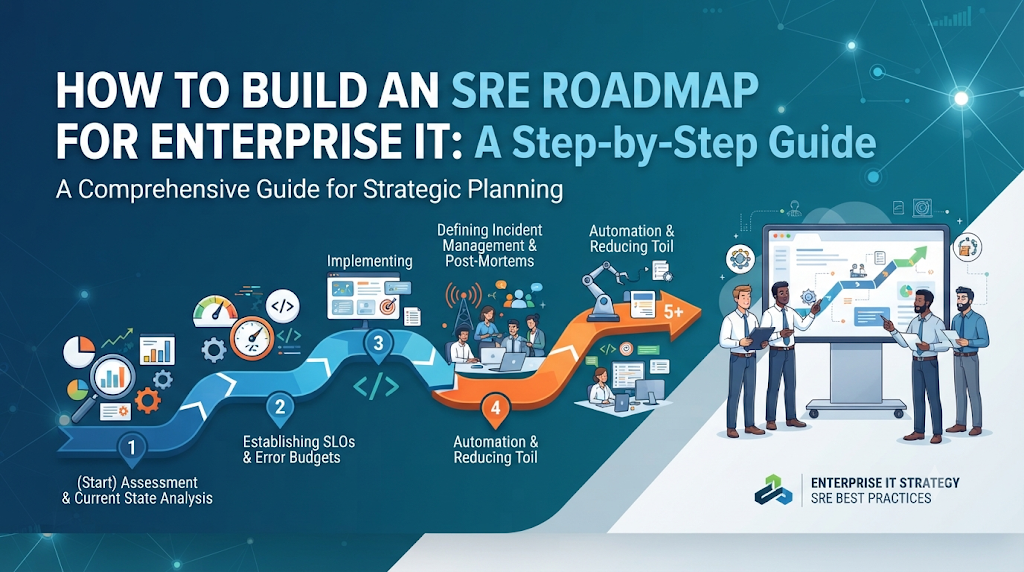
An effective SRE roadmap is built around specific, measurable pillars. Let us look at the primary milestones every enterprise should include.
Phase 1: Define Stability with SLOs and Error Budgets
Before you change how you build software, you must measure how well it currently runs.
- Service Level Indicator (SLI): A metric that measures system performance, such as request latency or error rate.
- Service Level Objective (SLO): The target goal for that metric, such as “99.9% of requests must succeed.”
- Error Budget: The amount of downtime or failure a service is allowed to have over a specific period.
- Why it matters: Error budgets change the conversation from emotional arguments about “being safe” to data-driven agreements between developers and operations teams. If you have remaining error budget, you can ship new features fast. If the budget is empty, you must focus on fixing bugs and reliability.
Phase 2: Eliminate Toil through Automation
Toil is manual, repetitive, and automatable work that provides no enduring value and scales linearly with service growth.
- Simple meaning: Boring, repetitive computer chores that humans have to do over and over again.
- Why it matters: Toil burns out your best engineers. When engineers spend all day deploying code manually or resetting passwords, they have no time to build better systems.
- Example: Running the same database migration script by hand for every single release is toil. Writing a deployment pipeline that runs the script automatically removes the toil.
Phase 3: Implement Observability
You cannot fix what you cannot see. Observability means collecting enough data from your applications to understand their internal state based on their external outputs.
- Metrics, Logs, and Traces: The three pillars of observability. Metrics tell you that something is wrong; logs tell you what happened; traces show you where the error occurred across a distributed system.
- Why it matters: When a user reports a slow checkout page, an observable system lets engineers pinpoint the exact line of code or database query causing the delay in minutes instead of hours.
Phase 4: Master Incident Management and Post-Mortems
Failures are inevitable in large IT systems. How an enterprise handles failure defines its culture.
- Blameless Post-Mortems: Structured meetings held after an outage to figure out how the system failed, rather than who made the mistake.
- Why it matters: Blaming individuals hides the true systemic flaws in your software. Fixing systemic flaws prevents the exact same outage from happening twice.
Practical Example: The Journey of Enterprise RetailCorp
Imagine RetailCorp, a large online retailer with hundreds of developers. Their website frequently crashes during major holiday sales events.
- The Old Way: During a Black Friday sale, the database crashes. Ten system administrators rush in, panic, and try various manual fixes until the site comes back online hours later. Everyone is exhausted, and thousands of customers leave.
- Implementing the Roadmap: RetailCorp leadership introduces an SRE roadmap. They start by defining an SLO: the checkout service must have 99.95% uptime. Next, they implement automated scaling rules so the system adds computing power automatically when traffic spikes. Finally, they run game days—simulating high traffic before the holiday—to find weak spots safely.
- The Result: During the next holiday sale, traffic spikes even higher. The automated scaling handles the load, the team monitors the dashboards peacefully, and zero human firefighting is required.
Common Mistakes in SRE Adoption
Many enterprises fail in their SRE journey because of avoidable traps.
1. Renaming Operations Teams to “SRE” Without Changing Culture
- What people do: Change job titles from “SysAdmin” to “Site Reliability Engineer” on paper.
- Why it causes problems: The team still does the exact same manual firefighting as before, leading to frustration and high turnover.
- What to do instead: Give the newly formed SRE team the authority, tooling, and software engineering mandate to write automation and push back on unstable code.
2. Trying to Automate Everything on Day One
- What people do: Spend six months building a massive custom automation framework before fixing basic monitoring.
- Why it causes problems: Projects drag on, business leaders lose patience, and the initiative dies.
- What to do instead: Start small. Automate the single most painful, repetitive weekly task your team faces, then build momentum from there.
3. Setting Unrealistic SLO Targets
- What people do: Demand 100% uptime for every single internal microservice.
- Why it causes problems: 100% uptime is astronomically expensive and impossible to maintain. It slows down development to a crawl.
- What to do instead: Match your SLOs to actual customer expectations and business needs. Non-critical internal tools do not need the same uptime as your core customer payment gateway.
Risks and Limitations
SRE is not a silver bullet. Organizations must understand its inherent challenges before starting:
- High Skill Requirement: True SRE work requires professionals who understand both software development and systems operations. These skills are scarce and expensive to hire.
- Cultural Friction: Developers want to ship features fast; SREs want to protect stability. Balancing speed and stability requires strong leadership.
- Tool Sprawl Risk: Teams often buy dozens of expensive monitoring and automation tools without a clear integration strategy, creating more complexity.
SRE Decision-Making Framework
Use this simple framework to guide your enterprise SRE roadmap adoption:
- Step 1: Assess Current State: Measure your current system availability, deployment frequency, and mean time to recovery (MTTR).
- Step 2: Secure Leadership Buy-in: Show executives how reliability improvements protect revenue and customer trust.
- Step 3: Establish a Pilot Team: Pick one important customer-facing service to test SRE practices before rolling them out company-wide.
- Step 4: Define SLOs and Dashboards: Make system health visible to both developers and business leaders.
- Step 5: Automate High-Toil Tasks: Free up engineering hours to focus on proactive architecture improvements.
- Step 6: Scale and Iterate: Share success stories from the pilot team to encourage other departments to adopt SRE principles.
Checklist for Your Enterprise SRE Roadmap
Use this checklist to verify your roadmap before execution:
- Are our SLOs tied directly to customer experience and business value?
- Do we have a system in place to track and measure toil?
- Are our post-mortems strictly blameless and focused on system improvements?
- Is leadership committed to slowing down feature releases when error budgets are exhausted?
- Do we have a pilot application chosen for our initial SRE rollout?
- Are developers and operations teams communicating through shared metrics rather than silos?
Key Terms
- SLI (Service Level Indicator): A quantitative measure of how well a service is performing.
- SLO (Service Level Objective): A target value for a service level indicator set by the organization.
- Error Budget: The maximum amount of unreliability a service can accumulate before developers must stop releasing new features.
- Toil: Manual, repetitive work that lacks enduring value and scales with service growth.
- Observability: The degree to which you can understand the internal state of a system by examining its outputs.
- Post-Mortem: A blameless analysis conducted after an incident to prevent recurrence.
- MTTR (Mean Time to Recovery): The average time it takes to restore a service after a failure.
- Automation: Using software scripts to perform tasks without human intervention.
- Telemetry: Automated communications sent from remote systems to monitoring equipment.
- Infrastructure as Code (IaC): Managing and provisioning computing infrastructure through machine-readable definition files.
FAQs
What is the difference between DevOps and SRE?
DevOps is a cultural philosophy focused on breaking down walls between development and operations teams to ship software faster. SRE is a specific implementation of that philosophy. You can think of DevOps as the mindset, and SRE as the specific playbook for keeping systems reliable.
How long does it take to implement an enterprise SRE roadmap?
A full enterprise SRE transformation usually takes between 12 to 36 months. Because it involves deep cultural changes and legacy system updates, rushing the process rarely works.
Do we need a dedicated SRE team?
In large enterprises, yes. Starting with a dedicated core SRE team helps establish standards, patterns, and tooling. Over time, these practices spread to standard product development teams.
What should we automate first?
Automate the tasks that your engineers complain about the most and that happen most frequently. Reducing daily frustration builds immediate trust in the SRE initiative.
How do we measure the success of our SRE roadmap?
Track metrics such as a decrease in incident frequency, faster recovery times (lower MTTR), an increase in successful feature deployments, and higher employee satisfaction scores.
Conclusion
Building an SRE roadmap for enterprise IT is not about buying expensive software or forcing teams into rigid rules. It is a steady journey toward building resilient, automated, and observable systems. By starting small with clear SLOs, removing daily toil, and learning from past outages, large organizations can achieve high reliability without sacrificing development speed. Take your first step by measuring your current system health, and build your roadmap one stable service at a time.