Introduction
Many companies invest heavily in artificial intelligence. They hire smart data scientists, collect massive amounts of data, and train advanced machine learning models that look impressive on a laptop screen. Yet, many of these models never reach actual customers. They sit on computers gathering dust because moving them into live software systems is slow, painful, and prone to error.
This gap between building a model and running it in the real world is a major business problem. Data scientists speak one language, while software engineers and IT teams speak another. When these groups work in silos, projects stall.
This is where MLOps enters the picture. By bringing order, automation, and shared tools to the workflow, MLOps bridges the gap between data science and IT operations. It turns experimental code into dependable business products that can be updated quickly and safely.
What Is MLOps?
Professional Term
MLOps (Machine Learning Operations) is an engineering culture and practice that aims to unify ML system development (Dev) and ML system operation (Ops).
Simple Meaning
MLOps is like a modern assembly line for artificial intelligence. Instead of workers hand-crafting every single piece and moving it manually, MLOps uses automated belts and quality checks to take raw data and turn it into working software.
Why It Matters
Traditional software can be tested using standard automated tools. Machine learning is different because it depends on both code and data. Data changes over time, and models can degrade silently. MLOps provides the framework to manage code, data, and models together, ensuring they keep working reliably in the real world.
Example
Imagine a retail company builds a model to predict holiday sales. Without MLOps, if customer shopping habits change, the data science team must manually notice the drop in accuracy, clean new data, retrain the model, and hand a file to the software team to rewrite the app. With MLOps, the system detects the data drift, triggers retraining automatically, tests the new model, and deploys it with minimal human intervention.
How MLOps Works
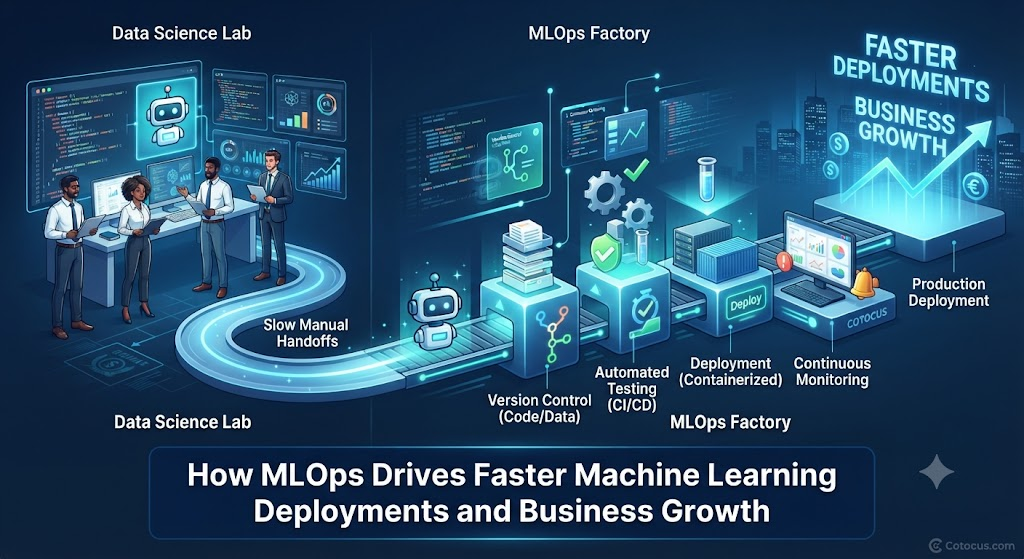
MLOps borrows best practices from DevOps—the system used to build and deploy standard software—and adapts them for the unique challenges of machine learning. The workflow generally follows a continuous loop.
1. Version Control for Code and Data
In standard software, you track code changes. In MLOps, you must track code, data versions, and model parameters simultaneously. If a model starts making strange predictions, the team needs to know exactly which dataset and code version created it.
2. Automated Testing (CI/CD)
Continuous Integration and Continuous Deployment mean that every time a data scientist updates a model feature or retraining script, automated checks run. These tests verify that the model does not crash, meets performance benchmarks, and handles unexpected inputs safely before it touches live users.
3. Automated Deployment and Serving
Once a model passes testing, it is packaged into a container—such as Docker—and deployed to the cloud or on-premise servers. An API allows other software applications to send data to the model and receive predictions instantly.
4. Continuous Monitoring
Deploying a model is not the finish line. Real-world data changes. MLOps systems monitor models continuously to check if prediction accuracy drops, latency increases, or data inputs shift away from what the model was trained on.
Why Speed Matters in Model Deployment
Speed in machine learning is not just about moving fast for the sake of it; it is about business agility and survival.
- Market Responsiveness: Consumer preferences shift rapidly. If a financial institution needs a new fraud detection model to catch a novel scam, waiting six months to deploy it means massive financial losses.
- Faster Experimentation: When deployment is easy, data scientists can test ten different ideas in a week instead of waiting months to test one. This rapid feedback loop sparks innovation.
- Lower Operational Costs: Manual deployments require hours of high-paid engineering time. Automation reduces human error and frees technical staff to focus on solving complex business problems rather than wrestling with server configurations.
Important Factors to Understand
Before adopting MLOps, decision-makers should understand the core pillars that make these systems successful.
Data Pipelines
A machine learning model is only as good as the data feeding it. Automated data pipelines ensure that raw data is cleaned, formatted, and delivered consistently to the model without manual spreadsheet shuffling.
Model Registry
Think of a model registry as a secure digital library for all trained models. It stores model versions, performance metrics, and approval statuses so teams always know which model is active in production.
Reproducibility
If an auditor or manager asks why a model denied a loan or recommended a product, the team must be able to reproduce the exact conditions under which the prediction was made. MLOps guarantees this audit trail.
Practical Examples
Case Study: E-Commerce Recommendation Engine
An online bookstore wants to update its product recommendation engine weekly to feature trending titles.
- Without MLOps: The data science team spends three weeks extracting data, retraining the model, writing custom deployment scripts, and coordinating with web developers to push the update. By the time it launches, the trend has passed.
- With MLOps: An automated pipeline triggers every Sunday night. It pulls the latest purchase logs, trains the model, runs quality tests, and deploys the new recommendation engine by Monday morning without manual engineering intervention.
Case Study: Predictive Maintenance in Manufacturing
A factory uses sensors on heavy machinery to predict when a part is about to break.
- Without MLOps: If a sensor upgrade changes the data format, the prediction model breaks silently, leading to unexpected machinery failure.
- With MLOps: Data drift monitoring catches the input change immediately, alerts the engineering team, and routes the new data format through an automated retraining pipeline.
Common Mistakes
1. Treating MLOps as Purely a Tool Purchase
- What people do: Buy expensive enterprise software platforms and expect MLOps to happen automatically.
- Why it causes problems: Tools do not fix broken workflows or cultural silos between data scientists and IT staff.
- What they should do instead: Focus first on standardizing processes and collaboration, then choose tools that support those workflows.
2. Neglecting Data Quality Management
- What people do: Focus entirely on model algorithms while ignoring where the training data comes from.
- Why it causes problems: Flawed input data leads to incorrect predictions, regardless of how advanced the algorithm is.
- What they should do instead: Implement strict automated data validation checks before training begins.
3. Ignoring Model Monitoring
- What people do: Deploy a model and assume it will perform indefinitely.
- Why it causes problems: Real-world environments change, causing model accuracy to rot silently over time.
- What they should do instead: Set up real-time performance dashboards and alerts for data drift.
Risks and Limitations
While MLOps delivers substantial benefits, it comes with specific challenges that organizations must manage.
- High Initial Complexity: Setting up automated pipelines, model registries, and testing frameworks requires specialized engineering skills. Small teams may find the upfront setup daunting.
- Cultural Resistance: Data scientists who are used to working in isolated notebooks may resist strict coding standards, version control, and operational guardrails.
- Infrastructure Costs: Running continuous monitoring and automated retraining pipelines requires reliable cloud computing resources, which can increase operational overhead if not optimized.
Decision Framework: Is Your Business Ready for MLOps?
Organizations should evaluate their operational maturity before investing heavily in complex MLOps infrastructure.
- Assess Model Value: Are models central to your core revenue or customer experience? If yes, MLOps is essential.
- Review Deployment Frequency: How long does it currently take to push a model update? If it takes months, automation will yield an immediate return on investment.
- Evaluate Team Skills: Do you have engineers who understand both software deployment and machine learning fundamentals?
- Start Small: Begin with a pilot project. Automate deployment for one low-risk model before scaling the practice across the entire enterprise.
Key Terms
- Data Drift: A change in real-world data over time that makes a machine learning model’s predictions less accurate.
- Model Registry: A centralized storage system for managing model versions, metadata, and performance metrics.
- CI/CD: Continuous Integration and Continuous Deployment; practices that automate the building, testing, and releasing of software.
- Containerization: Packing software code and all its dependencies into a single container (like Docker) so it runs reliably on any computer.
- Inference: The process of a trained machine learning model making predictions on new data.
- Pipeline: A series of automated steps that take raw data, process it, train a model, and deploy it.
FAQs
What is the main difference between DevOps and MLOps?
DevOps focuses on automating the deployment and monitoring of traditional software applications. MLOps handles those same operational needs but adds management for data versions, model training pipelines, and the unique risk of models degrading over time due to changing data.
Do small businesses need MLOps?
Small businesses with simple analytics needs or single static models may not need full-scale MLOps. However, any company relying on real-time machine learning predictions—such as dynamic pricing or fraud detection—benefits from basic automation and monitoring.
How does MLOps reduce deployment time?
MLOps removes manual handoffs between data scientists and software engineers. By automating testing, packaging, and release processes, models move from development to production with a single click or automatic trigger.
What causes machine learning models to fail in production?
Models typically fail because of data drift (when real-world inputs change from training data), software integration bugs, or shifts in user behavior that the model was never trained to recognize.
Who is responsible for MLOps in an organization?
MLOps is a collaborative responsibility shared among data scientists, data engineers, and DevOps or platform engineers.
Conclusion
Machine learning models hold immense potential to transform business efficiency and customer experience, but that potential remains locked away if models cannot reach production safely and quickly. MLOps provides the bridge from experimental science to reliable business software. By automating pipelines, monitoring data drift, and aligning technical teams, businesses can deploy models faster, reduce operational risk, and turn artificial intelligence into measurable long-term value.