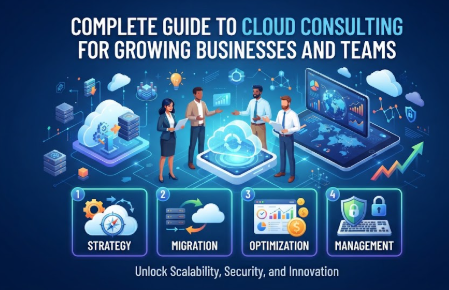
Introduction
A growing business may begin with a few employees, basic software, and limited technology needs, but its systems can quickly become difficult to manage as customers, data, applications, and teams increase. Business owners often hear that moving to the cloud will reduce costs, improve flexibility, and support growth, yet they may not know which services to choose or how migration should be managed. Poor cloud planning can create unexpected expenses, security gaps, downtime, and vendor dependency. This complete guide to cloud consulting for growing businesses explains how professional cloud guidance works, why planning matters, what risks to review, and how organizations can build a practical cloud adoption roadmap without making rushed or technology-driven decisions.
What is Cloud Consulting ?
Cloud consulting is a professional advisory service that helps an organization plan, adopt, manage, secure, and improve cloud technology.
A cloud consultant studies the organization’s current applications, servers, data, workflows, security requirements, business goals, and budget. The consultant then recommends an appropriate cloud approach.
This may involve:
- Moving applications from physical servers to the cloud
- Selecting a suitable cloud service provider
- Designing a cloud architecture
- Protecting cloud data and user accounts
- Reducing unnecessary cloud expenses
- Automating development and deployment processes
- Creating backup and disaster-recovery systems
- Managing hybrid or multi-cloud environments
- Training employees to use new systems safely
Cloud consulting is not limited to moving servers. It connects technology decisions with business needs.
For example, a retail company opening new locations may need its inventory system to work across all stores. Instead of buying and maintaining separate servers for each location, the company may use cloud infrastructure that allows authorized employees to access the same system securely.
A common misunderstanding is that every business must move all its systems to the public cloud immediately. In reality, some organizations benefit from a gradual migration, a hybrid environment, or keeping certain sensitive systems on private infrastructure.
The practical takeaway is simple: cloud adoption should begin with business objectives and system requirements, not with a provider, product, or popular trend.
Why Cloud Consulting Is Important
Cloud decisions influence more than an organization’s IT department. They can affect operating costs, customer service, employee productivity, data protection, innovation, regulatory compliance, and the company’s ability to expand.
It connects cloud technology with business goals
A cloud platform may offer hundreds of services, but a growing company rarely needs all of them. Consultants help businesses identify the services that support actual goals, such as improving application speed, reducing manual work, supporting remote employees, or launching products faster.
The mistake is selecting cloud services because they are popular. The better approach is to define the desired business outcome before designing the technical solution.
It improves scalability
Traditional infrastructure may require a business to purchase servers based on future demand. This can lead to unused capacity during quiet periods or insufficient capacity during sudden growth.
Cloud infrastructure can scale resources according to demand. However, scaling must be configured carefully because uncontrolled scaling can also increase expenses.
It supports better cost visibility
Cloud services usually follow consumption-based pricing. Businesses pay for storage, computing resources, databases, data transfer, backups, support plans, and other services according to usage.
Cloud cost optimization helps businesses understand where money is being spent and whether those resources are providing value.
It strengthens security planning
Cloud providers protect the underlying platform, but businesses remain responsible for many areas, including user access, data classification, application security, device protection, and configuration.
Cloud security consulting helps clarify these responsibilities and establish appropriate controls.
It reduces migration risk
Moving applications and data can cause service interruptions if dependencies, integrations, backups, or performance requirements are overlooked. Consultants create migration plans, testing procedures, rollback options, and communication processes.
It supports long-term operational discipline
A well-designed cloud environment requires monitoring, access reviews, cost reviews, patching, backup testing, documentation, and policy updates. Consulting can help establish these practices before problems appear.
Consider a growing software company that experiences slow application performance whenever customer activity increases. Purchasing more hardware may solve the immediate problem but create maintenance work and future capacity limitations. A consultant could assess the application, redesign selected components for scalable cloud infrastructure, establish monitoring, and create budget controls. The result is not automatically lower cost, but it can provide better flexibility and operational visibility.
The Real Problems Businesses Face With Cloud Consulting
Most cloud challenges are not caused by a complete lack of technology. They are caused by unclear objectives, weak planning, fragmented responsibility, and unrealistic expectations.
Unclear business requirements
Organizations sometimes begin with statements such as “we need to move to the cloud” without explaining what must improve. This makes it difficult to measure whether the project succeeds.
A better requirement might be to reduce application downtime, support remote access, improve backup recovery, or shorten software deployment cycles.
Too much confusing advice
Cloud providers, consultants, vendors, and online publications may recommend different solutions. Some advice is technically accurate but unsuitable for a smaller organization’s budget, team, or compliance requirements.
Businesses should evaluate recommendations against their own workloads and operating model.
Weak understanding of current systems
An organization may not have a complete list of its applications, servers, databases, integrations, software licences, users, or data flows. Migrating without this information can result in overlooked dependencies and service failures.
Unrealistic cost expectations
Cloud computing is not automatically cheaper than traditional infrastructure. Savings depend on architecture, usage, contracts, management discipline, application design, and staffing.
An inefficient application moved to the cloud may remain inefficient and become more expensive.
Poor comparison of providers
Selecting a provider based only on brand recognition or headline pricing ignores service availability, regional coverage, support, security, skills availability, integration needs, and exit options.
Ignoring shared responsibility
Some businesses incorrectly assume that a cloud provider protects everything automatically. The provider secures parts of the infrastructure, while the customer must secure accounts, identities, data, applications, and configurations.
Depending on social media recommendations
A cloud architecture that works for a global technology company may be unnecessarily complex for a growing local business. Online examples should provide ideas, not substitute for workload assessment.
No clear next step
Businesses may spend months discussing providers without creating an inventory, defining objectives, or running a small pilot project. A structured cloud adoption roadmap turns general interest into manageable actions.
How Cloud Consulting Works Step by Step
Step 1: Define business objectives
The first step is identifying what the organization expects cloud technology to improve. This may include faster product delivery, better remote collaboration, improved application availability, lower infrastructure maintenance, stronger backup systems, or easier expansion. Clear objectives matter because they guide architecture, budget, provider selection, and success measurements. For example, a company wanting better disaster recovery may prioritize backup automation and geographically separate recovery systems. A common mistake is starting with a preferred cloud product. The better approach is to document measurable business and operational outcomes first.
Step 2: Assess the existing technology environment
The consultant reviews applications, servers, networks, storage, databases, licences, integrations, user accounts, security controls, and support processes. This assessment reveals dependencies and technical limitations that could affect migration. A business may discover that an old accounting application depends on a specific operating system or local hardware device. The common mistake is assuming every application can be moved in the same way. The better approach is to classify workloads individually and document their technical, security, and business requirements.
Step 3: Classify applications and data
Applications and data should be classified according to importance, sensitivity, performance needs, compliance requirements, and migration difficulty. Customer records, payment information, employee data, intellectual property, public website content, and archived files should not all receive identical treatment. Classification helps determine encryption, access controls, backup frequency, recovery expectations, and hosting location. The mistake is treating all information as ordinary business data. The better approach is to apply stronger controls to sensitive and business-critical information.
Step 4: Select the cloud model and provider
The business evaluates public cloud, private cloud, hybrid cloud, and multi-cloud options. It also compares infrastructure, platform, software, support, region availability, pricing, technical compatibility, and provider reliability. A growing company using common business applications may benefit from software-as-a-service, while a software company may need configurable infrastructure and development platforms. A common mistake is selecting the cheapest advertised option without calculating the complete operating cost. The better approach is to compare total cost, technical fit, support quality, security controls, and long-term flexibility.
Step 5: Design the cloud architecture
Cloud architecture defines how applications, networks, databases, users, security controls, backups, monitoring, and integrations will work together. A well-designed architecture balances reliability, performance, security, manageability, and cost. For example, an online business may use load balancing, automated backups, restricted administrative access, monitoring alerts, and separate development and production environments. The common mistake is copying a complex architecture from another company. The better approach is to design the simplest environment that meets current needs while allowing controlled growth.
Step 6: Build and test a migration plan
The migration plan explains what will move, when it will move, who is responsible, how it will be tested, and what will happen if the migration fails. A pilot workload is often useful before moving critical systems. Testing should cover performance, security, integrations, user access, data accuracy, backups, and recovery. The common mistake is scheduling a full migration without adequate testing or rollback procedures. The better approach is to migrate in controlled stages and verify each stage before continuing.
Step 7: Migrate applications and data
During migration, the team moves or rebuilds workloads according to the selected strategy. Data may need to be cleaned, encrypted, synchronized, validated, and backed up. Employees and customers may need advance communication about service interruptions or process changes. A common mistake is judging success only by whether the system starts successfully. The better approach is to confirm data accuracy, application performance, security settings, monitoring, backups, and user experience.
Step 8: Optimize, govern, and improve continuously
Cloud consulting continues after migration because cloud environments change constantly. New resources may be added, users may change roles, costs may increase, and security requirements may evolve. Regular reviews should cover spending, resource utilization, user access, backup testing, incident response, compliance, and performance. The common mistake is treating migration as the final stage. The better approach is to establish cloud governance and continuous improvement as normal business practices.
Key Factors That Influence Cloud Consulting
Business goals
The cloud architecture should reflect the company’s priorities. A business focused on international expansion has different needs from one focused on internal efficiency or disaster recovery.
Cloud consultants should translate broad goals into technical requirements and measurable outcomes.
Current application architecture
Modern web applications may move easily, while older systems may depend on fixed hardware, unsupported software, or local network connections.
The application’s design determines whether it should be moved as it is, modified, replaced, rebuilt, or retained outside the cloud.
Data sensitivity
Sensitive customer, financial, employee, or health-related information may require stronger access controls, encryption, logging, retention policies, and regional hosting considerations.
Ignoring data classification can create security and compliance exposure.
Internal skills
A company may choose an advanced architecture but struggle to operate it if employees lack relevant skills. Training, documentation, managed cloud services, or a simpler design may be necessary.
The best architecture is one the organization can manage reliably.
Budget and cost model
Cloud budgets should include migration work, consulting, subscriptions, data transfer, licences, support, monitoring, backups, security tools, training, and ongoing management.
Looking only at computing or storage prices creates an incomplete cost estimate.
Security maturity
An organization with weak password practices, excessive administrative access, or limited monitoring may carry these weaknesses into the cloud.
Cloud adoption should include identity management, account protection, configuration controls, logging, incident response, and employee awareness.
Performance requirements
Applications may need specific response times, processing power, storage speed, or network connectivity. Poor provider-region selection or architecture can create delays.
Performance testing should occur before critical workloads are moved.
Availability and recovery needs
Not every system requires continuous operation. Businesses should identify acceptable downtime and data-loss limits for each workload.
Critical systems may require stronger redundancy and recovery arrangements, which can increase cost.
Regulatory and contractual requirements
Industry rules, customer contracts, privacy obligations, and data-location requirements may influence where and how data is stored.
Businesses should obtain qualified legal or compliance advice where necessary.
Future scalability
The selected approach should support reasonable growth without creating unnecessary complexity today.
A better cloud strategy provides a clear expansion path rather than building an oversized environment before it is needed.
Detailed Breakdown of Cloud Consulting
Cloud strategy development
A cloud strategy explains why the business is adopting cloud technology, what will move, which operating model will be used, and how progress will be measured.
An effective strategy usually covers:
- Business objectives
- Current technology limitations
- Workload priorities
- Security and compliance requirements
- Provider-selection principles
- Budget boundaries
- Skills and staffing
- Governance responsibilities
- Migration sequence
- Performance measurements
The common mistake is creating a strategy that lists technologies without connecting them to business outcomes. A better strategy explains how each major cloud decision supports a specific organizational need.
Cloud readiness assessment
A readiness assessment determines whether the business, applications, data, security processes, and employees are prepared for cloud adoption.
It may examine:
- Application compatibility
- Network capacity
- Data quality
- Existing contracts
- Technical dependencies
- Security practices
- Employee skills
- Operating procedures
- Business continuity requirements
The purpose is not to delay migration. It is to identify the work required for a safer and more predictable transition.
Cloud migration strategy
Different workloads require different migration methods.
A business may:
- Move an application with minimal changes
- Make selected changes before migration
- Replace the application with a cloud-based service
- Rebuild it using cloud-native components
- Keep it in the current environment
- Retire it if it is no longer needed
A cloud migration strategy should consider cost, complexity, business value, technical risk, and expected application lifespan.
Moving every application without reviewing whether it is still useful can waste time and money.
Cloud architecture design
Cloud architecture is the structural design of the environment. It determines how resources communicate, how access is controlled, where data is stored, and how the system responds to failure.
Important architectural areas include:
- Network separation
- Identity and access management
- Application hosting
- Database design
- Encryption
- Backup and recovery
- Monitoring
- Logging
- Automation
- Scalability
- Cost controls
Architecture should be documented clearly enough that internal teams and service providers understand how the environment operates.
Cloud security consulting
Cloud security consulting helps organizations identify threats, assign responsibilities, configure controls, and prepare for incidents.
Important security activities include:
- Enabling strong authentication
- Limiting administrative access
- Applying least-privilege permissions
- Encrypting sensitive information
- Protecting credentials and secrets
- Monitoring unusual activity
- Reviewing configurations
- Updating systems
- Testing backups
- Preparing an incident-response process
A common mistake is purchasing multiple security products without fixing basic identity and configuration weaknesses. Strong foundations are usually more valuable than unnecessary tool complexity.
Identity and access management
Identity is one of the most important security areas in cloud environments. Employees, contractors, applications, and automated systems may all require access.
Businesses should define:
- Who can access each resource
- What actions each identity can perform
- How access is approved
- How access is reviewed
- How accounts are removed
- How privileged actions are monitored
Sharing administrator accounts or leaving former employees’ access active creates avoidable risk.
Cloud cost optimization
Cloud cost optimization means aligning cloud spending with actual business value. It does not mean reducing every expense regardless of operational impact.
Optimization may involve:
- Removing unused resources
- Selecting appropriate resource sizes
- Scheduling non-production systems
- Reviewing storage classes
- Limiting unnecessary data transfer
- Using commitments carefully
- Setting budgets and alerts
- Assigning costs to departments or projects
- Reviewing architecture efficiency
The mistake is reducing resources so aggressively that performance and reliability suffer. The better approach is to remove waste while protecting business requirements.
Cloud infrastructure management
Cloud infrastructure requires ongoing administration even when physical hardware is managed by a provider.
Management activities may include:
- Resource provisioning
- Configuration control
- Patching
- Monitoring
- Backup verification
- Access reviews
- Incident management
- Capacity management
- Cost reporting
- Policy enforcement
Automation can make these activities more consistent, but automated processes must also be reviewed and secured.
Managed cloud services
Managed cloud services allow an external provider to perform selected operational responsibilities. These may include monitoring, patching, backups, technical support, security operations, or infrastructure management.
Managed services can be useful when a business lacks a large internal technology team. However, responsibilities must be documented clearly.
The organization should know:
- What the provider manages
- What remains the customer’s responsibility
- How incidents are reported
- What response times apply
- How performance is measured
- How data can be retrieved
- What happens when the contract ends
Outsourcing operations does not remove the company’s responsibility for oversight.
Hybrid cloud strategy
A hybrid cloud combines cloud services with private infrastructure or on-premises systems.
This approach may be suitable when:
- An application cannot move immediately
- Certain data must remain in a controlled environment
- Local equipment is still required
- Migration must occur gradually
- The organization has made significant infrastructure investments
Hybrid environments can provide flexibility, but they may also increase networking, monitoring, security, and management complexity.
Multi-cloud strategy
A multi-cloud strategy uses services from more than one cloud provider.
Possible reasons include:
- Access to specialized services
- Customer or regional requirements
- Existing acquisitions or business units
- Risk distribution
- Negotiating flexibility
Using multiple providers solely to avoid dependency can create additional cost and operational complexity. Multi-cloud should solve a clear business problem.
Business continuity and disaster recovery
Cloud services can support business continuity, but recovery does not happen automatically.
Businesses must define:
- Which systems are critical
- How much downtime is acceptable
- How much data loss is acceptable
- How backups are protected
- Where recovery systems are located
- Who starts the recovery process
- How recovery is tested
A backup that has never been restored successfully should not be treated as proven protection.
Cloud governance
Cloud governance establishes policies, responsibilities, and controls for using cloud resources.
It may cover:
- Account structure
- Resource naming
- Approved regions
- Access management
- Security standards
- Data handling
- Budget limits
- Procurement
- Backup requirements
- Logging and monitoring
- Resource ownership
- Exception approval
Governance should guide responsible use without making ordinary work unnecessarily slow.
Common Mistakes Beginners Make With Cloud Consulting
Moving everything without assessment
This happens when leadership wants a fast cloud transformation. It is risky because applications may have hidden dependencies, unsupported software, or unsuitable performance requirements.
Businesses should assess and prioritize workloads before deciding how each one should be handled.
Assuming cloud always reduces cost
Cloud can reduce hardware ownership and improve flexibility, but inefficient usage can create higher monthly expenses.
Businesses should build a total-cost estimate and establish cost-monitoring practices before migration.
Selecting a provider before defining requirements
A familiar provider may appear to be the safest option, but provider selection should follow workload, security, budget, support, and integration analysis.
Define decision criteria before comparing platforms.
Ignoring employee training
Employees may use weak passwords, mishandle data, misunderstand new workflows, or create unauthorized services.
Training should cover both system use and security responsibilities.
Giving excessive access
Broad permissions are often granted because they are convenient during implementation. These permissions may remain active long after they are needed.
Use role-based access, least privilege, approval processes, and regular reviews.
Migrating outdated applications unchanged
Moving an inefficient or unsupported application to cloud infrastructure does not automatically modernize it.
Evaluate whether the application should be improved, replaced, retired, or retained.
Failing to test recovery
Some organizations confirm that backups are running but never test whether systems and data can actually be restored.
Schedule recovery tests and document the results.
Ignoring data-transfer costs
Businesses may focus on storage and computing prices but overlook charges related to moving data between systems, providers, regions, or users.
Architecture and cost estimates should include expected data movement.
Using unnecessary complexity
Advanced architectures may appear impressive but require more skills, monitoring, and maintenance.
Start with the simplest design that satisfies business, reliability, and security needs.
Depending completely on a consultant
Consultants can provide expertise, but internal teams still need documentation, knowledge transfer, access, and decision-making capability.
The organization should remain able to understand and govern its own environment.
Skipping contract and exit reviews
A service may be easy to adopt but expensive or difficult to leave.
Review data-export methods, contract terms, notice periods, support arrangements, and migration options before committing.
Ignoring legal and compliance responsibilities
Data protection, contractual obligations, record retention, and industry requirements may affect cloud decisions.
Qualified legal, security, and compliance professionals should be consulted when required.
Don’t Do This Checklist
- Do not migrate business-critical systems without tested backups.
- Do not share administrator accounts or passwords.
- Do not assume every cloud service is automatically secure.
- Do not select providers only by advertised price.
- Do not ignore data-location and contractual requirements.
- Do not create resources without ownership and budget controls.
- Do not move sensitive data before classifying it.
- Do not use a complex architecture without skilled support.
- Do not treat migration as the end of cloud management.
- Do not sign long commitments without reviewing expected usage.
- Do not leave former employees’ accounts active.
- Do not depend on undocumented verbal promises from vendors.
Practical Real-Life Examples of Cloud Consulting
Example 1: A retailer opening additional branches
Situation: A retailer manages inventory through a server located at its original store. New branches need secure access to the same information.
Challenge: Buying separate servers could create inconsistent records and additional maintenance.
Better action: A consultant assesses connectivity, application compatibility, security, and recovery before recommending centralized cloud hosting.
Learning: Cloud adoption should solve the shared-access problem while protecting availability and data integrity.
Example 2: A software company facing performance problems
Situation: A growing software company experiences slow application performance during periods of high customer activity.
Mistake: The team repeatedly upgrades one server without examining the application architecture.
Better action: Consultants identify bottlenecks, introduce monitoring, and redesign selected services for controlled scaling.
Learning: Increasing infrastructure alone may not solve an application-design problem.
Example 3: A professional-services company supporting remote work
Situation: Employees need access to documents, communication tools, and business applications from different locations.
Challenge: Files are stored on individual computers and sent through email.
Better action: The company adopts managed cloud collaboration tools with access controls, retention policies, and employee training.
Learning: Cloud collaboration requires governance and security, not only software subscriptions.
Example 4: An online store with increasing cloud bills
Situation: An online store has moved its application to cloud infrastructure, but monthly expenses continue to rise.
Mistake: Developers create test systems and leave them operating permanently.
Better action: The company introduces tagging, budgets, alerts, automated schedules, and monthly cost reviews.
Learning: Cloud cost optimization depends on ownership and regular operational discipline.
Example 5: A manufacturer using an older production application
Situation: A manufacturer wants to move all systems to the cloud, including an application connected to factory equipment.
Challenge: The application requires low-latency local connections and unsupported software.
Better action: Consultants recommend a hybrid arrangement while the company evaluates modernization options.
Learning: Retaining a workload temporarily may be safer than forcing an unsuitable migration.
Table 1: Common Cloud Models and Their Business Uses
| Cloud model | Basic meaning | Suitable business situation | Important consideration |
|---|---|---|---|
| Public cloud | Shared provider infrastructure delivered as services | Businesses needing scalability, broad services, and flexible consumption | Configuration, access, usage, and spending must be controlled |
| Private cloud | Cloud-style infrastructure dedicated to one organization | Organizations with specialized control, performance, or policy requirements | Usually requires greater investment and management capability |
| Hybrid cloud | Combination of cloud and private or on-site systems | Businesses migrating gradually or retaining specific local workloads | Integration, networking, monitoring, and security can be complex |
| Multi-cloud | Services from more than one cloud provider | Organizations with clear regional, technical, customer, or resilience needs | Skills, governance, cost management, and operations become more demanding |
| Software as a service | Complete software accessed through a subscription | Email, collaboration, customer management, accounting, and common business functions | Review data ownership, access, integrations, security, and exit options |
Table 2: Cloud Mistakes and Better Approaches
| Common mistake | Possible impact | Better approach |
|---|---|---|
| Moving every workload in one project | Downtime, missed dependencies, and difficult troubleshooting | Prioritize workloads and migrate in controlled stages |
| Selecting only by headline price | Unexpected support, transfer, storage, or management costs | Compare total cost and long-term operating requirements |
| Giving all technical staff administrator access | Greater risk of accidental or unauthorized changes | Apply role-based access and least privilege |
| Assuming backups guarantee recovery | Failed restoration during an incident | Test recovery regularly and document results |
| Creating resources without ownership | Waste, security gaps, and unclear responsibility | Assign owners, tags, budgets, and review dates |
| Using advanced services without internal skills | Operational errors and provider dependence | Choose manageable services and invest in training |
| Ignoring the exit strategy | Expensive or difficult provider change | Review portability, export methods, contracts, and dependencies |
Tools, Methods, and Frameworks Businesses Can Use
Cloud readiness assessment
A cloud readiness assessment is a structured review of the organization’s technology, people, processes, and business requirements.
Beginners can use it to identify which applications are suitable for migration and what preparation is required. It prevents the mistake of assuming that all systems have the same migration difficulty.
Application inventory
An application inventory records each system’s purpose, owner, users, data, integrations, infrastructure, licence, support status, and importance.
This creates a reliable starting point for cloud planning. It helps prevent important dependencies from being overlooked.
Workload-classification method
This method groups applications according to business importance, data sensitivity, performance, recovery needs, and technical complexity.
Businesses can use simple categories such as critical, important, standard, and low priority. Classification helps teams avoid spending equal time and money on systems with very different requirements.
Cloud decision scorecard
A scorecard compares providers or solutions using consistent criteria.
Criteria may include:
- Technical compatibility
- Security controls
- Regional availability
- Support quality
- Cost structure
- Skills availability
- Integration options
- Reliability
- Portability
- Contract conditions
This method reduces decisions based only on brand recognition or sales presentations.
Total-cost-of-ownership estimate
A total-cost estimate includes implementation, migration, subscriptions, support, data transfer, licences, training, security, monitoring, managed services, and internal staff time.
It helps businesses avoid comparing a full traditional environment with only one portion of cloud pricing.
Migration wave plan
A migration wave plan groups workloads into manageable stages.
Organizations often begin with low-risk systems, learn from the process, improve their approach, and then move more important workloads. This reduces the risk of a large, uncontrolled migration.
Responsibility matrix
A responsibility matrix identifies who approves, performs, reviews, and supports each cloud activity.
It may cover access, security alerts, cost reviews, backups, vendor communication, deployments, and incident handling. This prevents tasks from being ignored because everyone assumes someone else owns them.
Cloud cost dashboard
A cost dashboard shows spending by account, project, service, environment, or department.
Beginners can review it monthly to identify unexpected changes. It prevents cloud bills from being treated as a single unexplained amount.
Security baseline checklist
A security baseline defines minimum controls for every environment.
It may require strong authentication, restricted access, encryption, logging, backups, approved regions, and documented owners. A baseline prevents teams from repeatedly making basic security decisions from the beginning.
Cloud governance framework
A governance framework combines policies, ownership, technical controls, and review processes.
It helps the organization use cloud services consistently while controlling security, cost, and compliance risks.
Architecture review process
An architecture review examines whether a proposed solution is secure, reliable, cost-aware, manageable, and aligned with business needs.
Reviews are especially useful before launching critical systems or making expensive commitments.
Monthly cloud review
A monthly review brings technology, finance, security, and business representatives together to examine:
- Spending
- Performance
- Availability
- Security findings
- Access changes
- New resources
- Incidents
- Improvement actions
This prevents cloud management from becoming isolated within one technical team.
Expert Tips to Make Better Cloud Decisions
1. Begin with the business problem
Write down the exact problem cloud technology is expected to solve. This matters because unclear objectives produce unfocused projects. Use measurable outcomes such as improved recovery time, faster deployments, or secure remote access.
2. Create a complete technology inventory
Document applications, databases, integrations, users, servers, licences, and owners. This helps consultants identify dependencies. Do not rely only on the knowledge of one employee.
3. Classify data before moving it
Identify sensitive, confidential, regulated, operational, and public information. This affects storage, access, encryption, retention, and location decisions. Avoid moving data before its importance is understood.
4. Compare total cost instead of basic prices
Include migration, support, licences, security, backups, monitoring, training, data transfer, and management. This creates a more realistic financial view and prevents surprise expenses.
5. Use a pilot workload
Test the chosen architecture and migration process with a manageable application. A pilot helps reveal technical and operational gaps before critical systems are affected.
6. Protect identities first
Require strong authentication, restrict privileges, remove inactive accounts, and review access regularly. Many cloud incidents become serious because compromised accounts have excessive permissions.
7. Keep the initial architecture manageable
Use the simplest solution that meets business, security, availability, and growth needs. Unnecessary complexity increases cost, training requirements, and troubleshooting difficulty.
8. Assign ownership to every resource
Each account, application, database, storage area, and subscription should have a responsible owner. Ownership improves cost control, security reviews, and decision-making.
9. Establish budget alerts early
Create budgets and usage alerts before workloads grow. Alerts do not control spending automatically, but they help teams investigate changes before bills become unmanageable.
10. Test backup restoration
Do not assume that a completed backup means successful recovery. Restore selected systems and data regularly, record the results, and correct weaknesses.
11. Request documentation and knowledge transfer
Consultants should provide architecture records, operating procedures, access details, known limitations, and training. This reduces long-term dependence on individuals.
12. Review provider dependency
Identify services that would be difficult to replace or migrate. Provider-specific services may deliver strong value, but the organization should understand the trade-off before adoption.
13. Include employees in the transition
Explain why systems are changing, how workflows will be affected, and what security responsibilities employees have. Adoption problems often come from communication gaps rather than technical failures.
14. Review cloud operations regularly
Cloud environments change quickly as teams create resources and applications evolve. Schedule reviews for cost, access, security, performance, backups, and compliance.
15. Seek specialist advice where necessary
Cloud consultants can guide technology decisions, but legal, regulatory, privacy, tax, and contractual questions may require qualified professionals. Avoid expecting one consultant to provide authoritative advice in every discipline.
Case Studies: How Better Understanding Changes Decisions
Case Study 1: Growing digital agency
Profile: A digital agency with 45 employees serving clients from several locations.
Situation: Project files, customer information, and creative assets were stored across employee laptops and a small office server.
Problem: Remote employees experienced access problems, files were duplicated, and backup practices were inconsistent.
Wrong approach: Management considered moving every folder into a general cloud storage account without permission planning or data classification.
Better approach: A consultant mapped file categories, identified client confidentiality requirements, defined user roles, introduced managed collaboration software, configured access controls, and created backup and employee-offboarding procedures.
Result or learning: The agency gained more consistent access and clearer ownership while reducing the risk created by uncontrolled file sharing. Management also learned that cloud storage and backup serve different purposes.
Key takeaway: Collaboration improves when access, data classification, employee processes, and recovery are planned together.
Case Study 2: Expanding e-commerce company
Profile: An online retailer experiencing seasonal changes in customer traffic.
Situation: The website performed adequately during normal periods but slowed significantly during major campaigns.
Problem: The company lacked monitoring and did not know whether the main limitation was computing capacity, database performance, application code, or external integrations.
Wrong approach: The team planned to purchase the largest available cloud server before understanding the bottleneck.
Better approach: Consultants introduced performance monitoring, reviewed the application architecture, tested the database, configured caching, and created controlled scaling for suitable components.
Result or learning: The company improved its ability to identify performance problems and scale selected resources rather than increasing every component. It also established cost alerts for campaign periods.
Key takeaway: Cloud scalability works best when monitoring and application design identify what actually needs to scale.
Case Study 3: Regional business-services provider
Profile: A business-services company with a small internal IT team and several older applications.
Situation: Senior management wanted a complete cloud migration within a short period to reduce dependence on office infrastructure.
Problem: One critical application used an unsupported database version and depended on a local document-scanning device.
Wrong approach: The initial plan treated all systems as simple server migrations.
Better approach: The consultant created an application inventory, separated workloads into migration groups, moved standard collaboration services first, retained the critical application temporarily, and developed a modernization plan.
Result or learning: The company avoided disrupting a core business process while still making progress. The phased approach also gave employees time to develop cloud operating skills.
Key takeaway: A controlled hybrid stage can be a responsible part of cloud transformation rather than a sign of failure.
Risk Awareness: What Businesses Must Check First
Security risk
Security risk includes unauthorized access, data exposure, malicious changes, and compromised accounts.
Reduce it by using strong authentication, least-privilege permissions, encryption, logging, secure configuration, updates, and regular access reviews.
Data privacy risk
Cloud systems may store personal, employee, customer, or confidential business information.
Businesses should understand what information is collected, where it is stored, who can access it, how long it is retained, and how it is deleted. Qualified privacy or legal advice may be necessary.
Cost risk
Flexible consumption can create unexpected bills when resources are oversized, left running, duplicated, or poorly monitored.
Use budgets, alerts, ownership tags, usage reports, and scheduled optimization reviews.
Vendor-dependency risk
Some applications become closely connected to provider-specific technologies.
Dependency is not always negative, but businesses should understand migration difficulty, data-export methods, alternative options, and contractual obligations.
Availability risk
Cloud services can experience failures, and applications can also fail because of poor design or configuration.
Identify critical systems, design appropriate redundancy, monitor services, and create tested recovery procedures.
Migration risk
Data can become incomplete, corrupted, exposed, or unavailable during migration.
Maintain backups, test transfers, validate data, define rollback procedures, and migrate in controlled stages.
Compliance risk
Industry rules, contracts, record-retention requirements, and privacy obligations may influence cloud use.
Document requirements before selecting regions, providers, data services, and retention settings.
Skills risk
A complex cloud environment may be difficult to operate without trained employees.
Reduce this risk through training, documentation, managed services, appropriate architecture, and clear support arrangements.
Configuration risk
Cloud platforms provide many settings, and a small error may expose data or interrupt services.
Use approved templates, configuration reviews, automation, change controls, and monitoring.
Cyberattack risk
Cloud environments may be targeted through stolen credentials, vulnerable applications, exposed services, or malicious software.
Apply layered protection and prepare an incident-response process before an incident occurs.
Business continuity risk
An organization may depend on cloud services without knowing how it will continue operating during an outage.
Document alternative processes, recovery responsibilities, communication plans, and service priorities.
Misinformation risk
Online recommendations may be outdated, incomplete, or designed for organizations with very different needs.
Verify important information using provider documentation, qualified professionals, testing, and internal requirements.
Checklist Before Taking Action
- Business objectives are clearly documented.
- Current applications, databases, integrations, and owners are listed.
- Data has been classified according to sensitivity and importance.
- Critical workloads and acceptable downtime have been identified.
- Cloud models and providers have been compared consistently.
- Total costs have been estimated beyond basic service prices.
- Security responsibilities are understood.
- Access and authentication requirements are documented.
- Legal, contractual, privacy, and compliance impacts have been reviewed.
- Migration stages and priorities have been defined.
- Backups have been created and restoration has been tested.
- Performance and integration testing are included.
- A rollback process has been prepared.
- Resource owners and budget limits have been assigned.
- Employees have received appropriate communication and training.
- Documentation and knowledge transfer are included in the consulting scope.
- Managed-service responsibilities are clearly divided.
- Provider exit and data-export options have been reviewed.
- Ongoing cost, security, access, and performance reviews are scheduled.
- Qualified specialist advice has been considered where required.
Businesses should use this checklist before signing a cloud contract, beginning a migration, or launching an important cloud-hosted system. It is also useful during project reviews because some requirements change as new information is discovered. A checked item should represent verified evidence or a completed action, not an assumption.
Strategic Insights for Better Decision-Making
Treat cloud adoption as an operating-model change
Cloud technology changes how systems are purchased, deployed, monitored, secured, and funded. Teams may gain the ability to create resources quickly, but this freedom requires policies and accountability.
Leadership should plan for changes in responsibilities, approval processes, budgeting, and employee skills.
Balance speed with governance
Too little control can create security and cost problems, while excessive approval processes can remove the agility cloud technology is expected to provide.
A practical governance model uses pre-approved patterns, automated controls, budget boundaries, and clearly defined exceptions.
Connect cost with business value
A higher cloud bill is not automatically negative if it supports more customers, stronger reliability, or faster delivery. Similarly, a lower bill is not positive if service quality declines.
Cloud cost optimization should examine both spending and the outcome supported by that spending.
Separate fixed requirements from preferences
Requirements may include data protection, recovery objectives, application compatibility, and contractual obligations. Preferences may include familiar tools or a favored provider.
Separating them improves provider comparisons and reduces biased decisions.
Build internal capability
Consultants can accelerate progress, but the business should retain enough knowledge to govern providers, approve changes, understand costs, and respond to incidents.
Knowledge transfer should be a formal project deliverable.
Review architecture as the business changes
An architecture designed for 20 employees may not remain suitable for 200 employees, multiple regions, or new customer requirements.
Schedule architecture reviews after major growth, acquisitions, product launches, regulatory changes, or repeated incidents.
Use standardization carefully
Standard resource names, account structures, security settings, templates, and deployment methods improve consistency.
However, standards should be reviewed when they create unnecessary work or fail to support new business needs.
Plan for failure
Reliable systems are not built by assuming that providers, networks, applications, and people will always work perfectly.
Businesses should design recovery procedures, monitoring, communication, and fallback arrangements based on realistic failure scenarios.
Measure outcomes
Useful cloud measurements may include:
- Service availability
- Recovery performance
- Deployment frequency
- Incident resolution time
- Resource utilization
- Cost by application or department
- Security findings
- User satisfaction
- Customer response time
Measurements should support decisions rather than becoming reporting activities with no clear purpose.
Review consultant recommendations independently
A consultant may also resell services or maintain provider partnerships. That does not automatically make the recommendation unsuitable, but commercial relationships should be transparent.
Businesses should understand why a solution is recommended and how alternatives were evaluated.
Key Terms Explained for Beginners
- Cloud computing: Cloud computing delivers technology resources such as servers, storage, databases, and software through network-based services instead of requiring the business to own all physical infrastructure.
- Cloud consulting: Cloud consulting is professional guidance that helps an organization plan, migrate, secure, manage, and improve its use of cloud technology.
- Cloud migration: Cloud migration is the process of moving applications, data, or technology services from one environment to a cloud platform or between cloud platforms.
- Cloud adoption roadmap: A cloud adoption roadmap is a phased plan showing objectives, priorities, responsibilities, migration stages, risks, budgets, and expected outcomes.
- Public cloud: A public cloud provides computing services through infrastructure operated by an external provider and shared securely among multiple customers.
- Private cloud: A private cloud provides cloud-style capabilities through infrastructure dedicated to one organization.
- Hybrid cloud: Hybrid cloud combines public cloud services with private or on-site systems that remain connected.
- Multi-cloud: Multi-cloud means using services from more than one cloud provider as part of an organization’s technology environment.
- Software as a service: Software as a service provides a complete application through a subscription, usually accessed through a web browser or mobile application.
- Infrastructure as a service: Infrastructure as a service provides configurable computing, network, and storage resources that the customer manages at the operating-system and application levels.
- Scalability: Scalability is the ability of a system to increase or decrease resources as user demand, processing, or storage requirements change.
- Shared-responsibility model: The shared-responsibility model divides security and operational duties between the cloud provider and the customer.
- Cloud governance: Cloud governance consists of policies, responsibilities, standards, and controls that guide how cloud resources are created and managed.
- Cloud cost optimization: Cloud cost optimization aligns spending with actual usage, performance needs, reliability requirements, and business value.
- Disaster recovery: Disaster recovery is the planned process for restoring systems and data after a major failure, cyber incident, or other disruption.
Who Should Read This Blog
Business beginners
Readers with limited technical knowledge can understand cloud concepts, common risks, and the main questions to ask consultants.
Startup founders
Founders can learn how to build scalable systems without adopting unnecessary complexity or losing control of costs.
Small business owners
Small business owners can evaluate whether cloud services support collaboration, backup, remote work, customer service, and expansion.
Salaried managers
Managers responsible for operations, finance, projects, or technology can understand how cloud decisions affect budgets, employees, and business continuity.
Students
Students can use the guide to understand cloud strategy, migration, governance, security, and consulting processes in a practical business context.
Technology professionals
IT employees can use the framework to communicate cloud requirements and risks more clearly to management.
Finance teams
Finance professionals can understand subscription costs, usage-based pricing, budget alerts, provider commitments, and cloud cost optimization.
Security professionals
Security teams can identify identity, data protection, configuration, monitoring, incident-response, and compliance considerations.
Growing e-commerce businesses
Online businesses can learn how performance, scalability, availability, data protection, and cost controls work together.
Professional-services companies
Consulting firms, agencies, legal practices, and other service businesses can evaluate secure collaboration, file management, remote access, and client-data responsibilities.
Cloud consultants
Consultants can use the structure as a client-discovery, assessment, and education framework.
Business decision-makers
Senior leaders can understand why cloud adoption requires business ownership rather than being treated only as an IT project.
Frequently Asked Questions
1. What is cloud consulting?
Cloud consulting helps a business assess, plan, migrate, secure, manage, and optimize cloud technology. Consultants connect technical decisions with business goals, budgets, risks, skills, and operational requirements.
2. Why do growing businesses need cloud consulting?
Growing businesses often experience changing user demand, increasing data, remote-work requirements, and greater security responsibilities. Cloud consulting provides a structured way to address these needs without adopting unsuitable or unnecessarily complex services.
3. What does the Complete Guide to Cloud Consulting for Growing Businesses cover?
The guide covers cloud strategy, readiness assessment, architecture, migration, security, cost optimization, provider selection, governance, risks, and ongoing management. It is designed to support informed business decisions rather than promote a specific provider.
4. Is cloud consulting only for large companies?
No. Startups and smaller organizations can also benefit, particularly when they have limited internal technology expertise. The scope should be proportionate to the business’s systems, risks, budget, and growth plans.
5. Does moving to the cloud always reduce costs?
No. Cloud services can improve flexibility and reduce some infrastructure responsibilities, but poorly managed resources may increase expenses. Businesses should compare total cost and establish regular cost reviews.
6. How should a business select a cloud consultant?
Review the consultant’s relevant experience, assessment process, security knowledge, documentation standards, commercial relationships, communication approach, and knowledge-transfer plan. Recommendations should be supported by clear business and technical reasoning.
7. What is the safest way to begin cloud migration?
Start with a complete inventory, define business goals, classify data, assess risks, and test a manageable workload. Critical systems should not move until backups, security controls, integration testing, and rollback procedures are ready.
8. How long does cloud migration take?
The timeline depends on the number of workloads, technical complexity, data volume, employee readiness, integrations, compliance requirements, and migration approach. A small software adoption may be quick, while major application modernization may require several stages.
9. What is the biggest cloud consulting mistake?
One of the biggest mistakes is selecting technology before defining the business problem. This can lead to unsuitable architecture, unnecessary expenses, difficult operations, and unclear results.
10. How does cloud security responsibility work?
The provider protects selected parts of the underlying platform, while the customer usually remains responsible for areas such as user access, data, application security, configuration, devices, and account activity. Exact responsibilities depend on the service.
11. How often should cloud costs and security be reviewed?
Businesses should monitor important alerts continuously and conduct structured reviews regularly. Monthly cost and operational reviews are practical for many organizations, while access, architecture, and recovery reviews may follow additional risk-based schedules.
12. What is the best next step after reading this complete guide?
Document your business objectives and create an inventory of applications, data, users, infrastructure, and current challenges. This information provides a strong foundation for an internal cloud discussion or a professional readiness assessment.
Conclusion
The complete guide to cloud consulting for growing businesses shows that successful cloud adoption is not simply a matter of purchasing online services or moving servers to a provider. It is a structured business change involving strategy, applications, data, employees, costs, security, governance, and long-term operations. Growing companies should begin by defining the problem they want to solve, whether that problem involves scalability, remote collaboration, application performance, disaster recovery, security, or operational efficiency. They should then document their current technology environment, classify important data, compare appropriate cloud models, estimate total costs, and create a phased cloud adoption roadmap. Businesses must also remember that cloud providers and customers share responsibilities. A provider may operate the platform, but the organization still needs to control access, protect information, monitor activity, manage expenses, train employees, and prepare for incidents. Cloud migration should therefore include testing, validated backups, recovery procedures, employee communication, documentation, and clearly assigned ownership. Beginners should avoid copying architectures used by much larger organizations or assuming that the most advanced solution is automatically the best one. A simpler environment that meets business, security, availability, and growth requirements is often easier to operate reliably. Consulting support can provide valuable expertise, but the organization should remain involved in decisions and require clear knowledge transfer. The most practical next step is to write down the company’s objectives and create an accurate inventory of applications, data, integrations, users, vendors, and current problems. This allows future discussions to focus on evidence rather than assumptions. Cloud technology can support meaningful business growth, but responsible adoption requires regular review, measurable outcomes, controlled spending, strong security practices, and realistic expectations. A careful, phased, and well-governed approach gives businesses a stronger foundation for making cloud decisions that remain useful as their operations, customers, and technology needs continue to evolve.