Introduction
Many technology projects begin with excitement. Data scientists spend weeks cleaning information, training algorithms, and building a predictive model inside a secure laboratory environment. The model achieves high accuracy rates on test data. Everyone celebrates the success and prepares to launch the system into production for real users.
Then, reality arrives.
Within a few weeks, the model starts making bad predictions. The software application crashes because the data format changed slightly. Nobody knows which version of the code produced the failing results, and fixing the issue requires rebuilding the entire workflow from scratch.
This scenario happens across industries because teams treat machine learning like traditional software or isolated research. Traditional software follows predictable rules written by humans, whereas machine learning learns from dynamic data. When data changes, the system breaks.
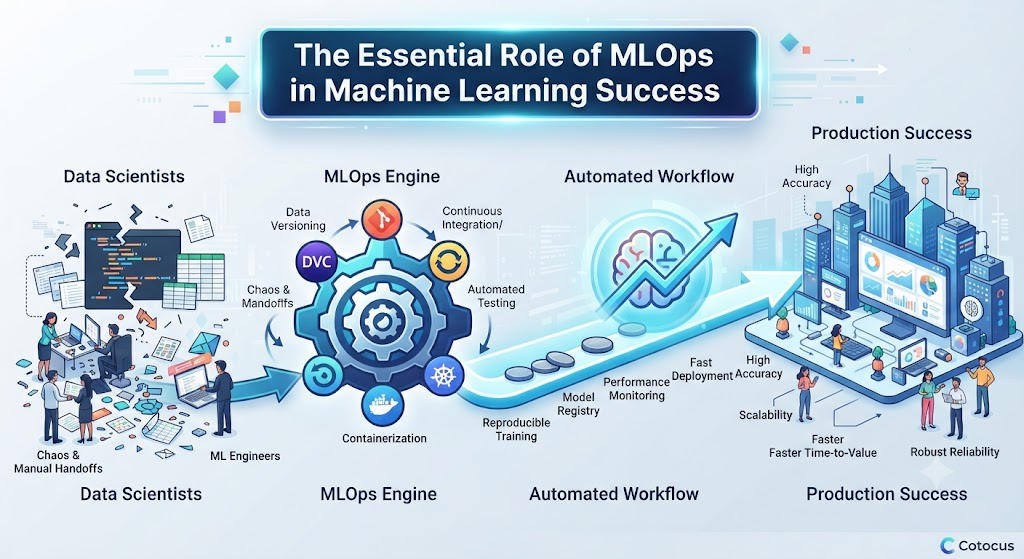
MLOps solves this problem by combining machine learning, data engineering, and software operations. Implementing MLOps from the very beginning transforms a fragile experiment into a stable, scalable production system.
What Is MLOps?
Professional Term
MLOps, short for Machine Learning Operations, is a set of practices that automates and standardizes the lifecycle of machine learning models from development to production.
Simple Meaning
MLOps is like a modern factory assembly line for artificial intelligence. It connects the people who write code, the people who manage data, and the people who keep servers running, ensuring that models move smoothly from a laptop experiment to a live application.
Why It Matters
Without MLOps, moving a model from development to production is a manual, error-prone chore. Teams waste valuable time moving files manually, arguing over which model version is correct, and fixing broken integrations. MLOps automates these repetitive tasks so engineers can focus on solving business problems.
Example
Imagine a restaurant kitchen. Without a standardized system, every chef cooks meals differently, ingredients get misplaced, and orders get delayed during rush hour. MLOps provides the kitchen with standardized recipes, automated dishwashing, and clear inventory tracking so every meal comes out fast and delicious.
How Machine Learning Differs From Traditional Software
To understand why machine learning projects need early operational discipline, you must understand how machine learning differs from regular software.
Traditional software is deterministic. Programmers write explicit instructions, such as: “If the user clicks this button, open the settings menu.” The computer follows the instructions the same way every single time. Testing and deployment are straightforward because the rules do not change on their own.
Machine learning is probabilistic. Instead of writing explicit rules, programmers feed historical data into an algorithm, and the algorithm learns the rules on its own.
This creates unique challenges:
- Data Dependency: The behavior of the system depends entirely on the data it receives. If the incoming data changes, the model’s behavior changes.
- Hidden Technical Debt: Machine learning systems require massive amounts of supporting infrastructure for data collection, feature extraction, and monitoring, far beyond the core algorithm code.
- Silent Failures: Traditional software throws an error message when it breaks. A broken machine learning model often continues running and outputting wrong answers without showing any warning signs.
Why MLOps Must Start From Day One
Many organizations make the mistake of treating MLOps as an afterthought. They build the model first and plan to “add MLOps later” once the system is live. This approach creates massive hurdles.
1. Avoiding Architecture Rewrites
If you build a model locally on a data scientist’s laptop using custom scripts and manual file paths, transitioning that model into a scalable cloud environment requires rewriting almost everything. Starting with MLOps principles ensures that code is written cleanly, containerized properly, and integrated with version control from the start.
2. Ensuring Reproducibility
In machine learning, getting a great result once is not enough. You must be able to recreate that exact result weeks or months later. Early MLOps tracks every experiment, including the exact code version, hyperparameters, random seeds, and dataset snapshot used during training.
3. Managing Data Lineage
Data changes constantly. If a model fails in production, you need to trace the exact dataset that trained it. MLOps pipelines track data lineage, showing how raw information transforms into features and feeds into the final model.
Core Components of an MLOps Pipeline
A robust MLOps setup consists of several interconnected stages that work together seamlessly.
Version Control for Code, Data, and Models
Traditional software uses Git for code. MLOps expands this to include data versioning and model registry tools. Every dataset and trained model artifact receives a unique tag, making it easy to roll back to a previous version if a new update degrades performance.
Automated Pipelines (CI/CD)
Continuous Integration and Continuous Delivery (CI/CD) automate the process of testing and deploying code. In MLOps, this extends to continuous training (CT), where pipelines automatically retrain models when new data arrives or when performance dips below an acceptable threshold.
Monitoring and Observability
Once a model goes live, it enters a changing world. Monitoring tools track latency, resource consumption, and prediction drift to alert engineers before small issues turn into major business outages.
Real-World Considerations: What Can Go Wrong Without MLOps
When teams skip MLOps during early development, they encounter severe operational roadblocks down the road.
Data Drift and Concept Drift
Real-world patterns change over time. For example, a fraud detection model trained in 2019 will struggle to detect new fraudulent behaviors emerging in 2026. This is known as concept drift. Without automated monitoring, a degraded model continues making inaccurate predictions in silence.
Manual Deployment Bottlenecks
When model updates require manual handoffs between data scientists and IT operations teams, deployments take weeks instead of minutes. This slows down innovation and frustrates stakeholders.
Security and Compliance Risks
Machine learning models often handle sensitive customer data, financial records, or healthcare information. Early MLOps integration ensures proper access controls, encryption, and audit trails required to meet regulatory standards.
Common Mistakes Teams Make
- Treating Data Science Like Academic Research: Spending months optimizing a model’s accuracy on static data without considering how the model will run in a live production environment.
- Ignoring Infrastructure Costs: Training large models without tracking compute resources, leading to unexpected cloud bills that derail project budgets.
- Neglecting Monitoring: Launching a model and assuming it will maintain its accuracy forever without setting up automated alerts for performance degradation.
- Siloed Teams: Keeping data scientists, software engineers, and operations teams in separate departments, leading to communication breakdowns and integration failures.
Decision-Making Framework: When and How to Apply MLOps
You do not need an enterprise-grade MLOps platform for a simple weekend prototype, but any project headed toward production needs a structured approach. Use this framework to guide your setup:
- Assess Project Scope: Is this a temporary proof-of-concept or a core business application? If it impacts customers or revenue, plan for MLOps immediately.
- Standardize Version Control: Set up Git repositories for code and lightweight tracking tools for datasets and model weights on day one.
- Automate Testing: Write unit tests for data validation and model outputs before deploying code to staging environments.
- Establish Monitoring Early: Instrument basic logging to track prediction accuracy and system latency from the first test deployment.
- Scale Gradually: Introduce advanced orchestration tools (such as Kubeflow or MLflow) only as project complexity and team size grow.
Checklist for Starting an MLOps Project
- Code stored in a version control system with clear branch protection rules.
- Datasets tracked and versioned alongside code modifications.
- Automated unit tests established for data validation scripts.
- Containerized environments (such as Docker) used to ensure consistency across development and production servers.
- Model registry configured to store trained model artifacts with metadata.
- Basic logging and performance monitoring set up for initial deployment testing.
Key Terms
- Model Drift: The decay in a machine learning model’s prediction accuracy over time due to changes in real-world data patterns.
- CI/CD: Continuous Integration and Continuous Delivery, a set of operating practices that automates software testing and deployment.
- Data Lineage: The traceable lifecycle of data from its raw source through every transformation step to its final destination.
- Hyperparameters: Adjustable configuration settings used to tune how a machine learning algorithm learns during training.
- Artifact: Any valuable file produced during the machine learning lifecycle, such as trained model weights, evaluation reports, or processed datasets.
- Containerization: Packaging software code and all its dependencies into a single lightweight container so it runs reliably on any computer.
Frequently Asked Questions
What is the main benefit of MLOps?
MLOps bridges the gap between data science experimentation and production software operations. It automates testing, deployment, and monitoring, reducing errors and ensuring models stay accurate over time.
Do small machine learning projects need MLOps?
Small projects or temporary prototypes may not need complex enterprise tooling. However, basic practices like version control, reproducible training scripts, and simple logging are valuable for every project.
When should a team start implementing MLOps?
Teams should integrate MLOps practices at the very beginning of a project. Setting up version control and reproducible environments early prevents painful architectural rewrites later.
What is the difference between DevOps and MLOps?
DevOps manages the lifecycle of traditional software applications. MLOps builds upon DevOps principles while adding specialized workflows to handle dynamic data, model training, and continuous evaluation specific to artificial intelligence.
How does MLOps prevent model drift?
MLOps pipelines include continuous monitoring tools that track incoming production data against training data baselines, alerting engineers or triggering automated retraining when performance drops.
Who is responsible for MLOps in an organization?
MLOps is a collaborative effort involving data scientists who build models, data engineers who manage pipelines, and operations engineers who maintain the underlying infrastructure.
Conclusion
Building a successful machine learning model is an impressive intellectual achievement, but getting that model running reliably in the real world requires operational discipline. Treating machine learning as a one-time experiment leaves systems vulnerable to changing data, silent failures, and costly maintenance overhead.
By implementing MLOps practices from the start, teams establish clear version control, automated testing, and proactive monitoring. This early foundation transforms artificial intelligence from a fragile prototype into a resilient, scalable asset that delivers long-term value.