Introduction
Building a machine learning model inside a notebook is very different from running that same model for thousands of real users.
Many data scientists build great models on their local computers. However, moving those models into a live software environment often leads to unexpected problems. Code fails, data changes over time, and tracking down bugs becomes difficult.
This gap between development and production is where machine learning operations comes in.
This guide explores a clear roadmap for data scientists and engineering teams. It explains what MLOps is, why it matters, and how teams can build a smooth workflow from research to production.
What Is MLOps?
MLOps stands for Machine Learning Operations.
Simple meaning: MLOps is a set of practices that combines machine learning, software engineering, and operations. It aims to deploy machine learning models into production safely and maintain them efficiently.
Why it matters: Without MLOps, machine learning projects often stay trapped on laptops. Teams waste time manually moving files, fixing broken code, and guessing why a model’s accuracy dropped. MLOps creates an automated assembly line for machine learning.
Example: Imagine a bank builds a fraud detection model. Without MLOps, updating the model requires developers to manually rewrite code and risk breaking the app. With MLOps, new data triggers automated tests, and the updated model deploys smoothly with zero downtime.
How MLOps Works
Traditional software engineering uses DevOps to test and release code automatically. MLOps adds unique machine learning needs to this process.
Machine learning is different from traditional software because systems depend on two things: code and data. If either changes, the model’s behavior changes.
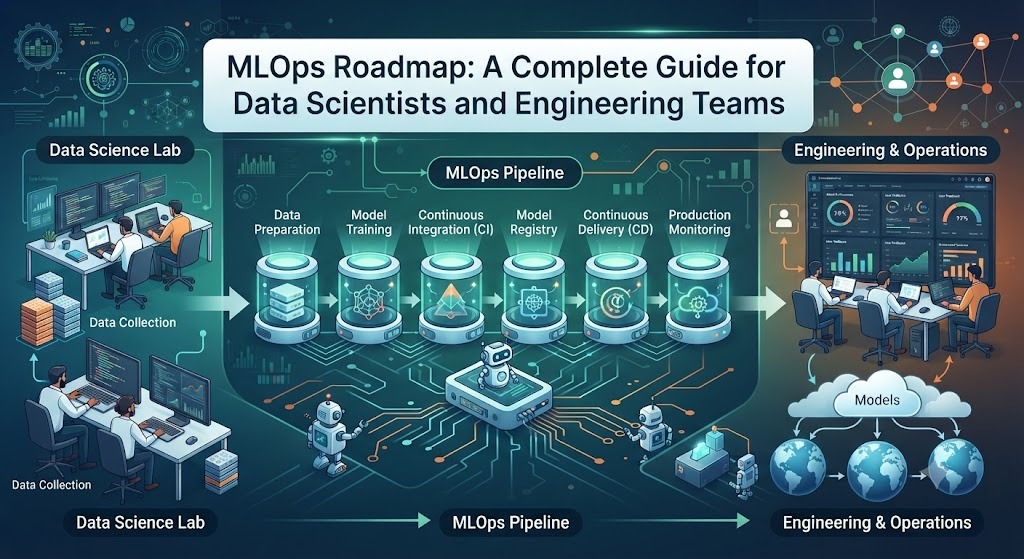
An MLOps workflow generally follows these stages:
- Data Engineering: Collecting, cleaning, and storing data safely.
- Model Development: Training algorithms, testing ideas, and tracking experiments.
- Continuous Integration (CI): Testing the code and data pipelines automatically.
- Continuous Delivery (CD): Packing the trained model into a container and deploying it to a server.
- Monitoring: Watching the live model for errors, slow speeds, and dropping accuracy.
Why MLOps Matters for Teams
When data science and engineering teams work in separate silos, projects fail. Data scientists focus on math and accuracy, while software engineers focus on system stability and speed.
MLOps bridges this gap by providing shared tools and common standards.
- For Data Scientists: It removes manual deployment chores so they can focus on improving algorithms and finding insights.
- For Engineers: It turns unpredictable machine learning models into stable, manageable software components.
- For Businesses: It reduces costs, speeds up delivery, and ensures AI features actually make money in the real world.
The MLOps Roadmap: Step-by-Step
A successful MLOps journey does not happen overnight. Teams usually move through several maturity levels, starting from manual work and moving toward full automation.
Phase 1: Manual Process and Exploration
In the beginning, teams build models manually.
- Focus: Writing code in local notebooks, tracking experiments by hand in spreadsheets, and handing off static model files to developers via email or chat.
- Limitations: Slow, prone to human error, and hard to reproduce.
Phase 2: Automation of Training and Pipelines
Teams begin to automate the steps required to build models.
- Focus: Setting up automated data pipelines and training scripts. Introducing version control for code using Git.
- Key Goal: Making sure anyone on the team can run the training script and get the same results.
Phase 3: Automated CI/CD for Machine Learning
This phase connects model training directly to software deployment.
- Focus: Building automated testing pipelines. Whenever code or data changes, the system retrains the model, runs quality tests, and prepares it for release.
- Key Goal: Reducing the time it takes to push a new model update from weeks to minutes.
Phase 4: Full Automated Monitoring and Feedback Loops
The final stage involves keeping a close eye on models running in the real world.
- Focus: Tracking data drift, model decay, and system performance automatically, triggering alerts or retraining when performance dips.
Key Components of an MLOps Architecture
Building an MLOps pipeline requires specific components that work together.
Feature Store
A centralized repository for organizing, storing, and sharing machine learning features across different teams. This prevents data scientists from writing the same data preparation code twice.
Model Registry
A version-controlled library where trained models are saved. It stores model weights, performance scores, and deployment history so teams always know which version is active.
Experiment Tracking
Tools that record parameters, datasets, and accuracy metrics during model training. This ensures every experiment is reproducible.
Pipeline Orchestration
Tools that schedule and manage automated workflows, ensuring data is cleaned before training starts, and training finishes before deployment begins.
Real-World Considerations
Putting MLOps into practice brings real-world challenges that teams must manage.
Complexity and Over-Engineering
Do not adopt complex enterprise tools if a simple script works. Start small. A basic automated script is better than an over-complicated platform that nobody knows how to use.
Skill Gaps
Data scientists may not know containerization tools like Docker, and software engineers may not understand machine learning evaluation metrics. Cross-training is essential.
Cultural Alignment
Tools alone will not fix an MLOps problem. Data science and engineering teams must communicate regularly, share responsibility, and agree on common workflows.
Common Mistakes to Avoid
- Treating MLOps as an afterthought: Waiting until a model is finished before thinking about how it will run in production leads to expensive rewrites.
- Ignoring data quality: Spending all your time tuning model parameters while ignoring messy, inconsistent input data.
- Manual tracking: Relying on memory or local folders to remember which parameters produced the best model version.
- No monitoring: Deploying a model and assuming it will run forever without checking if user behavior has changed.
Risks and Limitations
- Data Drift: Real-world data changes over time. A model trained on past data will eventually make mistakes if customer habits shift.
- Feedback Loops: If a model influences user behavior, it can create biased data that ruins future training cycles.
- High Infrastructure Costs: Running continuous automated training pipelines and real-time inference servers can become expensive quickly if not managed carefully.
Decision Framework: Where Should Your Team Start?
Use this simple checklist to figure out your team’s immediate next steps:
- Assess Your Current State: Are models deployed manually? If yes, focus on version control and basic packaging first.
- Identify Bottlenecks: Where do projects slow down? Is it data preparation, model training, or deployment? Fix the biggest bottleneck first.
- Choose the Right Tools: Pick tools that fit your existing cloud provider and team skill set rather than buying the most expensive platform on the market.
- Measure Success: Track metrics like deployment frequency, time-to-market, and system uptime to see if your MLOps process is improving.
Key Terms
- Continuous Integration (CI): The practice of automatically testing and merging code changes into a shared repository frequently.
- Continuous Delivery (CD): The practice of automatically preparing and releasing code or models to production environments.
- Data Drift: A change in the input data over time that causes a machine learning model’s accuracy to degrade.
- Model Registry: A centralized storage system for managing model versions, metadata, and artifacts.
- Feature Store: A warehouse for storing and sharing pre-calculated machine learning features across different projects.
- Artifact: Any valuable output generated during the machine learning lifecycle, such as trained weights, plots, or logs.
- Inference: The process of using a trained machine learning model to make predictions on new, unseen data.
- Containerization: Packing software code and all its dependencies into a single container so it runs reliably on any computer.
Frequently Asked Questions
What is the main difference between DevOps and MLOps?
DevOps focuses on automating software code delivery. MLOps includes everything DevOps does, but adds specific handling for machine learning data pipelines, model training experiments, and performance monitoring.
Do small teams need MLOps?
Small teams may not need complex enterprise platforms, but they still benefit from basic MLOps practices like version control, automated training scripts, and model tracking.
What programming languages are most common in MLOps?
Python is the primary language for data science and model building. Infrastructure tools often rely on configuration languages like YAML, alongside shell scripting and container management tools.
How does MLOps handle data drift?
MLOps systems monitor incoming production data against training data. When a significant difference is detected, the system can trigger automated alerts or retrain the model with fresh data.
Who is responsible for MLOps in an organization?
MLOps is usually a shared responsibility among data scientists, machine learning engineers, data engineers, and traditional software operations teams.
How long does it take to implement an MLOps roadmap?
Implementing an MLOps roadmap is an incremental process. Basic automation can take a few weeks, while a fully mature enterprise setup can take several months.
Conclusion
An MLOps roadmap is more than just a set of tools—it is a cultural and technical shift that connects data science experiments with reliable software engineering.
By starting small, automating manual steps, and monitoring models in production, teams can turn machine learning into a repeatable engine for business value. Focus on solving your biggest operational bottleneck first, keep your workflows simple, and build your MLOps capabilities step by step.