Introduction
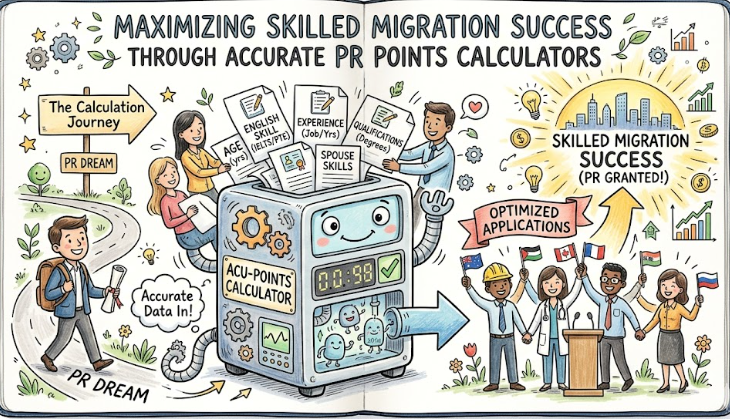
A PR Points Calculator is more than just a digital form; it is a sophisticated algorithm designed to evaluate a candidate’s potential to integrate into a new society and economy. In the competitive landscape of global migration, these tools act as the primary filter for immigration departments in nations like Canada, Australia, and New Zealand. By quantifying human attributes—such as linguistic dexterity, academic rigor, and professional tenure—the calculator provides a transparent, objective roadmap for aspiring residents.
Why Precision in Calculation Matters
For an applicant, the difference between a successful invitation and a rejected profile often comes down to a handful of points. Immigration eligibility is no longer a matter of “meeting the requirements” in a broad sense; it is about outperforming the median score of the current applicant pool. Utilizing a calculator allows you to:
- Identify Strategic Vulnerabilities: See exactly where your profile lacks (e.g., a specific language tier).
- Forecast Outcomes: Predict your chances based on historical “cut-off” trends.
- Optimize Documentation: Focus your energy on providing proof for the factors that carry the most weight.
The Turning Point: A Story of Strategic Migration
Consider the story of a lead developer named Arjun. Arjun had a stellar career, a high salary, and a Master’s degree. He assumed his residency in a new country was a “sure thing.” However, without checking a points calculator, he didn’t realize that his age was beginning to work against him. After a quick assessment, he discovered he was five points shy of the average invitation score.
Instead of despairing, he used the calculator to simulate different outcomes. He realized that if his spouse also took a language test and scored well, their combined score would exceed the threshold. This data-driven realization saved him from a year of waiting in uncertainty. Arjun’s story is a testament to why these tools are the first, and perhaps most critical, step in any migration journey.
What Is a PR Points Calculator?
The Philosophy of Points-Based Immigration
The concept of points-based immigration is rooted in “Human Capital Theory.” Governments believe that certain traits—youth, high education, and language skills—are reliable predictors of a person’s ability to find high-paying work and pay taxes, thereby supporting the local economy. Rather than relying on subjective interviews, these systems use a standardized scoring matrix to ensure fairness and economic efficiency.
How PR Points Determine Visa Eligibility
Your score in a PR Points Calculator determines your rank in a “Pool of Candidates.” Immigration authorities periodically conduct “draws” or “selection rounds.” During these rounds, the system selects the highest-ranking individuals and issues them an Invitation to Apply (ITA).
- The Threshold: If your points are above the cut-off, your path to residency is cleared.
- The Ranking: Even if you meet the minimum requirements, if your rank is too low, you may remain in the pool until your profile expires or you improve your score.
How Points Systems Work (General Overview)
At its core, a points system is an additive mathematical model. The fundamental formula can be visualized as:
$$Total Score = \sum (Core Human Capital) + \sum (Skill Transferability) + \text{Bonus Points}$$
Key Factors for Global Points Scoring
| Factor | Scoring Metric | Strategic Insight |
| Age | Highest points usually between 20 and 32. | This factor is a “depreciating asset.” The sooner you apply, the better. |
| Education | Bachelors < Masters < PhD. | Qualifications must be verified by recognized assessment bodies. |
| Language | CLB, IELTS, PTE, or JLPT levels. | This is the most “elastic” factor; you can always improve it through study. |
| Work Experience | Years in “Skilled” occupations. | Experience in the target country often counts for double. |
| Adaptability | Spouse’s skills, previous study, or local relatives. | These “minor” points often bridge the gap to the cut-off. |
Case Scenarios for Understanding Scores
- The High-Value Generalist: A 28-year-old with a Master’s and 3 years of experience. They score maximum points for age and high for education, making them a “gold standard” candidate.
- The Experienced Specialist: A 45-year-old with a PhD and 20 years of experience. They may lose 100 points on age but can recoup them through the “Education” and “Job Offer” categories.
Country-Specific Sections
Canada PR Points Calculator
Canada utilizes the Comprehensive Ranking System (CRS) within the Express Entry framework. It is divided into several sub-sections that target different aspects of your profile.
- The CRS Breakdown: Points are awarded for Core Human Capital (up to 600) and Additional Factors (up to 600), for a total of 1200 points.
- Step-by-Step Scoring Example:
- Age (29): 110 points.
- Education (Master’s): 135 points.
- Language (CLB 9): 124 points.
- Experience (3+ years): 50 points.
- Total Core: 419 points.
- Skill Transferability Bonus: (e.g., Masters + CLB 9) = 50 extra points.
- Final Score: 469.
Australia PR Points Calculator
Australia’s General Skilled Migration (GSM) is a “Step-Ladder” system. The minimum requirement is usually 65 points, but most successful applicants score between 85 and 95.
- Points-Based Skilled Migration: Australia focuses heavily on the “Points Test” for subclasses 189, 190, and 491.
- Distribution:
- Professional Year: Completing a professional year in Australia adds 5 points.
- Regional Study: Studying in a designated regional area adds 5 points.
- English: “Superior” English (IELTS 8 or equivalent) adds 20 points.
➡️ New Zealand PR Points Calculator
New Zealand’s Skilled Migrant Category (SMC) has recently moved toward a more simplified “6-point system” to streamline the process.
- Scoring Logic: Points are gained from professional registration, income (earning 1.5x to 3x the median wage), or qualifications.
- Tips: You can only claim points from one of these three categories, which is then added to points earned for skilled work experience in New Zealand.
Japan / Other Highly Skilled Systems
Japan uses the Highly Skilled Professional (HSP) points system, which provides a fast track to Permanent Residency.
- HSP Tiers: Points are awarded for academic background, annual salary, and age.
- Fast-Track Residency: Scoring 70 points reduces the PR wait time to 3 years; 80 points reduces it to just 1 year.
Global Migration Comparison Matrix
| Country | Primary System | Priority Factor | PR Wait Time (Avg) |
| Canada | Express Entry (CRS) | Language & Youth | 6 – 12 Months |
| Australia | SkillSelect | Occupation & Region | 9 – 15 Months |
| New Zealand | SMC (6-Point) | Income & NZ Experience | 12 – 18 Months |
| Japan | HSP System | Academic & Research | 1 – 3 Years |
Benefits of Using a PR Points Calculator
- Immediate Feedback: You don’t have to wait for an official response to know where you stand.
- Budget Planning: If your points are too low, you can save money by not submitting a weak application and instead investing that capital into improving your profile.
- Strategic Diversification: You might discover that your profile is “average” for Canada but “exceptional” for a specific Australian state nomination.
Step-by-Step Guide to Calculate Your Points
- Gather Official Documents: You cannot guess your points. You need your ECA (Educational Credential Assessment) and your language test results.
- Determine Your NOC/ANZSCO Code: Identify your specific job category as defined by the destination country’s labor department.
- Input Core Data: Enter your age, marital status (this affects scoring distribution), and education level.
- Add Spouse/Partner Details: In many systems, a spouse with high language scores can add up to 20-30 points to your total.
- Simulate “What If” Scenarios: Run the calculator again with a higher language score or a potential job offer to see how much your ranking improves.
How to Maximize Your PR Points
If you find yourself below the cut-off, consider these high-impact strategies:
- The “CLB 9” Jump: In the Canadian system, moving from CLB 8 to CLB 9 (IELTS 8777) doesn’t just add language points; it triggers “Skill Transferability” bonuses that can jump your score by 50+ points.
- Bilingual Bonus: Learning a second official language (like French for Canada) can add up to 50 additional points.
- State/Provincial Nomination: This is the “Holy Grail” of points. A nomination from a specific region often provides enough points to ensure an immediate invitation.
Common Mistakes to Avoid
- Misidentifying Skilled Work: Not all work experience counts. It must be “Skilled” (usually managerial, professional, or technical).
- Using Expired Results: Language tests are typically valid for only 2 years. Using an expired score will result in an automatic rejection.
- Double-Counting Points: Some applicants try to claim points for both a Master’s degree and a Bachelor’s degree simultaneously; usually, you only claim for the highest qualification.
Practical Case Studies
Case Study 1: The Tactical Retest
A senior analyst named Sarah found herself 15 points short of the Australian subclass 189 invitation threshold. She was frustrated because she had “Competent” English. After using a PR Points Calculator, she realized that achieving “Superior” English would grant her 20 additional points. She spent six weeks in an intensive preparation course, retook the exam, and achieved the score. She was invited in the next draw.
Case Study 2: The Provincial Pivot
A software engineer named Leo had a strong profile but was being outranked in the general pool by younger candidates. By analyzing his points, he realized he qualified for a Provincial Nomination program that targeted his specific technical stack. He focused his efforts on that province, received a nomination, and gained 600 points instantly, securing his PR in record time.
FAQs
Q: How should a candidate view the “Age Penalty” when planning a long-term migration strategy?
A: Strategically, age should be viewed as a hard deadline. For every year of delay after age 30, a candidate effectively loses a percentage of their competitive “equity” in the pool. The decision-maker should prioritize the application as soon as the Master’s degree or the 3rd year of work experience is completed to maximize the age-to-experience ratio.
Q: Is it more beneficial to apply as a single applicant or with a spouse?
A: This depends entirely on the spouse’s profile. If the spouse has a Master’s degree and high language scores, they are an asset that adds points. If the spouse has low language scores or a lower education level, it may actually lower the “Average” point score per person in the application. A strategic calculation is required for both scenarios.
Q: How accurate are PR points calculators during periods of high policy volatility?
A: Calculators are highly accurate for current rules, but they cannot predict “policy shifts.” A strategic applicant should monitor government announcements. A calculator tells you your score today; a strategy tells you if that score will be relevant tomorrow.
Q: Can professional certifications or non-degree qualifications boost points?
A: Generally, most systems only recognize formal academic degrees for core education points. However, certain certifications may assist in “Skills Assessment” stages (especially in Australia), which is a prerequisite for using the points calculator.
Q: What is the ROI of a Job Offer in the points system?
A: A job offer is the highest ROI factor, but it is also the hardest to obtain from abroad. It usually provides a “Point Buffer” that makes other factors—like age or slightly lower language scores—irrelevant. It is a strategic “fast-pass.”
Q: How does the “Human Capital” scoring differ from “Labor Market” scoring?
A: Human Capital (Canada) focuses on the person’s potential. Labor Market (New Zealand/Australia) focuses on the job’s necessity. A successful strategist will ensure their profile excels in both: having a strong personal score while targeting a high-demand occupation.
Conclusion
The PR Points Calculator is the fundamental tool for anyone seeking a global future. It replaces guesswork with data, and anxiety with a clear plan of action. By understanding the mechanics of age, education, and language, and by strategically utilizing country-specific nuances, you can move from being an “aspirant” to being a “resident.” The journey of immigration is long, but it starts with a single, accurate calculation.