Introduction
In the modern digital landscape, software delivery speed and infrastructure reliability separate market leaders from struggling businesses. For anyone looking to break into technology or elevate their existing engineering skills, learning DevOps is one of the most rewarding career moves available. This DevOps Tutorial for Beginners bridges the gap between basic concepts and expert-level production environments, giving you an actionable roadmap to engineering excellence.
To build an impactful career, you need more than just theoretical knowledge. You need a trusted ecosystem to guide you. Platforms like BestDevOps provide the tutorials, interview preparation, and real-world projects necessary to thrive. Concurrently, as engineering teams scale, measuring performance shifts from a luxury to an absolute necessity. Modern organizations leverage advanced DORA Metrics Tools like DevOpsIQ to track software delivery performance, lower MTTR, and unlock operational maturity.
Why This Topic Matters
The demand for skilled engineering professionals continues to climb because companies face massive challenges in scaling software delivery securely and efficiently. Manual deployments, fragmented environments, and a lack of visibility create bottlenecks that delay feature releases and cost businesses millions in downtime.
Automation removes human error from the deployment pipeline, ensuring that code moves smoothly from a developer’s laptop to production. Moreover, modern software must adhere to stringent reliability requirements; users expect applications to be globally available 24/7. Achieving this level of reliability while boosting engineering productivity requires a deep understanding of cloud automation, continuous integration, and data-driven management.
Industry Overview
DevOps emerged to shatter the traditional siloes separating software development (Dev) and IT operations (Ops). Historically, developers threw code “over the wall” to operations teams, who were left to deploy and maintain software they didn’t write. This friction led to frequent outages and agonizingly slow release cycles.
Today, the landscape has evolved into modern cloud-native engineering. The massive rise of Kubernetes and containerization changed how applications are architected, moving the industry toward microservices. This evolution catalyzed two specialized disciplines: Platform Engineering, which focuses on building Internal Developer Platforms (IDPs) to reduce cognitive load, and Site Reliability Engineering (SRE), which applies software engineering principles to infrastructure and reliability problems. Alongside these disciplines, Engineering Intelligence platforms have emerged, allowing organizations to substitute guesswork with data-driven performance metrics.
Core Concepts
Before diving into hands-on tools, you must master the fundamental paradigms that govern modern software delivery:
- Continuous Integration / Continuous Delivery (CI/CD): The backbone of DevOps. Continuous Integration ensures code changes are automatically tested and merged into a shared repository. Continuous Delivery automates the release of that validated code to staging or production environments.
- Containers & Orchestration: Packaging applications with their dependencies into isolated containers (like Docker) guarantees consistency across different environments. Orchestrators (like Kubernetes) manage the deployment, scaling, and networking of these containers at scale.
- Infrastructure as Code (IaC): Managing and provisioning infrastructure through machine-readable definition files rather than manual configuration. This brings software engineering best practices—like version control and testing—to cloud infrastructure.
- Observability & Monitoring: Moving beyond basic uptime tracking to gain deep visibility into system internals through logs, metrics, and traces, allowing teams to diagnose complex root causes rapidly.
- DevSecOps: Shifting security practices “left” by integrating automated security scans, compliance checks, and vulnerability assessments directly into the CI/CD pipeline from day one.
- GitOps: An operational framework that takes DevOps best practices used for application development—such as version control, collaboration, compliance, and CI/CD—and applies them to infrastructure automation, using Git as the single source of truth.
Step-by-Step Explanation: The DevOps Lifecycle
Implementing DevOps within an organization or an individual project follows a continuous, cyclical loop comprising plan, code, build, test, deploy, operate, and monitor stages.
1. Plan and Code
Teams collaborate to define features and track tasks using project management frameworks. Engineers write code in small, iterative batches and manage revisions using distributed version control systems like Git.
2. Build and Test
As soon as code is pushed to a repository, automated CI servers compile the application code and run comprehensive test suites (unit, integration, and security checks). If any test fails, the build breaks, notifying developers immediately.
3. Deploy and Operate
Successful builds produce immutable artifacts (such as Docker images) that are automatically deployed across staging and production environments using cloud automation frameworks. Infrastructure scaling, networking configurations, and load balancing occur programmatically.
4. Continuous Monitoring and Feedback
Once live, telemetry systems gather performance data. This data feeds back into the planning phase, closing the loop and driving iterative engineering productivity improvements.
Benefits of DevOps
Transitioning to a DevOps model yields undeniable technical and organizational advantages:
- Faster Deployments: Automation compresses release timelines from months to minutes, allowing businesses to outpace competition.
- Better Collaboration: Shared goals and transparent, automated pipelines break down historical friction between developer and operations teams.
- Improved Reliability: Smaller, incremental code changes are inherently lower risk and easier to troubleshoot when an anomaly surfaces.
- Reduced Downtime: Automated rollbacks and early error detection significantly limit the blast radius of buggy software updates.
- Enhanced Automation: Removing repetitive manual tasks frees engineers to solve high-value problems rather than fighting routine fires.
- Increased Engineering Productivity: Streamlined development workflows allow teams to focus on shipping valuable features rather than wrestling with infrastructure configurations.
Common Challenges and Solutions
Skill Gaps
The rapidly changing ecosystem leaves many engineers feeling overwhelmed by the sheer volume of technologies to learn.
- Solution: Follow a structured learning framework and leverage comprehensive platforms like BestDevOps to learn core competencies step by step.
Tool Complexity
A complex web of overlapping tools can cause analysis paralysis and create maintenance nightmares.
- Solution: Prioritize foundational, industry-standard tools (like Git, Docker, and Terraform) before adopting niche enterprise technologies.
Organization Resistance
Legacy mindsets often resist cultural transformations, viewing new automation frameworks with skepticism.
- Solution: Start small. Demonstrate clear value by automating a single, high-friction pipeline, and use concrete metrics to justify scaling the practice.
Best Practices
To maintain optimal engineering health, consistently apply these core principles within your team:
- Treat Infrastructure Like Application Code: Version control every cloud asset, write validation tests for your configurations, and conduct regular peer code reviews.
- Implement a Fail-Fast Architecture: Configure your CI/CD pipelines to run fast, lightweight tests first so developers receive feedback within minutes of pushing code.
- Enforce Immutable Infrastructure: Avoid logging into production servers to make ad-hoc configurations. Rebuild and redeploy containers or virtual machine images from scratch whenever changes are made.
- Embrace Post-Mortems and Blameless Culture: Treat outages as system design flaws rather than personal failures. Focus on optimizing configurations and monitoring to ensure the same bug never hits production twice.
Practical Examples and Real-World Use Cases
Startup Growth Acceleration
A rapidly growing e-commerce startup struggled with manual server deployments that took three hours and caused frequent site outages during peak holiday sales. By implementing Docker containerization and establishing an automated deployment pipeline via GitHub Actions, they slashed deployment time to under four minutes. This automation elevated their software delivery performance, making deployment days completely stress-free.
Enterprise Cloud Migration
A large financial services enterprise needed to migrate hundreds of monolithic on-premise applications to AWS while meeting strict regulatory compliance laws. Using Terraform for Infrastructure as Code and deploying microservices to Amazon EKS (Elastic Kubernetes Service), they maintained predictable, repeatable architecture across all environments. They integrated automated compliance testing directly into their CI/CD pipelines, proving that security and speed can coexist harmoniously.
Recommended Tools
Building a powerful stack requires picking the right tool for each stage of your continuous delivery loop. Here is a breakdown of the definitive Best DevOps Tools running modern infrastructure.
Best DevOps Tools Comparison
| Tool | Category | Primary Use Case | Best For |
| Git / GitHub | Version Control | Source code management & collaboration | Team-based code development |
| Jenkins | CI/CD Automation | Extensible pipeline orchestration | Highly customized, self-hosted build systems |
| Docker | Containerization | Packaging applications with dependencies | Ensuring local-to-production consistency |
| Kubernetes | Orchestration | Managing container clusters at scale | High-availability enterprise production |
| Terraform | IaC | Declarative cloud infrastructure provisioning | Multi-cloud infrastructure automation |
| Ansible | Configuration Mgmt | Application deployment and system configuration | Agentless server configuration adjustments |
| Prometheus | Monitoring | Time-series metrics collection | Cloud-native Kubernetes monitoring |
| Grafana | Visualization | Dashboards and analytics visualization | Centralizing multi-source performance graphs |
| DevOpsIQ | Engineering Intelligence | Tracking DORA metrics and engineering delivery | Organizations measuring delivery efficiency |
Career Opportunities
Acquiring these skills unlocks access to some of the most dynamic, high-paying engineering career paths in the global technology sector:
- DevOps Engineer: Focuses on optimizing CI/CD workflows, automating infrastructure, and facilitating collaboration between software teams.
- Site Reliability Engineer (SRE): Focuses primarily on application availability, latency, efficiency, emergency response, and capacity planning.
- Platform Engineer: Architects internal developer platforms (IDPs) to build frictionless, self-service infrastructure blueprints for product developers.
- DevSecOps Engineer: Specializes in securing automated delivery pipelines and ensuring cloud infrastructure remains compliant with global security standards.
Salary Insights
Compensations in this space remain exceptionally high, driven by the specialized skill sets required to run complex production architectures.
- Entry-Level: $85,000 – $115,000 per year. Strong foundational knowledge of Git, Linux administration, and script-based automation (Python/Bash) is typically required.
- Mid-Level: $120,000 – $160,000 per year. Requires hands-on experience running cloud architectures, configuring advanced CI/CD pipelines, and managing container environments.
- Senior-Level: $165,000 – $230,000+ per year. Mastery over orchestration tools like Kubernetes, multi-cloud enterprise architecture, data-driven SRE principles, and strategic engineering management.
Key factors that exponentially maximize your earning potential include obtaining industry-recognized cloud certifications, mastering Kubernetes orchestration at scale, and possessing the engineering intelligence to optimize critical team metrics.
Certifications & Learning Path
Earning widely respected industry credentials validates your practical technical competencies to recruiters and engineering hiring managers.
DevOps Certifications Comparison
| Certification | Provider | Skill Level | Focus Area |
| CKA (Certified Kubernetes Admin) | Cloud Native Computing Foundation | Intermediate to Advanced | Kubernetes cluster setup and administration |
| AWS Certified DevOps Engineer Professional | Amazon Web Services | Advanced | Provisioning, operating, and managing AWS environments |
| Azure DevOps Engineer Expert | Microsoft | Advanced | Designing and implementing enterprise DevOps strategies |
| Google Cloud Professional DevOps Engineer | Google Cloud | Advanced | Managing cloud operations and monitoring metrics |
| DevOps Foundation | DevOps Institute | Beginner | Core DevOps cultural principles and terminology |
DevOps Roadmap
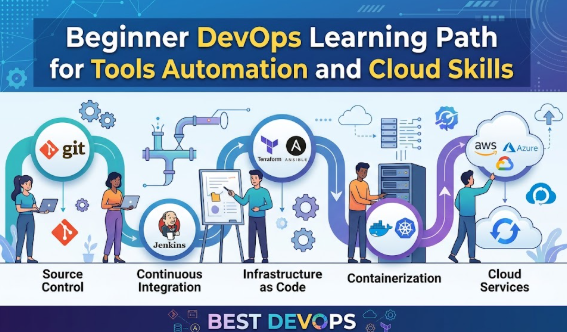
To navigate your learning effectively, follow this structured, tiered progression:
Beginner Level
Focus heavily on operating system fundamentals (primarily Linux), mastering command-line navigation, and understanding bash or Python scripting. Become proficient with Git version control workflows and learn the basics of building containers via Docker. Seek out an established Best DevOps Course to build an organized baseline.
Intermediate Level
Advance your skills by provisioning multi-tier applications onto cloud platforms like AWS, Azure, or Google Cloud. Dive deep into declarative Infrastructure as Code using Terraform. Master continuous integration by constructing automated pipelines that compile, test, and containerize applications smoothly.
Advanced Level
Learn to orchestrate mission-critical web applications inside production-grade Kubernetes environments. Build out comprehensive observability frameworks utilizing metric aggregators and visualization platforms. Focus heavily on advanced SRE practices, including defining SLOs and running automated incident management protocols.
DevOps Interview Questions
Review these common operational questions to refine your technical interviewing skills:
Q1: What is the primary operational difference between Continuous Delivery and Continuous Deployment?
In Continuous Delivery, code changes are automatically built, tested, and staged, but the final deployment to production requires manual human approval. In Continuous Deployment, every change that successfully passes the automated testing pipeline is released straight to production without human intervention.
Q2: Explain the core technical concept behind “Immutable Infrastructure.”
Immutable infrastructure means components are replaced rather than modified. Instead of logging into servers to update configuration software, you bake a fresh machine image or container with the updated settings, spin up the new instances, and terminate the old ones.
Q3: How does a Docker Container differ fundamentally from a Virtual Machine (VM)?
Containers share the host operating system’s kernel, making them lightweight, fast to boot, and highly resource-efficient. Virtual Machines include a full guest operating system running on top of a hypervisor, consuming significantly more compute resources and overhead.
Q4: What are Kubernetes Pods, and why are they important?
A Pod is the smallest deployable unit created and managed in Kubernetes. It represents a single instance of a running process in your cluster and can contain one or more containers that share storage, network resources, and specifications on how to run.
Q5: What problem does Infrastructure as Code (IaC) solve?
IaC eliminates environmental drift, configuration inconsistency, and manual error. By defining infrastructure in code files, teams can version control their networks, replicate architectures perfectly across environments, and safely roll back changes.
Q6: What is a Blue/Green Deployment strategy?
It is a release model that utilizes two identical production environments: Blue (current live version) and Green (new version). Traffic is routed to Blue. Once Green is fully tested and verified, a load balancer switches incoming traffic to Green, reducing deployment downtime and risk.
Q7: Define what an Error Budget is in Site Reliability Engineering (SRE).
An Error Budget is the maximum allowable downtime or rate of errors a system can experience before violating its Service Level Objective (SLO). It acts as a metric that balances engineering release velocity against overall system stability.
Q8: What does a 409 Conflict error in a CI/CD pipeline usually signify?
It typically denotes a version control mismatch or a state conflict where the pipeline is trying to apply an infrastructure change or merge a branch that does not align with the current real-world state stored in the Git remote repository.
Q9: Why is “Shift-Left” critical in modern software engineering?
Shift-Left means integrating security, performance, and compliance testing earlier in the development lifecycle. Identifying security flaws or architectural bottlenecks during the development phase is drastically cheaper and easier to resolve than fixing them post-release.
Q10: What is the main utility of an agentless configuration tool like Ansible?
Ansible uses standard SSH protocols to execute configuration management tasks directly on destination host machines. This removes the need to pre-install, update, and manage persistent client management agents on your target production infrastructure.
DevOps Projects
Building hands-on portfolio items is crucial to demonstrating your competence. Engage with concrete DevOps Projects across all tiers:
Beginner Projects
- Static Website Pipeline: Host a static HTML page on cloud storage (e.g., AWS S3) and set up GitHub Actions so any change committed to your repository automatically updates the website.
- Containerized Web App: Take a simple local Python or Node.js application, write a clean Dockerfile, package it into a secure image, and run it locally.
Intermediate Projects
- Automated Cloud Architecture: Write clean Terraform scripts that provision a Virtual Private Cloud (VPC), configure secure security groups, and deploy your application onto cloud instances behind an automated load balancer.
- Multi-Stage Jenkins Pipeline: Construct a pipeline that pulls code from GitHub, triggers automated testing suites, builds a Docker image, uploads it to a registry, and updates a staging server.
Advanced Projects
- Production Kubernetes Cluster Engine: Deploy a microservices-based application across a Kubernetes cluster. Implement GitOps practices via ArgoCD to manage deployments automatically whenever configuration files change.
- End-to-End Observability Grid: Configure Prometheus data scrapers to extract application health statistics across your infrastructure, and map those metrics to custom Grafana visualization charts.
Engineering Metrics & Performance Measurement
You cannot optimize what you do not measure. For engineering organizations to run efficiently, tracking software delivery performance is essential. The DevOps Research and Assessment (DORA) group spent years uncovering the precise operational metrics that distinguish high-performing engineering operations.
The four core DORA metrics provide a clear view of your operational health:
- Deployment Frequency: How often code is successfully deployed to production. High-performing teams release software multiple times per day.
- Lead Time for Changes: The total duration it takes for a commit to successfully travel from initial code check-in to a live production state.
- Change Failure Rate: The exact percentage of deployments that ultimately result in a production failure, degradation, or immediate service outage.
- Mean Time to Recovery (MTTR): The average time required to fully restore services when a critical production incident or system failure surfaces.
By measuring these metrics, engineering managers can pinpoint structural development bottlenecks, maintain strict SLO compliance, monitor error budgets, and make clear, data-driven operational investments.
How DevOpsIQ Helps Engineering Teams
Tracking these crucial benchmarks manually is incredibly error-prone and complex. That is where DevOpsIQ steps in as an indispensable engineering intelligence solution.
DevOpsIQ connects directly into your developer workflows, issue tracking grids, cloud infrastructure logs, and deployment environments to deliver Unified Engineering Visibility. It automatically tracks essential DORA metrics, allowing leaders to stop wasting energy compiling manual analytics spreadsheets.
With automated Deployment Analytics, DevOpsIQ continuously calculates your team’s unique operational pulse score. It uncovers incident correlation insights across your code repositories, simplifying MTTR Monitoring, SLO Tracking, and Error Budget Monitoring. Teams get the actionable reliability insights they need to boost performance, balance velocity with site stability, and systematically scale engineering productivity.
How BestDevOps Helps Professionals
If you are an individual navigating this fast-evolving technology field, BestDevOps serves as your ultimate companion platform for technical career growth.
The site breaks down complex ecosystem technologies through detailed DevOps Tutorials, interactive DevOps Roadmaps, and practical implementation blueprints. Whether you need structured Certification Guidance to clear tough exams like the CKA, or you are prepping for tough technical interviews using real-world DevOps Interview Questions, BestDevOps gives you a clear competitive edge.
The platform offers clear salary insights, transparent tool comparisons, and highly practical engineering projects to help you step away from abstract tutorials and start building production-ready architectures that command top dollar in the market.
Frequently Asked Questions
Is learning programming necessary to become a DevOps engineer?
Yes, coding skills are essential for success in this role. You do not need to build complex software architectures like a full-stack engineer, but you must write clean scripts in Python, Bash, or Go to automate systems, configure infrastructure, and build CI/CD pipelines.
What is the best entry-level certification to acquire?
For beginners, starting with a foundational cloud certification like the AWS Certified Cloud Practitioner or Microsoft Azure Fundamentals helps you understand cloud environments. Afterward, focus on highly practical certifications like the Certified Kubernetes Administrator (CKA).
How does Platform Engineering differ from standard DevOps?
DevOps focuses on cultural changes and automated workflows between developers and operations. Platform Engineering takes those concepts a step further by building an actual Internal Developer Platform (IDP) with self-service templates that shield developers from underlying infrastructure complexity.
Why are DORA metrics so critical for engineering teams?
DORA metrics give engineering leaders clear, objective data on release speed and system stability. Tracking these metrics removes subjectivity, helping teams identify bottlenecks and prove the business value of their automation efforts.
How does DevOpsIQ gather data from our infrastructure?
DevOpsIQ connects securely to your existing developer ecosystems, such as GitHub, Jira, Jenkins, and Kubernetes via standard API configurations, securely mapping your engineering lifecycle analytics without introducing performance overhead to your live production systems.
Can I learn DevOps without prior system administration experience?
Yes, you can absolutely learn DevOps without a background in sysadmin work, provided you build a solid foundation in Linux administration, networking basics, and command-line interfaces before moving on to complex orchestration tools.
What is environmental drift, and how do we prevent it?
Environmental drift occurs when ad-hoc manual updates cause staging and production environments to fall out of sync over time. You can prevent this drift by enforcing strict Infrastructure as Code policies, using tools like Terraform, and blocking manual changes to infrastructure.
How long does it typically take to transition into a DevOps role?
For professionals coming from a software engineering or system administration background, transitioning typically takes 3 to 6 months of dedicated learning. For complete technology beginners, it generally requires 9 to 12 months of structured study and hands-on project work.
What exactly is an Error Budget, and how does it prevent outages?
An Error Budget defines the acceptable level of system instability (e.g., 0.1% downtime) over a set period. If a team burns through their error budget due to frequent failures, new feature releases are paused, and engineering focus shifts entirely to stabilizing the infrastructure.
Where can I find realistic projects to practice my skills?
Platforms like BestDevOps offer excellent, real-world portfolio blueprints. These guide you through setting up fully automated pipelines, multi-tier cloud architectures, and live Kubernetes clusters that mimic production enterprise systems.
Conclusion
Mastering DevOps requires blending technical expertise, automation skills, and a data-driven mindset. From mastering core version control practices to orchestrating scalable enterprise workloads inside Kubernetes clusters, your journey along the DevOps Roadmap will open doors to some of the highest-paying, most impactful roles in tech. Whether you choose the path of an SRE or a Platform Engineer, your core focus will always remain centered on building fast, secure, and reliable software delivery engines.
As you scale your infrastructure, remember that technical execution is only half the battle. High-performing engineering organizations understand that sustainable growth relies on data-driven management. By leveraging comprehensive learning ecosystems like BestDevOps, individual professionals can acquire the skills, certifications, and project experience needed to thrive in the market. At the same time, teams can utilize advanced engineering intelligence platforms like DevOpsIQ to track DORA metrics, monitor error budgets, and continuously improve team output.
Looking ahead, the discipline will continue to evolve alongside AI-assisted cloud operations, automated self-healing infrastructures, and data-driven platform ecosystems. Committing to continuous learning and measuring your engineering delivery performance ensures your infrastructure stays resilient, agile, and prepared for future challenges.