Introduction
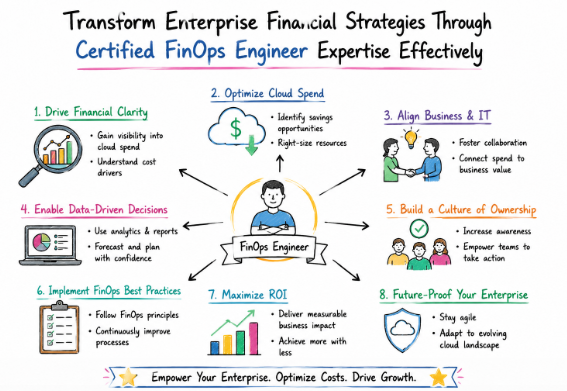
In the current landscape of cloud computing, managing infrastructure costs is as important as building the infrastructure itself. As businesses scale their digital footprints, the complexity of cloud spending increases significantly. Many organizations find that their cloud bills are growing faster than their actual business value. This is where the discipline of cloud financial management becomes vital. By mastering how to align cloud resources with budget requirements, engineers can become essential assets to their organizations. The Certified FinOps Engineer program is designed to bridge the gap between technical operations and financial accountability.
What is Certified FinOps Engineer
The Certified FinOps Engineer certification is a professional program focused on the intersection of cloud engineering and cost management. It provides a structured approach to monitoring, analyzing, and optimizing cloud expenditures across various service providers. Through this certification, participants learn how to implement cost-aware architecture and foster a culture of shared responsibility for cloud spending.
Why it matters today?
Today, cloud resources are consumed at an unprecedented rate. Without proper oversight, unnecessary spending often occurs due to over-provisioned instances, idle resources, or inefficient storage policies. Organizations are now prioritizing professionals who can demonstrate fiscal discipline alongside technical competence. By achieving this certification, engineers ensure that every dollar spent on cloud technology translates into direct business outcomes.
Why Certified FinOps Engineer certifications are important
Efficiency in cloud operations is no longer optional. When engineers are certified, they are equipped with standard frameworks and best practices to reduce waste. These certifications are important because they validate a professional’s ability to navigate complex pricing models and apply automation to cost-saving tasks. They provide a common language for technical teams and finance departments to communicate effectively.
Why Choose Finopsschool?
Finopsschool is chosen by professionals because the training is rooted in real-world application rather than abstract theory. The curriculum is maintained by active practitioners who understand the daily challenges of cloud financial management. Learning paths are designed to be practical, ensuring that skills gained can be applied to production environments immediately. Furthermore, the focus on vendor-neutral frameworks allows engineers to manage costs effectively across any cloud provider.
Certification Deep-Dive
What is this certification?
This certification is a comprehensive validation of an engineer’s ability to manage, monitor, and optimize cloud infrastructure costs. It covers the technical methods required to control spending while maintaining high performance.
Who should take this certification?
This program is intended for Cloud Engineers, DevOps specialists, SREs, and Finance professionals who work closely with cloud infrastructure and want to master cost-governance techniques.
Certification Overview Table
| Track | Level | Who it’s for | Prerequisites | Skills Covered | Recommended Order |
| Cloud Cost | Associate | DevOps Engineers | Cloud Basics | Cost Allocation | 1 |
| Infrastructure | Advanced | SREs | System Admin | Capacity Planning | 2 |
| Governance | Expert | Cloud Architects | Budget Management | Policy Enforcement | 3 |
| FinOps | Professional | FinOps Practitioners | Financial Analysis | Unit Economics | 4 |
| Optimization | Master | Engineering Managers | Strategic Planning | ROI Analysis | 5 |
Skills you will gain
- Advanced techniques for cloud cost attribution and allocation.
- Implementation of automated cost-saving policies within CI/CD pipelines.
- Deep understanding of reserved instance and savings plan management.
- Skill in building cost-aware dashboards for engineering teams.
Real-world projects you should be able to do after this certification
- Building a custom automated tagging strategy for multi-cloud environments.
- Developing a reporting system that maps infrastructure costs to specific product features.
- Executing a full-scale audit to eliminate unused resources and optimize instance sizing.
- Creating a monthly budget alert system integrated with internal communication tools.
Preparation plan
- 7–14 days plan: Focus on understanding core cloud pricing models and basic cost-tracking tools.
- 30 days plan: Combine theoretical study with hands-on practice in a sandbox cloud account to implement cost-optimization scripts.
- 60 days plan: Complete multiple lab-based projects and review case studies on complex cloud cost scenarios to prepare for certification exams.
Common mistakes to avoid
- Focusing only on the cheapest services rather than the most efficient ones.
- Ignoring the importance of tagging and resource labeling.
- Failing to collaborate with stakeholders before implementing cost-cutting changes.
Best next certification after this
- Same track: Certified Cloud Economist.
- Cross-track: Certified Site Reliability Engineer.
- Leadership / management: Certified Engineering Manager.
Choose Your Learning Path
- DevOps: Best for those focused on automating cost-governance within the deployment pipeline.
- DevSecOps: Ideal for engineers who need to manage cloud security costs alongside infrastructure protection.
- Site Reliability Engineering (SRE): Tailored for professionals balancing system availability with budgetary limits.
- AIOps / MLOps: Designed for teams managing high-cost GPU and data processing environments.
- DataOps: Best for individuals managing massive data storage and processing costs.
- FinOps: Perfect for those dedicated entirely to the lifecycle of cloud financial management.
Role → Recommended Certifications Mapping
| Role | Recommended Certification |
| DevOps Engineer | Certified FinOps Engineer |
| Site Reliability Engineer (SRE) | Certified SRE Professional |
| Platform Engineer | Certified Platform Engineer |
| Cloud Engineer | Certified Cloud Architect |
| Security Engineer | Certified DevSecOps Engineer |
| Data Engineer | Certified DataOps Professional |
| FinOps Practitioner | Certified FinOps Engineer |
| Engineering Manager | Certified Engineering Manager |
Next Certifications to Take
- Same-track: The Certified Cloud Economist certification is recommended next as it dives deeper into advanced pricing structures and high-level financial modeling for cloud environments.
- Cross-track: The Certified Site Reliability Engineer certification should be pursued to gain the technical proficiency required to maintain system stability while enforcing strict cost controls.
- Leadership-focused: The Certified Engineering Manager certification is essential for those moving into roles that require strategic decision-making and team-wide financial accountability.
Training & Certification Support Institutions
- DevOpsSchool: Provides extensive training and certification guidance for engineers looking to master DevOps practices and automation workflows.
- Cotocus: Offers specialized training programs for cloud-native technologies, focusing on hands-on lab environments for certification preparation.
- ScmGalaxy: Known for providing deep insights and training into supply chain management and related technical infrastructure certifications.
- BestDevOps: Focuses on delivering practical training modules that align with current industry standards for DevOps and cloud operations.
- devsecopsschool.com: Offers comprehensive training courses for professionals seeking to integrate security into their development and operations lifecycles.
- sreschool.com: Dedicated to building expertise in site reliability engineering through structured learning paths and practical projects.
- aiopsschool.com: Provides advanced learning modules for those interested in the application of AI and machine learning in operational environments.
- dataopsschool.com: Specialized training institution focusing on data operations and management best practices for modern engineering teams.
- finopsschool.com: The primary destination for specialized cloud financial management training and certification support.
FAQs Section
- What is the difficulty level of this certification?
It is structured for professionals, so it requires a solid understanding of cloud fundamentals and a commitment to hands-on practice. - How much time is required to prepare?
Most professionals dedicate between 30 to 60 days of consistent study to fully grasp the material. - Are there specific prerequisites?
Basic familiarity with cloud infrastructure platforms and general system administration is recommended. - What is the recommended certification sequence?
It is best to start with cloud fundamentals before moving into specialized tracks like FinOps. - What is the career value of this certification?
It is highly valued as it demonstrates a specialized skill set that directly impacts the bottom line of any company. - How do job roles grow with this certification?
Professionals can move into roles such as FinOps Lead, Cloud Cost Architect, or Engineering Manager. - Is this certification globally recognized?
Yes, the skills learned are based on universal cloud financial management frameworks. - Can I apply these skills to any cloud?
Yes, the principles taught are vendor-neutral and applicable to all major cloud providers. - Are there labs included?
Practical labs are a core component of the learning path provided by Finopsschool. - How is the exam structured?
The exam tests both theoretical knowledge and the ability to solve real-world cost-optimization scenarios. - Who validates these certifications?
These are professional certifications issued by industry-recognized training bodies. - What if I have limited experience?
The programs are designed to scale, allowing beginners to build a foundation while experts refine their strategies.
Certified FinOps Engineer FAQs
- What is the core focus of the Certified FinOps Engineer program?
The program focuses on the technical and financial processes required to optimize cloud spending. - Does this certification help with career advancement?
Yes, it positions you as a strategic thinker who can manage resources efficiently. - Will I learn to use cost-management tools?
You will gain proficiency in both native cloud tools and third-party cost-management solutions. - Is this only for finance professionals?
No, it is primarily for engineers and technical staff who manage the infrastructure. - How does this differ from standard cloud certifications?
It focuses specifically on fiscal governance and cost-efficiency rather than just service functionality. - Can I take this if I am a developer?
Absolutely, as developers are responsible for the resources that generate cloud costs. - What if my company uses multi-cloud?
The curriculum is designed to handle the complexities of multi-cloud billing and cost management. - Are the concepts updated regularly?
Yes, the content is updated to reflect the latest changes in cloud pricing and industry best practices.
Testimonials
- The hands-on projects helped me realize where our team was wasting budget. My confidence in managing cloud spend has grown significantly. — Arjun, DevOps Engineer
- This path provided the clarity I needed to bridge the gap between engineering goals and financial realities. The training was extremely practical. — Sarah, SRE
- I was able to apply the cost-allocation techniques immediately to our cloud environment. My team now has much better visibility into our spending. — David, Cloud Engineer
- The certification made me feel much more capable of leading secure and cost-efficient deployments. It was a great learning experience.— Priya, Security Engineer
- The structured approach to financial management has allowed me to make better strategic decisions for my department’s infrastructure needs.— Marcus, Engineering Manager
Conclusion
Achieving the Certified FinOps Engineer certification is a strategic move for any professional operating in the cloud space. It provides the necessary tools to transform cloud costs from an uncontrollable expense into a manageable asset. By mastering these skills, you ensure your long-term relevance and value within any engineering organization. It is highly recommended that you begin your planning and start your learning journey today to stay ahead in the competitive landscape of cloud engineering.