Introduction
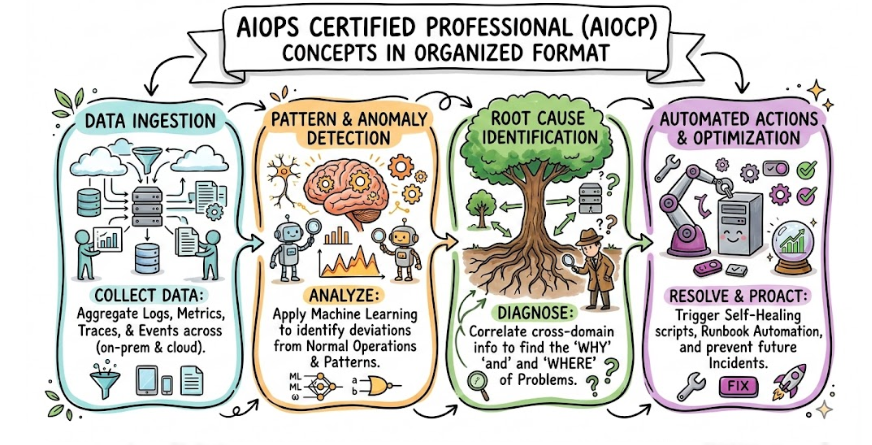
The landscape of digital infrastructure is being fundamentally redefined by the integration of intelligence into operational workflows. It is observed that traditional methods of managing software systems are no longer sufficient to handle the vast amounts of data produced by modern cloud environments. A shift is being made toward a future where machine learning is utilized to maintain system health and reliability. This guide is prepared to shed light on the AIOps Certified Professional (AIOCP) program and how it serves as a cornerstone for engineers navigating this new era.
What is AIOCP ?
The AIOps Certified Professional (AIOCP) is a credential that is granted to those who demonstrate a deep understanding of how artificial intelligence is applied to IT operations. In the current technology ecosystem, the complexity of microservices and global networks has reached a point where human intervention alone is too slow. Therefore, AIOps is seen as a necessary evolution. It allows for the automation of pattern recognition and the prediction of system failures before any impact is felt by the users.
For both individual contributors and engineering leaders, certifications are regarded as essential benchmarks for professional growth. A structured learning path ensures that knowledge is not just gathered randomly but is built upon a solid foundation of industry-recognized practices. By obtaining this certification, a professional is acknowledged as someone who can bridge the gap between traditional maintenance and intelligent, self-healing systems. It is this expertise that is increasingly sought after by organizations looking to maintain a competitive edge in a data-driven world.
Structural Breakdown of the Certification
| Specialization Track | Mastery Level | Intended Audience | Necessary Background | Competencies Developed | Suggested Sequence |
| Intelligent Operations | Professional | Cloud & Platform Engineers | Automation Fundamentals | ML for Ops, Data Mining | Post-DevOps Specialization |
Why is DevOpsSchool Selected by Professionals?
The choice of a training institution is often viewed as one of the most significant investments an engineer can make in their career. DevOpsSchool is frequently selected because the training is built on a foundation of practical experience rather than just theoretical concepts. It is recognized that the best way to learn is through the lens of real-world scenarios that simulate the pressures of a live production environment.
A comprehensive support system is provided to every learner, ensuring that complex topics are simplified and made accessible. The curriculum is constantly updated to reflect the latest changes in the industry, which ensures that the skills being taught are always relevant. By choosing this institution, access is gained to a global network of experts and a library of resources that have been refined over many years. This commitment to quality and student success is why the school remains a top choice for those aiming for the AIOCP credential.
Detailed Exploration: AIOps Certified Professional (AIOCP)
What is the purpose of this certification?
The AIOCP is a professional validation that confirms the ability of a technician to use machine learning algorithms to automate operational tasks. It is focused on the transition from reactive manual fixes to a proactive environment where data is used to drive every operational decision.
Who is this path intended for?
This program is designed for Software Engineers, Site Reliability Engineers, and Infrastructure Leads who are looking to advance their automation skills. It is also highly recommended for those in management who need to understand the strategic benefits of moving toward an AI-driven operational model.
Skills that are Acquired
- A comprehensive understanding is developed regarding how various data models are used to monitor system performance.
- Proficiency is gained in the collection and analysis of massive datasets from cloud-native environments.
- The ability to design and implement automated systems for identifying the root cause of complex errors is mastered.
- Expertise is built in the area of predictive analytics, allowing for the anticipation of resource shortages or hardware failures.
- A clear understanding is provided on how to integrate AI tools into existing deployment and monitoring pipelines.
Practical Projects to be Undertaken
- An intelligent dashboard is created that uses machine learning to filter out unnecessary alerts and focus on real issues.
- A predictive auto-scaling system is developed that adjusts resources based on anticipated traffic patterns rather than current load.
- An automated security monitoring tool is built that uses anomaly detection to identify potential unauthorized access in real-time.
The Learning Roadmap
The 14-Day Initial Phase
During the first two weeks, a strong focus is placed on the core principles that define AIOps. The terminology is learned, and the way AI differs from traditional automation is explored. The primary goals of the AIOCP exam are identified, and a basic study schedule is established.
The 30-Day Developmental Phase
In the second month, the focus is shifted toward the practical application of data science in operations. Time is spent working with datasets and learning how to train simple models for anomaly detection. The relationship between different operational metrics is studied in great detail.
The 60-Day Mastery Phase
The final stage is dedicated to the execution of full-scale projects and the completion of mock examinations. Real-world challenges are simulated to ensure that the AI models can handle unexpected failures. Peer reviews are used to identify any remaining gaps in technical knowledge.
Common Errors to be Avoided
- The quality of the data is sometimes neglected; it must be understood that an AI model cannot provide accurate results without clean, well-organized data.
- A common mistake is trying to implement complex solutions too early; it is advised to start with simple, high-impact use cases.
- The cultural impact of AI is often ignored; it is essential that the entire team understands and supports the shift toward intelligent operations.
Next Steps in the Certification Journey
- Within the Track: Advanced Machine Learning for Operations.
- Across Tracks: MLOps Certified Professional.
- For Leadership: Strategic Digital Transformation Lead.
Selection of a Specialized Learning Path
Choosing the correct path is vital for ensuring that your technical growth aligns with your professional aspirations. Six distinct paths are outlined below:
- The DevOps Path: This track is created for those who want to use AI to speed up the delivery of high-quality software.
- The DevSecOps Path: Here, the focus is placed on using intelligence to identify security threats before they can be exploited.
- The SRE Path: This journey is designed for those who are responsible for the uptime and reliability of massive, distributed systems.
- The AIOps & MLOps Path: A specialized track for individuals who wish to master the lifecycle of AI models in a production setting.
- The DataOps Path: The focus here is on the management and flow of data, ensuring that the AI systems have the fuel they need to operate.
- The FinOps Path: This path is intended for those who want to use AI to optimize cloud spending and manage budgets more effectively.
Role Alignment with Recommended Credentials
The mapping of job functions to specific certifications is provided to help in planning your career trajectory:
- DevOps Engineer: AIOCP and the Certified DevOps Professional.
- Site Reliability Engineer: AIOCP and the Certified SRE Professional.
- Platform Specialist: AIOCP and specialized Cloud Infrastructure tracks.
- Security Architect: AIOCP and the DevSecOps Certified Professional.
- Data Systems Engineer: AIOCP and the DataOps Professional credential.
- Cloud Cost Analyst: AIOCP and the FinOps Certified Associate.
- Engineering Manager: AIOCP and Leadership in Technology Management.
Suggestions for Continued Learning
To remain relevant in a rapidly changing market, continuous education is seen as a requirement. The following next steps are suggested:
- Primary Track: Advanced Predictive Analytics for IT.
- Cross-Track: MLOps Professional Certification.
- Leadership Focus: Executive Program in AI Strategy.
Organizations Providing Training and Support
Several institutions are available to provide the necessary guidance and resources for achieving these goals:
- DevOpsSchool: This is a well-known institution where hands-on training is prioritized. Every student is provided with the tools and mentorship needed to succeed in the certification exam.
- Cotocus: A practical approach is taken here, with courses that are designed around real-world industry problems. The training is delivered by experts who have deep production experience.
- ScmGalaxy: This platform serves as a vital community hub where knowledge is shared and the latest trends in automation are discussed. It is an excellent resource for any engineering professional.
- BestDevOps: Efficient and focused training programs are offered here to help professionals gain new skills quickly. The curriculum is designed to be both comprehensive and easy to follow.
- devsecopsschool.com: This site is dedicated to the integration of security into the development process. It is a key resource for anyone interested in protecting modern cloud applications.
- sreschool.com: Reliability and system performance are the core focus areas of this institution. It provides the specialized training needed for modern SRE roles.
- aiopsschool.com: As the name suggests, this platform is entirely dedicated to the world of AIOps. It is the most focused resource available for the AIOCP credential.
- dataopsschool.com: The management of data pipelines is taught here with a high degree of technical precision. It is an essential stop for DataOps practitioners.
- finopsschool.com: Financial management in the cloud is addressed through specialized training. This helps professionals master the art of cost optimization.
Frequently Asked Questions (FAQs)
General Career Questions
- What is the difficulty of the AIOCP certification?
It is considered an intermediate level that requires a strong foundation in operations. - How long is the typical preparation period?
Most professionals spend between 45 and 60 days preparing for the exam. - Are there specific prerequisites for the AIOCP?
While no formal rules exist, experience in a DevOps or Cloud environment is highly beneficial. - What is the best sequence for these certifications?
It is often recommended that a general automation certificate be earned before moving into AIOps. - Is this credential recognized in the Indian market?
Yes, it is highly valued by top technology firms across India’s major tech hubs. - What roles can be pursued after obtaining AIOCP?
Roles such as Automation Architect, SRE, and AIOps Engineer become accessible. - Is recertification necessary?
Staying current with technology is recommended, though specific renewal rules vary by provider. - How does AIOps impact career growth?
It is observed that professionals with these skills often see a significant increase in their career opportunities. - Can someone new to tech take this exam?
It is better suited for those who understand how modern software is deployed and managed. - Is online training available for this track?
Yes, all the mentioned institutions offer high-quality remote learning options. - Are labs a part of the training process?
Practical lab work is seen as an essential part of the learning journey. - Is the AIOCP recognized by global companies?
The certification is respected by technology organizations throughout the world.
Specific AIOCP Questions
- Which AI techniques are covered in the AIOCP?
The curriculum includes clustering, regression, and pattern matching for system logs. - Is coding a requirement for this certification?
A basic understanding of scripting languages like Python is considered very helpful. - How is AIOps different from traditional monitoring?
Traditional monitoring relies on fixed rules, while AIOps learns from the data itself. - Will this help in reducing the number of daily alerts?
Yes, the ability to filter out noise and focus on critical issues is a core part of the training. - Are tools like Prometheus or Grafana discussed?
The principles taught can be applied to any modern monitoring and observability suite. - What is the passing grade for the AIOCP?
A score of 70% or above is generally required to pass the examination. - Are mock tests provided during the training?
Yes, mock exams are used to help students gauge their readiness for the final test. - Can the certification be verified by employers?
A digital certificate with a verification link is provided to every successful candidate.
Perspectives from the Professional Community
“The way I view operational data was completely changed. A much deeper understanding of predictive maintenance was achieved through this program.”
— Kavya
“A significant shift in my career trajectory was experienced. The skills learned have made me a more valuable member of my engineering team.”
— Dimitri
“The practical projects were a highlight for me. Real-world problems were solved during the training, which gave me a great deal of confidence.”
— Zain
“A very clear and structured path was provided. The transition from manual tasks to intelligent automation was made very easy to understand.”
— Sana
“Skill improvement was noticed almost immediately. The ability to identify issues before they happen has changed how our operations team works.”
— Nikhil
Final Thoughts
The pursuit of the AIOps Certified Professional (AIOCP) designation is viewed as a strategic decision for any technical professional. As systems continue to evolve, the reliance on manual management will decrease, and the need for intelligent systems will grow. By completing this journey, an engineer is not just learning a new skill but is preparing for the future of the industry. Long-term benefits include increased career stability, higher earning potential, and the opportunity to lead the next wave of digital innovation. A careful and planned approach to education is encouraged for all who wish to succeed.