Introduction
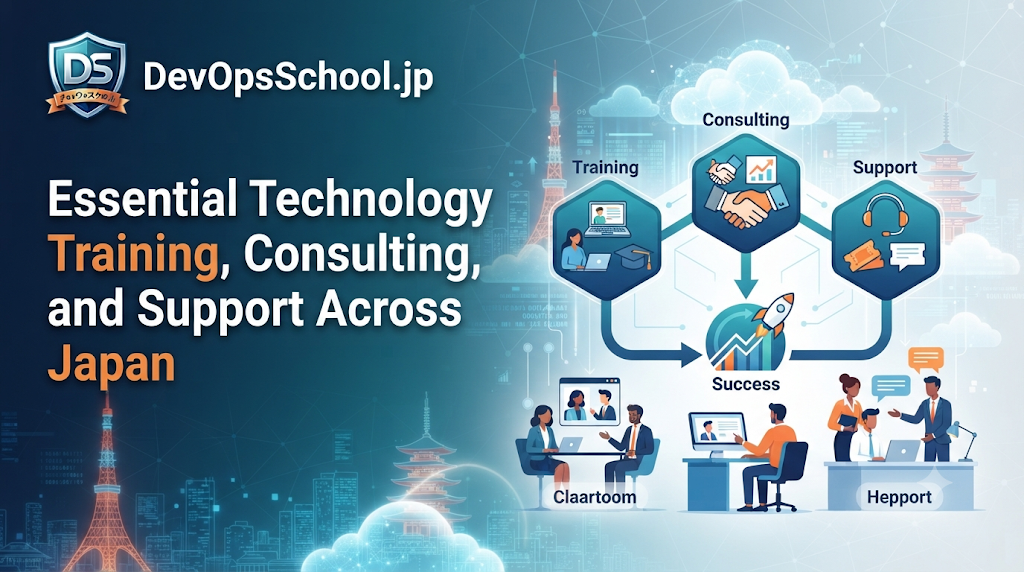
Many technology teams struggle when their software applications are ready, but getting those applications running smoothly on production servers takes too much manual effort. Writing code is only the first step. Modern software delivery requires careful handling of cloud infrastructure, automated deployments, system monitoring, and security checks. Without proper coordination, teams face bottlenecks, deployment errors, and prolonged system downtime. DevOpsSchool.jp addresses these engineering challenges as a Japan-focused platform that provides structured training, professional consulting, implementation assistance, and ongoing technical support for modern software engineering practices.
What Is DevOpsSchool.jp?
DevOpsSchool.jp is an educational and professional technical platform designed for organizations operating in Japan. It bridges the gap between traditional IT operations and fast-paced software development by offering structured learning programs and professional guidance.
The platform focuses on several core areas:
- Corporate Training: Delivering structured courses for engineering teams.
- Consulting: Helping organizations plan their technical transformation.
- Implementation Assistance: Guiding teams as they adopt new tools and workflows.
- Ongoing Support: Providing technical help after systems go live.
Rather than focusing on theory alone, the platform emphasizes practical methods that engineering teams can apply directly to their daily work.
Who Can Benefit from Its Technology Focus?
Different roles within a technology organization face unique daily challenges. A technical platform of this nature serves various groups across the industry:
- Developers: Need to understand how code moves from a local laptop to cloud servers without manual intervention.
- IT Managers: Look for ways to improve team productivity, reduce deployment errors, and align technical goals with business needs.
- Engineering Teams: Require shared knowledge so developers and operations staff can work together smoothly.
- DevOps Professionals: Want to deepen their expertise in automation, continuous integration, and infrastructure management.
- Enterprise Technology Teams: Need structured pathways to modernize legacy systems and adopt cloud-native architectures.
- Organizations Modernizing Infrastructure: Look for guidance on moving away from physical servers and manual setup processes.
- Teams Improving Software Delivery: Focus on speeding up release cycles while keeping production environments stable.
What Areas Does It Cover?
Modern software engineering relies on a connected set of tools and practices. The platform covers several technical disciplines that work together to create stable systems.
Continuous integration and continuous deployment ensure that code changes are tested and released automatically. Cloud-native technologies allow applications to run efficiently across scalable environments. Automation reduces human error during server setup and software updates. Monitoring tools keep track of system health so teams can spot issues before users notice them. When these elements connect properly, organizations can deliver software updates faster and with greater confidence.
Why Practical DevOps Training Matters
Many engineers understand software concepts from books, but applying those ideas in a real production environment is entirely different. Practical learning helps teams understand how automation scripts, continuous integration pipelines, and server configurations interact during actual software releases.
When companies want to upskill their staff, structured DevOps 研修 programs provide hands-on experience with real-world scenarios. For larger organizations, organizing structured DevOps corporate training Japan sessions ensures that all team members share a common understanding of modern workflows, collaboration practices, and automated delivery pipelines.
How Cloud-Native Skills Fit Into DevOps
Cloud-native engineering changes how applications are built, packaged, and run. Instead of relying on a single large server, modern applications run inside isolated packages called containers. Managing hundreds of these containers requires specialized tools.
This is where container orchestration tools become essential. Through targeted Kubernetes 研修 programs, engineers learn how to manage, scale, and secure containerized applications across different server environments. At the same time, managing physical cloud servers manually is too slow for modern teams. Tools that allow infrastructure to be written as code solve this problem. Participating in Terraform 研修 helps engineers learn how to define cloud servers, networks, and storage using readable configuration files, making infrastructure changes repeatable and easy to track.
How Reliability and Security Connect With DevOps
Moving software quickly is important, but systems must also remain stable and secure. If an application crashes frequently or suffers security breaches, fast delivery loses its value.
Site Reliability Engineering focuses on system uptime, performance monitoring, and incident management. Participating in SRE 研修 helps teams learn how to set service level objectives, analyze failure logs, and build resilient production systems. At the same time, security cannot wait until the end of a project. Integrating security checks early in the development cycle is essential. Through DevSecOps 研修 programs, engineers learn how to run automated security scans, check code for vulnerabilities, and secure cloud environments without slowing down release schedules.
How MLOps Extends Modern Engineering Practices
Machine learning models require a different approach compared to standard software applications. Once a data scientist trains a model, that model must be deployed, monitored, and updated as new data arrives.
Machine learning operations bring traditional engineering discipline into the world of data science. Through specialized MLOps 研修 sessions, teams learn how to automate the deployment of machine learning models, monitor prediction accuracy over time, and manage large datasets reliably. This ensures that artificial intelligence projects move smoothly from experimental notebooks into stable production systems.
Consulting and Technical Support
Training is only the first part of technical growth. Organizations often need expert guidance when planning major architectural changes or solving complex production problems.
Seeking professional DevOps コンサルティング helps companies assess their current workflows, plan safe migrations, and choose the right tools for their specific needs. When internal teams face difficult technical hurdles, working alongside an experienced DevOps consultant Japan provides outside perspective and expert troubleshooting. Additionally, having access to reliable DevOps support Japan ensures that engineering teams receive ongoing assistance during critical deployments and system upgrades.
Five-Step Process for Planning a DevOps Skill Development Program
Step 1: Identify Current Skills and Problems
Review current engineering workflows to find bottlenecks, manual deployment steps, or recurring system failures.
Step 2: Define the Required Skills
Determine whether the team needs foundational automation knowledge, container management, infrastructure as code, reliability practices, or security integration.
Step 3: Build a Practical Learning Plan
Combine theoretical study with hands-on lab exercises that reflect actual engineering projects.
Step 4: Apply the Skills to Real Work
Encourage team members to use their new knowledge on internal staging environments and non-critical projects before touching main production systems.
Step 5: Measure and Improve
Review deployment speed, system uptime, and team feedback after training to identify the next areas for growth or technical support.
Common Mistakes Organizations Should Avoid
- Learning tools without understanding the problem: Adopting complex software simply because it is popular without knowing what issue it solves.
- Focusing only on theory: Reading books or watching videos without writing actual configuration files or running test deployments.
- Ignoring hands-on practice: Skipping lab sessions during learning programs.
- Choosing training without checking team needs: Enrolling staff in advanced classes before they understand foundational concepts.
- Treating DevOps as only an operations topic: Forgetting that developers must also understand deployment and infrastructure.
- Ignoring security: Adding security checks only at the very end of a project instead of during development.
- Ignoring reliability: Failing to set up proper monitoring and logging before releasing applications to users.
- Trying to adopt too many technologies at once: Overwhelming the team by introducing Kubernetes, Terraform, and advanced monitoring all on the same day.
Real-Life Example
Consider a Japanese software company named Tokyo Web Solutions. The company has talented developers who write excellent application code, but every time they release an update, the operations team has to deploy everything manually on cloud servers. This manual process causes frequent delays and occasional human errors.
To solve this, Tokyo Web Solutions first reviews its internal workflows and identifies manual server setup as the main bottleneck. The company arranges structured learning sessions focusing on basic automation and continuous delivery. Next, the engineers take part in container and infrastructure workshops to learn how to manage cloud resources using code.
Over the next few months, the team applies these new methods to a staging environment, gradually automating their release pipeline. As their confidence grows, they add monitoring tools to track system stability. By combining structured skill development with practical application, the company successfully reduces deployment time and improves overall system reliability.
Technical Areas and Their Primary Focus
| Area | What It Helps Teams Understand |
| DevOps | Collaboration, automation, and software delivery workflows |
| Kubernetes | Container management and orchestration across servers |
| Terraform | Infrastructure as Code and automated cloud provisioning |
| SRE | Reliability engineering, monitoring, and production operations |
| DevSecOps | Security practices integrated directly into software delivery |
| MLOps | Operating, monitoring, and scaling machine learning systems |
Frequently Asked Questions
1. What is DevOpsSchool.jp?
It is a Japan-focused platform that provides technology training, professional consulting, implementation assistance, and technical support for modern software engineering practices.
2. What does DevOps training cover?
It covers automation, continuous integration, continuous delivery pipelines, collaboration between teams, and efficient software release processes.
3. Why are Kubernetes skills useful for DevOps teams?
Kubernetes helps teams manage, scale, and run containerized applications reliably across different cloud environments.
4. What is the purpose of Terraform training?
It teaches engineers how to define and manage cloud servers and network infrastructure using readable configuration files instead of manual clicks.
5. How does SRE connect with DevOps?
Site Reliability Engineering focuses on system uptime, performance monitoring, and incident management, ensuring that automated software releases remain stable in production.
6. What does DevSecOps add to software delivery?
It integrates security checks, vulnerability scanning, and compliance verification early into the development cycle rather than treating security as an afterthought.
7. Why is MLOps important for machine learning systems?
It provides the operational practices needed to deploy, monitor, and update machine learning models reliably in production environments.
8. What does DevOps consulting involve?
It involves assessing an organization’s current technical workflows, planning safe transformations, and recommending appropriate tools and processes.
9. What does corporate DevOps training mean in Japan?
It refers to structured educational programs designed specifically for Japanese enterprises and engineering teams to build modern technical skills together.
10. When might an organization need ongoing DevOps support?
An organization may need ongoing technical support when modernizing legacy systems, handling complex cloud migrations, or troubleshooting critical production environments.
Conclusion
Modern software development requires much more than writing good application code. Engineering teams must understand cloud infrastructure, container orchestration, infrastructure automation, system reliability, security practices, and machine learning operations. Platforms like DevOpsSchool.jp play a valuable role in the Japanese technology ecosystem by offering structured education, consulting, and professional support. Organizations that take time to assess their internal needs, invest in practical skill development, and combine training with real-world application can build stable, efficient, and scalable software systems.