Introduction
The landscape of software engineering is undergoing a fundamental transformation. For decades, the industry was focused on the stability of static code and predictable logic. However, the rise of Artificial Intelligence has introduced a new variable: data that changes constantly. This shift has created a critical need for a new discipline. The MLOps Certified Professional (MLOCP) is the standard created to meet this challenge, ensuring that machine learning is handled with the same rigor as traditional software.
What is MLOps Certified Professional (MLOCP)?
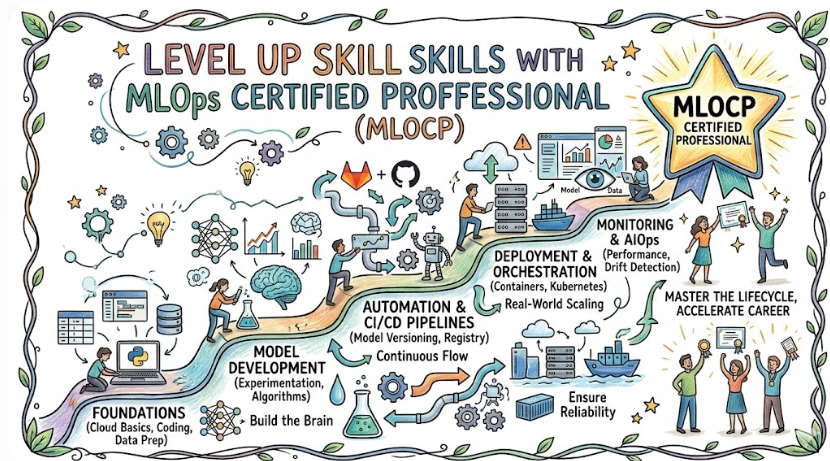
Machine Learning Operations (MLOps) is not merely a collection of tools; it is a cultural and technical shift. The MLOps Certified Professional (MLOCP) designation is awarded to those who demonstrate mastery over the entire lifecycle of a machine learning model. This journey begins at the data ingestion phase and continues long after a model has been deployed.
It is often observed that data scientists are experts at creating “the brain,” but the infrastructure required to support that brain is often fragile. An MLOCP expert builds the robust “nervous system.” This involves creating automated pathways where data flows, models are trained, and performance is monitored without manual intervention. It is the bridge that connects the experimental world of data science with the high-availability world of IT operations.
Why It Matters in Today’s Software Ecosystem
In the modern cloud era, speed is everything. However, speed without reliability leads to disaster. Many organizations find that their AI models perform beautifully in a controlled lab environment but fail miserably when exposed to real-world data. This is known as “production friction.”
MLOCP is vital because it introduces the concept of Continuous Everything.
- Continuous Integration is applied not just to code, but to the data itself.
- Continuous Deployment ensures that when a better model is trained, it replaces the old one safely.
- Continuous Monitoring ensures that if the model starts making poor decisions due to changing market trends, the engineering team is alerted immediately.Without these automated guardrails, AI is a liability; with them, it is a powerful competitive advantage.
Why Certifications are Important for Engineers and Managers
For the individual engineer, the path to seniority is often cluttered with “tutorial hell.” A certification like MLOCP provides a structured, validated curriculum that separates useful knowledge from noise. It acts as a professional signal, proving that the engineer possesses the discipline to manage complex, multi-stage automation pipelines that are critical to business revenue.
For leadership, the stakes are even higher. Engineering managers are often tasked with delivering AI-driven products without having a deep background in data science. By encouraging or requiring MLOCP certification, a standardized framework is established. It ensures that the team uses the same terminology, follows the same security protocols, and adheres to the same deployment standards. This reduces the risk of project failure and ensures that the infrastructure is built to scale from day one.
Certification Overview Table
| Track | Level | Who it’s for | Prerequisites | Skills Covered | Recommended Order |
| MLOps | Professional | DevOps, SRE, & Data Engineers | Basic DevOps & Python | Automated Pipelines, Drift Detection, Model Governance | Follows DevOps Professional |
Why Choose DevOpsSchool?
DevOpsSchool is frequently chosen by global professionals because the gap between theoretical knowledge and industrial reality is bridged effectively. The curriculum is not built on slide decks alone; it is rooted in thousands of hours of real-world consulting experience. Every lesson is designed to solve a problem that an engineer will actually face in a production environment.
A heavy emphasis is placed on hands-on mastery. Participants are not just told how a pipeline works; they are required to build, break, and fix one. This methodology builds “muscle memory” that is invaluable during high-pressure production incidents. Furthermore, a global community of experts is provided, ensuring that learners have access to mentorship and peer support long after the certification is achieved.
Certification Deep-Dive: MLOps Certified Professional (MLOCP)
What is this certification?
The MLOCP is a high-level professional credential that validates an engineer’s ability to automate the machine learning workflow. It moves beyond simple “coding” and focuses on the orchestration of data, models, and code into a single, unified delivery stream.
Who should take this certification?
- DevOps Engineers: Those who wish to expand their automation skills into the realm of AI and Data Science.
- Site Reliability Engineers (SREs): Professionals responsible for the uptime and performance of AI-powered platforms.
- Data Engineers: Individuals who build the pipelines that feed machine learning models and want to ensure those pipelines are production-ready.
- Software Architects: Leaders who need to design systems where machine learning components interact seamlessly with traditional microservices.
Skills you will gain
- Automated Pipeline Orchestration: The ability to build workflows that trigger model retraining automatically when new data patterns are detected.
- Model Versioning and Data Lineage: Mastery over tracking which specific version of data was used to train a specific version of a model, which is essential for audit and compliance.
- Scalable Inference Infrastructure: Knowledge of how to deploy models using containers and orchestrators like Kubernetes to handle millions of user requests.
- Performance Monitoring and Drift Detection: Skills in setting up alerts that trigger when a model’s accuracy begins to decay in the real world.
- Security for ML (DevSecOps Integration): Ensuring that the models and the data they consume are protected from unauthorized access or malicious “poisoning” attacks.
Real-world projects you should be able to do
- The Automated Retraining System: A project is built where a pipeline detects “Data Drift” (when real-world data changes) and automatically kicks off a new training job, evaluates the result, and prepares it for deployment.
- The Model API Gateway: Designing a system that hosts multiple versions of a model simultaneously, allowing for “A/B testing” to see which version performs better with actual users.
- The Centralized Feature Store: Creating a shared repository where data features are stored and reused across different teams, ensuring consistency and saving hours of repetitive data preparation.
Preparation Plan
- 7–14 Days Plan (The Foundation): The primary focus is placed on the “MLOps Mindset.” The differences between traditional software and ML software are studied. Basic tools for containerization and version control are reviewed to ensure the technical foundation is solid.
- 30 Days Plan (The Implementation): Deep technical dives are conducted into CI/CD tools tailored for ML. Hands-on labs are performed daily, focusing on building simple pipelines that automate the movement of data from a database into a trained model file.
- 60 Days Plan (The Mastery): Full-scale, end-to-end production scenarios are simulated. Complex topics like distributed training, high-availability model serving, and automated security scanning for ML artifacts are mastered through repetitive practice and troubleshooting.
Common mistakes to avoid
- Treating Models Like Static Code: Models are “living” entities; they decay over time. The mistake of deploying a model and never checking its accuracy again must be avoided.
- Neglecting Data Quality: Huge amounts of time are often wasted fixing code when the actual problem is “dirty” or biased data. Data validation must be integrated into the pipeline.
- Over-Engineering Early: It is a common pitfall to use the most complex tools available when a simple, well-structured script and a basic CI/CD tool would suffice. Focus is kept on solving the business problem first.
Best next certification after this
- Same Track: Advanced AI Infrastructure Specialist.
- Cross-Track: DevSecOps Certified Professional (to secure the AI pipelines).
- Leadership: Engineering Manager / Director of Platform Engineering.
Choose Your Learning Path
1. DevOps Path
This is designed for the automation enthusiast. The focus is placed on making the delivery of software as fast and frictionless as possible. It is best for those who enjoy building the “highways” that code travels on.
2. DevSecOps Path
This path is for the security-conscious engineer. It is based on the philosophy that security is everyone’s responsibility. It is best for those who want to build “impenetrable” automated pipelines where every line of code is scanned for vulnerabilities.
3. Site Reliability Engineering (SRE) Path
The SRE path is for those who value stability above all else. It focuses on monitoring, incident response, and building “self-healing” systems. It is best for engineers who enjoy solving complex puzzles under pressure.
4. AIOps / MLOps Path
This is the “Future-Proof” path. It is tailored for engineers who want to work at the intersection of intelligence and operations. It is best for those who want to manage the sophisticated systems that power modern AI applications.
5. DataOps Path
DataOps is for the data-centric engineer. The focus is on the “plumbing” of data—ensuring it is clean, secure, and delivered to the right place at the right time. It is best for those who want to manage the lifeblood of the modern enterprise.
6. FinOps Path
This path is for the strategic engineer who understands that cloud costs can spiral out of control. It focuses on the financial optimization of technology. It is best for those who want to show the business the “Return on Investment” for every dollar spent in the cloud.
Role → Recommended Certifications Mapping
| Role | Primary Certification | Strategic Secondary Step |
| DevOps Engineer | DevOps Professional | MLOCP (To handle AI workloads) |
| SRE | SRE Professional | AIOps Professional (To automate monitoring) |
| Platform Engineer | Kubernetes Professional | DevSecOps Professional |
| Cloud Engineer | Cloud Architect | FinOps Certified (To manage cloud spend) |
| Security Engineer | DevSecOps Professional | SRE Professional (For secure reliability) |
| Data Engineer | DataOps Professional | MLOCP (To bridge into ML Engineering) |
| FinOps Practitioner | FinOps Certified | DevOps Professional |
| Engineering Manager | Leadership Program | SRE Professional (To understand risk) |
Next Certifications to Take
For the Technical Individual Contributor:
- Same-track: Kubernetes Certified Administrator (CKA).
- Cross-track: MLOCP.
- Leadership: Certified DevOps Leader.
For the Data-Focused Professional:
- Same-track: Advanced Data Architecture.
- Cross-track: DevSecOps Professional.
- Leadership: Data Engineering Manager.
Training & Certification Support Institutions
DevOpsSchool
An industry leader that provides comprehensive training across the entire “Ops” spectrum. The focus is kept strictly on job-readiness, ensuring that every participant can handle real-world production environments with confidence.
Cotocus
A specialized institution known for its high-end technical consulting and deep-dive training. It is the preferred choice for enterprises looking to upskill their workforce in complex cloud-native architectures.
ScmGalaxy
A massive knowledge hub and community platform. It is widely recognized for its extensive library of tutorials, open-source resources, and foundational training in configuration management and CI/CD.
BestDevOps
This platform offers streamlined, practical learning paths designed for the busy professional. The curriculum is stripped of fluff, focusing only on the tools and techniques that matter in today’s market.
devsecopsschool.com
A dedicated portal for the “Security First” movement. It provides specialized training that teaches engineers how to weave security into the very fabric of the DevOps pipeline.
sreschool.com
The premier destination for learning the art of reliability. Training is focused on the Google-pioneered principles of SRE, including error budgets, toil reduction, and incident management.
aiopsschool.com
This institution focuses on the application of AI to IT operations. It teaches engineers how to use machine learning to predict outages and automate routine maintenance tasks.
dataopsschool.com
Education is provided here on the management of data delivery. It helps engineers build automated, high-quality data pipelines that serve as the foundation for all business intelligence.
finopsschool.com
The central resource for cloud financial management. It provides the training necessary to bring financial accountability to the variable spend model of the cloud.
FAQs Section
1. How difficult is the MLOCP certification?
The exam is designed to be challenging. A solid grasp of automation and a basic understanding of how machine learning models are trained is required. It is not a “beginner” exam; it is a professional-level validation.
2. How much time is needed to prepare?
For a working professional, 6 to 10 hours a week over a period of 2 months is generally sufficient to master the material and pass the exam.
3. Are there any prerequisites?
While not mandatory, having a basic DevOps certification or 2 years of experience in cloud operations makes the journey much smoother.
4. What is the recommended sequence for certifications?
It is suggested to start with a General DevOps certification, followed by Kubernetes mastery, and finally moving into the specialized MLOCP track.
5. What is the career value of this certification?
Engineers with MLOps skills are among the most sought-after in the tech industry today. It often leads to “Lead” or “Principal” roles in AI-driven companies.
6. Which job roles can I apply for?
The certification prepares you for roles such as MLOps Architect, Machine Learning Operations Engineer, and Senior DevOps (AI Focus).
7. Does the certification expire?
To ensure that skills remain current with rapidly changing technology, renewal is typically required every two years through continuing education or re-examination.
8. Is coding required for this?
Yes. Automation is driven by code. A working knowledge of Python and Shell scripting is essential for building the pipelines taught in this program.
9. Can an Engineering Manager take this?
Absolutely. Managers who understand the technical lifecycle of ML are far better equipped to estimate timelines, manage risks, and hire the right talent.
10. Is the exam online or offline?
The exam is delivered through a secure, proctored online platform, allowing professionals from all over the world to participate.
11. Are there lab-based questions?
The assessment includes scenario-based questions that require you to apply your knowledge to solve real-world architectural problems.
12. Will this help in getting a job abroad?
Yes. The principles of MLOps are universal. This certification is recognized by global tech giants and startups alike across all major continents.
MLOCP Specific FAQs
13. How is MLOps different from standard DevOps?
DevOps manages the lifecycle of code. MLOps manages the “triple crown” of code, data, and models. It is significantly more complex due to the unpredictable nature of data.
14. What tools are covered in MLOCP?
The curriculum focuses on tools for containerization (Docker), orchestration (Kubernetes), versioning (DVC/Git), and pipeline automation (Jenkins/GitHub Actions).
15. Why should a Cloud Engineer learn MLOps?
Cloud providers are releasing “AI Services” daily. A Cloud Engineer who understands how to operationalize these services becomes indispensable to their organization.
16. Does MLOCP cover Model Security?
Yes. Techniques for ensuring that models are not “fooled” by bad data and ensuring that sensitive training data is kept private are included.
17. How does MLOCP impact salary?
Due to the scarcity of MLOps talent, certified professionals often command a significant premium over traditional DevOps roles.
18. Can I learn MLOps without being a Data Scientist?
Yes. You do not need to know the complex math behind the algorithms. You only need to know how to manage the infrastructure that runs those algorithms.
19. Is AWS or Azure knowledge required?
The concepts are “cloud-agnostic,” but having experience with a major provider helps in understanding how the managed services fit into your custom pipelines.
20. What is the pass percentage for the exam?
A score of 70% or higher is required. This ensures that only those with a deep, practical understanding of the lifecycle are certified.
Testimonials
Ananya, Senior DevOps Engineer
“Before this certification, our machine learning deployments were manual and prone to error. The techniques I learned allowed me to build a fully automated pipeline. The increase in my team’s efficiency was noticed immediately by leadership.”
Karthik, SRE
“I always struggled with how to monitor ‘accuracy’ instead of just ‘uptime.’ This program taught me the specific metrics needed for ML. My ability to maintain stable AI systems has improved my career prospects immensely.”
Arjun, Cloud Architect
“The shift from traditional cloud to AI-focused cloud was daunting. This certification provided the roadmap I needed. I now lead the AI infrastructure team at my company with complete confidence.”
Priya, DevSecOps Lead
“Securing data pipelines is a unique challenge. The MLOCP program addressed the security gaps that are often ignored in standard DevOps. It has given me a unique edge in the security market.”
Rohan, Engineering Manager
“I can now make informed decisions about our AI roadmap. I understand the hidden costs of ‘Data Drift’ and how to mitigate them. This certification is essential for any manager overseeing modern software teams.”
Conclusion
The MLOps Certified Professional (MLOCP) certification is a strategic investment in the future of one’s career. As Artificial Intelligence becomes integrated into every piece of software, the role of the “Operations” expert must evolve. By mastering the skills of model versioning, automated retraining, and drift detection, a professional becomes a key architect of the modern intelligent enterprise.
The long-term benefits are clear: increased job security, higher compensation, and the chance to work on the most innovative projects in the tech world. Strategic learning is the key to success. One should not wait for the industry to move past them; instead, the lead should be taken by becoming a certified expert today.