Introduction
The management of global digital services has reached a level of complexity that can no longer be handled by traditional monitoring alone. Every microservice, container, and cloud instance produces a constant stream of telemetry data. For years, IT professionals relied on setting static thresholds to trigger alerts. However, these methods often result in thousands of meaningless notifications, a phenomenon known as “alert fatigue.”
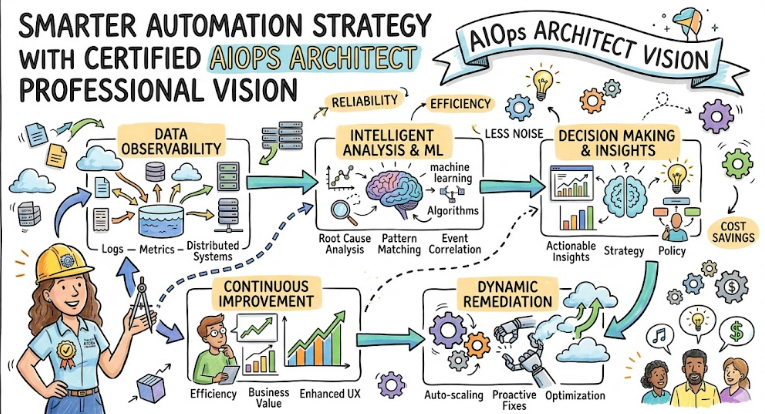
To solve this, the integration of machine learning into the operational lifecycle has become a necessity. AIOps allows for the automated analysis of vast datasets to identify patterns that are invisible to the human eye. This handbook is written for software engineers, managers, and architects who are ready to transition from reactive troubleshooting to a proactive, AI-driven model of operations. The focus is placed on the Certified AIOps Architect certification as a standard for professional excellence.
What is Certified AIOps Architect?
The Certified AIOps Architect is a specialized professional designation that validates a deep understanding of AI-enhanced infrastructure management. It is not simply a technical training on a specific toolset; rather, it is a comprehensive framework for designing “self-aware” systems.
The curriculum is built around the intersection of data science and IT operations. It involves learning how to build architectural blueprints that allow systems to ingest data, correlate events, and predict failures before they impact the end-user. It is the highest level of certification for those aiming to be leaders in the “Ops” domain.
Why it matters today?
In the modern business world, even a few minutes of downtime can result in significant financial and reputational damage. As systems become more distributed, finding the root cause of a problem becomes a “needle in a haystack” challenge. Traditional tools tell you that something is broken, but they rarely explain why or how to fix it automatically.
AIOps matters because it provides the cognitive layer needed to manage this scale. By achieving the status of a Certified AIOps Architect, professionals are equipped to implement systems that filter out noise and highlight critical issues. In markets across India and the globe, this ability to maintain high availability through automation is viewed as a vital competitive advantage.
Why Certified AIOps Architect certifications are important
As the industry moves toward “Cognitive Operations,” the demand for verified experts is increasing. A formal certification is important for several strategic reasons:
- Validation of Expertise: A standardized level of skill in both machine learning and system architecture is proven to the market.
- Strategic Problem Solving: The ability to design long-term automation strategies is gained, moving beyond simple scripting.
- Global Career Mobility: The certification is recognized by major enterprises worldwide, providing a clear path to senior leadership roles.
- Standardized Frameworks: A common language and set of best practices are learned, ensuring that AI implementations are consistent and reliable.
Why Choose AIOps School?
When a platform is chosen for professional development, the relevance of its content is the most important factor. AIOps School is preferred by technical experts for the following reasons:
- Deep Specialization: The institution is dedicated entirely to the operational spectrum of AI, ensuring that every module is highly relevant to engineers.
- Realistic Lab Scenarios: Theoretical concepts are supported by hands-on labs that simulate real-world infrastructure failures and data anomalies.
- Industry-Led Curriculum: The lessons are designed by veterans who have spent years managing large-scale, high-traffic environments.
- Ongoing Knowledge Access: Access to a growing library of resources and a network of professionals is provided to all students.
- Architectural Focus: The training goes beyond “how to use a tool” and focuses on “how to design a system,” which is essential for senior-level growth.
Certification Deep-Dive: Certified AIOps Architect
What is this certification?
The Certified AIOps Architect is an advanced-level program designed to teach the design of AI-driven IT ecosystems. It focuses on using data science and machine learning to improve monitoring, incident management, and automated remediation.
Who should take this certification?
This track is ideal for Senior DevOps Engineers, SREs, and Platform Architects. It is also highly valuable for Engineering Managers who are responsible for the digital transformation of their technical departments.
Certification Overview Table
| Track | Level | Who it’s for | Prerequisites | Skills Covered | Recommended Order |
| DevOps | Foundation | Build Engineers | Linux, Scripting | CI/CD, Automation | 1 |
| SRE | Professional | Reliability Teams | Cloud Principles | SLIs/SLOs, Monitoring | 2 |
| AIOps/MLOps | Architect | Senior Leads | Python, Statistics | ML Models, Data IQ | 3 |
| DevSecOps | Professional | Security Leads | Security Basics | AI-Driven Defense | 4 |
| DataOps | Advanced | Data Engineers | SQL, Big Data | Data Governance | 5 |
| FinOps | Intermediate | Finance/IT Leads | Cloud Billing | Cost Prediction | 6 |
Skills you will gain
- Cognitive Event Correlation: The ability to link millions of disparate log entries into a single actionable incident is developed.
- Anomaly Identification: Machine learning techniques are mastered to identify subtle changes in system behavior that signal a future crash.
- Predictive Maintenance: Knowledge is gained on how to use historical telemetry data to forecast and prevent outages.
- Automated Root Cause Analysis (RCA): Systems are designed to automatically trace the source of an error through complex microservices.
- Intelligent Self-Healing: Workflows are created that allow the infrastructure to automatically resolve common issues without human intervention.
Real-world projects you should be able to do after this certification
- Predictive Outage Engine: A system is built that uses historical server data to alert the team 30 minutes before a potential memory leak occurs.
- Smart Log Parser: An AI tool is designed to scan millions of lines of logs and group them into logical categories for faster troubleshooting.
- Dynamic Scaling Framework: An automated logic is implemented that scales cloud resources based on predicted user traffic patterns instead of static triggers.
- Incident Noise Filter: A platform is created that reduces the number of non-actionable alerts by 85%, allowing engineers to focus on real issues.
Preparation Plan
7–14 Days Plan (The Intensive Sprint)
- Days 1-4: The core definitions of AIOps and the basic lifecycle of operational data are studied.
- Days 5-9: Focused time is spent on the machine learning models used for anomaly detection and event grouping.
- Days 10-14: Practice exams are utilized to identify knowledge gaps, and final revisions are made to the architectural blueprints.
30 Days Plan (The Professional Path)
- Week 1: Time is dedicated to understanding data ingestion from various cloud and on-premise sources.
- Week 2: The focus is shifted toward the practical application of AI algorithms to solve incident management challenges.
- Week 3: Hands-on labs are performed to build and test self-healing scripts in a simulated environment.
- Week 4: The final week is used for reviewing architectural case studies and completing the certification assessment.
60 Days Plan (The Deep Mastery Path)
- Month 1: A slow and thorough foundation is built in Python for operations, data statistics, and cloud architecture.
- Month 2: Complex, multi-cloud AIOps scenarios are designed and tested. The final two weeks are used for a comprehensive review of all modules.
Common mistakes to avoid
- Neglecting Data Quality: AI is only as effective as the data it processes; feeding the system “dirty” data will lead to incorrect alerts.
- Over-Automation: Designing automated fixes for complex, non-standard problems can lead to unpredictable system states.
- Ignoring the Human Factor: AIOps is meant to assist humans, not replace them; failing to include human oversight in the design is a common error.
Best next certification after this
- Same track: Professional MLOps Architect to master the deployment and management of machine learning models at scale.
- Cross-track: Certified DataOps Professional to ensure the data pipelines feeding the AI are always healthy and secure.
- Leadership / management: Strategic Engineering Leadership for those aspiring to move into Director or CTO positions.
Choose Your Learning Path
1. The DevOps Learning Path
This track is intended for those who manage the software delivery lifecycle. It focuses on using AI to make the CI/CD pipeline smarter, ensuring that only stable and secure code is deployed to production.
2. The DevSecOps Learning Path
Security professionals choose this route to integrate AI into their threat detection systems. It involves the automated scanning of networks and code to find vulnerabilities before they are exploited.
3. The Site Reliability Engineering (SRE) Learning Path
This path is centered on maintaining the highest possible uptime. AI is used here to reduce the “toil” of manual monitoring and to ensure that system reliability targets are always met.
4. The AIOps / MLOps Learning Path
This is the core path for specialists. It covers everything from the building of the machine learning models to the ongoing management of those models in a production environment.
5. The DataOps Learning Path
Data-focused engineers follow this path to ensure that the “fuel” for AIOps—the data—is delivered accurately, securely, and with high quality across the entire enterprise.
6. The FinOps Learning Path
For those interested in the financial side of technology, this track uses AI to predict cloud spending and suggest ways to optimize costs across different vendors.
Role → Recommended Certifications Mapping
| Current Role | Professional Goal | Recommended Certification |
| DevOps Engineer | Lead Architect | Certified AIOps Architect |
| SRE | Zero-Downtime Lead | Certified AIOps Architect |
| Platform Engineer | Scalable Tooling Lead | Professional Cloud Architect |
| Cloud Engineer | AI Infrastructure Lead | Certified AIOps Architect |
| Security Engineer | AI Threat Expert | Certified DevSecOps Expert |
| Data Engineer | Pipeline Reliability Lead | Certified DataOps Professional |
| FinOps Practitioner | Cost Prediction Expert | Certified FinOps Architect |
| Engineering Manager | Strategic Director | AIOps for Leaders |
Next Certifications to Take
same-track
This certification is suggested as a natural progression on the same track. It focuses on the technical challenges of keeping machine learning models healthy, fast, and accurate after they have been deployed to production.
cross-track
As a cross-track option, this is highly valuable. Because AIOps is entirely dependent on the quality of data, mastering the management of data pipelines is a logical next step for any serious infrastructure architect.
Leadership
For those aiming for management roles, a leadership-focused certification is vital. It provides the skills needed to manage budgets, teams, and the long-term vision of a technology organization.
Training & Certification Support Institutions
DevOpsSchool
This institution is well-regarded for its deep library of technical training modules. A strong emphasis is placed on providing live, instructor-led sessions that help students master complex automation and AI concepts.
Cotocus
Specialized training for corporate teams is provided by this organization. They help large companies migrate their traditional operations to an AI-driven model through customized upskilling workshops.
ScmGalaxy
A vast technical community and repository of resources are maintained by this platform. It is a preferred destination for engineers who need to stay updated on the latest trends in software configuration and automation.
BestDevOps
Practical, project-based learning is the core methodology of this center. Students are given the opportunity to build real-world systems to demonstrate their proficiency in DevOps and cloud technologies.
devsecopsschool.com
This platform is dedicated to the integration of security within the development lifecycle. Training is provided to help engineers build secure, AI-enhanced software pipelines.
sreschool.com
Site Reliability Engineering is the sole focus of this institution. The curriculum is designed to teach the practical skills needed to maintain system health and reliability in complex, high-traffic environments.
aiopsschool.com
As the primary source for AIOps-specific learning, this site offers the most focused and up-to-date curriculum available for aspiring AIOps Architects.
dataopsschool.com
The management of data lifecycles is explored in depth at this school. Training is provided to ensure that data flows are robust, scalable, and ready for AI applications.
finopsschool.com
This institution helps IT and finance professionals work together. Lessons are provided on how to use data to optimize cloud spending and improve financial transparency.
FAQs Section
1. What is the difficulty level of the Certified AIOps Architect exam?
The exam is designed to be challenging and is considered to be at an advanced level. A deep understanding of both architectural design and operational AI is expected.
2. How long does the preparation typically take?
Most professionals find that four to eight weeks of consistent study are required to be fully prepared for the final assessment.
3. Are there any specific prerequisites for the program?
There are no strict mandatory requirements, but experience in a DevOps, SRE, or Cloud Engineering role is highly beneficial for success.
4. What is the recommended order for these certifications?
It is usually best to complete a foundational DevOps or SRE certification before moving into the AIOps Architect specialization.
5. How does this certification help with career growth?
Individuals with this designation are often prioritized for senior architectural and leadership roles, frequently leading to higher compensation and more responsibility.
6. Which job roles are available after becoming certified?
Roles such as AIOps Lead, Site Reliability Architect, Platform Manager, and Technical Director are commonly pursued by certified professionals.
7. Is there a strong demand for AIOps in India?
Yes, the demand in the Indian market is growing rapidly as top tech firms and global captive centers move toward intelligent, automated operations.
8. Is the certificate recognized by international companies?
The program follows global industry standards and is respected by major technology employers in all parts of the world.
9. Is a knowledge of Python required for the course?
A basic understanding of Python is very helpful, as it is the primary language used for the majority of data and AI tasks.
10. Are the certification exams conducted online?
Yes, the exams are offered through an online proctored platform for the convenience of candidates from different geographic locations.
11. Is hands-on work included in the assessment?
The exam includes scenario-based questions that test the ability to apply architectural principles to real-world infrastructure problems.
12. How often is the certification curriculum updated?
The content is reviewed and updated annually to ensure it reflects the latest tools and machine learning techniques in the market.
Specific FAQs for Certified AIOps Architect
1. Does the course cover specific AI tools?
Yes, several industry-standard tools for monitoring, log analysis, and machine learning are discussed during the training.
2. Is a deep data science background required?
No, a specialized degree is not needed. The course is designed to teach the specific machine learning concepts required for IT operations.
3. What is the format of the exam questions?
The exam consists of multiple-choice questions that focus on architectural decision-making and practical operational scenarios.
4. Is mentorship available during the preparation?
Mentorship is provided through the supporting institutions to help students understand the more complex modules of the course.
5. Is a retake allowed if the exam is not passed?
Yes, a retake policy is provided by the platform, allowing students to study their weak areas and try again after a short period.
6. How is the digital certificate issued?
The certificate is provided immediately upon passing the exam and can be shared on professional social networks such as LinkedIn.
7. Is there a community for certified architects?
A private community of alumni is accessible for networking, sharing knowledge, and discussing industry trends.
8. Does the certification cover multi-cloud environments?
Yes, the architectural principles taught are applicable across all major cloud providers, including AWS, Azure, and Google Cloud.
Testimonials
Meera Nair
The move from a senior SRE role to an architect position was made much smoother by this program. The concepts of event correlation and automated RCA are now central to my daily strategy.
Robert Wilson
I found the practical focus of the labs to be extremely valuable. I was able to build a predictive monitoring system for my company’s infrastructure while I was still in the middle of the course.
Sanjay Gupta
A clear path for my professional growth was finally established after I completed this certification. It bridged the gap between my engineering skills and the needs of a modern digital enterprise.
Lisa Chen
My understanding of system reliability was greatly improved. I can now design infrastructures that fix themselves, which has significantly reduced our team’s workload during night-time shifts.
Vikram Singh
The career clarity I gained was exceptional. The certification validated my experience and gave me the technical authority to lead our organization’s AI and automation initiatives.
Conclusion
The pursuit of the Certified AIOps Architect credential is seen as a transformative step for any dedicated technical professional. As the industry moves further away from manual oversight, the ability to manage infrastructure through intelligent automation is recognized as a vital skill. This guide has outlined how such expertise is developed and applied in modern environments.
Enduring advantages are gained by those who complete this path, including a more secure position in the global job market and the capability to lead high-level technical projects. The importance of becoming an expert in AI-driven operations is emphasized for anyone seeking to stay relevant. Strategic planning for this educational journey is encouraged today, as the rewards for such a commitment are realized throughout a long and successful professional life.
eqweqe