Introduction
Modern software systems run around the clock. When an application crashes, users notice immediately, and businesses lose money. Keeping these complex digital systems running smoothly is one of the biggest challenges in technology today.
In the past, traditional IT operations teams manually fixed broken servers and updated software. Today, that approach is too slow. Modern systems require a smarter engineering approach. This is where Site Reliability Engineering comes in.
Whether you are looking for an SRE Course, preparing for an SRE Certification, or exploring the best SRE Tools and SRE Best Practices, understanding this field is essential for modern cloud infrastructure. This guide covers everything you need to know about becoming a successful SRE Engineer, what to expect from SRE Training in India and globally, and how these practices change the way modern software runs.
What Is Site Reliability Engineering?
Site Reliability Engineering is a discipline created to build ultra-reliable and scalable software systems. Simply put, SRE takes software engineers and asks them to design and run operations teams.
Instead of waiting for servers to fail and fixing them by hand, an SRE Engineer writes code and builds automated systems to prevent failures before they happen. They treat operations problems as software problems.
Why Does It Matter?
Without SRE, development teams push new code quickly, but production systems break often. Operations teams spend all their time putting out fires instead of improving infrastructure. SRE bridges this gap. It gives teams a shared language to balance how fast they release new features with how stable the system remains.
How SRE Works in Modern Organizations
To understand how SRE works in practice, you have to look at how modern cloud systems operate. Reliability does not happen by accident; it requires a structured approach to monitoring, automation, and risk management.
The Core Principles of SRE
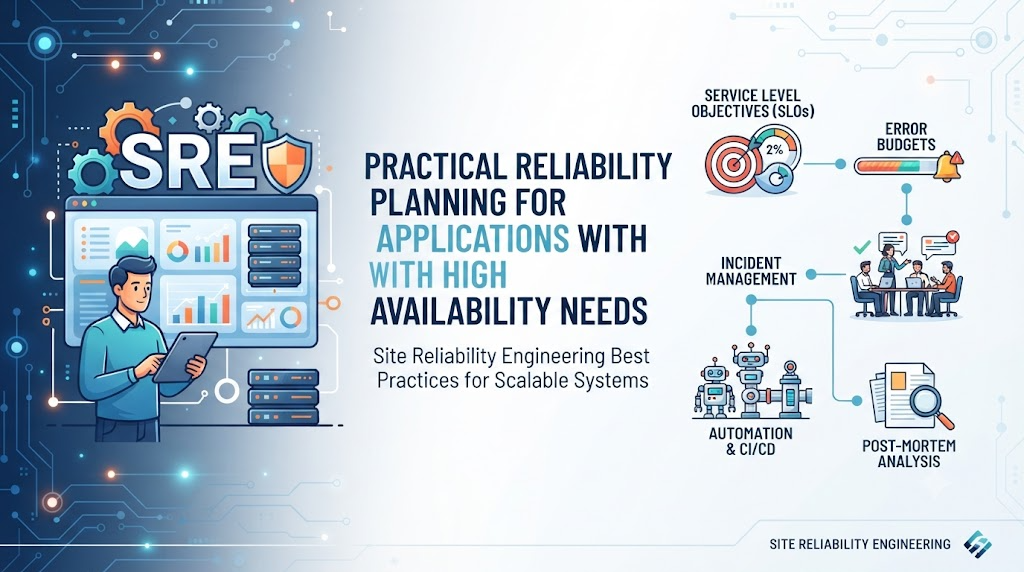
- Embracing Risk: You can never achieve 100% uptime because the cost is too high. SRE teams use “Error Budgets” to measure how much downtime is acceptable.
- Eliminating Toil: “Toil” is manual, repetitive work that has no enduring value. SREs automate toil using scripts and software.
- Monitoring and Observability: You cannot fix what you cannot see. SREs use specialized SRE Tools to track system performance in real time.
- Simplicity and Automation: The simpler a system is, the easier it is to keep reliable. Automation reduces human error during deployments.
- Blameless Post-Mortems: When things break, teams focus on fixing the system design rather than blaming individuals.
Important Concepts in SRE Training
When you enroll in a structured Site Reliability Engineering Training program, you will learn several foundational metrics and concepts that govern how reliable systems are measured.
1. Service Level Indicators (SLIs)
An SLI measures how well your service is performing. For example, it could be the percentage of successful web requests or the average time it takes a server to load a page.
2. Service Level Objectives (SLOs)
An SLO is the target goal for your SLI. For example, your SLO might state that 99.9% of all user requests must succeed over a 30-day window.
3. Service Level Agreements (SLAs)
An SLA is a business contract with customers. If the system fails to meet the SLA, the business usually has to pay financial penalties or offer service credits.
4. Error Budgets
An error budget is the amount of unreliability your system is allowed to have within a specific timeframe. If your SLO is 99.9% uptime, your error budget is 0.1%. Development teams can use this budget to release new features quickly. If the budget runs out, new releases pause until stability is restored.
SRE Course Pathways and Certification
Professionals looking to advance their careers often look for formal education paths. A comprehensive SRE Course typically starts with foundational Linux and cloud concepts and moves up to advanced production engineering.
What You Learn in an SRE Tutorial
- Cloud Infrastructure: Understanding how cloud platforms like AWS, Google Cloud, or Azure host modern applications.
- Containerization and Orchestration: Using Docker and Kubernetes to manage containerized workloads.
- Infrastructure as Code (IaC): Using tools like Terraform to provision servers and networks programmatically.
- CI/CD Pipelines: Automating software delivery from development to production.
- Incident Response: Managing major outages calmly and systematically.
Preparing for an SRE Certification
An SRE Certification proves to employers that you understand both the theory and the operational practices required to maintain enterprise-grade systems. While hands-on experience is vital, certification courses help structure your learning and provide a recognized credential for your resume.
Essential SRE Tools
An engineer is only as good as their toolkit. Modern site reliability engineering relies heavily on software that provides deep visibility into complex systems.
- Observability and Monitoring: Prometheus, Grafana, Datadog, and ELK stack help teams collect logs, metrics, and traces.
- Infrastructure Management: Terraform, Ansible, and Kubernetes automate the deployment and scaling of resources.
- Incident Management: PagerDuty and Opsgenie manage alerts and notify the right engineers when an outage occurs.
- Version Control and CI/CD: Git, GitHub Actions, and Jenkins manage code changes and automated testing.
Real-World Practical Considerations
When organizations try to implement SRE practices, they often face real-world hurdles. Understanding these challenges helps you avoid common pitfalls.
Common Operational Problems
- Alert Fatigue: Setting up too many alarms causes engineers to ignore real warnings. Good SRE practices focus on alerting based on symptoms that affect users, not just internal server spikes.
- Resistance to Automation: Teams used to manual deployments often resist changing their habits. Transitioning requires cultural support from leadership.
- Siloed Teams: If developers and operations teams do not communicate, reliability initiatives fail. SRE promotes shared responsibility.
Common Mistakes Beginners Should Make-Up For
- Treating Monitoring as an Afterthought: Adding logs only after an outage happens leaves teams blind during a crisis.
- Chasing 100% Uptime: Trying to make a system completely fail-proof is excessively expensive and slows down innovation. Aim for realistic SLOs.
- Ignoring Toil: Allowing manual tasks to pile up drains team morale and leads to burnout.
SRE Training in India and Global Growth
The demand for skilled reliability engineers has skyrocketed globally. For professionals looking for localized, structured education, SRE Training in India has grown significantly, offering bootcamps, online courses, and corporate workshops designed to bridge the skill gap in cloud operations and DevOps.
Organizations across finance, e-commerce, healthcare, and SaaS industries actively look for certified professionals who can protect their revenue streams by keeping digital platforms online and responsive.
Decision Framework for SRE Adoption
If you are wondering whether your organization needs SRE practices, follow this simple framework:
- Assess System Complexity: If your application runs on microservices spread across multiple cloud servers, manual management will fail. You need SRE.
- Evaluate Downtime Cost: Calculate how much revenue you lose every minute your system is offline. If the cost is high, investing in SRE tools and training is justified.
- Review Team Capacity: Determine if your operations team spends more time fighting fires than building automation. If so, shift focus toward reliability engineering principles.
- Start Small: Implement SLOs and error budgets for a single non-critical service before rolling them out across the entire enterprise.
Checklist for Aspiring SRE Engineers
- Master Linux fundamentals and shell scripting.
- Learn core networking concepts (DNS, TCP/IP, HTTP/HTTPS, Load Balancers).
- Gain hands-on experience with containerization (Docker) and orchestration (Kubernetes).
- Understand Infrastructure as Code (Terraform or Ansible).
- Learn how to set up monitoring, logging, and alerting systems (Prometheus and Grafana).
- Study incident management workflows and blameless post-mortem practices.
- Explore formal certification options to validate your knowledge.
Key Terms
- Toil: Manual, repetitive operational work that provides no long-term engineering value.
- Observability: The ability to measure the internal state of a system by examining its outputs (logs, metrics, and traces).
- Containers: Lightweight, standalone packages of software that include everything needed to run an application.
- Post-Mortem: A blameless analysis conducted after an incident to understand what went wrong and how to prevent it.
- High Availability: A system characteristic that aims to ensure an agreed level of operational performance for a higher-than-normal period.
Frequently Asked Questions
What is the difference between DevOps and SRE?
DevOps is a cultural and professional movement that focuses on collaboration between development and operations teams to ship software faster. SRE is a specific implementation of DevOps that treats operations as a software engineering problem, focusing heavily on reliability, SLOs, and error budgets.
Do I need coding skills to become an SRE?
Yes. An SRE engineer spends a significant amount of time writing code to automate tasks, build monitoring tools, and fix infrastructure issues. Proficiency in languages like Python, Go, or Bash is very helpful.
How long does it take to complete an SRE training course?
The duration depends on your background. Beginners with basic IT knowledge typically take 3 to 6 months of structured study and hands-on lab work to become proficient in core SRE concepts.
Is an SRE certification necessary for a job?
While not always mandatory, an SRE certification helps validate your skills, sets your resume apart, and demonstrates to employers that you understand modern production systems engineering.
What background is best for transitioning into SRE?
Professionals with backgrounds in system administration, software development, cloud support, or DevOps engineering find it easiest to transition into Site Reliability Engineering.
Conclusion
Building reliable, scalable systems is one of the most valuable skills in modern technology. Whether you are an individual engineer looking to upskill through an SRE Training program or an organization trying to minimize downtime, embracing site reliability principles changes how software is built and maintained. By focusing on automation, clear metrics, and continuous learning, you can build resilient systems that stand up to the demands of modern users.