Introduction
Many companies want to use artificial intelligence to improve their business. They hire skilled data scientists who build smart models in test environments. These models can predict customer churn, spot fraudulent transactions, or automate support tickets with high accuracy.
However, a big surprise often happens when the company tries to launch these models for real customers. A model that works wonderfully on a researcher’s computer can fail or stall in production. It might run too slowly, break when incoming data formats change, or consume expensive cloud servers without clear business value.
This gap between building an AI model and running it reliably at scale is where MLOps comes in. MLOps—short for Machine Learning Operations—combines software engineering, data science, and IT operations. Its goal is to deploy and maintain machine learning models safely and efficiently.
This guide explores the common challenges enterprises face during AI adoption, why they happen, and how teams can solve them.
What Is MLOps and Why Is It Hard?
MLOps is the practice of managing the entire lifecycle of machine learning systems. Traditional software development follows predictable paths: you write code, test it, and deploy it to a server. When a bug occurs, the code is fixed and redeployed.
Machine learning is different. An AI system relies on two things: code and data.
- Code tells the computer how to learn from information.
- Data is the actual information the model learns from.
If the data changes, the model’s behavior changes, even if the code stays exactly the same. This dual dependency makes machine learning systems much harder to test, monitor, and update than standard software. Enterprises struggle because traditional IT tools and processes are not built to handle this dynamic nature.
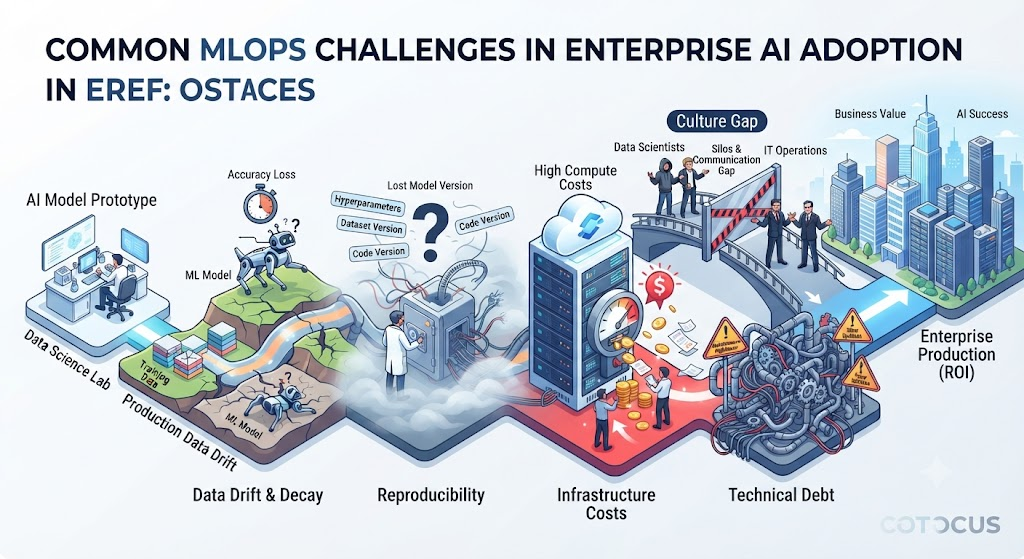
Challenge 1: Data Drift and Model Decay
One of the most common operational challenges after deploying an AI model is data drift.
What Is Data Drift?
Data drift happens when the statistical properties of the data entering a production model change over time compared to the data used to train the model.
Why It Matters
A model learns patterns from past data. If the real world changes, those old patterns may no longer apply. For example, a retail demand forecasting model trained before an economic shift will make inaccurate predictions because customer buying habits changed.
Example
A bank builds a fraud detection model using transaction data from a stable economic period. Suddenly, travel habits shift or new payment methods emerge. The model begins flagging normal purchases as fraud or missing new fraud tactics altogether.
How to Reduce the Risk
- Set up automated monitoring dashboards to track input data distributions in real-time.
- Compare incoming production data against baseline training data distributions regularly.
- Establish clear retraining triggers so models are updated before their accuracy drops below an acceptable business threshold.
Challenge 2: Reproducibility and Version Control
In traditional software, version control systems like Git track every line of code. In machine learning, tracking code is only half the battle.
The Complexity of ML Artifacts
To recreate a specific machine learning model, a team needs more than just the Python code. They need:
- The exact dataset used for training.
- The specific version of every software library.
- The hyperparameter settings (the knobs and dials adjusted during training).
- The random seed values that control initial states.
Why It Matters
Without tracking all these moving parts, a data scientist might train a model that performs well today, but nobody can recreate it next week. If a regulator asks why a model made a specific prediction, or if a bug slips into production, the team must be able to trace back to the exact training run.
How to Reduce the Risk
- Use specialized model registries and data versioning tools.
- Treat datasets like code by tracking their lineage and versions alongside source code repositories.
Challenge 3: The Culture Gap Between Data Scientists and IT Operations
AI adoption often stalls because of human communication barriers rather than technical ones.
The Problem
Data scientists focus on experimentation, statistical accuracy, and rapid prototyping in isolated environments. They write code in languages like Python and use notebooks that favor quick iteration over strict software standards.
On the other side, IT operations and DevOps teams focus on system stability, security, compliance, uptime, and predictable resource usage. They prefer clean, modular containerized applications with rigorous testing protocols.
Why It Matters
When a data scientist hands over a complex model notebook to an operations team with the instruction, “Just run it on the server,” friction occurs. Operations teams often view ML code as difficult to manage, poorly tested, and opaque.
How to Reduce the Risk
- Encourage cross-functional collaboration where data scientists and infrastructure engineers plan deployments together from day one.
- Establish shared standards and automated templates that bridge experimentation environments with production deployment pipelines.
Challenge 4: High Infrastructure and Compute Costs
Training modern machine learning models and serving them to millions of users requires immense computing power, often using specialized hardware like Graphics Processing Units (GPUs) or Tensor Processing Units (TPUs).
Why It Matters
Cloud computing bills can skyrocket quickly if AI workloads are left unmanaged. Data science teams often spin up expensive cloud instances for training and leave them running idle, or deploy resource-heavy models for simple tasks that a smaller model could handle efficiently.
How to Reduce the Risk
- Implement cost-monitoring tags on cloud resources dedicated to AI experiments.
- Use model optimization techniques like quantization and pruning to make models smaller and faster, reducing the need for expensive server hardware during inference (prediction).
- Auto-scale inference endpoints so servers spin down when user traffic drops.
Challenge 5: Managing Technical Debt in Machine Learning
Google researchers famously published a paper highlighting that machine learning code is often only a tiny fraction of a real-world AI system. The vast majority of code consists of data pipelines, configuration management, monitoring, and infrastructure.
Why It Matters
Organizations often rush to build the coolest model while neglecting the surrounding plumbing. Over time, poorly structured data pipelines and undocumented manual scripts turn into massive technical debt. Fixing a broken data source can silently break downstream models in ways that are hard to diagnose.
How to Reduce the Risk
- Build modular, automated data pipelines using established orchestration tools.
- Write automated unit and integration tests for data schemas and model input/output formats before deployment.
Common Mistakes Enterprises Make During AI Adoption
| Mistake | Why It Happens | Result | What to Do Instead |
| Treating ML like traditional software | Assuming models behave like standard applications once deployed. | Unexpected failures when real-world data changes. | Build dedicated monitoring for data drift and model accuracy. |
| Neglecting data quality pipelines | Focusing entirely on algorithm tuning while ignoring source data hygiene. | Garbage-in, garbage-out predictions that damage business trust. | Invest heavily in data validation and automated cleaning pipelines. |
| Manual deployment processes | Relying on data scientists to manually move models to production servers. | Slow deployment cycles, human error, and inconsistent environments. | Implement CI/CD (Continuous Integration and Continuous Delivery) pipelines specifically designed for machine learning (CI/CD for ML). |
| Ignoring regulatory compliance and bias | Assuming models are purely objective math equations. | Legal fines, biased customer outcomes, and brand damage. | Implement governance frameworks, explainability tools, and audit trails. |
Decision-Making Framework: Is Your Enterprise Ready for MLOps?
Before pouring more budget into AI initiatives, leadership teams should evaluate their operational readiness through a structured checklist:
- Assess Data Readiness: Can your organization ingest, clean, and store data reliably and securely?
- Evaluate Infrastructure: Do your IT teams have containerization and cloud orchestration skills (such as Docker and Kubernetes)?
- Define Ownership: Is it clear who is responsible for a model once it leaves the development environment?
- Establish Monitoring: Do you have systems in place to detect when model performance drops?
- Review Security: Are sensitive user data and proprietary models protected against unauthorized access and leaks?
Key Terms
- Model Registry: A centralized repository where teams store, manage, and track versions of trained machine learning models.
- Inference: The phase where a trained machine learning model makes predictions on new, unseen data.
- CI/CD for ML: Automated processes that test, build, and deploy machine learning code and models whenever changes occur.
- Model Explainability: Techniques that help humans understand why a machine learning model made a specific prediction.
- Feature Store: A centralized warehouse where data teams store, manage, and share clean data attributes (features) used for training and inference.
Frequently Asked Questions
What is the main difference between DevOps and MLOps?
DevOps focuses on automating software code delivery and infrastructure management. MLOps includes all of DevOps while adding specific practices to manage data pipelines, model training, tracking model versions, and monitoring data drift over time.
Why do machine learning models fail after deployment?
Models usually fail because the real-world data they encounter in production looks different from the data they were trained on (data drift), or because underlying business logic and user behaviors shifted.
Do small companies need MLOps?
If a company runs simple models that rarely change, manual updates might suffice. However, as soon as a business relies on multiple models, automated predictions, or real-time customer data, basic MLOps practices prevent costly outages and errors.
How long does it take to implement MLOps in an enterprise?
Implementing MLOps is an incremental journey rather than a single project. Basic version control and automated deployments can be set up in weeks, while a mature, automated ML lifecycle platform across multiple departments can take several months.
Who should be responsible for MLOps within an organization?
MLOps is typically a collaborative effort shared between data scientists who build the models, data engineers who build pipelines, and IT/DevOps engineers who manage infrastructure and deployment guardrails.
Conclusion
Adopting artificial intelligence offers immense potential for modern enterprises, but building a great model is only half the battle. Without strong operational foundations, AI projects often stall in testing or fail quietly in production.
By recognizing common hurdles like data drift, version control complexity, and the cultural gap between teams, organizations can build robust MLOps practices. Prioritize automated pipelines, clear monitoring, and strong collaboration to turn experimental AI proofs-of-concept into reliable, long-term business value.