Introduction
Managing big data can feel like trying to drink from a rushing fire hose. Every day, companies collect massive amounts of information from customer clicks, mobile apps, sales transactions, and smart devices.
If this data is messy, delayed, or broken, business leaders make bad decisions. They might launch a product nobody wants or miscalculate their inventory.
In the past, data teams worked in isolated silos. Software developers built apps, data engineers built pipelines to move information, and analysts tried to make sense of the results. When something broke—and it often did—everyone pointed fingers at each other.
DataOps fixes this communication breakdown. It brings people, processes, and technology together so that big data flows smoothly from source to business user.
What Is DataOps?
DataOps (short for Data Operations) is a collaborative management approach that improves the speed and accuracy of data analytics.
- Simple meaning: It is a teamwork system designed to get clean, trustworthy data to the right people as fast as possible.
- Why it matters: Without DataOps, data pipelines break silently, analysts spend 80% of their time cleaning dirty files, and decision-makers wait weeks for basic reports.
- Example: Imagine a restaurant kitchen. Without organization, the chefs bump into each other, orders get cold, and meals take an hour. DataOps is the kitchen system that ensures ingredients arrive fresh, cooking steps happen in order, and plates reach the customer hot and fast.
DataOps borrows ideas from Agile software development (building things in small, fast steps) and DevOps (automating IT infrastructure testing and deployment).
How DataOps Works
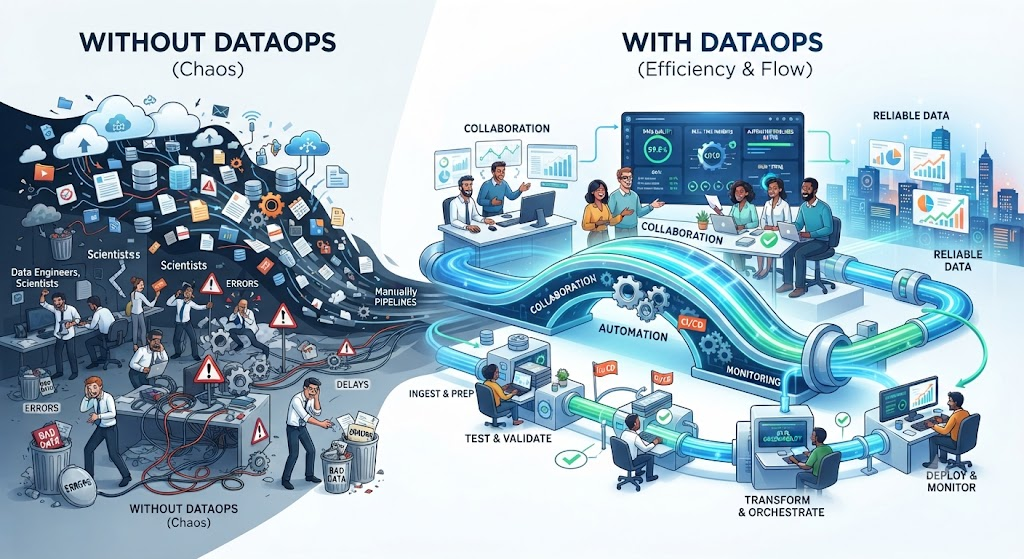
DataOps transforms how information moves through an organization by treating data like a product on a manufacturing line. Here is how the process works in practice:
- Data Ingestion: Raw data is collected from various sources, such as websites, databases, and cloud storage.
- Automated Testing: As soon as data enters the system, automated quality checks scan it for errors, missing values, or formatting issues.
- Transformation: Data engineers clean and organize the information so it is ready for analysis.
- Continuous Delivery: Clean datasets and dashboards are pushed automatically to business users and automated tools.
- Monitoring: Automated alerts notify the team immediately if a data pipeline breaks or if numbers look unusual.
Why Big Data Management Is So Hard Without DataOps
Handling petabytes of information brings unique operational challenges. Without a structured DataOps approach, teams typically run into several persistent roadblocks:
- Data Silos: Different departments keep information locked in their own systems, making it impossible to get a complete view of the business.
- Silent Failures: A data pipeline might stop working or drop half its records, and nobody notices until an executive spots a broken dashboard days later.
- Lack of Trust: When reports show conflicting numbers, business leaders stop trusting the data team entirely.
- Slow Delivery: Making a simple change to a data report can take weeks because every step requires manual approval and testing.
Important Factors to Understand in DataOps
To successfully manage big data using DataOps, teams must focus on three core pillars: automation, collaboration, and measurement.
1. Automation
Manual tasks slow down data pipelines and invite human error. DataOps relies heavily on automation to test code, schedule data loads, and clean incoming files. If a script fails, the system should catch it instantly rather than waiting for a human to notice.
2. Collaboration
DataOps breaks down the walls between data engineers, data scientists, analysts, and business operators. Everyone uses shared repositories, common definitions, and transparent workflows so that everyone speaks the same language.
3. Observability
Data observability means knowing the health of your data at all times. Just as car engines have dashboard lights that warn when oil is low, DataOps systems monitor data freshness, volume, schema changes, and anomalies.
Real-World Considerations
Implementing DataOps is not just about buying new software; it requires a cultural shift within the organization.
- Cultural Resistance: Traditional IT and data teams used to working in isolated silos may resist sharing their workflows or adopting rapid, iterative release cycles.
- Toolchain Complexity: There is no single “DataOps tool.” Organizations must integrate storage systems, transformation tools, orchestration engines, and monitoring software into a cohesive pipeline.
- Skill Development: Team members need training in version control (like Git), automated testing frameworks, and continuous integration concepts that traditionally belonged only to software engineering.
Common Mistakes
Mistake 1: Treating DataOps as Just Another Software Tool
- Why it happens: Vendors often market products as a “complete DataOps solution in a box.”
- Why it causes problems: Buying software does not fix broken communication or messy processes.
- What you should do instead: Focus first on team workflows, communication habits, and quality standards, then select tools that support those goals.
Mistake 2: Skipping Automated Data Testing
- Why it happens: Teams rush to deliver reports and assume data arriving from trusted sources is always clean.
- Why it causes problems: Upstream systems change their formats without warning, silently corrupting downstream analytics models.
- What you should do instead: Implement automated tests for data uniqueness, row counts, null values, and acceptable value ranges at every stage of the pipeline.
Mistake 3: Ignoring Version Control for Data Models
- Why it happens: Analysts often write queries directly in production environments without tracking changes.
- Why it causes problems: When a query breaks or an old metric calculation is needed, nobody knows what changed or who changed it.
- What you should do instead: Store all transformation code and data models in version control systems, requiring peer review before updates go live.
Risks and Limitations
While DataOps offers massive improvements, organizations must keep realistic expectations:
- Initial Setup Cost: Building automated pipelines and setting up testing frameworks takes time and upfront engineering effort before teams see productivity gains.
- Over-Engineering: Smaller teams with simple data needs might find full enterprise DataOps frameworks overly complex and heavy.
- Garbage In, Garbage Out: DataOps ensures pipelines run smoothly and data is delivered reliably, but it cannot fix fundamentally flawed business logic or incorrect source data collected at the origin.
Decision Framework: Is Your Team Ready for DataOps?
Use this step-by-step checklist to evaluate whether your organization needs to adopt a DataOps approach:
- Assess Data Volume and Velocity: Are you handling large, fast-moving datasets from multiple sources that manual processes can no longer keep up with?
- Measure Time-to-Insight: How long does it take your team to fulfill a request for a new data report or metric? If it takes weeks or months, your workflow is too slow.
- Check Error Frequency: Do business stakeholders frequently find incorrect numbers or broken dashboards after reports are published?
- Evaluate Team Friction: Do data engineers, analysts, and business users blame each other when data problems occur?
- Calculate Maintenance Burden: Do your data engineers spend most of their time firefighting broken pipelines rather than building new value?
If you answered yes to multiple questions above, introducing DataOps practices will help stabilize your operations and speed up delivery.
Checklist for Implementing DataOps
- Establish version control for all data transformation scripts and queries.
- Implement automated data quality tests for schema changes, missing values, and row counts.
- Set up continuous integration and continuous deployment (CI/CD) for data pipelines.
- Create centralized data documentation and shared definitions for key business metrics.
- Configure automated alerts for pipeline failures and data anomalies.
- Establish regular feedback loops between data producers, data engineers, and business consumers.
Key Terms
- Data Pipeline: A set of actions that moves data from a source system, transforms it, and loads it into a destination for analysis.
- Data Observability: The ability to fully understand the health, quality, and state of data across your systems.
- Continuous Integration (CI): The practice of automatically testing and merging code changes into a shared repository frequently.
- Data Silo: Isolated pockets of information controlled by a single department, preventing other teams from accessing them.
- Orchestration: Managing the scheduling, dependencies, and execution order of data processing tasks.
- Data Governance: The internal rules, policies, and standards that ensure data is secure, private, and accurately used.
- Schema: The structural blueprint that defines how data is organized within a database or table.
- Anomalies: Unusual or unexpected spikes, drops, or patterns in data that may indicate an error or an emerging trend.
FAQs
What is the difference between DevOps and DataOps?
DevOps focuses on automating software development, testing, and deployment for applications. DataOps applies those same engineering principles specifically to data pipelines, analytics code, and data quality management.
Does DataOps replace data governance?
No. DataOps works alongside data governance. Data governance defines the rules, security policies, and ownership of data, while DataOps provides the automated operational workflows to enforce and manage those data flows efficiently.
Do small teams need DataOps?
Small teams may not need complex enterprise tooling, but adopting DataOps principles—like version control, automated testing, and collaborative workflows—prevents data errors as the team and data volume grow.
How does DataOps improve data quality?
DataOps catches errors early by running automated tests at every stage of the pipeline. If corrupted data or an unexpected format change appears, the system halts the process and alerts the team before bad data reaches executive dashboards.
What tools are used in DataOps?
DataOps toolchains typically include version control systems (like Git), orchestration tools (like Apache Airflow or Prefect), data transformation tools (like dbt), automated testing frameworks, and data observability platforms.
How long does it take to see results from DataOps?
Teams usually see improvements in reliability and a reduction in manual firefighting within the first few weeks of automating their testing and pipeline deployments.
Who is responsible for DataOps in an organization?
DataOps is a team sport. It involves data engineers who build pipelines, data scientists and analysts who use the data, and IT operations staff who manage infrastructure, all working together under shared practices.
Can DataOps be used with cloud data warehouses?
Yes. Modern DataOps practices fit naturally with cloud data platforms, where automated scaling, fast provisioning, and flexible storage make continuous integration and testing much easier to implement.
Conclusion
Managing big data effectively requires more than just high-capacity storage and fast processing power. Without organized workflows, automated testing, and cross-team collaboration, growing data volumes quickly lead to errors, delays, and lost trust.
DataOps brings order to the chaos by treating data management like an automated, reliable production line. By catching errors early, streamlining collaboration, and automating repetitive tasks, teams can spend less time fixing broken pipelines and more time delivering accurate, valuable insights to the business.