Introduction
Most companies today collect a massive amount of information. They track customer clicks, sales numbers, inventory levels, and website traffic. However, having data is not the same as using data well. Often, this information sits trapped in separate systems, messy spreadsheets, or broken pipelines that delay reports by days or weeks.
When a company tries to fix these data problems on its own, teams often run into friction. The data engineers blame the data analysts, the analysts blame the software developers, and business leaders are left waiting for answers.
This is where external guidance steps in. DataOps consulting provides an outside perspective to untangle messy data workflows. This guide explains what DataOps consulting is, why it matters, how it works, and how to know if your business needs it.
What Is DataOps Consulting?
DataOps—short for Data Operations—is a set of practices that brings data engineers, data analysts, and IT operations teams together. DataOps consulting is the practice of hiring experienced outside advisors and engineers to help your company set up these workflows, tools, and cultural habits.
Professional term → Simple meaning → Why it matters → Example
- Data Pipeline: A series of steps that moves data from where it is collected (like a mobile app) to where it is stored and analyzed (like a dashboard). If the pipeline breaks, your dashboard shows old or incorrect numbers.
- CI/CD (Continuous Integration and Continuous Delivery): A method of automatically testing and releasing changes to software or code. It matters because it catches mistakes in your data code before they ruin your business reports.
- Orchestration: Scheduling and managing when different data tasks run. For example, ensuring sales data is updated after the nightly store closes, but before the morning executive meeting.
DataOps consulting bridges the gap between raw data and business value. Consultants do not just write code; they help your entire organization change how it handles information.
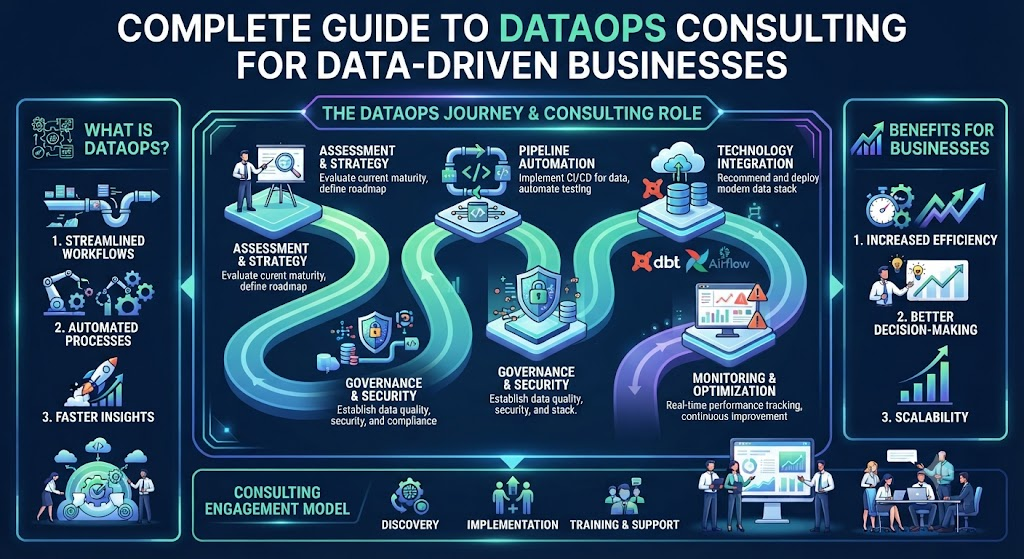
How DataOps Consulting Works
When a business brings in DataOps consultants, they follow a structured path to diagnose problems and build better systems. Here is how the typical process unfolds.
1. Assessment and Discovery
Consultants start by looking at your current data setup. They talk to engineers, analysts, and business leaders to answer key questions:
- Where does your data come from?
- How long does it take for a new data source to become a useful report?
- How often do data pipelines break, and how long does it take to fix them?
2. Architecture and Tool Selection
Next, they design a blueprint for your data infrastructure. They help you choose the right tools for data storage, transformation, and testing. Instead of recommending the most expensive software on the market, good consultants pick tools that fit your team’s actual skill level and budget.
3. Automation and Testing
This is the core of DataOps. Consultants set up automated tests to check data quality. For example, if a customer database suddenly records negative ages or missing email addresses, an automated test stops the data flow and alerts the engineering team instantly.
4. Cultural Alignment and Training
Technology alone does not fix broken data processes. Consultants work with your internal teams to establish new habits, such as daily check-ins, collaborative code reviews, and shared ownership of data quality.
Why DataOps Consulting Matters
Many businesses try to build internal data teams and let them figure out workflows organically. This often leads to burnout and broken systems. Here is why specialized consulting makes a difference:
- Speed to Insight: Traditional data updates can take weeks. DataOps reduces this to hours or minutes by automating repetitive tasks.
- Trust in Numbers: When reports keep changing or showing conflicting numbers, executives stop trusting the data. DataOps establishes strict quality checks so everyone trusts the dashboards.
- Cost Control: Running messy, unoptimized cloud data queries can lead to massive, unexpected cloud computing bills. Consultants optimize these queries to save money.
Important Factors to Understand
Before hiring a DataOps consultant or starting an internal initiative, you must understand a few foundational concepts.
Collaboration Over Silos
In many traditional companies, software developers write code, data engineers move data, and business analysts build dashboards, all without talking to each other. DataOps breaks down these walls so everyone works as a single unit.
Automation Over Manual Labor
If your team spends hours every morning manually cleaning spreadsheets and fixing broken CSV files, you are losing valuable time. DataOps automates these repetitive chores so humans can focus on problem-solving.
Version Control for Data
Just as writers use version control to track edits in a document, DataOps applies version control to data pipelines and SQL queries. If a new update breaks a report, the team can instantly roll back to the working version.
Practical Examples
Example 1: The Struggling E-Commerce Retailer
The Situation: A mid-sized online shoe store has data coming from its website, mobile app, and inventory warehouse. Every Monday morning, the marketing team needs a sales report. However, the data pipeline breaks almost every weekend, forcing engineers to spend their Monday mornings manually fixing tables.The DataOps Solution: Consultants step in to set up automated monitoring and testing. Now, if the warehouse data feed fails on a Saturday night, an automated alert wakes up the on-call engineer, who fixes it in ten minutes. The Monday morning report is ready on time.
Example 2: The Growing Financial Services Firm
The Situation: A financial firm is scaling rapidly. As they add more clients, their cloud data warehouse costs triple, but their query speeds get slower.The DataOps Solution: DataOps consultants audit the company’s data transformations. They remove redundant data models, optimize heavy queries, and set up cost-monitoring alerts. Query speeds improve by 70%, and cloud bills drop significantly.
Real-World Considerations
Bringing in outside consultants requires careful planning. You must consider internal readiness, ongoing maintenance, and team dynamics.
- Internal Buy-In: If your existing engineering team feels threatened by external consultants, they may resist the new tools. Good management must frame consultants as helpers who take away painful, repetitive chores, not as replacements.
- Knowledge Transfer: Consultants should never leave you dependent on them forever. A successful engagement ends with your internal team fully trained to manage and update the new systems.
- Maintenance Effort: DataOps is not a one-time project you finish and forget. It requires ongoing monitoring, updating of tests, and adapting to new business requirements.
Common Mistakes
| What People Do | Why They Do It | Why It Causes Problems | What They Should Do Instead |
| Buying expensive tools first | They believe brand-name software will magically solve data chaos. | Tools cannot fix broken team habits or unclear processes. | Define your workflow problems first, then choose tools that solve them. |
| Ignoring data testing | They want to ship new reports as fast as possible. | Bad data slips into executive dashboards, leading to poor business decisions. | Build automated data quality tests into every pipeline from day one. |
| Treating DataOps as IT-only | They view data as a purely technical background function. | The data built by IT may not match what business analysts actually need. | Involve business users early to ensure the data pipelines answer real business questions. |
Risks and Limitations
- Disruption During Migration: Redesigning data pipelines while the business is running can temporarily disrupt ongoing reporting.
- Over-Engineering: Consultants sometimes implement overly complex architectures that a smaller business does not need and cannot maintain.
- Vendor Lock-In: Relying too heavily on proprietary tools from a single cloud provider can make it difficult and expensive to switch providers later.
Tools and Methods
DataOps consultants use a variety of modern tools to keep data flowing smoothly:
- dbt (data build tool): A framework that allows data analysts and engineers to transform data in their warehouses cleanly and collaboratively using SQL.
- Apache Airflow / Prefect: Orchestration tools used to schedule, monitor, and manage complex data workflows.
- Great Expectations / Soda: Data quality testing tools that verify data meets specific standards before it reaches business reports.
- Git: Version control software used to track changes in data transformation code.
Decision-Making Framework
Use this simple step-by-step framework to decide if your business needs DataOps consulting:
- Audit Your Pain Points: Count how many times last month your business leaders could not trust a report or missed a deadline due to broken data.
- Evaluate Internal Skill Gaps: Do your current engineers know modern CI/CD, automated testing, and cloud data orchestration? If no, outside help can speed up the learning curve.
- Calculate the Cost of Delay: Estimate how much money or time your company loses because insights arrive days late.
- Define Clear Scope: Hire consultants for a specific, high-impact goal—such as fixing a failing data warehouse or setting up automated testing—rather than an open-ended project.
- Ensure Knowledge Transfer: Make sure your contract includes training sessions so your internal team takes full ownership at the end.
Checklist for Data-Driven Businesses
- Do you have automated tests running on your core data pipelines?
- Can your team roll back a broken data transformation with a single click?
- Are cloud data costs monitored and predictable?
- Do data engineers and business analysts collaborate regularly without finger-pointing?
- Is your reporting pipeline reliable enough that executives trust every number on Monday morning?
Key Terms
- Data Warehouse: A central repository designed to store, manage, and analyze large volumes of data from multiple sources.
- Data Quality: A measure of how clean, accurate, complete, and reliable your data is for business use.
- Latency: The time delay between data being created in an application and it becoming available in a report.
- Version Control: A system that tracks changes to code or data pipelines over time, allowing teams to collaborate safely.
- Agile: A project management approach that focuses on small, fast, collaborative updates rather than massive, slow releases.
- Monitoring: The ongoing process of watching data systems for failures, slow performance, or unexpected anomalies.
- CI/CD: Automated processes that test and deploy code changes quickly and safely.
- Orchestration: The automated coordination and scheduling of multiple data tasks across different systems.
FAQs
What is the main difference between DevOps and DataOps?
DevOps focuses on automating and improving software development and application deployment. DataOps takes those same principles and applies them specifically to data engineering, data pipelines, and analytics workflows.
How long does a typical DataOps consulting engagement last?
It varies based on company size and complexity. A focused assessment and pilot project might take 4 to 8 weeks, while a full enterprise transformation can take 6 months or more.
Do we need to replace our existing database tools to practice DataOps?
Usually, no. DataOps is more about how your team works, tests, and automates processes than about buying brand-new software. Good consultants work with the tools you already have whenever possible.
How can small businesses benefit from DataOps?
Small businesses do not need massive enterprise setups. Consultants can help smaller teams set up lightweight, automated pipelines that prevent manual spreadsheet errors and save valuable employee time.
How do we measure the success of DataOps consulting?
Success is measured by fewer broken data pipelines, faster report delivery, lower cloud storage and computing costs, and increased trust in analytics among business leaders.
Is DataOps consulting a one-time project?
While consultants help set up the initial framework, DataOps becomes an ongoing operational habit for your internal team to maintain and improve over time.
Conclusion
DataOps consulting is more than just a technical upgrade; it is a way to bring order, speed, and trust to how your business uses information. By combining automated testing, collaborative workflows, and expert guidance, companies can stop fighting broken spreadsheets and start focusing on growth. Assess your current data bottlenecks, choose the right partners, and build a reliable foundation for your data-driven future.