Introduction
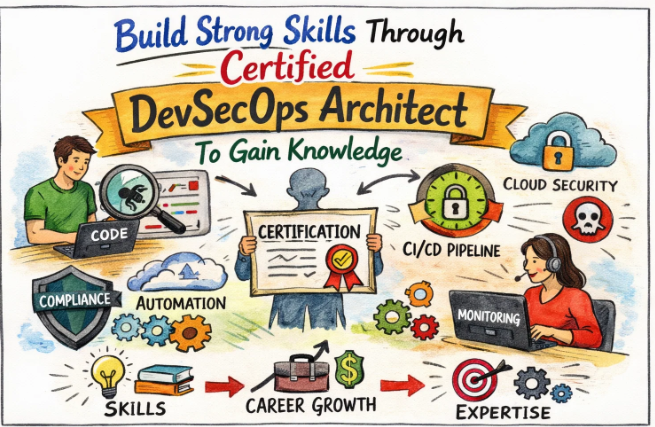
The foundation of modern software delivery is being fundamentally redesigned to prioritize safety at every layer. As digital threats evolve, the role of a traditional architect is being replaced by those who can weave security directly into the fabric of automation. A specialized path for this transition is offered through the Certified DevSecOps Architect program. By shifting the focus from reactive patching to proactive design, a more resilient future for global engineering is being built.
Understanding the Role: What is a Certified DevSecOps Architect?
The Certified DevSecOps Architect is viewed as a master designer of secure automation ecosystems. Rather than simply managing tools, this professional is responsible for creating the overarching strategy that allows security to function at the speed of DevOps. A deep understanding of how code moves from a developer’s machine to a production environment is required. Within this role, security is no longer treated as a separate department but is instead integrated as a continuous service.
An architect in this field is expected to build systems that can self-heal and automatically detect vulnerabilities before they are ever deployed. High-level planning is combined with technical execution to ensure that every cloud resource and every line of script follows a strict security policy. The goal is to move beyond basic automation and achieve a state of “Security as Code,” where the infrastructure itself is a defensive shield.
Why It Matters Today ?
The speed of business is currently dictated by the speed of software releases, yet this speed often leads to significant risks. Traditional security gates are being found to be insufficient when updates are released multiple times a day. Because of this, a major shift in perspective is being demanded by industry leaders. When security is neglected, the financial and reputational costs of a breach are often high enough to threaten the survival of an organization.
Furthermore, the complexity of cloud-native environments means that human error is more likely to occur. Automated guardrails are being identified as the only reliable way to manage this complexity. By placing security at the heart of the architectural design, the entire development lifecycle is made more robust. It is now understood that speed and security are not opposing forces, but rather two sides of the same coin.
Why Certified DevSecOps Architect Certifications are Important ?
The depth of a professional’s expertise is formally recognized through the achievement of a high-level certification. In a crowded job market, these credentials are used to distinguish true experts from those with only surface-level knowledge. A structured learning path is provided, ensuring that all critical domains of security automation are covered systematically. This prevents the “knowledge gaps” that often occur when skills are learned only through on-the-job experience.
Confidence is also instilled in stakeholders when a certified architect leads a project. It serves as proof that the latest industry standards and best practices are being followed. Long-term career stability is often gained, as organizations are willing to invest more in individuals who have proven their mastery through rigorous assessment. It is a commitment to excellence that pays dividends across an entire career.
Why Choose DevSecOpsSchool?
A specialized focus on the security pillar of automation is provided by DevSecOpsSchool. Unlike general programs that treat security as an afterthought, this institution places security at the very center of the curriculum. Deep technical dives into automated security testing, threat modeling, and compliance as code are prioritized.
A community of security-focused experts is built around this school, allowing for the exchange of advanced knowledge and real-world problem-solving strategies. The labs are designed to simulate actual security breaches and defense scenarios, ensuring that the training is practical and immediately applicable. By choosing a school that specializes strictly in DevSecOps, a more nuanced and thorough understanding of the domain is gained..
Deep-Dive: Certified DevSecOps Architect
What is this certification?
The design and implementation of secure CI/CD pipelines are the primary focus of this advanced program. It is created for professionals who wish to lead the technical security strategy within an automated environment.
Who should take this certification?
This path is intended for experienced Software Engineers, Cloud Architects, and Security Leads. It is also suitable for technical managers who are responsible for the overall security posture of their engineering teams.
Certification Overview Table
| Track | Level | Who it’s for | Prerequisites | Skills Covered | Recommended Order |
| DevSecOps | Foundation | Beginners, Developers | Basic Linux/Git | DevOps Culture, Security Basics | 1st |
| DevSecOps | Professional | DevOps Engineers | Foundation Cert | CI/CD Security, Tool Integration | 2nd |
| DevSecOps | Architect | Senior Engineers | Professional Cert | Secure Design, Infrastructure as Code | 3rd (Mastery) |
| SRE | Practitioner | Operations Engineers | Linux Internals | Monitoring, Incident Response | Cross-Track |
| AIOps | Specialist | Data Engineers | Python Basics | ML Pipelines, Predictive Ops | Cross-Track |
| FinOps | Associate | Managers, Architects | Cloud Basics | Cost Optimization, Cloud Governance | Cross-Track |
Skills You Will Gain
- The creation of automated security gates is mastered.
- Advanced threat modeling for distributed systems is performed.
- Secure container orchestration is designed and managed.
- Infrastructure as Code (IaC) is audited and hardened.
- Automated compliance monitoring is established.
- Incident response is integrated into the DevOps flow.
Real-World Projects
- A multi-cloud secure deployment framework is constructed.
- A centralized secrets management system is implemented for large teams.
- Real-time vulnerability dashboards are built for executive reporting.
- Automated rollback procedures for security failures are designed.
Preparation Plan
7–14 Days Plan
The foundational elements of the DevSecOps manifesto are revisited. Key security tools are identified and installed in a test environment. Initial documentation and course materials are thoroughly read.
30 Days Plan
Integration techniques for various security scanners are practiced. Automated scripts are written to handle common security tasks. Detailed focus is given to identity management and network security policies.
60 Days Plan
End-to-end secure pipelines are built and tested. Mock scenarios involving security breaches are simulated to test response strategies. The final week is spent refining architectural designs and preparing for the final assessment.
Common Mistakes to Avoid
- Over-reliance on a single security tool is a frequent error.
- The importance of developer experience is often forgotten.
- Documentation of the security architecture is sometimes neglected.
- Failure to stay updated on the latest cloud threats can lead to outdated designs.
Best Next Certification After This
- Same Track: Certified DevSecOps Expert.
- Cross-Track: SRE Professional Certification.
- Leadership / Management: Technical Director Program.
Choose Your Learning Path
The DevOps Path
This journey is intended for those who wish to perfect the art of continuous delivery. The primary goal is to reduce the time between a code commit and production deployment while maintaining quality. It is best suited for engineers who love optimization.
The DevSecOps Path
A specialized focus on security automation is maintained throughout this track. It is ideal for those who want to ensure that software is not only fast but also safe. This is the recommended path for aspiring security architects.
The Site Reliability Engineering (SRE) Path
System stability and scalability are the main objectives here. It is chosen by those who enjoy deep technical troubleshooting and creating systems that can handle massive amounts of traffic without failing.
The AIOps / MLOps Path
This modern track is designed for engineers who want to apply machine learning to operations. It is best for data-focused individuals who want to build “smart” infrastructure that can predict issues before they occur.
The DataOps Path
The efficient flow of data through an organization is the focus of this learning path. It is perfect for those who manage data lakes and analytical pipelines, ensuring that data is always available and secure.
The FinOps Path
The intersection of cloud technology and finance is explored in this track. It is highly recommended for those who want to lead cost-saving initiatives and bring financial accountability to the engineering team.
Role → Recommended Certifications Mapping
| Current Role | Recommended Certification |
| DevOps Engineer | Certified DevSecOps Architect |
| Site Reliability Engineer (SRE) | SRE Master |
| Platform Engineer | Advanced Infrastructure Architect |
| Cloud Engineer | Cloud Security Expert |
| Security Engineer | DevSecOps Specialist |
| Data Engineer | DataOps Professional |
| FinOps Practitioner | Strategic FinOps Leader |
| Engineering Manager | Architecture for Executives |
Next Certifications to Take
For the DevOps Professional
- Same-track: Master of DevOps Automation.
- Cross-track: SRE Foundation.
- Leadership: DevOps Strategy Leader.
For the Cloud Architect
- Same-track: Advanced Cloud Security.
- Cross-track: FinOps for Architects.
- Leadership: CTO Development Path.
For the Software Manager
- Same-track: Engineering Leadership.
- Cross-track: DevSecOps for Managers.
- Leadership: Organizational Transformation.
Training & Certification Support Institutions
DevOpsSchool
An extensive range of certification programs is offered here to help professionals stay ahead. Practical labs and real-world scenarios are used to ensure high-quality learning. Continuous support is provided to all alumni.
Cotocus
A focus on high-end consulting and technical training is maintained by this group. Complex business problems are solved through the application of advanced DevOps principles. Expert guidance is provided for career growth.
ScmGalaxy
A vast knowledge base for configuration management and automation is hosted on this platform. Community interaction is encouraged to solve technical hurdles. It serves as a reliable source for learning the latest tools.
BestDevOps
The highest quality standards in DevOps education are pursued by this institution. Courses are designed to be relevant for today’s competitive job market. Technical mastery is emphasized in every program.
devsecopsschool.com
This is a dedicated space for those specializing in the security aspect of DevOps. Comprehensive guides and certifications for architects are found here. It is a primary hub for security engineering knowledge.
sreschool.com
The principles of site reliability are taught with a focus on practical uptime strategies. It is an essential resource for those looking to master system resilience. Detailed courses on SRE tools are provided.
aiopsschool.com
The future of operations through artificial intelligence is explored here. Professionals are trained to manage machine learning models in production. It is a leading platform for MLOps education.
dataopsschool.com
The complexities of data delivery are addressed through specialized training programs. Data engineers are equipped with the skills needed to manage modern data stacks. Efficiency and security are the main themes.
finopsschool.com
Financial management in the cloud era is the core focus of this school. Engineers are taught how to balance technical needs with budget constraints. It is a vital resource for cost-conscious organizations.
FAQs Section
General FAQs
Q: What level of difficulty is associated with the Architect certification?
A: A high degree of difficulty is encountered, as it requires both strategic and technical proficiency.
Q: How many hours should be set aside for study?
A: Between 50 and 70 hours are typically required for a thorough understanding of the material.
Q: Are there any specific requirements before joining the course?
A: A solid foundation in DevOps practices and general cloud knowledge is expected.
Q: What is the recommended sequence for these certifications?
A: Moving from foundational levels to specialist and then architect levels is the most common path.
Q: How does this certification impact career growth?
A: It is often the key to unlocking senior leadership and high-level architectural roles.
Q: What types of jobs can be secured after passing?
A: Candidates often find roles as DevSecOps Leads, Platform Security Architects, or Cloud Consultants.
Q: Is there a requirement for periodic renewal?
A: Renewal is recommended every three years to stay current with the rapidly changing landscape.
Q: Is this certification recognized globally?
A: Yes, it is valued by major enterprises across India and international tech hubs.
Q: Are the labs based on real industry scenarios?
A: Yes, every lab is designed to simulate actual challenges faced in a production environment.
Q: Can an Engineering Manager take this course?
A: Yes, it provides the technical depth needed to make informed security decisions for the team.
Q: Is ongoing support provided after the exam?
A: Access to a community of experts and updated resources is provided to all certified individuals.
Q: How is the final exam conducted?
A: The assessment is performed through a secure online platform with proctoring.
Certified DevSecOps Architect Specific FAQs
- Q: Is Kubernetes security a core part of the architect track?
A: Yes, securing containerized environments is a major focus of the architectural design.
- Q: Will I learn how to choose between different security tools?
A: The criteria for evaluating and selecting the right tools for your specific needs are covered.
- Q: Is threat modeling for cloud services included?
A: Advanced techniques for modeling threats in dynamic cloud environments are taught.
- Q: How is “Compliance as Code” handled in this course?
A: The methods for automating legal and regulatory checks within the pipeline are demonstrated.
- Q: Does the course cover secrets management?
A: Yes, the architectural design for handling passwords and API keys securely is included.
- Q: What is the difference between this and a security engineering course?
A: This course focuses on the automation and integration of security within the DevOps lifecycle.
- Q: Are there practice tests that mimic the actual exam?
A: Several mock exams are provided to ensure a high level of preparedness.
- Q: How does this certification help with organizational digital transformation?
A: It provides the blueprint for building a secure and scalable foundation for all digital initiatives.
Testimonials
Kabir
A completely new perspective on security automation was provided by this training. The architectural concepts were explained in a way that made immediate sense for my current projects. Career confidence has been significantly boosted.
Ananya
The transition from a developer role to a security-focused position was made much easier. Practical examples and hands-on labs were the most valuable part of the experience. My value within the team has grown tremendously.
Arjun
Complex security challenges are now approached with a clear strategy thanks to this program. The emphasis on real-world application ensured that no time was wasted on irrelevant theory. It is a must for any serious engineer.
Meera
A deep understanding of the DevSecOps lifecycle was developed in a very short time. The support from the mentors was exceptional, and the learning materials were easy to follow. I now lead the security initiatives for my department.
Siddharth
The gap between DevOps and Security was finally bridged for me. Short, practical lessons allowed for learning to take place without disrupting my busy work schedule. The long-term benefits for my career are already being seen.
Conclusion
The Certified DevSecOps Architect certification is established as an essential credential for the modern engineering leader. Long-term career benefits are realized through the ability to design systems that are both fast and inherently secure. Strategic learning and careful planning are encouraged for anyone looking to reach the top tier of the technology sector. By mastering these architectural skills, a professional is prepared to face the security challenges of today and the innovations of tomorrow.