Introduction
The security of digital assets is now the most critical responsibility for any modern organization. In the cloud era, traditional perimeter security is no longer sufficient. The AWS Certified Security – Specialty is designed to validate the expertise required to protect data and infrastructure within the AWS ecosystem. This guide is written from the perspective of a domain expert to help you navigate this essential career path.
What is AWS Certified Security – Specialty?
This credential is provided to professionals who demonstrate a deep technical understanding of AWS security services. It is an advanced certification that goes beyond basic configurations. It focuses on the ability to design and implement a secure cloud environment that meets strict compliance and regulatory standards.
Why it Matters in Today’s Ecosystem
As automation becomes the standard for software delivery, the “Shift Left” security philosophy is adopted by leading engineering teams. Security is no longer a separate phase; it is integrated into the code itself. This certification ensures that the principles of DevSecOps and automated governance are properly understood and applied.
Why Certifications are Important for Engineers and Managers
For an engineer, this certification is a signal of specialized proficiency. It represents a commitment to mastering the most complex aspects of cloud architecture. For a manager, it serves as a risk mitigation strategy. When a team is led by certified specialists, the likelihood of configuration errors and data leaks is significantly reduced.
Certification Overview Table
| Track | Level | Who it’s for | Prerequisites | Skills Covered | Recommended Order |
| Security | Specialty | Cloud & Security Pros | 2+ years of AWS | Governance, Crypto, IAM | After Associate level |
Why Choose DevOpsSchool?
Deep technical knowledge is best acquired through structured, mentor-led programs. DevOpsSchool is recognized for its industry-aligned curriculum that focuses on practical outcomes. The training is conducted by experts who bring years of production-level experience into the classroom. It is designed to ensure that the concepts learned can be immediately applied to solve real-world security challenges.
Certification Deep-Dive
What is this certification?
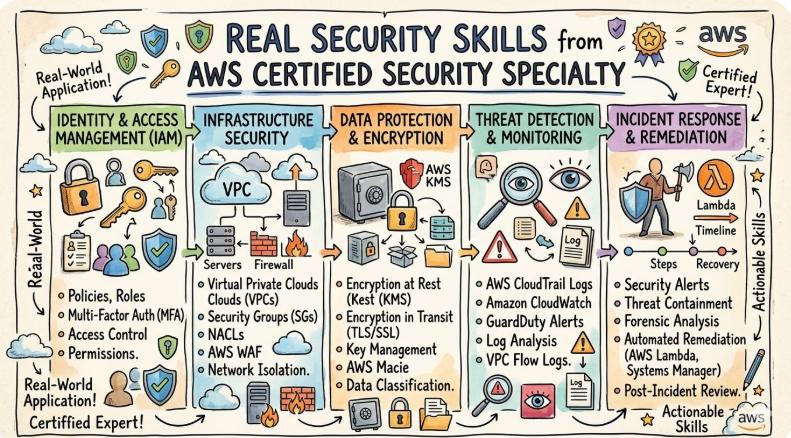
The AWS Certified Security – Specialty is a comprehensive exam that evaluates a candidate’s ability to secure data, manage access, and respond to security incidents. It covers five key domains that form the backbone of a secure AWS environment.
Who should take this certification?
- Professionals responsible for cloud governance and compliance.
- Engineers who manage identity and access across large-scale organizations.
- Security architects who design multi-account AWS structures.
- SREs focused on maintaining the integrity of production systems.
Skills you will gain
- The ability to architect fine-grained access control using complex IAM policies.
- Expertise in managing encryption keys at an enterprise scale using KMS.
- Competence in setting up automated auditing and continuous compliance monitoring.
- Mastery of network security tools to defend against DDoS and web-based attacks.
- The skill to implement automated remediation for security findings.
Real-world projects you should be able to do
- Implementing a centralized security logging solution for a global enterprise.
- Designing a secure CI/CD pipeline with automated vulnerability scanning.
- Configuring a multi-region disaster recovery plan with encrypted backups.
- Building a self-healing infrastructure that responds to unauthorized configuration changes.
- Migrating on-premise security policies to a cloud-native AWS environment.
Preparation Plan
7–14 Days Plan
- The exam guide is reviewed to identify high-impact topics.
- Intensive practice tests are taken to simulate the exam environment.
- Knowledge gaps in IAM and KMS are addressed through focused study.
30 Days Plan
- The first two weeks are dedicated to mastering the five security domains.
- Hands-on labs are performed to gain familiarity with security service configurations.
- The final week is spent on full-length mock exams and final reviews.
60 Days Plan
- Month one is used for deep conceptual learning and reading technical whitepapers.
- Month two is focused on complex architectural scenarios and multi-account security.
- The last ten days are reserved for intensive testing and weak-point analysis.
Common mistakes to avoid
- Overlooking the importance of Service Control Policies (SCPs) in AWS Organizations.
- Relying too much on the GUI instead of understanding the underlying API actions.
- Failing to practice the logic of complex IAM policy evaluation.
- Not spending enough time on troubleshooting incident response scenarios.
Best next certification after this
- Same Track: AWS Certified Solutions Architect – Professional.
- Cross-Track: AWS Certified Advanced Networking – Specialty.
- Leadership / Management: CISM (Certified Information Security Manager).
Choose Your Learning Path
DevOps
Focus is placed on the security of the delivery pipeline and infrastructure-as-code. This path is ideal for those who manage automated deployments.
DevSecOps
This path is designed for those who want to integrate security into every stage of the development lifecycle. It is the most direct application of this certification.
Site Reliability Engineering (SRE)
Security is treated as a component of system reliability. This path focuses on observability, logging, and minimizing the blast radius of incidents.
AIOps / MLOps
Security is applied to data pipelines and machine learning models. It ensures that sensitive training data and intellectual property are protected.
DataOps
The emphasis is placed on data privacy and governance. This path is best for those securing large-scale data lakes and analytical platforms.
FinOps
Security is aligned with cost management. It ensures that security services are utilized efficiently and that financial data remains confidential.
Role → Recommended Certifications Mapping
| Role | Primary Certification | Secondary Certification |
| DevOps Engineer | AWS SysOps Assoc | AWS Security Specialty |
| SRE | AWS Developer Assoc | AWS Security Specialty |
| Platform Engineer | AWS Architect Assoc | AWS Security Specialty |
| Cloud Engineer | AWS SysOps Assoc | AWS Security Specialty |
| Security Engineer | AWS Security Specialty | AWS Architect Prof |
| Data Engineer | AWS Data Engineer Assoc | AWS Security Specialty |
| FinOps Practitioner | AWS Cloud Practitioner | AWS Security Specialty |
| Engineering Manager | AWS Cloud Practitioner | AWS Security Specialty |
Next Certifications to Take
- Same-track: AWS Certified Solutions Architect – Professional.
- Cross-track: CKS (Certified Kubernetes Security Specialist).
- Leadership-focused: CISSP (Certified Information Systems Security Professional).
Training & Certification Support Institutions
DevOpsSchool
Mentorship and deep-dive training are provided to help professionals master AWS security. The curriculum is focused on practical, job-ready skills.
Cotocus
Interactive learning paths are offered for cloud and security certifications. The focus is kept on high-quality, expert-led instruction.
ScmGalaxy
A vast repository of technical resources and community support is maintained for DevOps and security practitioners.
BestDevOps
Practical training is delivered to help engineers transition into specialized cloud security roles.
devsecopsschool.com
A dedicated platform for learning the integration of security within the DevOps lifecycle is provided.
sreschool.com
Training is focused on the intersection of reliability, stability, and security in production environments.
aiopsschool.com
Specialized courses are offered for securing artificial intelligence and automated operations.
dataopsschool.com
The governance and security of data-driven architectures are the primary focus of this institution.
finopsschool.com
Educational programs are provided for managing the security and costs of cloud operations simultaneously.
FAQs Section
Core Career & Business FAQs
- How does this certification impact organizational risk?
The risk of catastrophic data breaches is lowered by ensuring that engineers follow the AWS Well-Architected Security Pillar. - Is this credential valued by executive leadership?
Yes, it is often viewed as a requirement for leads who manage mission-critical cloud infrastructure. - What is the ROI of this certification for a company?
Investment in this certification is recovered through reduced audit findings and more efficient incident response. - Does this certification satisfy regulatory compliance requirements?
Knowledge gained helps organizations meet standards like GDPR, HIPAA, and SOC2. - How does it change the day-to-day work of an engineer?
The focus shifts from manual security checks to building automated, self-healing security guardrails. - Can this help in transitioning to a CISO office?
It provides the technical foundation required for high-level security governance roles. - Is it beneficial for Engineering Managers who don’t code?
It allows managers to make informed decisions about security budgets and tool selection. - How does it improve team collaboration?
A common language for security is established between development and operations teams. - What is the global demand for this specialty?
The demand is consistently high as companies prioritize data privacy in every market. - How does this certification address multi-account complexity?
Strategies for centralizing security management across hundreds of accounts are mastered. - Is it relevant for startups?
Yes, it ensures that security is built-in from day one, preventing costly rework later. - What is the long-term career shelf-life?
While the tools change, the security principles learned remain relevant for years.
AWS Security – Operational FAQs
- How is automated compliance testing addressed?
Tools like AWS Config and AWS Security Hub are leveraged to monitor compliance in real-time. - What is the strategic role of KMS in this exam?
The separation of duties between key administrators and key users is a major focus. - How are threat detection capabilities evaluated?The ability to analyze logs and identify anomalies using GuardDuty is tested.
- What is the importance of identity federation?
It is taught as the primary method for managing large-scale user access without manual IAM users. - How does the exam treat “Zero Trust” architecture?
The principle of “least privilege” is applied to every service and network layer. - What role does logging play in disaster recovery?
Immuntable logs are emphasized as the final source of truth during an incident investigation. - Are shared responsibility boundaries clearly defined?
Yes, knowing exactly where the customer’s responsibility starts is critical for passing. - How is the security of data in transit prioritized?
The implementation of TLS and secure VPC endpoints is evaluated for various scenarios.
Testimonials
Aman, DevOps Engineer
A strategic shift in how I view cloud infrastructure was experienced. Security is no longer an afterthought in my deployments.
Deepika, SRE
The ability to handle production incidents was greatly enhanced. I now lead the security response team at my firm.
Kunal, Cloud Engineer
Career growth was accelerated after obtaining this specialty. It opened doors to high-level architectural roles.
Megha, Security Architect
Confidence in designing multi-account governance was gained. The focus on automation was exactly what I needed.
Robert, Engineering Manager
Decision-making regarding our cloud security stack has become much more efficient. The technical depth provided is invaluable.
Conclusion
The AWS Certified Security – Specialty is a defining credential for those who wish to lead in the cloud era. It represents a mastery of the most sensitive and complex aspects of AWS. By pursuing this path, a commitment to protecting the digital future is demonstrated. Long-term career growth and the ability to solve high-stakes problems are the ultimate rewards. Strategic planning and a focus on hands-on application will ensure success in this journey.