Introduction
Technology moves fast. Every time you open a ride-hailing app, stream a movie, or use a translation tool, you are relying on complex software working quietly behind the scenes.
Building that software used to be messy. Developers wrote code on their own computers, handed it over to operations teams, and hoped it would work on server computers. Usually, it broke. DevOps was created to fix this communication gap.
Today, a new challenge has arrived: Artificial Intelligence (AI) and Machine Learning (ML). Building an AI model is very different from writing a standard website or mobile app. AI models do not just run on fixed code; they rely heavily on massive amounts of data that constantly change.
Because standard DevOps tools were not built to handle data changes, a new practice called MLOps was born. Understanding the difference between these two approaches helps us see how modern technology gets built, scaled, and maintained.
What Is DevOps?
DevOps is a combination of “Development” and “Operations.” It is a set of practices and tools designed to help software teams build, test, and release software faster and with fewer bugs.
Why Does It Matter?
Before DevOps, software development was slow. Programmers would spend months writing code in isolation. When they finally handed the finished product to the IT operations team to launch, things would fail because the server environment was different from the developer’s laptop. DevOps automates this entire pipeline so code moves smoothly from a programmer’s desk to live users.
How Does It Work?
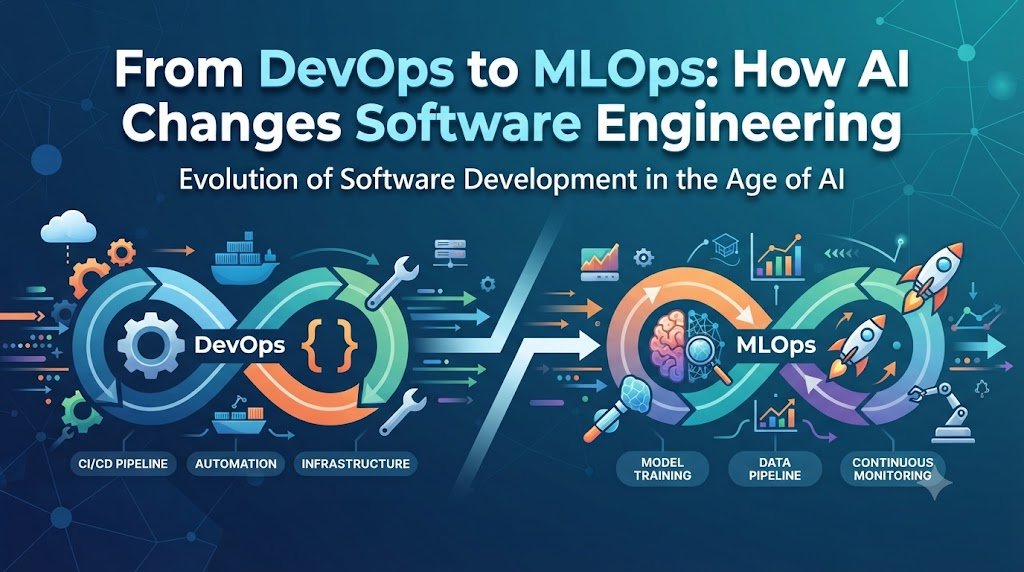
A typical DevOps pipeline follows a clear path:
- Plan: The team decides what features to build.
- Code: Developers write the software instructions.
- Build & Test: Automated tools check the code for errors.
- Deploy: The code is automatically pushed to cloud servers.
- Monitor: Engineers watch the live system to ensure it stays online.
What Is MLOps?
MLOps stands for “Machine Learning Operations.” It is a specialized extension of DevOps tailored specifically for machine learning and artificial intelligence systems.
Why Does It Matter?
Writing machine learning code is only a small part of creating an AI product. Unlike standard software, AI systems depend on data. If the data changes, the AI model’s accuracy can drop drastically overnight.
For example, a fraud-detection AI might work wonderfully in testing, but if financial scammers change their tactics, the underlying data changes. MLOps automates the tracking of data, model training, and continuous updates so the AI stays accurate in the real world.
How Does It Work?
An MLOps pipeline includes everything a DevOps pipeline does, plus steps unique to data science:
- Data Gathering & Cleaning: Collecting raw data and preparing it for training.
- Model Training: Feeding data into algorithms so the computer learns patterns.
- Model Evaluation: Testing the AI model for accuracy and fairness.
- Deployment: Publishing the model so apps can use it to make predictions.
- Data Monitoring: Watching for “data drift,” which happens when real-world inputs change and make the AI outdated.
Key Differences Between DevOps and MLOps
While MLOps borrows many best practices from DevOps, they target entirely different problems, artifacts, and life cycles.
| Feature | DevOps | MLOps |
|---|---|---|
| Primary Goal | Ship reliable traditional software quickly. | Build, deploy, and maintain accurate AI/ML models. |
| Core Artifact | Application source code, configuration files, and binaries. | Data sets, machine learning algorithms, and trained model weights. |
| Testing Focus | Testing code logic, security vulnerabilities, and user interfaces. | Testing model accuracy, data quality, bias, and prediction drift. |
| Update Triggers | Code changes made by human software engineers. | New data arrivals, changing patterns, or performance drops. |
| Primary Teams | Software Developers and IT System Administrators. | Data Scientists, Data Engineers, and ML Engineers. |
Practical Example: Streaming Recommendations
To see how these two systems work together, let’s look at a popular video streaming service.
- The DevOps Side: The video player app on your phone, the button you click to pause a video, and the user login screen are managed by DevOps. If engineers update the button color or fix a login bug, DevOps pipelines test and push that code update safely to millions of users.
- The MLOps Side: The system that suggests what movie you should watch next is powered by machine learning. As millions of people watch movies every day, their viewing habits change. MLOps automatically collects these new viewing patterns, retrains the recommendation algorithm, and updates the suggestion engine without crashing the video player app itself.
Common Mistakes Beginners Make
When studying or implementing these practices, beginners often run into a few predictable traps:
- Treating ML Models Like Regular Code:
- What people do: They push an AI model through a standard DevOps pipeline without tracking the data used to train it.
- Why it causes problems: If the model fails later, nobody knows which dataset or parameters created it.
- What to do instead: Use specialized model registries that track both code versions and data versions together.
- Ignoring Data Quality:
- What people do: They focus entirely on writing clever algorithms while ignoring messy incoming data.
- Why it causes problems: The old computer science rule applies here: “Garbage in, garbage out.” Poor data leads to terrible AI predictions.
- What to do instead: Build automated data validation checks before the model training phase begins.
Risks and Limitations
Neither DevOps nor MLOps is a silver bullet. Both come with operational trade-offs.
- High Complexity: Setting up automated pipelines requires specialized technical tools and cloud infrastructure expertise. Small teams can easily spend more time maintaining their pipelines than building features.
- Resource Costs: Training large machine learning models in an MLOps pipeline consumes massive amounts of cloud computing power, which can lead to surprisingly high bills if not monitored closely.
- Maintenance Overhead: Tools and frameworks in the tech world change rapidly. Keeping automation scripts updated requires ongoing effort from skilled engineers.
Decision-Making Framework: Which Do You Need?
If you are planning a software project, determining whether you need standard DevOps or a combination of DevOps and MLOps depends on your core product:
- Identify the Core Product: Is your application primarily rule-based logic, forms, databases, and user workflows? If yes, you need DevOps.
- Evaluate the Intelligence Layer: Does your product rely on predictions, classifications, natural language processing, or computer vision that learns from data? If yes, you need MLOps on top of your DevOps foundation.
- Assess Team Skills: Do you have data scientists on staff who need to ship models frequently? If so, investing in MLOps automation will save countless hours of manual work.
Key Terms
- Continuous Integration (CI): The practice where developers frequently merge their code changes into a central repository, where automated tests run immediately.
- Continuous Delivery (CD): The automated process of pushing tested code changes to staging or production environments.
- Data Drift: A phenomenon where real-world data changes over time, causing an AI model’s predictions to become less accurate.
- Model Registry: A centralized storage system used to track different versions of trained machine learning models, along with their performance metrics.
- Pipeline: An automated sequence of steps that takes code or data from raw input to a finished, running product.
FAQs
Is MLOps just a subset of DevOps?
Yes and no. MLOps borrows heavily from DevOps principles like automation, testing, and continuous deployment. However, because MLOps deals with unpredictable data and probabilistic models rather than deterministic code, it requires entirely separate workflows and specialized tools.
Do I need to learn DevOps before learning MLOps?
It is strongly recommended. MLOps builds directly on top of DevOps fundamentals. Understanding how code is packaged, tested, deployed, and monitored in standard software engineering makes learning how to manage machine learning models much easier.
Why do machine learning models fail in production?
Models often fail because the real-world data they encounter looks different from the data they were trained on. Changes in user behavior, seasonal shifts, or external events can all degrade an AI model’s performance over time.
What tools are commonly used in DevOps?
Popular DevOps tools include Docker for packaging software, Kubernetes for managing servers, GitHub Actions for automation pipelines, and Terraform for cloud infrastructure setup.
What tools are commonly used in MLOps?
Popular MLOps tools include MLflow for tracking experiments, Kubeflow for managing machine learning workflows, Apache Airflow for data pipelining, and specialized vector databases for AI memory.
Conclusion
DevOps and MLOps are two sides of the same modern engineering coin. DevOps keeps traditional software running smoothly, reliably, and fast. MLOps extends those automated safeguards into the unpredictable world of data and artificial intelligence.
By understanding how code and data flow through these pipelines, beginners can better grasp how the digital tools and intelligent systems we use every day are built to last.