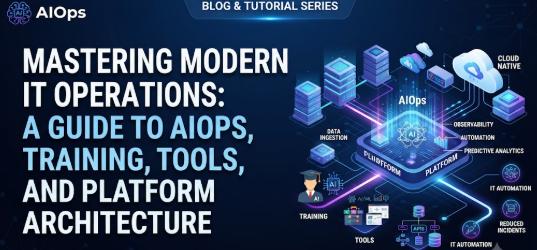
Introduction
Managing modern digital systems is hard. Traditional IT systems used to be small. A company might run a few servers in a local room. When something broke, an engineer looked at a log file, found the issue, and fixed it.
Today, systems are massive. Applications run in the cloud using containers, microservices, and distributed networks. They generate millions of log lines, metrics, and alerts every single minute.
Human operators cannot read millions of alerts. If a server slows down, it triggers dozens of warning lights. Engineers waste hours sorting through noise instead of fixing the actual problem.
This is why modern IT teams use Artificial Intelligence for IT Operations.
What is TheAIOps.com?
TheAIOps.com is a specialized learning, consulting, and knowledge platform focused on Artificial Intelligence for IT Operations.
It helps individuals and organizations understand how machine learning, big data, observability, and automation can transform day-to-day IT work.
The platform connects several key areas:
- Learning and skill development
- Enterprise tools and platform architecture
- Implementation strategies and expert consulting
Instead of treating AI as a buzzword, the platform focuses on practical ways to collect operational data, spot patterns, and automate routine tasks.
Understanding Artificial Intelligence for IT Operations
To understand what Artificial Intelligence for IT Operations means, let us break it down into simple parts.
- IT Operations: The daily work of keeping software, servers, and networks running smoothly.
- Operational Data: The digital footprint left by systems, including logs, metrics, traces, and events.
- Artificial Intelligence: Computer systems designed to process large amounts of data, find patterns, and make decisions.
Think of a busy hospital. Heart monitors beep constantly. If every single beep sounded the same, doctors would get confused. A smart monitor learns what is normal for a specific patient and only alerts the staff when a real danger occurs.
AIOps does the exact same thing for computer networks. It acts as a smart filter for IT data.
Exploring AIOps Training
As cloud systems grow, companies need people who understand how to use intelligent monitoring tools. AIOps Training helps professionals build these practical skills.
Good training covers core topics such as:
- Intelligent Monitoring: Moving away from static threshold alerts to dynamic baselines.
- Anomaly Detection: Teaching systems to spot unusual behavior automatically.
- Event Correlation: Grouping related alerts together so engineers see one incident instead of fifty.
- Root-Cause Analysis: Tracing a problem back to its true source.
- Automated Remediation: Setting up safe scripts to fix known issues without human delay.
Training gives engineers the confidence to handle complex production environments without guessing.
The Role of AIOps Certification
Studying is important, but validating knowledge helps professionals demonstrate their competence. An AIOps Certification provides a structured way to test what a person has learned.
Certification exams typically cover architecture design, data ingestion, tool selection, and operational workflows.
However, passing an exam is only part of the journey. Real-world experience matters most. A certificate proves that an engineer understands the concepts, but daily practice in test labs and live environments builds true troubleshooting skill.
What Does an AIOps Course Cover?
A well-designed AIOps Course takes a learner step-by-step from basic concepts to advanced automation.
Here is what a typical structured learning path looks like:
- Foundations: Understanding traditional monitoring limits and why data volumes are growing.
- Data Collection: Learning how logs, metrics, and traces flow from servers to storage.
- Machine Learning Basics: Discovering how algorithms detect patterns in large datasets.
- Alert Reduction: Learning methods to silence duplicate and low-value warnings.
- Incident Management: Using automated insights to resolve user-facing bugs faster.
- Implementation Challenges: Studying real-world roadblocks like bad data quality and tool integration.
Each stage builds on the last, ensuring students understand the “why” behind every technology.
Navigating AIOps Tools
Every IT team uses software to watch their systems. AIOps Tools are specialized applications that add intelligence to standard monitoring setups.
Here are common tool categories and their purposes:
- Log Management Tools: Collect and index text logs from applications to make searching faster.
- Metric Monitoring Tools: Track CPU usage, memory limits, and network traffic over time.
- Incident Management Tools: Track active tickets and assign them to the right support teams.
- Analytics Engines: Apply machine learning models to historical data to predict future hardware failures.
Using a tool effectively requires clean data. If the input data is messy, the tool’s output will also be incorrect.
What is an AIOps Platform?
While individual tools handle specific tasks, an AIOps Platform brings everything together into a single system.
An enterprise platform follows a clear data pipeline:
$$\text{Data Collection} \rightarrow \text{Processing} \rightarrow \text{Analysis} \rightarrow \text{Correlation} \rightarrow \text{Action}$$
- Collection: Gathering logs, metrics, and traces from cloud servers.
- Processing: Cleaning the data and removing duplicates.
- Analysis: Running machine learning models to detect anomalies.
- Correlation: Linking a database slowdown to a network error on the same server rack.
- Action: Sending a clear alert to an engineer or triggering an automated fix.
Platforms vary widely. Some focus heavily on log analytics, while others specialize in cloud infrastructure monitoring.
Planning an AIOps Implementation
Moving from basic monitoring to intelligent operations requires careful planning. AIOps Implementation is an engineering project, not a weekend software installation.
A practical implementation roadmap includes:
- Assess the Current Setup: List all existing monitoring tools and data sources.
- Identify Pain Points: Find out where engineers spend the most time troubleshooting.
- Clean the Data: Ensure logs and metrics use consistent timestamps and formats.
- Start Small: Implement monitoring on a single non-critical application first.
- Measure Results: Track whether alert noise decreases and incident resolution speeds up.
Trying to automate everything at once often leads to confusion and project failure.
AIOps Consulting and Services
Many organizations need expert guidance before changing their monitoring architecture. AIOps Consulting helps leaders make smart technology choices.
Consultants typically review:
- Existing tool overlap and license costs
- Gaps in current observability data
- Readiness for automation
- Security and compliance risks
Meanwhile, AIOps Services involve hands-on support. Service providers help set up data pipelines, build custom machine learning models, and integrate platforms with existing incident ticketing systems.
Skills Needed for an AIOps Engineer
An AIOps Engineer sits at the intersection of system administration, data analysis, and software development.
Key skills include:
- Linux and Cloud Fundamentals: Understanding how operating systems and cloud services run.
- Scripting: Writing Python or Bash scripts to automate routine fixes.
- Data Literacy: Knowing how to query databases and read log formats.
- Monitoring Knowledge: Understanding metrics like latency, error rates, and saturation.
- Troubleshooting Methodology: Knowing how to isolate a bug in a distributed system.
Building these skills takes hands-on lab practice and exposure to real production environments.
Monitoring, Observability, and AIOps
It is common to confuse monitoring with observability, but they mean different things.
- Monitoring tells you when something is broken. (Example: “Server CPU usage is at 100%.”)
- Observability helps you understand why it is broken based on its outputs. (Example: “A bad database query caused CPU usage to spike.”)
- AIOps uses machine learning to analyze that observability data automatically, finding patterns humans might miss.
Collecting data is only the first step. Understanding what the data means is where intelligence begins.
Anomaly Detection in Practice
An anomaly is anything that falls outside normal operating behavior.
Imagine an e-commerce website. On a normal Tuesday morning, 5,000 users visit the checkout page every hour. If traffic suddenly drops to zero, or jumps to 50,000, that is an anomaly.
Traditional monitoring uses static rules, like alerting when traffic exceeds 10,000 users. But what if a holiday sale makes high traffic normal? A static rule would send false alarms all day.
Machine learning solves this by learning weekly and daily cycles, adjusting the baseline automatically. However, models can still make mistakes, which is why human review remains important for critical alerts.
Event Correlation and Root-Cause Analysis
When a single cloud server fails, it can trigger fifty different alerts across three different monitoring tools. This is called alert noise.
Event correlation groups those fifty alerts into a single incident ticket.
Root-cause analysis takes it a step further. Instead of showing that the web server, payment gateway, and user login page are all failing, the system traces the issue back to its source: a single expired security certificate on the database.
Finding the root cause in seconds saves hours of stressful debugging.
Predictive Analytics and Automated Remediation
Beyond fixing current problems, advanced systems try to prevent future ones.
- Predictive Analytics: Using historical trends to forecast disk space shortages or memory leaks before they crash an application.
- Automated Remediation: Writing safe scripts that restart a failing service or clear temporary cache files automatically without waking up an engineer at midnight.
Automation is powerful, but dangerous if applied blindly. Every automated action must be tested thoroughly in a staging environment first.
How TheAIOps.com Connects These Areas
The different elements of IT operations work best as a connected ecosystem:
Learning builds the foundation. Tools and platforms provide the technical capability. Implementation brings the concepts into real business environments. TheAIOps.com serves as a central knowledge hub connecting these professional disciplines.
Real-World AIOps Examples
Consider a common IT scenario:
- Problem: An application suddenly becomes very slow for users.
- Data: The APM tool collects traces, logs show database timeout errors, and metrics show high memory consumption.
- Analysis: The platform correlates the database timeouts with a sudden spike in background query jobs.
- Insight: A poorly written database query is locking up system memory.
- Action: The system sends an alert with the exact query ID to the database administrator, or automatically scales up memory resources temporarily.
This structured flow turns chaotic troubleshooting into a repeatable process.
Common AIOps Implementation Mistakes
Teams often run into trouble when adopting new operational technologies. Here are frequent mistakes to avoid:
- Starting with Tools Instead of Problems: Buying expensive software before knowing what operational issue needs fixing.
- Ignoring Data Quality: Feeding messy, unformatted logs into advanced machine learning models.
- Expecting Full Automation Immediately: Turning on automatic fixes before trusting the AI’s accuracy.
- Treating It Solely as an AI Project: Forgetting that IT operations requires deep infrastructure knowledge, not just data science.
- Neglecting Team Training: Installing a platform without teaching engineers how to interpret its insights.
Avoiding these pitfalls saves time, budget, and frustration.
Benefits and Limitations
Potential Benefits
- Faster incident detection and resolution times.
- Significant reduction in alert fatigue for on-call engineers.
- Better visibility across complex cloud environments.
- Smarter use of operational data for capacity planning.
Limitations and Challenges
- Initial setup complexity and data integration hurdles.
- Risk of false positives if models are poorly trained.
- Ongoing maintenance requirements for custom rules and models.
- High skill requirements for engineering teams.
AIOps is a powerful assistant, not a magical replacement for skilled human operators.
Practical Learning Path
If you want to build expertise in this field, follow a logical progression:
- Master IT Basics: Learn Linux command line, networking fundamentals, and cloud concepts.
- Learn Monitoring: Understand how to collect metrics and read server logs.
- Explore Observability: Study traces, spans, and application performance monitoring.
- Study AIOps Concepts: Learn about anomaly detection, event correlation, and alert noise reduction.
- Practice with Tools: Set up open-source monitoring and log analysis tools in a home lab.
- Build Engineering Skills: Learn basic Python scripting and incident management workflows.
Take your time with each stage. Solid fundamentals make advanced concepts much easier to grasp.
Who Can Benefit?
These concepts are useful for a wide range of professionals:
- System Administrators: Looking to modernize their daily monitoring workflows.
- Cloud Engineers: Managing large-scale containerized applications.
- DevOps and SRE Professionals: Focused on system reliability and uptime.
- IT Leaders: Planning operational efficiency and automation roadmaps.
Anyone working with complex digital infrastructure can benefit from understanding how artificial intelligence supports modern IT operations.
Frequently Asked Questions
1. What is AIOps in simple terms?
AIOps stands for Artificial Intelligence for IT Operations. It uses machine learning and big data to help IT teams filter alert noise, find anomalies, and solve technical problems faster.
2. How does TheAIOps.com help IT professionals?
It serves as a specialized learning, consulting, and knowledge platform that explains modern IT operations, intelligent monitoring, tools, and implementation strategies.
3. Do I need to know programming to learn AIOps?
Basic scripting knowledge (like Python or Bash) is very helpful for automation tasks, but foundational IT operations knowledge is where most professionals start.
4. What is the difference between monitoring and AIOps?
Monitoring tells you when a system breaks. AIOps uses data analytics and machine learning to correlate events, find root causes, and predict failures before they impact users.
5. Can AIOps completely replace human IT engineers?
No. AIOps automates repetitive tasks and analyzes data quickly, but human engineers are still essential for decision-making, architecture design, and complex problem-solving.
6. What causes false positives in AIOps tools?
False positives usually happen due to poor data quality, poorly tuned machine learning baselines, or sudden unusual traffic patterns that the model has not seen before.
7. What is event correlation?
Event correlation is the process of grouping multiple related alerts from different monitoring tools into a single, understandable incident ticket.
8. What should an organization do before implementing AIOps?
Organizations should assess their current monitoring setup, identify specific operational pain points, and ensure their log and metric data is clean and consistent.
9. Why is data quality important for AIOps platforms?
Machine learning models rely entirely on incoming data. If logs are messy, incomplete, or incorrectly formatted, the platform’s analysis and predictions will be inaccurate.
10. How long does it take to become an AIOps Engineer?
Timeline depends on prior IT experience. Someone with a background in cloud engineering or system administration can usually transition by learning monitoring, data analysis, and automation tools over several months.
Conclusion
Modern IT systems generate more data than any human team can read alone. Artificial Intelligence for IT Operations bridges that gap by turning raw logs and metrics into clear, actionable insights.
By combining structured learning, reliable tools, thoughtful implementation, and solid engineering skills, organizations can move away from reactive firefighting and toward proactive, intelligent operations. Platforms like TheAIOps.com provide the educational foundation needed to understand this evolving technological landscape and build a more resilient IT future.