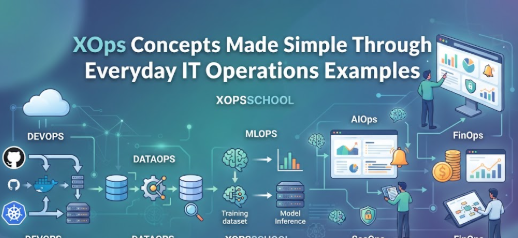
The modern digital landscape moves at a relentless pace, forcing engineering teams to look beyond single-focus workflows. Building resilient systems no longer stops at writing code or provisioning servers; it now demands deep coordination across data pipelines, machine learning models, cloud environments, and automated security barriers.
To make sense of this expanding web of responsibilities, the industry has embraced XOps. Rather than functioning as a standalone tool or a rigid framework, XOps represents an interconnected philosophy that brings siloed operational practices under one unified umbrella.
Navigating this multi-disciplinary shift requires the right educational foundation. XOpsSchool acts as a comprehensive learning resource designed to demystify how these advanced operational tracks intersect. Instead of treating software delivery, artificial intelligence, and data management as unrelated subjects, the platform helps learners understand the shared mechanics that tie them together.
This comprehensive breakdown explores the mechanics of modern IT operations, untangles the various disciplines living beneath the XOps umbrella, and highlights how structured learning paths through XOpsSchool help professionals turn theoretical knowledge into tangible engineering capability.
What is XOps?
The term XOps acts as an umbrella concept in modern technology. The “X” represents a variable that can be replaced by different operational disciplines, such as Data, Machine Learning, Security, or Artificial Intelligence.
At its core, XOps is the practice of applying consistent operational principles across all areas of technology. It takes the successful concepts pioneered by software development operations and extends them to other specialized fields. This means using automation, continuous delivery, version control, and continuous monitoring for data pipelines, security protocols, and machine learning models.
XOps connects multiple areas of technology delivery. Instead of a data team using one set of deployment practices while a software team uses another, XOps encourages shared methodologies. Organizations need these connected practices to reduce operational friction, improve collaboration, and maintain consistent governance across complex cloud environments.
Treating different operational fields as isolated practices often creates bottlenecks. When teams share automation strategies and processes, they deliver faster and resolve incidents more efficiently. XOps provides the framework to unify these efforts.
Through the XOpsSchool learning ecosystem, professionals discover how to stop viewing operations as a single tool or a disjointed set of scripts. Instead, learners explore XOps as a holistic approach to continuous technology delivery.
Why XOps Matters in Modern IT
Modern organizations manage massive technology footprints. They deploy containerized applications, manage globally distributed cloud infrastructure, process massive data streams, and integrate artificial intelligence into customer-facing products.
Disconnected operational processes create severe challenges in these environments. When infrastructure teams cannot see application performance, or when data engineers cannot align their pipelines with security policies, deployments fail. Troubleshooting becomes slow and expensive. Cost management becomes impossible when different teams deploy resources without shared standards.
XOps thinking solves these operational challenges by encouraging standardization. When an organization adopts XOps principles, it builds common workflows. Automation replaces manual configurations. Observability platforms provide visibility across the entire technology stack.
This connected approach ensures continuous improvement. Teams receive faster feedback on their deployments. Governance and security checks happen automatically during the delivery process rather than acting as roadblocks at the very end.
XOps does not automatically solve every engineering problem. It requires careful planning, disciplined execution, and continuous learning. Platforms like XOpsSchool provide the necessary educational context to help teams understand how to implement these shared practices successfully.
Major XOps Disciplines
The XOps framework encompasses several distinct but connected operational disciplines. Understanding these distinct areas is a core part of the XOpsSchool learning philosophy.
DevOps
DevOps forms the foundation of modern technology operations. It focuses on the collaboration between software development and IT operations. Core concepts include continuous integration and continuous deployment, infrastructure automation, containerization, and source code management. DevOps ensures that software moves from a developer’s workstation to a production environment quickly and reliably.
DataOps
DataOps applies operational discipline to data engineering and analytics. It focuses on building reliable data pipelines, ensuring data quality, and orchestrating data movement. DataOps uses continuous data delivery practices to ensure that analysts and applications receive accurate, timely data without manual intervention or pipeline breakages.
MLOps
Machine Learning Operations manages the lifecycle of machine learning models. MLOps covers model development, deployment, versioning, testing, and continuous monitoring. It ensures that machine learning models remain accurate in production environments and provides automated processes for retraining models when their performance degrades.
AIOps
Artificial Intelligence for IT Operations uses machine learning and analytics to improve operational monitoring and automation. AIOps tools analyze massive volumes of system logs and performance metrics. They perform anomaly detection, correlate alerts to reduce noise, and help operations teams identify the root cause of complex incidents faster.
SecOps
Security Operations integrates security practices directly into the daily operational workflow. SecOps emphasizes automated security testing, continuous vulnerability scanning, and proactive threat monitoring. It ensures that security remains a shared responsibility rather than an afterthought.
FinOps
Financial Operations brings financial accountability to cloud computing and technology spend. FinOps connects engineering, finance, and business teams. It focuses on understanding cloud costs, optimizing resource usage, and making informed decisions about technology investments during the operational lifecycle.
Platform Engineering
Platform Engineering focuses on building internal developer platforms. It provides developers with self-service capabilities, reusable infrastructure templates, and standardized engineering workflows. This discipline reduces cognitive load on developers by abstracting away the underlying operational complexity.
XOps Training
A well-structured XOps training path builds a comprehensive understanding of modern technology environments. The training resources discussed within the XOpsSchool ecosystem emphasize the connections between different technical disciplines.
Effective XOps training begins with strong fundamentals. Learners must first understand basic cloud infrastructure, networking, and operating systems. From there, training expands into DevOps foundations, covering automation, continuous integration, and container orchestration platforms like Kubernetes.
Advanced training covers specialized operational fields. Learners explore how to manage data operations and deploy machine learning models. They study how artificial intelligence can support IT operations through intelligent monitoring. Finally, comprehensive training integrates security, reliability, and governance into every operational layer.
The core value of this training lies in understanding relationships. Learning how a data pipeline interacts with a container orchestration system provides much more value than studying either technology in total isolation.
XOps Certification
Technical certification plays a specific role in an IT professional’s educational journey. XOps certification preparation helps learners organize their knowledge systematically.
Following a structured certification syllabus ensures that learners do not skip foundational concepts. Preparing for an exam forces professionals to test their understanding, identify their knowledge gaps, and demonstrate familiarity with established operational principles. XOpsSchool resources often align with these structured learning paths to support comprehensive knowledge validation.
However, certification alone does not equal practical expertise. A certificate proves that a learner understands the theory and terminology of XOps disciplines. It does not replace the critical thinking required to troubleshoot a broken production database or optimize a poorly performing automation pipeline. Certification should act as a milestone in a broader learning journey, complementing hands-on experience rather than replacing it.
XOps Course
A structured XOps course provides the roadmap necessary to master complex operational domains. Within the XOpsSchool learning framework, a logical progression is essential for knowledge retention.
A useful course starts with XOps fundamentals before moving into DevOps concepts like version control and basic automation. It then introduces cloud platforms and infrastructure as code. Once learners understand how to deploy basic infrastructure, the course introduces data operations and machine-learning operations.
Subsequent modules cover AIOps, teaching learners how to monitor these complex environments intelligently. The course concludes with advanced observability, security integration, and governance.
Learners should choose the depth of a course based on their existing technical background. A software developer might need a course focused heavily on infrastructure automation, while a systems administrator might need a course emphasizing data pipelines and software delivery processes.
XOps Tutorial
Tutorials provide the practical bridge between theoretical concepts and actual engineering work. XOps tutorial content is a vital component of the XOpsSchool approach to technical education.
Practical tutorials guide learners through specific configurations. They help professionals understand how to write automation scripts, configure deployment pipelines, provision cloud infrastructure, and deploy containerized applications. Tutorials also provide hands-on experience with monitoring dashboards, data pipeline orchestration, and machine-learning workflows.
Following a tutorial helps learners understand how different tools integrate. However, learners must recognize the difference between following step-by-step tutorial instructions and possessing true practical experience. A good tutorial should inspire the learner to experiment, break the configuration, and learn how to troubleshoot the resulting errors independently.
XOps Tools
XOps is not a single piece of software. It relies on an ecosystem of technologies designed to support different operational purposes. The XOpsSchool platform helps learners categorize and understand these tools based on their function.
Source Control and Collaboration
Version control forms the foundation of all XOps practices. Git remains the industry standard, supported by collaboration platforms that store code, manage versions, and facilitate team reviews.
CI/CD
Continuous Integration and Continuous Deployment tools automate the testing and delivery of code. Jenkins, GitHub Actions, GitLab CI/CD, and similar technologies orchestrate the deployment pipelines that push changes to production.
Containers and Orchestration
Containers package applications and their dependencies. Docker provides the standard container format, while Kubernetes serves as the primary orchestration platform for deploying, scaling, and managing containerized applications across clusters of servers.
Infrastructure Automation
Infrastructure as code tools allow teams to provision servers and networks using configuration files. Terraform excels at provisioning cloud resources, while configuration management tools like Ansible handle software installation and system configuration.
Observability
Modern operations require deep visibility. Prometheus collects system metrics, Grafana provides visualization dashboards, and OpenTelemetry offers a standardized framework for generating and collecting traces, metrics, and logs.
GitOps
GitOps tools ensure that a live environment always matches the configuration stored in version control. Technologies like Argo CD, Flux, and Helm automate the continuous delivery of applications specifically within Kubernetes environments.
Data Operations
Data operations rely on orchestration technologies to schedule and monitor data pipelines. These tools ensure that data moves reliably between databases, data warehouses, and analytics platforms while maintaining quality and consistency.
MLOps
Model lifecycle tools manage the unique requirements of machine learning. These technologies handle model deployment, track experiments, monitor production model performance, and automate the retraining process when data changes.
AIOps
AIOps tools connect to existing monitoring systems. They use intelligent algorithms to detect anomalies, correlate event alerts, and provide automated insights that help human operators solve complex infrastructure problems faster.
Selecting the right tool depends entirely on technical architecture, existing team skills, security requirements, and scale. No single tool is universally the best for every organization.
DevOps Training
DevOps training forms a critical segment of the broader XOps learning path. XOpsSchool emphasizes DevOps as the foundation upon which other operational disciplines are built.
This training covers the essential mechanics of software delivery. Learners study continuous integration, version control strategies with Git, and containerization using Docker and Kubernetes. Training dives into infrastructure as code using Terraform and Ansible, teaching professionals how to treat cloud platforms as programmable resources.
While DevOps focuses heavily on application delivery and infrastructure automation, it is only one part of the XOps equation. Understanding DevOps principles makes it much easier to learn DataOps and MLOps, as the underlying concepts of automation, testing, and continuous delivery remain largely the same.
AIOps Training
AIOps training teaches professionals how to handle the massive volume of alerts and logs generated by modern cloud environments. XOpsSchool resources help learners understand where artificial intelligence adds genuine value to IT operations.
Training covers modern event management and anomaly detection. Learners discover how AIOps tools correlate thousands of seemingly unrelated system alerts into a single actionable incident. This process reduces alert fatigue for engineering teams and speeds up incident analysis.
AIOps training highlights where AI can automate standard operational responses and where human judgment remains critical. AI assists operations teams by surfacing relevant data, but human engineers still make the final architectural and strategic decisions.
MLOps Training
Machine learning models require entirely different operational handling than standard web applications. MLOps training connects the work of data scientists with the reliability practices of operations engineers.
This training explores the complete model development lifecycle. Learners study model deployment, versioning, and validation. They learn how to build automation that tests both the code and the underlying data feeding the model.
Crucially, MLOps training covers model performance monitoring. Models can degrade over time as real-world data changes. Training teaches professionals how to build operational systems that detect this degradation and trigger automated maintenance and retraining workflows.
DataOps Training
DataOps training introduces operational rigor to data engineering. Through XOpsSchool resources, learners discover how to treat data pipelines with the same care as production software.
Training focuses on orchestrating complex data movement. Learners study how to implement continuous data delivery, ensuring data arrives on time and in the correct format. The training covers automated data quality checks, testing methodologies for data transformations, and comprehensive data observability.
By applying operational best practices, DataOps training helps data engineers build resilient architectures that survive unexpected data changes and infrastructure failures.
How XOps Connects DevOps, DataOps, MLOps and AIOps
Understanding the conceptual relationship between these disciplines is the primary educational goal of XOpsSchool. While they serve different functions, they share a common operational DNA.
DevOps supports the delivery of applications and infrastructure. DataOps supports the reliable movement and quality of information. MLOps supports the lifecycle and accuracy of machine-learning models. AIOps applies intelligent analytics to monitor all of these systems efficiently.
The connection lies in their shared principles. All these disciplines rely on source control to manage their configurations. They all utilize CI/CD principles to automate testing and deployment. They all require robust infrastructure, deep observability, and strict governance to function securely.
By understanding XOps as a unified framework, teams can share automation platforms and operational feedback loops. A single observability dashboard can display application metrics (DevOps), data pipeline health (DataOps), model accuracy (MLOps), and intelligent alert correlations (AIOps).
Who Can Benefit from XOpsSchool?
1. DevOps and Cloud Engineers
Professionals already familiar with infrastructure and software delivery can use XOps knowledge to broaden their technical scope. They can learn how to apply their existing automation skills to support data engineering and machine learning workloads, making them more versatile across different engineering departments.
2. Data Engineers
Data professionals can benefit significantly by learning DataOps concepts. Understanding how to apply software engineering practices—like version control, automated testing, and continuous integration—to data pipelines improves data quality, reduces pipeline failures, and brings operational stability to analytics platforms.
3. Machine Learning Professionals
Data scientists and machine learning engineers often struggle to move their models from a local environment into reliable production systems. Learning MLOps concepts helps them connect their mathematical models with robust deployment strategies, automated retraining loops, and ongoing operational monitoring.
4. IT Operations and SRE Professionals
Traditional systems administrators and Site Reliability Engineers can use XOps knowledge to modernize their skill sets. Learning about AIOps, advanced observability, automated incident response, and platform engineering concepts complements their existing troubleshooting and infrastructure management abilities.
5. Developers and Technical Learners
Software developers benefit from understanding the operational side of modern applications. Learning XOps concepts helps developers write more reliable code, understand how their applications behave in containerized cloud environments, and utilize internal platform engineering tools more effectively.
6. Technology Teams and Organizations
Entire engineering organizations can use XOps principles to break down internal silos. When teams share a common operational vocabulary regarding infrastructure, data, AI, security, reliability, and cost management, they collaborate more effectively and deliver technology solutions with greater speed and stability.
First Professional Table
| XOps Discipline | Main Focus | Common Learning Areas |
| DevOps | Software delivery and infrastructure automation | CI/CD pipelines, containerization, Git, infrastructure as code. |
| DataOps | Reliable data pipelines and data quality | Data orchestration, continuous data delivery, data observability. |
| MLOps | Machine-learning model lifecycle management | Model deployment, automated retraining, model performance monitoring. |
| AIOps | Intelligent operational monitoring and automation | Anomaly detection, event correlation, automated incident analysis. |
| SecOps | Integrated security and automated compliance | Vulnerability scanning, automated security testing, threat monitoring. |
| FinOps | Cloud cost management and operational efficiency | Resource optimization, budget governance, technology spend analysis. |
| Platform Engineering | Internal developer platforms and self-service | Developer portals, reusable infrastructure templates, standardized workflows. |
Common Mistakes When Learning XOps
Navigating the XOps ecosystem can be overwhelming. XOpsSchool learning resources help professionals avoid common pitfalls that derail technical education.
The most common mistake is treating XOps as a single tool. Learners often obsess over learning a specific software brand without understanding the underlying concept. Another frequent error is trying to learn every discipline simultaneously. Attempting to master MLOps, DataOps, and AIOps at the same time usually leads to confusion and burnout.
Many learners ignore foundational DevOps concepts. Jumping straight into complex machine learning operations without understanding basic version control or containerization creates massive knowledge gaps. Focusing entirely on passing certification exams without completing practical exercises is another critical mistake. Theoretical knowledge fails quickly during real operational incidents.
Finally, learners often ignore observability, security, and data quality. They focus entirely on deployment automation but forget to learn how to monitor the system once it is running, secure it against threats, or ensure the data flowing through it remains accurate.
Best Practices for Learning XOps
Successful technical learning requires discipline and strategy. The most effective approach is to start with fundamentals. Build strong DevOps foundations first. Understand how operating systems, networking, and basic cloud computing work.
Once the basics are secure, practice infrastructure as code. Learn how to provision resources automatically. Follow this by mastering observability concepts. Knowing how to read logs and metrics is essential for all XOps disciplines.
From there, expand into specialized areas. Understand data workflows and study MLOps and AIOps concepts according to your interests or job requirements. The most important practice is building small, integrated projects. Document everything you learn. Review real operational problems and design automated solutions to solve them. Practical application cements theoretical knowledge.
Second Professional Table
| Learning Goal | Recommended XOps Area | Skills to Develop |
| Automate application delivery | DevOps | CI/CD creation, container orchestration, Git workflows. |
| Provision cloud infrastructure | DevOps / Platform Engineering | Infrastructure as code, cloud networking, self-service portals. |
| Build reliable data pipelines | DataOps | Data orchestration, data quality testing, continuous data delivery. |
| Manage machine-learning deployment | MLOps | Model versioning, automated model testing, performance tracking. |
| Implement intelligent operations | AIOps | Log analysis, alert correlation, automated anomaly detection. |
| Improve system reliability | DevOps / SecOps | Incident management, monitoring dashboards, automated security scanning. |
8-Step XOps Learning Guide
Following a structured methodology simplifies complex technical education. This guide outlines a logical path for approaching XOps topics.
Step 1: Understand What XOps Means
Begin by learning the basic idea of connected operational disciplines. Understand the high-level goals of automation, collaboration, and continuous delivery across all technology domains.
Step 2: Build DevOps Foundations
Master the core mechanics of software delivery. Understand source control, CI/CD pipelines, configuration management, containerization, and basic infrastructure automation.
Step 3: Learn Cloud and Infrastructure
Study the major cloud computing platforms. Understand cloud networking basics, load balancing, storage solutions, and how to manage these resources using infrastructure as code.
Step 4: Learn Observability and Reliability
Understand how to monitor running systems. Learn about logs, metrics, distributed traces, and alerting rules. Study Service Level Indicators (SLIs), Service Level Objectives (SLOs), and incident management practices.
Step 5: Explore DataOps
Learn how data engineering intersects with operations. Understand how reliable data pipelines function, how to automate data quality checks, and how data orchestration platforms manage workflows.
Step 6: Explore MLOps and AIOps
Study the operational requirements of artificial intelligence. Understand machine-learning model operations, deployment strategies, and how AI can be utilized to assist traditional IT operations.
Step 7: Learn Security, Governance and Cost Awareness
Integrate protective measures. Study SecOps principles, automated compliance concepts, governance frameworks, and the basics of FinOps for cloud cost optimization.
Step 8: Build an Integrated Practical Project
Combine your knowledge. Instead of studying every XOps area separately forever, build a practical project that utilizes infrastructure automation, deployment pipelines, observability, and data management together.
Practical XOps Learning Approach
Moving from theory to practical understanding requires hands-on engagement. Reading about concepts on XOpsSchool provides the foundation, but execution builds true capability.
Learners should focus on building small, isolated projects. Start by configuring a basic CI/CD pipeline that deploys a simple application. Next, write infrastructure automation scripts to provision the server for that application.
Once comfortable, experiment with different tools. Deploy a containerized database and build a small data pipeline to move information into it. Integrate monitoring tools to track the pipeline’s health. Run incident simulations by intentionally breaking a configuration and practicing how to troubleshoot and resolve the resulting alerts using logs and metrics. Documenting these steps helps solidify the knowledge and serves as a personal reference guide for future projects.
How to Choose XOps Tools
The technology market offers thousands of operational tools. Selecting the right software requires careful evaluation rather than simply following industry hype.
Tool selection must prioritize business requirements and existing technical architecture. A massive enterprise dealing with strict regulatory compliance will require different CI/CD and security tools than a small startup prioritizing deployment speed.
Consider existing team skills. Adopting a complex container orchestration platform makes little sense if the engineering team has no experience with basic containerization. Evaluate integration capabilities. A new tool must communicate easily with existing observability platforms, source control systems, and cloud environments.
Finally, assess security standards, maintenance requirements, and the strength of community support. Choosing tools merely because they are popular on social media often leads to bloated, unmanageable technology stacks.
XOps Career and Skill Development
Developing XOps knowledge significantly broadens a professional’s technical understanding. In modern engineering teams, roles often overlap. A developer who understands infrastructure automation or a data engineer who understands CI/CD pipelines becomes a highly capable, T-shaped professional.
Studying XOps builds crucial skills in automation, cloud computing, continuous delivery, observability, and platform engineering. These skills improve daily operational efficiency and help professionals design more resilient system architectures.
However, practical ability and experience dictate career progress. Communication skills, role-specific knowledge, and the ability to solve complex business problems are just as important as knowing how to configure a deployment pipeline. Technical knowledge forms the foundation, but executing that knowledge effectively drives actual skill development.
Using XOpsSchool as a Learning Resource
XOpsSchool functions as a comprehensive ecosystem for technical knowledge. Approaching the platform intelligently ensures learners extract the maximum educational value.
A highly effective learning process begins with exploring XOps fundamentals. Next, professionals should identify the specific discipline closest to their current role—whether that is DevOps, DataOps, or MLOps.
Learners can then dive into the relevant tools and utilize specific tutorials to master practical concepts. Practicing through available labs or applying the concepts to personal projects solidifies the theory. Over time, learners should explore related XOps disciplines to understand the broader operational picture. Where appropriate, they can use certification resources for structured revision. Continuous learning through real-world operational problem-solving ultimately transforms educational resources into practical engineering expertise.
FAQ Section
1. What is XOps in simple terms?
XOps is an umbrella term for applying modern operational practices—like automation, continuous delivery, and monitoring—across various technology disciplines, including software development, data engineering, machine learning, and security.
2. How is XOps different from DevOps?
DevOps focuses primarily on the collaboration between software development and IT operations to deliver applications quickly. XOps takes those core DevOps principles (like CI/CD and automation) and applies them to other fields, such as data (DataOps) and machine learning (MLOps).
3. What disciplines are included in XOps?
The major disciplines include DevOps (software delivery), DataOps (data pipelines), MLOps (machine learning lifecycle), AIOps (intelligent monitoring), SecOps (security integration), FinOps (cost management), and Platform Engineering (developer self-service).
4. Is XOps suitable for beginners?
Yes, provided beginners start with the foundational concepts. While the full scope of XOps is highly complex, platforms like XOpsSchool structure the learning path so beginners can master basic cloud computing and DevOps fundamentals before moving to advanced topics.
5. What should an XOps training path include?
A complete training path should include cloud basics, infrastructure as code, CI/CD pipelines, containerization, observability, and an introduction to specialized operational areas like data orchestration, machine learning operations, and integrated security.
6. What is the purpose of XOps certification?
Certification provides a structured syllabus to guide learning and helps professionals validate their theoretical understanding of operational frameworks. It acts as a milestone to identify knowledge gaps but should always be paired with hands-on experience.
7. What should learners look for in an XOps course?
Learners should look for courses that progress logically from basic automation to complex integration. A good course explains not just how to use specific tools, but why those tools are necessary and how they connect different engineering disciplines.
8. Which tools are commonly associated with XOps?
Common tools include Git for version control, Jenkins or GitHub Actions for CI/CD, Docker and Kubernetes for containerization, Terraform for infrastructure automation, and Prometheus or Grafana for observability.
9. How are DevOps, DataOps, MLOps, and AIOps connected?
They are connected by shared operational principles. All of these disciplines rely on source code management, automated testing, continuous deployment workflows, robust infrastructure, and deep system observability to function reliably.
10. How can someone start learning XOps?
The best way to start is by understanding basic infrastructure and version control. From there, professionals should use resources like XOpsSchool to build small, practical projects, such as creating a basic automated deployment pipeline, and gradually add complexity like monitoring and data integration.
Conclusion
Achieving engineering excellence in today’s cloud-native environment requires breaking down traditional internal boundaries. When infrastructure teams, data engineers, and machine learning specialists operate in isolation, organizations inevitably run into operational friction, deployment bottlenecks, and fragmented visibility.
XOps eliminates these barriers by establishing a shared operational language. By anchoring everyday workflows in unified automation, continuous delivery principles, robust observability, and shared governance, technical teams can scale systems safely and efficiently. Grasping the interplay between DevOps, DataOps, MLOps, and AIOps is no longer optional for forward-thinking technology professionals.
Mastering these connected disciplines demands more than casual reading; it takes a deliberate, structured educational approach. While specific software tools will inevitably change, fundamental operational patterns endure. By leveraging specialized learning and knowledge hubs like XOpsSchool, professionals can follow a clear, logical progression, test their skills through practical application, and build the versatile expertise required to lead in modern IT operations.