Introduction
Modern organizations live and die by data. Every click, transaction, and sensor reading feeds massive data systems that drive business decisions. However, moving data from a raw source to a dashboard or a machine learning model is rarely smooth. Data pipelines break, tables duplicate, and business teams often complain that reports arrive too late or contain errors.
To solve similar delivery bottlenecks in software development, the tech industry created DevOps years ago. Now, as data volumes explode, organizations are adopting DataOps. While both frameworks rely on automation, collaboration, and continuous improvement, they solve very different operational problems.
This guide breaks down DataOps and DevOps, examines their core differences, explores real-world operational challenges, and helps you determine which approach your enterprise needs.
What Is DevOps?
DevOps is an organizational and technical approach that bridges the gap between software developers (who write code) and IT operations teams (who manage servers and infrastructure).
Why DevOps Matters
In the past, developers wrote code in isolation and threw it over the wall to operations teams to deploy. This caused constant friction, deployment failures, and slow release cycles. DevOps unites these teams using shared tools, automated testing, and continuous integration and continuous deployment (CI/CD) pipelines. This ensures software updates move from a developer’s laptop to production users safely and rapidly.
How DevOps Works
- Continuous Integration (CI): Developers frequently merge their code changes into a central repository, where automated builds and tests run.
- Continuous Deployment (CD): Approved code changes are automatically released to production environments.
- Infrastructure as Code (IaC): Servers and networks are managed using configuration files rather than manual setup.
What Is DataOps?
DataOps (Data Operations) is an automated, agile methodology used to design, implement, and maintain data pipelines and analytics systems.
Why DataOps Matters
Data analytics is inherently chaotic. Data engineers build pipelines, data analysts write queries, and data scientists train machine learning models. Unlike traditional software code, data changes constantly, external APIs break unpredictably, and data quality issues lurk silently. DataOps brings manufacturing-style quality control and automation to data management, reducing the time it takes to deliver trusted data to the business.
How DataOps Works
- Automated Data Pipelines: Moving, transforming, and loading data happens automatically with built-in monitoring.
- Data Quality Testing: Automated checks scan data for missing values, duplicates, and anomalies before it reaches dashboards.
- Version Control for Data: Changes to data models, schemas, and transformation logic are tracked just like software code.
Key Differences Between DataOps and DevOps
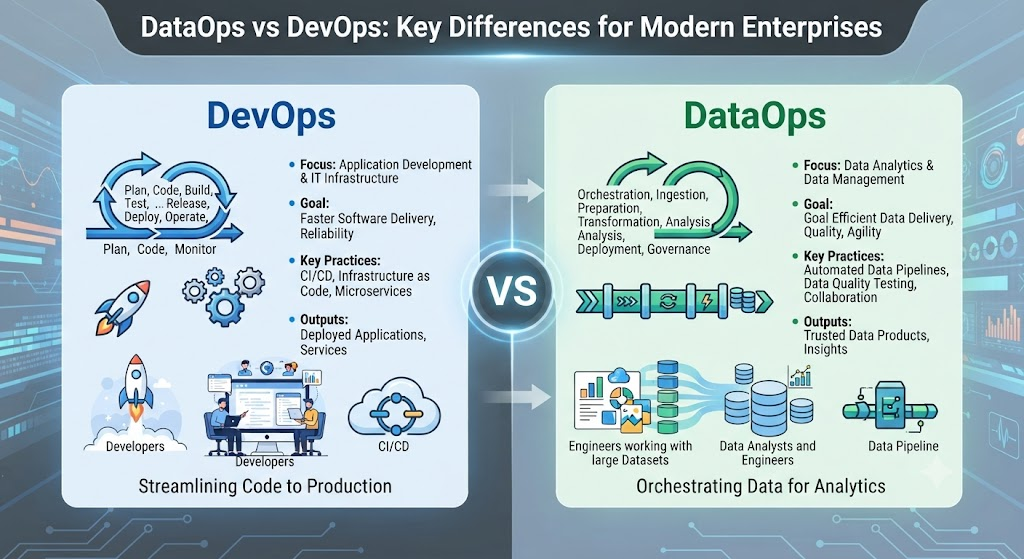
While DataOps borrows heavily from DevOps principles—such as automation, version control, and collaboration—their primary focuses, workflows, and success metrics differ significantly.
| Feature | DevOps | DataOps |
|---|---|---|
| Primary Focus | Application code, software delivery, and IT infrastructure. | Data pipelines, data quality, analytics, and machine learning models. |
| Core Artifacts | Source code, binaries, containers, and web applications. | Raw data, transformation scripts, schemas, dashboards, and ML models. |
| Primary Bottlenecks | Software release cycles, environment mismatches, and deployment errors. | Unreliable data sources, schema changes, slow query performance, and data drift. |
| Testing Paradigm | Unit tests, integration tests, and security scans for application code. | Data quality tests, schema validation, anomaly detection, and data profiling. |
| Key Stakeholders | Software developers, system administrators, and site reliability engineers (SREs). | Data engineers, data analysts, data scientists, and business intelligence teams. |
Why Does DevOps Fall Short for Data?
Many organizations try to manage their data workflows using standard DevOps tools. However, DevOps alone often fails in data-heavy environments due to unique data challenges:
- Data is Variable: Software code is deterministic (if you write X, it produces Y). Data is volatile; upstream schema changes or corrupted third-party feeds can silently break downstream models without throwing a standard software error.
- State and Storage Complexity: Moving applications is straightforward because stateless containers can be destroyed and recreated. Data workflows, however, involve massive historical data stores, data lakes, and complex state management.
- Cross-Disciplinary Collaboration: DevOps primarily connects developers and operators. DataOps must bridge technical data engineers with non-technical business stakeholders who consume the final insights.
Real-World Practical Considerations
When an enterprise decides to implement these frameworks, practical operational hurdles quickly emerge.
Implementation and Setup Costs
Setting up DevOps requires investing in CI/CD servers, cloud infrastructure, and training engineers on automation tools. DataOps requires similar tool investments, plus data cataloging software, automated data testing frameworks, and robust monitoring tools to catch data corruption early.
Daily Maintenance and Monitoring
- DevOps Monitoring: Focuses on server uptime, CPU usage, memory limits, and application response times.
- DataOps Monitoring: Focuses on pipeline latency, freshness of data tables, completeness of records, and anomaly detection. If a daily sales report is missing data at 8:00 AM, DataOps monitoring alerts the team before executives review the dashboard.
Common Mistakes
Mistake 1: Treating DataOps as Just “DevOps for Databases”
- Why it happens: Teams assume that applying database migration tools solves all data pipeline issues.
- Why it causes problems: Databases are only part of the puzzle. DataOps encompasses data ingestion, cleaning, transformation, machine learning training, and business intelligence delivery.
- What to do instead: Focus on end-to-end data quality and pipeline observability, not just database schema management.
Mistake 2: Ignoring Business User Involvement
- Why it happens: Technical teams build pipelines in isolation without consulting the business analysts who use the data.
- Why it causes problems: Pipelines may run successfully, but the business metrics calculated inside them might violate business logic.
- What to do instead: Include data consumers in the testing and validation feedback loops.
Risks and Limitations
- Data Drift and Model Decay: In machine learning workflows, input data changes over time, causing model accuracy to degrade silently. DataOps mitigates this by continuously monitoring data distributions.
- Compliance and Privacy Risks: Moving data across pipelines increases the risk of mishandling sensitive customer data (such as PII or financial records). Automated data governance and masking must be built directly into DataOps pipelines.
Decision Framework: When to Use Which?
To decide where to focus your engineering efforts, follow this simple framework:
- Identify the Product: Are you building a customer-facing web application, mobile app, or internal microservice? → Use DevOps.
- Identify the Workflow: Are you ingesting data from multiple sources, transforming tables, feeding data warehouses, or training machine learning models? → Use DataOps.
- Hybrid Environments: Modern data-driven enterprises (like e-commerce platforms or fintech apps) need both. DevOps keeps the core application running, while DataOps ensures the recommendation engine and analytics dashboards receive clean, reliable data.
Checklist for Enterprise Adoption
Before rolling out DevOps or DataOps across your organization, verify the following points:
- Clear version control is established for all application code or data transformation scripts.
- Automated testing is configured (unit tests for code; data quality and schema tests for data pipelines).
- Monitoring and alerting systems are active to notify engineers of failures immediately.
- Security and compliance protocols (like data encryption and access controls) are integrated into the workflow.
- Feedback loops exist between technical creators and end-users or business stakeholders.
Key Terms
- CI/CD: Continuous Integration and Continuous Deployment; practices that automate building, testing, and releasing code.
- Data Pipeline: A set of actions that moves data from a source system, transforms it, and loads it into a destination storage system.
- Data Drift: Changes in the statistical properties of input data over time that can make predictive models inaccurate.
- Infrastructure as Code (IaC): Managing and provisioning computing infrastructure through machine-readable definition files.
- Data Observability: The ability to fully understand the health, quality, and state of data across your systems.
FAQs
Can DataOps exist without DevOps?
Yes, but they complement each other. An organization can practice DataOps principles for analytics pipelines even if their software application deployment uses traditional methods. However, mature data teams often rely on underlying DevOps infrastructure.
What tools are commonly used in DevOps?
Common DevOps tools include Git for version control, Jenkins and GitHub Actions for CI/CD, Terraform for infrastructure as code, and Kubernetes for container orchestration.
What tools are commonly used in DataOps?
Common DataOps tools include dbt (data build tool) for transformations, Apache Airflow for workflow orchestration, Great Expectations for data quality testing, and modern data warehouses like Snowflake or Google BigQuery.
Does DataOps replace data engineering?
No. DataOps is a methodology and set of practices, whereas data engineering is the professional discipline of building and maintaining systems for collecting and storing data. DataOps helps data engineers work more efficiently.
How does DataOps improve data quality?
DataOps automates validation checks at every stage of a data pipeline. If incoming data fails predefined rules—such as unexpected null values or negative pricing—the pipeline halts or alerts the team before flawed data reaches production dashboards.
Conclusion
DevOps and DataOps solve similar problems—breaking down silos, eliminating manual errors, and accelerating delivery—but they operate in different domains. DevOps ensures reliable software applications, while DataOps ensures trusted, timely analytics and data pipelines. Understanding these differences allows modern enterprises to build robust technical foundations where both software and data can thrive.