Introduction
Modern organizations collect massive amounts of data every single day. Companies use this data to track sales, understand customer behavior, and make major business decisions. However, getting data from a raw source to a clean dashboard is rarely simple.
Data engineering teams build pipelines to move information, while analytics teams write queries and build reports. Often, these teams work in separate silos. When a source table changes, reports break, dashboards display incorrect numbers, and nobody knows who is responsible.
These breakdowns happen because traditional data workflows lack continuous integration, automated testing, and clear operational oversight. DataOps solves this problem by combining Agile software development methods, automated testing, and continuous delivery (CI/CD) into the data lifecycle. This article explores a practical DataOps roadmap for data engineering and analytics teams, helping organizations deliver trustworthy data at scale.
What Is DataOps?
DataOps is an automated, process-oriented methodology used by data engineering, analytics, and data science teams to improve the quality, speed, and collaboration of data analytics.
- Simple Meaning: DataOps is a system of teamwork and automation that keeps data clean, fast, and reliable as it moves through an organization.
- Why It Matters: Without DataOps, data pipelines break silently. Business leaders make decisions using outdated or incorrect numbers. DataOps catches these errors before they reach decision-makers.
- Example: Imagine a retail store tracking daily inventory. Without DataOps, a database update might silently corrupt the inventory count, leading managers to believe items are in stock when they are sold out. With DataOps, automated tests catch the bad data format immediately and alert the engineering team before the morning reports run.
How DataOps Works
DataOps borrows core ideas from DevOps (Software Development Operations) and Lean manufacturing, applying them specifically to data pipelines, data warehouses, and business intelligence (BI) dashboards.
The Core Loop
- Plan: Data engineers and analysts define what data is needed and how it should be transformed.
- Develop: Engineers write code (SQL, Python, or configuration files) to ingest and model the data.
- Test: Automated testing checks data quality, schema changes, and null values before code deployment.
- Deploy: Continuous integration and continuous delivery (CI/CD) pipelines push code changes to production automatically.
- Monitor: Real-time observability tools track pipeline health, latency, and anomalies.
Why DataOps Matters for Modern Teams
Data is only valuable if people trust it. When data breaks frequently, trust erodes.
- Speed of Delivery: Teams can ship new data models and dashboards in days instead of months.
- Higher Data Quality: Automated tests catch missing values, duplicate rows, and schema drift early.
- Better Collaboration: Engineers and analysts share a single workflow, reducing finger-pointing when reports fail.
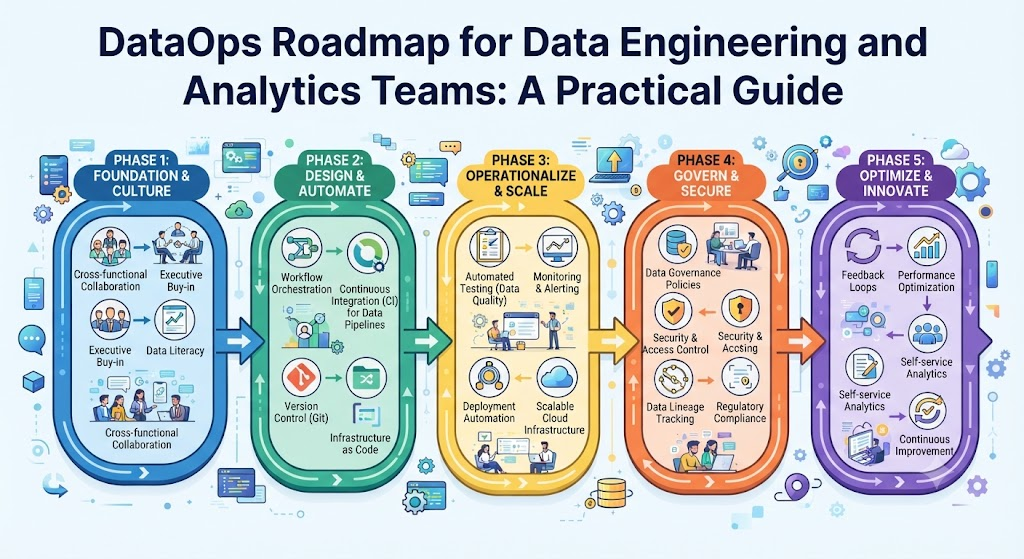
The DataOps Roadmap: Step-by-Step Implementation
Implementing DataOps does not happen overnight. Teams should follow a structured roadmap to adopt these practices without overwhelming their daily operations.
[Phase 1: Foundation] ➔ [Phase 2: Version Control] ➔ [Phase 3: Automated Testing] ➔ [Phase 4: CI/CD Pipelines] ➔ [Phase 5: Monitoring & Governance]
Phase 1: Foundation and Cultural Alignment
Before purchasing expensive tools, teams must align on culture and workflows.
- What to do: Break down silos between data engineers and analytics teams. Establish shared ownership of data pipelines from source to dashboard.
- Practical check: Do analysts talk to engineers before changing upstream database schemas?
Phase 2: Version Control and Code Organization
All data logic—including SQL queries, data models, and transformation scripts—must live in version control systems like Git.
- What to do: Move away from writing unversioned code directly in production databases. Use feature branches and pull requests for peer review.
- Why it matters: If a new data transformation breaks a report, version control allows the team to roll back to the last working version instantly.
Phase 3: Automated Data Testing
Testing is the backbone of DataOps. Teams should test both the code and the data itself.
- What to do: Implement tests for uniqueness, non-null values, accepted ranges, and referential integrity using tools like dbt (data build tool) or Great Expectations.
- Example: Test that every user record in a transformed table has a unique
user_idand that revenue values are never negative.
Phase 4: CI/CD (Continuous Integration and Continuous Delivery)
Manual deployments lead to human error. CI/CD automates the testing and promotion of code from development environments to production.
- What to do: Set up automated workflows (using GitHub Actions, GitLab CI, or Jenkins) that run tests whenever an engineer opens a pull request. If tests fail, the code cannot merge.
Phase 5: Monitoring, Observability, and Feedback Loops
Even with great testing, production issues happen. Data observability tools monitor pipeline health and data freshness.
- What to do: Set up alerts for missing data loads, unusual row count drops, or sudden spikes in data latency. Create a feedback loop where business users can flag bad data directly to engineers.
Practical Examples
Scenario: The Broken Executive Dashboard
- The Problem: An executive opens the monthly sales dashboard and sees zero revenue for yesterday. Panic ensues.
- Without DataOps: The analyst investigates, realizes an upstream API changed its data format, spends four hours tracking down the data engineer, and fixes the issue manually by the afternoon.
- With DataOps: An automated schema test caught the API change at 2:00 AM. The CI/CD pipeline blocked the broken ingestion, sent an alert to the Slack channel of the engineering team, and logged the specific error, allowing an engineer to fix the ingestion script before anyone opened the dashboard.
Real-World Considerations
Transitioning to a DataOps culture involves several operational realities:
- Tool Fatigue: The modern data stack contains hundreds of tools. Avoid adopting tools simply because they are trendy. Choose tools that integrate well with your existing cloud warehouse (like Snowflake, BigQuery, or Databricks).
- Skill Gaps: Data engineers may need training in software engineering best practices (Git, testing frameworks), while analysts may need basic familiarity with version control.
- Change Management: Shifting how teams work requires patience. Start with a single pilot project or data domain rather than rewriting the entire data architecture at once.
Common Mistakes
| Common Mistake | Why It Happens | Consequences | What to Do Instead |
|---|---|---|---|
| Testing only the code, not the data | Teams assume clean code equals clean data. | Corrupted source data bypasses tests and breaks downstream reports. | Implement both unit tests for code logic and data quality assertions for data values. |
| Boiling the ocean | Trying to automate every pipeline on day one. | Team burnout and abandoned initiatives. | Start with critical business pipelines and expand gradually. |
| Ignoring business users | Building pipelines in isolation from analysts and executives. | Delivering technically sound data that answers the wrong business questions. | Involve business stakeholders in defining data quality thresholds and requirements. |
Risks and Limitations
- False Positives in Testing: Overly strict data tests can flood engineering teams with alerts for minor, harmless anomalies (e.g., a weekend dip in web traffic), leading to alert fatigue.
- Initial Productivity Slowdown: Setting up CI/CD, version control, and testing frameworks slows down short-term feature delivery while building long-term stability.
Decision Framework: Is Your Team Ready for DataOps?
Use this simple framework to evaluate your current readiness:
- Can you roll back a broken data transformation in under five minutes? (If no, prioritize Version Control).
- Do you find out about broken dashboards from angry executives rather than automated alerts? (If yes, prioritize Observability and Testing).
- Are data engineers spending more than 50% of their time fixing ad-hoc data fires? (If yes, prioritize CI/CD and automation).
Key Terms
- CI/CD: Continuous Integration and Continuous Delivery; a method to automate the building, testing, and deployment of code changes.
- Data Observability: The practice of monitoring, tracking, and alerting on the health and quality of data within an organization.
- Schema Drift: Unplanned changes to the structure of source data (such as a column being renamed or deleted) that can break downstream queries.
- Data Pipeline: A series of steps that moves data from a source system, transforms it, and loads it into a destination storage system.
- Orchestration: The coordination, scheduling, and monitoring of dependent data tasks and pipelines (using tools like Apache Airflow or Prefect).
Frequently Asked Questions
What is the difference between DevOps and DataOps?
DevOps focuses on software application code and infrastructure. DataOps applies similar automation and collaboration principles specifically to data pipelines, data warehouses, and analytics workflows, accounting for the unique challenges of data variability and quality.
Do small analytics teams need DataOps?
While small teams may not need complex enterprise tooling, adopting basic DataOps principles—like version control for SQL queries and automated row-count checks—prevents embarrassing reporting errors as the team grows.
What tools are commonly used in a DataOps stack?
Common tools include version control systems (GitHub, GitLab), transformation and testing tools (dbt), orchestrators (Apache Airflow, Prefect, Dagster), and data observability platforms (Monte Carlo, Elementary).
How long does it take to implement DataOps?
A phased implementation typically takes 3 to 6 months. Teams usually start by introducing version control and basic testing for critical pipelines before scaling automation across the entire organization.
Conclusion
DataOps transforms data engineering and analytics from a reactive support function into a reliable, high-velocity engine for business insights. By combining version control, automated testing, continuous delivery, and cross-team collaboration, organizations can eliminate broken dashboards and build lasting trust in their data. Start small, focus on your most critical data pipelines, and scale your automated workflows step by step.