Introduction
Many data science projects start with excitement. A team trains a smart model on a clean dataset, sees great accuracy scores on a laptop screen, and assumes the hard work is done.
Then comes the real test: putting that model into production.
Suddenly, things break. The model gets old as user behavior changes. It runs too slowly when thousands of people use it at the same time. No one knows which version of the data trained the model that is currently crashing the website.
These problems happen because traditional software development and machine learning require different workflows. MLOps solves this gap. Without proper MLOps training, organizations often watch brilliant AI prototypes fail after launch. Good training gives teams the skills to turn experimental code into robust, dependable products.
What Is MLOps Training?
MLOps training is a structured learning path that teaches engineers, data scientists, and IT teams how to manage the complete lifecycle of a machine learning model.
Think of traditional software development. When a programmer writes an app, they use version control, automated testing, and cloud deployment pipelines. MLOps brings these exact engineering habits to artificial intelligence, with one major twist: AI systems depend on both code and data.
Why It Matters
A machine learning system is not just a static program. It learns from data, reacts to new inputs, and degrades over time. MLOps training teaches teams how to manage this complexity so AI systems do not become unpredictable black boxes.
Example
Imagine a bank builds a fraud-detection model.
- Without MLOps: The data scientist emails a zip file of the model to the IT team. Six months later, spending habits change, fraudsters use new tricks, and the model starts missing illegal transactions. Nobody knows how to update it safely without breaking the bank’s mobile app.
- With MLOps: The team uses automated pipelines taught in MLOps courses. When new fraud patterns appear, fresh data flows through automated tests, a better model is trained, and it replaces the old one safely with zero downtime.
How MLOps Differs from Traditional Software DevOps
Many people ask why traditional software training (DevOps) is not enough for machine learning. While both share a focus on automation and reliability, machine learning has unique challenges.
| Feature | Traditional DevOps | MLOps (Machine Learning Operations) |
| Core Asset | Code | Code + Data + Model Weights |
| Testing | Deterministic (Same input always gives the same output) | Probabilistic (Outputs are predictions based on probability) |
| Degradation | Software breaks due to bugs or server crashes | Models degrade silently due to changing real-world data |
| Tracking | Version control for code (Git) | Version control for code, huge datasets, and model experiments |
Why Teams Struggle Without MLOps Skills
When engineering teams lack MLOps training, they usually fall into common traps.
1. The “Notebook to Nowhere” Problem
Data scientists often work in interactive code notebooks (like Jupyter). These notebooks are great for quick experiments, but terrible for production. Without MLOps training, teams struggle to turn messy notebook scripts into clean, modular code that servers can run reliably.
2. Silent Failures
Traditional software throws an error message when it crashes. Machine learning models rarely crash loudly; instead, they quietly become wrong. If customer preferences shift, a recommendation model might start suggesting winter coats in July without throwing a single error code. Trained MLOps teams set up monitoring to catch these drops in accuracy early.
3. Reproducibility Nightmares
A data scientist might say, “It worked on my machine yesterday!” But if they cannot recreate the exact data, random seeds, and software libraries used to train that model, the company cannot fix bugs or prove compliance to regulators.
Core Pillars Taught in MLOps Training
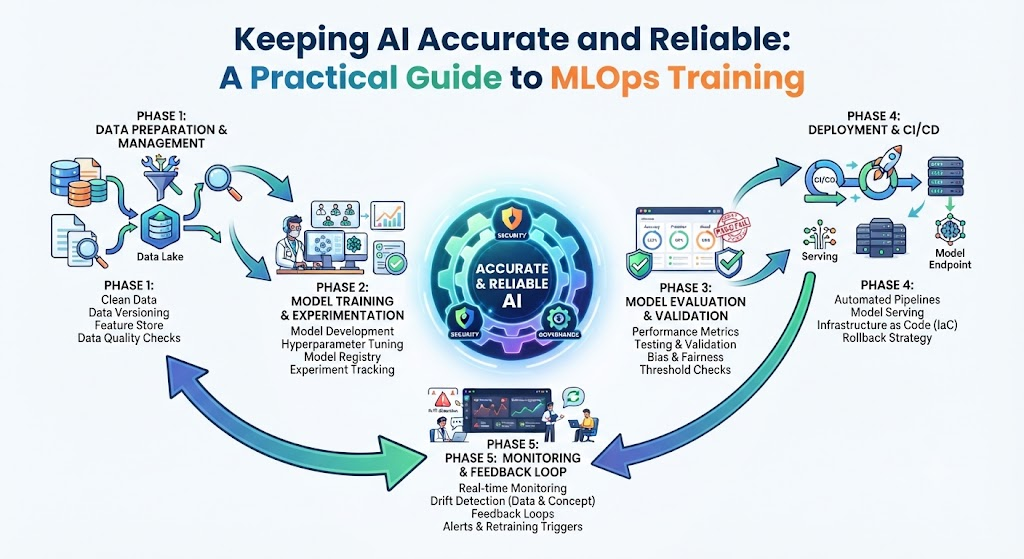
A strong MLOps training program covers several essential stages of the machine learning lifecycle.
[Data Ingestion & Versioning]
       ↓
[Automated Training (CI/CD for ML)]
       ↓
[Model Validation & Testing]
       ↓
[Production Deployment]
       ↓
[Monitoring & Drift Detection]
Data Version Control (DVC)
In regular software, files are small, so Git handles them easily. In AI, datasets are gigabytes or terabytes large. MLOps training teaches teams how to track changes in datasets just like they track changes in code.
Continuous Integration and Continuous Delivery (CI/CD) for ML
CI/CD means automating how software is built and tested. In MLOps, this pipeline automatically tests new data, retrains the model, evaluates its accuracy against a baseline, and packages it for deployment without manual human bottlenecks.
Model Monitoring and Drift Detection
Data drift happens when real-world data changes so much that the model’s training no longer matches reality. MLOps training teaches engineers how to set up alerts when model performance drops below acceptable thresholds.
Common Mistakes Teams Make When Adopting MLOps
Organizations often waste time and money because they approach MLOps with the wrong mindset.
- Mistake: Buying expensive tools before changing habits.
- Why it happens: Management thinks buying a shiny enterprise MLOps platform will instantly fix their AI workflow.
- What happens instead: The team does not know how to use the tool, and it becomes an expensive digital storage shelf.
- What to do instead: Learn the core principles and processes first. Start with open-source tools before scaling up to enterprise software.
- Mistake: Treating MLOps as a one-time setup.
- Why it happens: Teams build a deployment pipeline once and forget about it.
- What happens instead: Infrastructure changes, security patches fail, and pipelines break.
- What to do instead: Treat MLOps as an ongoing operational discipline that requires continuous maintenance and team training.
A Practical Decision Framework for MLOps Adoption
Not every small script needs a heavy, enterprise-grade MLOps setup. Teams should evaluate their needs before building complex pipelines.
- Assess Model Value: Is this AI model a core part of the business revenue, or is it an internal experiment? Critical systems need rigorous MLOps from day one.
- Evaluate Team Skills: Does the team understand basic containerization (like Docker) and cloud infrastructure? If not, start training with fundamentals before building automated retraining loops.
- Define Update Frequency: Does the model need to learn from live data every hour, or is a monthly manual update enough? Match the complexity of your MLOps pipeline to your actual business frequency.
- Establish Security and Governance: Ensure that data privacy rules are respected, especially if handling sensitive customer or financial information.
Key Terms
- CI/CD: Continuous Integration and Continuous Deployment; practices that automate building, testing, and releasing software.
- Data Drift: The change in real-world input data over time that causes a machine learning model’s accuracy to drop.
- Model Registry: A centralized storage system for managing different versions of trained machine learning models, their metadata, and performance scores.
- Containerization: Packaging software (or an AI model) with everything it needs to run so it works smoothly on any computer or server.
- Reproducibility: The ability of an engineer to run an experiment again and get the exact same results.
Frequently Asked Questions
Do data scientists need to learn MLOps?
Yes. While data scientists focus heavily on statistics and model accuracy, understanding MLOps helps them write cleaner code that engineers can actually deploy into production without rewriting everything from scratch.
Is MLOps only for large companies?
No. Even small startups benefit from basic MLOps practices like model versioning and automated testing. It prevents bugs, saves cloud computing costs, and prevents engineers from wasting time on manual deployments.
What background is needed before taking MLOps training?
Students and professionals should have basic programming skills in Python, a foundational understanding of machine learning concepts, and basic familiarity with command-line tools and cloud services.
How long does it take to learn MLOps?
Basic principles can be learned in a few weeks through dedicated courses and hands-on labs. However, mastering full production pipelines requires practical, hands-on project experience over several months.
Conclusion
Building an AI model is only half the battle; keeping it running reliably in the real world is where true business value is created. Without MLOps training, teams often struggle with brittle code, silent model failures, and broken deployments. By learning how to treat machine learning as a disciplined, automated engineering process, organizations can build secure, scalable, and production-ready AI systems that stand the test of time.