Introduction
Text Analytics Platforms are specialized artificial intelligence ecosystems designed to process, analyze, and interpret massive volumes of unstructured text data. Unlike traditional data tools that handle numbers and tables, these platforms utilize Natural Language Processing (NLP) and Large Language Models (LLM) to “read” human language, extracting sentiment, themes, intent, and entities. In 2026, the field has transitioned from basic word-cloud generation to sophisticated “Agentic AI” that can not only identify a customer’s frustration but also recommend the specific operational change required to fix the root cause.
The significance of these platforms lies in their ability to turn “dark data”—the 80% of enterprise information hidden in emails, chats, reviews, and social media—into a strategic asset. By automating the analysis of thousands of open-ended responses in seconds, organizations can bypass the bias and fatigue of manual coding. This leads to faster decision-making, improved customer retention (CX), and the discovery of “unknown unknowns” that traditional structured data often misses.
Key Real-World Use Cases
- Customer Feedback Loops: Automatically categorizing thousands of survey responses (NPS/CSAT) to identify high-impact product friction points.
- Voice of the Employee (VoE): Analyzing internal surveys and Slack sentiment to detect burnout trends or cultural misalignments before they lead to churn.
- Market Intelligence: Monitoring social media, news, and competitor reviews to spot emerging industry trends or PR crises in real-time.
- Support Ticket Optimization: Routing high-priority or high-frustration tickets to senior agents based on automated intent and sentiment detection.
- Regulatory Compliance: Scanning legal documents or communication logs for “red flag” language to ensure adherence to financial or healthcare regulations.
What to Look For (Evaluation Criteria)
When selecting a platform, prioritize theme discovery (can it find topics you didn’t ask for?), accuracy/fidelity (does it handle sarcasm and industry slang?), and multilingual support. You should also evaluate the “Time-to-Value”—some platforms require months of training data, while modern “zero-shot” tools provide insights on day one.
Best for: CX leaders, Product Managers, and Data Scientists in mid-to-large enterprises (especially in E-commerce, Finance, and SaaS) who need to synthesize vast amounts of qualitative feedback into actionable ROI.
Not ideal for: Small businesses with fewer than 50 customer interactions per month or teams looking for simple “keyword spotting” which can be handled by basic, free survey tools or Excel filters.
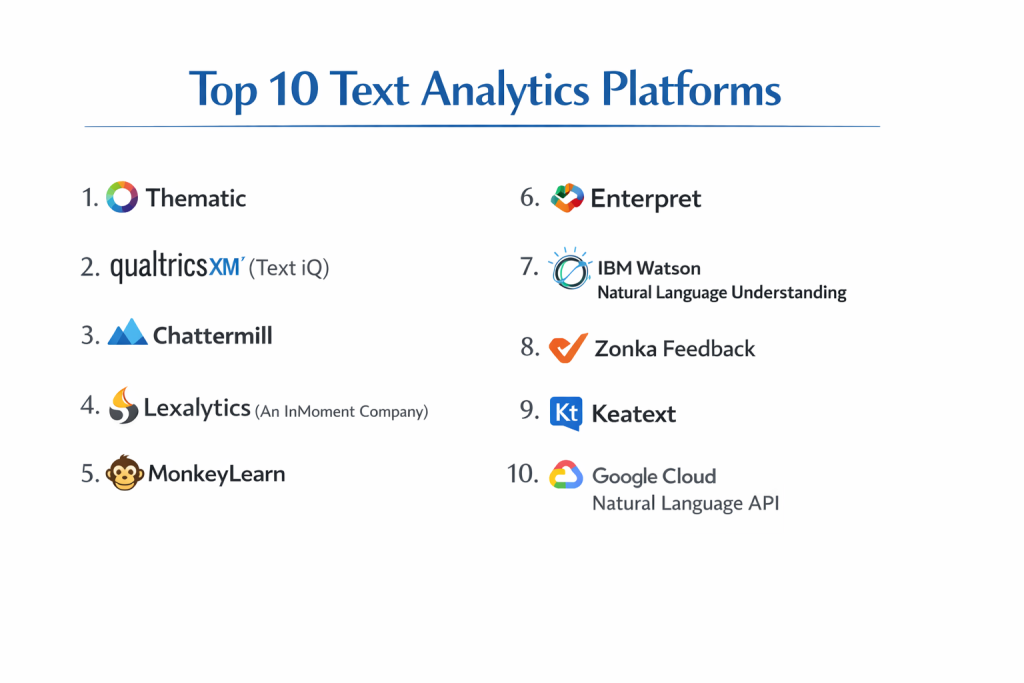
Top 10 Text Analytics Platforms
1 — Thematic
Thematic is an AI-powered insights platform that specializes in transforming qualitative customer feedback into clear, linked business metrics. It is designed for companies that need to understand the “Why” behind their scores.
- Key features:
- Unsupervised Theme Discovery: Automatically identifies emerging themes without requiring manual tagging or taxonomies.
- Metric Correlation: Directly links text themes to business outcomes like NPS or Churn.
- Answers Assistant: A generative AI interface that allows users to ask questions like “Why did our ease-of-use score drop in Germany?”
- Customizable Taxonomies: Allows for a “Human-in-the-Loop” approach to refine AI-discovered themes.
- Multi-Source Integration: Seamlessly pulls data from Zendesk, Intercom, App Store, and Trustpilot.
- Pros:
- Requires zero data training to start seeing insights.
- Strongest visual reporting for executive-level presentations.
- Cons:
- Enterprise-tier pricing ($25k+/year) is a barrier for smaller startups.
- Focused heavily on CX/Product; less specialized for legal/compliance text mining.
- Security & compliance: SOC 2 Type II, GDPR, and HIPAA compliant.
- Support & community: Dedicated Customer Success Manager (CSM), 24/7 support, and a robust library of CX research.
2 — Qualtrics XM (Text iQ)
Qualtrics is the industry giant in Experience Management, and its Text iQ module provides deep, integrated text analytics as part of its massive data ecosystem.
- Key features:
- Predictive Intelligence: Uses machine learning to predict future customer behavior based on past comments.
- Real-time Action Workflows: Automatically triggers emails or tickets when a specific sentiment is detected.
- Sentiment & Effort Scoring: Sophisticated models that measure not just emotion, but how “hard” a customer had to work.
- Native XM Integration: Part of the broader Qualtrics suite, making it ideal for existing users.
- Industry Blueprints: Pre-built configurations for Healthcare, Banking, and Retail.
- Pros:
- Unrivaled for large-scale, cross-departmental experience programs.
- Massive ecosystem of integrations and third-party partners.
- Cons:
- Implementation can be incredibly complex and time-consuming.
- Total cost of ownership is among the highest in the market.
- Security & compliance: ISO 27001, FedRAMP, HIPAA, and GDPR.
- Support & community: Extensive “Basecamp” training, global user community, and 24/7 enterprise support.
3 — Chattermill
Chattermill utilizes advanced deep learning to provide a unified “Customer Intelligence” platform that breaks down silos between support, product, and marketing.
- Key features:
- Lyra AI: A conversational assistant that provides summaries and insights from millions of data points.
- Unified Feedback View: Aggregates reviews, tickets, and social mentions into a single dashboard.
- Theme & Sentiment Mapping: Highly granular mapping of specific product features to customer emotion.
- Competitive Benchmarking: Ability to ingest competitor review data for head-to-head analysis.
- Auto-Alerting: Notifies teams of significant spikes in negative sentiment or specific issues.
- Pros:
- Excellent for high-growth consumer brands (B2C) with massive ticket volumes.
- Modern, intuitive UI that requires very little training for new users.
- Cons:
- Customizing the deep learning models can be less flexible than other platforms.
- Lower accuracy for highly technical or niche B2B industrial jargon.
- Security & compliance: SOC 2, GDPR, and localized data residency options.
- Support & community: Strong UK-based support, regular webinars, and a proactive success team.
4 — Lexalytics (An InMoment Company)
Lexalytics is a pioneer in NLP, offering one of the most technically robust engines available. It is often the choice for data science teams that want granular control.
- Key features:
- Salience & Semantria: Offers both on-premise (Salience) and cloud-based (Semantria) engines.
- Named Entity Recognition (NER): Industry-leading extraction of people, places, and brands.
- Intention Analysis: Goes beyond sentiment to identify “buying intent” or “quit intent.”
- Custom Syntax Rules: Allows developers to write specific rules for complex linguistic patterns.
- Multi-layered Sentiment: Scores sentiment at the document, sentence, and even entity level.
- Pros:
- Incredible technical depth; if the AI misses something, you can build a rule for it.
- Flexible deployment (Cloud or On-Prem) is vital for high-security sectors.
- Cons:
- Steep learning curve; usually requires a data scientist or linguist to manage.
- User interface for business users is less polished than Thematic or Chattermill.
- Security & compliance: SOC 2, HIPAA, and GDPR. High emphasis on data privacy.
- Support & community: Professional services for custom implementations and deep technical documentation.
5 — MonkeyLearn
MonkeyLearn provides an accessible, “no-code” text analytics solution that is highly popular with SMBs and individual developers.
- Key features:
- Template Library: Pre-built models for NPS, support tickets, and review analysis.
- Visual Studio: A drag-and-drop builder to create custom text classifiers and extractors.
- API-First Design: Very easy to plug into Zapier, Google Sheets, or custom applications.
- Keyword Extraction: Identifies the most relevant terms without complex setup.
- Simpler Workflows: Focuses on specific tasks like “Classify this email” rather than broad BI.
- Pros:
- The easiest platform to set up; you can have results in 15 minutes.
- Transparent, “build-as-you-go” pricing suitable for smaller budgets.
- Cons:
- Not built for massive enterprise-scale data processing (limits on queries/month).
- Lacks the deep “impact analysis” and ROI linking found in premium tools.
- Security & compliance: GDPR compliant; standard cloud security.
- Support & community: Good online help center, email support, and a popular blog on NLP basics.
6 — Enterpret
Enterpret is a modern entrant focusing on “Product-Led Growth,” specifically designed to help product teams turn feedback into a roadmap.
- Key features:
- Custom Adaptive Models: Learns your specific product taxonomy automatically over time.
- Feature-Level Insights: Tells you exactly which feature is causing churn or delight.
- GPT-Powered Querying: Use natural language to search across all your customer feedback.
- Semantic Search: Finds meaning even if the customer didn’t use the exact keyword.
- Integrations: Deep hooks into Jira, GitHub, and Productboard.
- Pros:
- The best tool for closing the loop between “Customer Feedback” and “Product Engineering.”
- Zero maintenance required once the initial integration is set.
- Cons:
- Relatively new to the market, so some legacy integrations may be missing.
- Pricing can be opaque and varies significantly based on data volume.
- Security & compliance: SOC 2 Type II and GDPR.
- Support & community: High-touch onboarding and direct access to product engineers.
7 — IBM Watson Natural Language Understanding
IBM Watson is a titan in AI, offering an enterprise-grade NLP engine that serves as the backbone for many global 500 companies.
- Key features:
- Relation Extraction: Identifies how two entities are related within a text.
- Tone Analyzer: Detects emotions like joy, fear, sadness, and anger, as well as analytical and confident tones.
- Custom Knowledge Studio: Train Watson on the specific language of your industry (e.g., Oil & Gas, Legal).
- Cross-Lingual NLU: Analyzes text in one language using models trained in another.
- IBM Cloud Integration: Part of the massive Watson Studio data science ecosystem.
- Pros:
- Unrivaled for complex, multi-lingual, and multi-domain global deployments.
- Supports air-gapped or hybrid-cloud environments for government-level security.
- Cons:
- Requires a dedicated “Watson Specialist” or Data Scientist to get the most value.
- The management console can be a maze of different products and permissions.
- Security & compliance: FedRAMP, HIPAA, SOC 1/2/3, ISO, and GDPR.
- Support & community: Global consulting arm, extensive certifications, and a massive academic community.
8 — Zonka Feedback
Zonka Feedback has evolved from a survey tool into a comprehensive text analytics platform that uses Agentic AI to recommend business actions.
- Key features:
- Agentic AI Recommendations: Doesn’t just show data; suggests “Increase staff at the NYC branch to reduce wait times.”
- Entity-Level Tagging: Automatically tags specific locations, people, and objects mentioned in surveys.
- No-Code AI Analysis: Designed for business users who want AI power without writing a line of code.
- Multi-Channel Collection: Strongest for gathering data via tablets, kiosks, and QR codes.
- Closing the Loop: Built-in ticketing system to act on negative feedback immediately.
- Pros:
- Best value for companies that need both a “Collector” and an “Analyzer” in one tool.
- Strong focus on offline and retail-location text analytics.
- Cons:
- The text analysis engine is slightly less powerful for unstructured social media mining.
- Lacks the deep technical API customization of Lexalytics or Watson.
- Security & compliance: ISO 27001, HIPAA, and GDPR.
- Support & community: Fast email/chat support and very helpful onboarding templates.
9 — Keatext
Keatext is a Montreal-based platform that uses AI to synthesize unstructured feedback into a “Prioritization Matrix.”
- Key features:
- Correlation Engine: Automatically identifies which topics have the most negative impact on your scores.
- One-Click Summaries: Generates a paragraph-long executive summary of 10,000 reviews.
- Plug-and-Play Sentiment: Requires no setup; works immediately on any CSV or Excel upload.
- Multilingual Processing: Handles 50+ languages with high accuracy.
- Multi-User Collaboration: Allows teams to comment and share specific insights within the dashboard.
- Pros:
- Extremely fast “Time-to-Value”; perfect for one-off deep dives or monthly reporting.
- The “Prioritization Matrix” is a fantastic tool for deciding where to spend budget.
- Cons:
- The dashboard can feel a bit rigid if you want to create highly custom visualizations.
- Limited native integrations compared to Qualtrics or Thematic.
- Security & compliance: SOC 2 and GDPR compliant.
- Support & community: High-quality personalized support and an active research blog.
10 — Google Cloud Natural Language API
For developers building their own custom text analytics stack, Google provides one of the most powerful and scalable APIs in the world.
- Key features:
- Syntactic Analysis: Breaks down sentences into their grammatical parts for deep linguistic study.
- Content Classification: Automatically classifies documents into 700+ predefined categories.
- Large-Scale NER: Leverages the Google Knowledge Graph to identify entities.
- Vertex AI Integration: Easy to feed text analytics data into custom machine learning models.
- Global Scale: Capable of processing millions of documents per second with minimal latency.
- Pros:
- Most cost-effective for extremely high-volume, programmatic text processing.
- Benefit from Google’s cutting-edge Research in LLMs (Gemini/PaLM).
- Cons:
- This is an API, not a “Platform”—you must build your own dashboard/UI.
- No “business logic” layer; you have to interpret the sentiment scores yourself.
- Security & compliance: FedRAMP, HIPAA, SOC 1/2/3, and GDPR.
- Support & community: World-class developer documentation and massive StackOverflow community support.
Comparison Table
| Tool Name | Best For | Platform(s) Supported | Standout Feature | Rating |
| Thematic | ROI-Focused CX Teams | Cloud / SaaS | Automatic Theme Discovery | 4.8 / 5 |
| Qualtrics XM | Global Enterprise CX | Cloud / SaaS | Predict iQ Behavior Models | 4.5 / 5 |
| Chattermill | B2C Consumer Brands | Cloud / SaaS | Lyra Conversational AI | 4.5 / 5 |
| Lexalytics | Data Science Teams | On-Prem / Cloud | Custom Syntax Rules | 4.0 / 5 |
| MonkeyLearn | SMB / No-Code Users | Cloud / SaaS | Drag-and-Drop Model Builder | 4.2 / 5 |
| Enterpret | Product-Led Growth | Cloud / SaaS | Adaptive Product Taxonomy | N/A |
| IBM Watson | Highly Regulated Sectors | Hybrid / Cloud | Tone & Relation Extraction | 4.5 / 5 |
| Zonka Feedback | Retail & Multi-Channel | Web / Tablet / Kiosk | Agentic AI Recommendations | 4.7 / 5 |
| Keatext | Rapid Prioritization | Cloud / SaaS | Prioritization Impact Matrix | 4.6 / 5 |
| Google Cloud | Developers / Scalability | API | Syntax & Knowledge Graph | 4.2 / 5 |
Evaluation & Scoring of Text Analytics Platforms
| Category | Weight | Score (1-10) | Evaluation Rationale |
| Core features | 25% | 9 | Advanced theme discovery is now standard across top tools. |
| Ease of use | 15% | 7 | Still a gap between “API-only” and “Business-Ready” tools. |
| Integrations | 15% | 8 | Most tools now connect to major CRMs and Support desks natively. |
| Security & compliance | 10% | 10 | Sector-specific compliance (HIPAA/FedRAMP) is widely available. |
| Performance | 10% | 8 | LLM-based processing is powerful but can be slower than old statistical methods. |
| Support & community | 10% | 8 | Strong enterprise support is standard for the top 5 vendors. |
| Price / value | 15% | 7 | High ROI potential, but entry costs remain high for small teams. |
Which Text Analytics Platform Is Right for You?
Solo Users vs SMB vs Mid-Market vs Enterprise
If you are a solo researcher or a very small team, start with MonkeyLearn. It offers the lowest barrier to entry and a generous trial. SMBs with a few hundred reviews a month will find Zonka Feedback or Keatext highly efficient. Mid-Market companies focused on product growth should look at Enterpret or Thematic. Finally, for global enterprises with millions of data points and complex compliance needs, Qualtrics, IBM Watson, or Chattermill are the only choices with sufficient infrastructure.
Budget-Conscious vs Premium Solutions
The most budget-conscious route is building on top of the Google Cloud Natural Language API or using MonkeyLearn. However, remember that “cheap” tools often require more “expensive” human time to interpret the data. Premium solutions like Thematic or Qualtrics carry a high sticker price ($25k–$100k+), but they automate the “Data Storytelling” part, potentially saving the cost of a full-time analyst.
Feature Depth vs Ease of Use
If you need Feature Depth—the ability to parse complex medical journals or legal contracts—you need Lexalytics or IBM Watson. If you prioritize Ease of Use and want a dashboard that “just tells you what to do,” Thematic, Chattermill, and Zonka Feedback are designed for business users rather than data scientists.
Integration and Scalability Needs
For companies already using AWS or Google Cloud, staying within the ecosystem via their respective NLP APIs is the most scalable path. However, if your data is scattered across Zendesk, Salesforce, and Trustpilot, a platform like Thematic or Chattermill with pre-built “Connectors” will save you weeks of engineering effort.
Security and Compliance Requirements
If you are in Healthcare, you must ensure your provider is HIPAA compliant—Qualtrics and IBM Watson are the leaders here. For Financial Services or Government where data cannot leave the building, Lexalytics (Salience) or IBM Watson (On-Prem) are the only viable options.
Frequently Asked Questions (FAQs)
1. What is the difference between Text Analysis and Text Analytics?
Text analysis is the process of identifying what is in the text (categories, entities). Text analytics is the broader process of finding patterns and trends across thousands of pieces of text to drive business decisions.
2. Can these tools understand sarcasm or irony?
Historically, this was a major weakness. However, in 2026, most platforms using Large Language Models (LLMs) like GPT-4 or Gemini are significantly better at identifying context, sarcasm, and cultural nuance.
3. Do I need a data scientist to use a text analytics platform?
No. Platforms like Thematic, Zonka, and Chattermill are designed for “Business Users.” You only need a data scientist if you are using raw APIs like Google Cloud or Lexalytics.
4. How much data do I need to get accurate results?
Most AI models need at least 300–500 responses per month to provide statistically significant “Theme Discovery.” For simple sentiment analysis, even 50 responses can provide value.
5. How long does it take to implement these tools?
No-code tools like MonkeyLearn or Keatext take minutes. Enterprise platforms like Qualtrics can take 3–6 months to fully integrate with all your internal data streams.
6. Is my customer data safe with these AI providers?
Top-tier providers like IBM and Qualtrics offer “Data Processing Agreements” (DPAs) that guarantee your data isn’t used to train their public models and is encrypted at rest and in transit.
7. Can these platforms handle languages other than English?
Yes. Most top platforms support 50–100+ languages. Some (like Google) translate the text first, while others (like Thematic) process the language natively for better accuracy.
8. What are “Unknown Unknowns” in text analytics?
These are issues your customers are talking about that you haven’t even thought to ask about. Unsupervised AI discovers these themes automatically without you having to pre-set a “tag” for them.
9. Can I analyze social media data with these tools?
Yes, but you usually need a platform with a built-in “Social Listening” connector like Chattermill or Lexalytics. Simple survey tools often struggle with the “slang” found on social media.
10. Why is “Impact Analysis” important?
Volume doesn’t always equal importance. 1,000 people might complain about a button color (high volume), but if 10 people can’t check out (low volume, high impact), you need a tool that can tell you which one is hurting your revenue more.
Conclusion
The evolution of Text Analytics Platforms has reached a tipping point where qualitative data is finally as measurable as quantitative data. Whether you choose the technical depth of IBM Watson, the business-ready insights of Thematic, or the developer scalability of Google Cloud, the most important step is simply to start.
The “best” tool isn’t the one with the most features; it’s the one that aligns with your specific technical maturity, your budget, and—most importantly—your specific business questions. In a world of infinite unstructured data, the organizations that can listen at scale will be the ones that win.