Introduction
Synthetic Data Generation Tools are advanced software platforms that create artificial datasets which mirror the statistical properties, patterns, and correlations of real-world “seed” data without containing any sensitive or identifiable information. Unlike traditional data masking, which simply obscures portions of a record, these tools use machine learning models—such as Generative Adversarial Networks (GANs) or Variational Autoencoders (VAEs)—to build entirely new records from scratch. This process ensures that the resulting data is “mathematically identical” to the original for analytical purposes but remains 100% private.
The importance of these tools has skyrocketed due to the collision of big data and global privacy regulations like GDPR, HIPAA, and CCPA. Accessing high-quality data is the primary bottleneck for AI development; however, using real customer data for testing or model training carries immense legal and security risks. Synthetic data solves this by providing “privacy-by-design” data that can be shared freely across departments or with third-party vendors. It allows organizations to bypass the weeks of bureaucratic “red tape” usually required to obtain data access, accelerating innovation while ensuring that a data breach of the synthetic environment would reveal nothing about actual human beings.
Key Real-World Use Cases
- AI & Machine Learning Training: Augmenting small datasets or balancing imbalanced ones (e.g., generating more examples of rare fraud events) to build more robust models.
- Software Testing & QA: Providing developers with high-fidelity, production-like data to find bugs that simple “mock” data would miss.
- Secure Data Sharing: Safely sharing datasets with external researchers, consultants, or offshore teams without exposing PII (Personally Identifiable Information).
- Product Demonstrations: Creating realistic environments for sales demos that look authentic but use entirely artificial customer identities.
- Medical Research: Synthesizing patient records to allow researchers to study disease patterns without compromising patient confidentiality.
What to Look For (Evaluation Criteria)
When choosing a tool, prioritize data fidelity (how well it mimics the original), privacy guarantees (does it use Differential Privacy?), relational integrity (maintaining links between tables), and scalability. You should also evaluate the tool’s ability to handle complex data types, such as time-series data or unstructured text.
Best for: Data scientists, MLOps engineers, and DevOps teams in highly regulated industries like Banking, Healthcare, and Insurance. It is also ideal for large enterprises that need to share data across global regions while adhering to strict local privacy laws.
Not ideal for: Small teams with non-sensitive data or simple “one-off” projects where basic random data generation (like using the Faker library) is sufficient. It is also not a replacement for real data when the goal is to analyze specific, individual historical events (e.g., forensic accounting for a specific transaction).
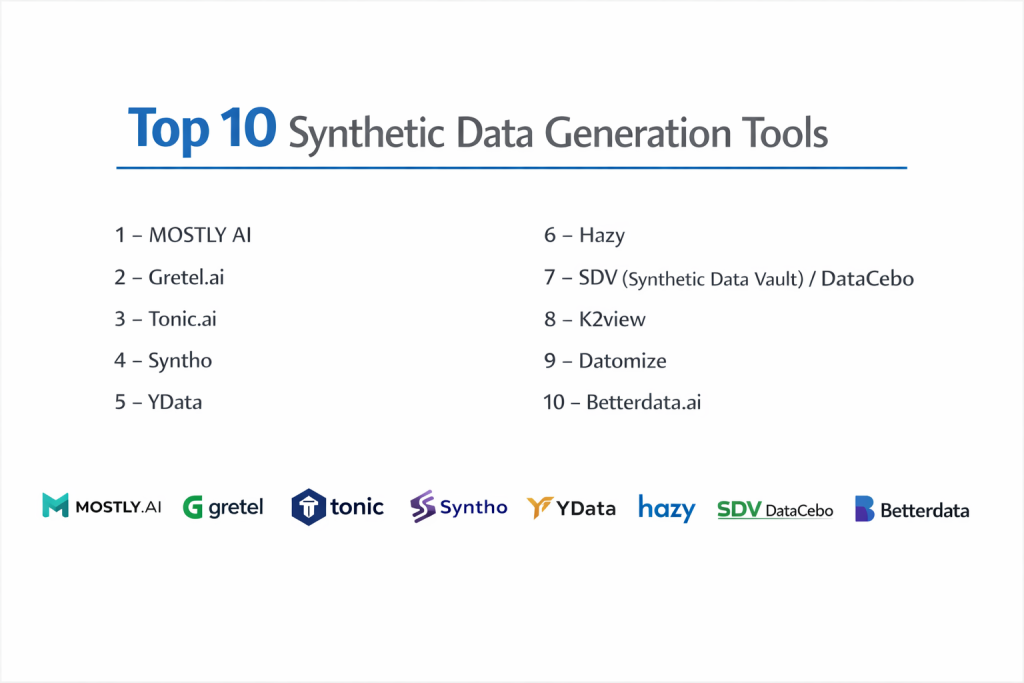
Top 10 Synthetic Data Generation Tools
1 — MOSTLY AI
MOSTLY AI is widely considered a pioneer in the space, offering an enterprise-grade platform that specializes in high-fidelity tabular and behavioral data synthesis. It is designed to make the creation of “synthetic twins” of datasets as easy as a few clicks.
- Key features:
- Automated AI Model Training: Automatically selects the best neural network architecture for your specific dataset.
- Behavioral Data Support: Capable of synthesizing complex time-series data, such as customer transaction histories.
- Data Quality Reports: Provides an automated, in-depth comparison between real and synthetic data distributions.
- Smart Imputation: Can fill in missing values in original datasets during the synthesis process.
- Flexible Deployment: Available as a SaaS, VPC, or on-premise installation to meet high-security needs.
- Pros:
- Industry-leading accuracy; synthetic data is often indistinguishable from real data in ML benchmarks.
- Extremely user-friendly interface that doesn’t require advanced coding skills.
- Cons:
- Premium pricing can be a barrier for smaller startups.
- Resource-intensive; large datasets require significant compute power for the training phase.
- Security & compliance: SOC 2 Type II, GDPR-compliant by design, and supports private cloud/air-gapped deployments.
- Support & community: High-quality enterprise support, detailed documentation, and an active blog focused on synthetic data best practices.
2 — Gretel.ai
Gretel.ai is a developer-centric platform that provides a suite of APIs and SDKs to generate, transform, and protect data. It is highly popular among AI engineers who want to integrate data synthesis directly into their CI/CD pipelines.
- Key features:
- Gretel Navigator: A generative AI interface that allows users to create data using natural language prompts.
- Multi-Modal Support: Handles tabular data, text, and is expanding into specialized formats like logs.
- Differential Privacy: Built-in mathematical guarantees to ensure zero risk of individual re-identification.
- Gretel Blueprints: Pre-configured workflows for common use cases like “Health Records” or “Financial Transactions.”
- Extensive SDK: A robust Python library that allows for deep customization of the generation process.
- Pros:
- Excellent developer experience (DX) with clean APIs and great documentation.
- The natural language interface (Navigator) significantly lowers the barrier to entry.
- Cons:
- Can become expensive when processing very high volumes of data via the API.
- Users need some Python knowledge to get the most out of the platform’s advanced features.
- Security & compliance: SOC 2, HIPAA, and GDPR compliant. Offers an “Evergreen” privacy model that checks for data leaks.
- Support & community: Very active Discord community, comprehensive public GitHub repositories, and responsive technical support.
3 — Tonic.ai
Tonic.ai focuses on the software engineering and DevOps side of synthetic data, providing tools that help developers populate their staging and local environments with safe, high-fidelity data.
- Key features:
- Database Subsetting: Allows you to create a smaller, representative slice of a massive production database.
- Referential Integrity: Ensures that synthetic IDs remain consistent across multiple, disconnected databases.
- Smart Masking: Combines traditional de-identification with AI-powered synthesis for maximum flexibility.
- Tonic Textual: A specialized component for finding and replacing sensitive PII within unstructured text or documents.
- Continuous Sync: Keeps your lower environments in sync with changes in production data schemas.
- Pros:
- Unrivaled for database management and keeping complex relational structures intact.
- Easy integration with existing developer workflows and CI/CD tools.
- Cons:
- Less focused on the “AI training” use case compared to MOSTLY AI or Gretel.
- Setup can be complex for very legacy or non-standard database architectures.
- Security & compliance: SOC 2 Type II, HIPAA, and GDPR compliant. Includes “Privacy Scans” to detect hidden PII.
- Support & community: Professional enterprise-level support and a robust knowledge base.
4 — Syntho
Syntho is an Amsterdam-based company that offers the “Syntho Engine,” a platform designed to unlock data and eliminate privacy concerns through AI-generated synthetic data.
- Key features:
- Syntho Engine: An AI-based generator that creates a “synthetic twin” of any structured dataset.
- Time-Series Synthesis: Specifically optimized for data that changes over time, like medical sensor readings.
- Built-in QA Dashboards: Visualizations that show how well the synthetic data preserves the correlations of the original.
- Upsampling: The ability to generate more records than the original dataset to improve ML model performance.
- Self-Service Portal: Designed for non-technical “Data Stewards” to manage requests and generation.
- Pros:
- Strong alignment with European privacy standards (GDPR) and “Privacy by Design” principles.
- Great balance between an easy-to-use UI and powerful underlying AI models.
- Cons:
- The community/open-source presence is smaller than some competitors.
- Documentation can sometimes be less detailed than developer-focused tools like Gretel.
- Security & compliance: ISO 27001, GDPR, and HIPAA compliant. Focuses on local, secure deployment options.
- Support & community: Personalized onboarding and enterprise-grade SLA-based support.
5 — YData
YData positions itself as a “Data Development Platform” that uses synthetic data to improve the overall quality of datasets used in AI and machine learning.
- Key features:
- Data Profiling: Automatically identifies data quality issues (like bias or missingness) before synthesis begins.
- Dataset Balancing: Can generate data specifically to fix “minority class” issues (e.g., creating more data for rare diseases).
- YData Fabric: An end-to-end environment for data preparation, synthesis, and evaluation.
- Stream Processing: Ability to synthesize data streams in real-time for certain applications.
- Open-source Profiler: They maintain a very popular open-source data profiling tool used by thousands.
- Pros:
- Excellent for data scientists who care deeply about “Data-Centric AI” and improving model performance.
- Provides high-quality synthetic data for very complex, imbalanced datasets.
- Cons:
- The platform can feel “heavy” if you only need a simple synthesizer.
- Slightly steeper learning curve due to the emphasis on data science principles.
- Security & compliance: SOC 2, GDPR, and supports enterprise SSO integrations.
- Support & community: Active Discord, regular community webinars, and top-tier MLOps education.
6 — Hazy
Hazy is a UK-based synthetic data company that grew out of a research project at University College London. It focuses on the financial services sector, providing high-fidelity data for banking and insurance.
- Key features:
- Enterprise Financial Models: Specifically tuned for financial data types like credit card transactions and mortgages.
- Explainable Privacy: Provides transparent metrics on how the tool protects privacy, which is vital for bank regulators.
- Scenario Testing: Allows users to generate “what-if” data scenarios to stress-test financial models.
- Hybrid Synthesis: Allows for the mixing of real and synthetic data based on user-defined rules.
- Automated PII Discovery: Scans source data to identify sensitive fields that require synthesis.
- Pros:
- Deep expertise in the specific needs and regulatory hurdles of the banking industry.
- Highly scalable for the massive, complex data structures found in global finance.
- Cons:
- Less “general purpose” than some of the more developer-centric tools.
- Marketing and support are heavily skewed toward large enterprise clients.
- Security & compliance: ISO 27001, GDPR, and fits within the “Ring-fenced” security models of major banks.
- Support & community: Enterprise-only support model with dedicated account managers and consulting.
7 — SDV (Synthetic Data Vault) / DataCebo
The SDV is the most popular open-source ecosystem for synthetic data, managed commercially by DataCebo. It is the gold standard for researchers and Python developers who want total control.
- Key features:
- Multi-Table Modeling: Uses “Hierarchical Modeling” to maintain relationships across an entire database.
- CTGAN & TVAE: Includes state-of-the-art deep learning models developed at MIT.
- Customizable Constraints: Users can write Python logic to enforce business rules (e.g., “Withdrawal amount cannot exceed Balance”).
- Evaluation Framework: A dedicated library for measuring the “Utility” and “Privacy” of synthetic datasets.
- SDV Enterprise: A commercial version that adds a UI, faster performance, and enterprise security.
- Pros:
- The open-source core is free to use and highly transparent (no “black box” models).
- Massive flexibility for data scientists who want to build their own custom pipelines.
- Cons:
- The open-source version requires significant Python expertise to set up and manage.
- Generating data at a massive scale (billions of rows) is much easier with the paid version.
- Security & compliance: Varies (Open-source) / SOC 2 (Enterprise). Enterprise version supports GDPR and HIPAA.
- Support & community: Huge Slack community, massive GitHub presence, and professional support for Enterprise customers.
8 — K2view
K2view is a “Data Product” platform that includes powerful synthetic data generation as part of its broader data management suite. It is designed for large-scale enterprise data operations.
- Key features:
- Entity-Based Synthesis: Organizes data around “entities” (like a customer), ensuring all related data across tables stays synced.
- Micro-Database™ Technology: A patented way to store and manage synthetic data for rapid access.
- On-Demand Generation: Developers can request synthetic data through a self-service portal.
- Multi-Source Integration: Connects to legacy mainframes, modern clouds, and everything in between.
- Rule-Based Augmentation: Allows users to combine AI synthesis with specific business logic.
- Pros:
- Unmatched for massive, legacy enterprise environments with “spaghetti” data structures.
- Part of a larger suite that handles data migration and privacy masking.
- Cons:
- Often “too much tool” for a team that only needs a basic synthetic dataset.
- Integration into the full K2view ecosystem is where the real value lies, which can be a large commitment.
- Security & compliance: SOC 1/2, GDPR, HIPAA, and PCI-DSS compliant.
- Support & community: Global enterprise support with 24/7 availability for large-scale deployments.
9 — Datomize
Datomize is an enterprise-grade platform that focuses on accelerating the “Data-to-Insight” cycle by providing high-quality synthetic data for complex business applications.
- Key features:
- Business Logic Preservation: Ensures that complex business rules and “edge cases” are preserved in the synthetic output.
- AI-Based Schema Discovery: Automatically maps out the relationships in your database before synthesis.
- Privacy-Accuracy Tradeoff Control: Allows users to slide a scale between “Maximum Privacy” and “Maximum Accuracy.”
- Collaboration Portal: Allows different teams to share and version their synthetic datasets.
- Cloud-Native Architecture: Built for high performance in AWS, Azure, and GCP.
- Pros:
- Excellent at capturing the “long tail” of data—those rare but important edge cases.
- Strong focus on collaboration between data scientists and business stakeholders.
- Cons:
- Smaller brand awareness compared to early movers like MOSTLY AI.
- The UI can be complex for very casual users.
- Security & compliance: SOC 2, HIPAA, and GDPR compliant.
- Support & community: High-touch professional services and onboarding.
10 — Betterdata.ai
Betterdata.ai is a newer entrant that leverages programmable synthetic data to help companies share data globally with zero privacy risk.
- Key features:
- TAEGAN Technology: Uses specialized “Tabular Autoencoder GANs” for high-accuracy synthesis.
- Global Compliance Engine: Automatically checks synthetic output against specific regional laws (GDPR, CCPA, PDPA).
- Relational Database Support: Maintains integrity across complex SQL schemas.
- No-Code Interface: Designed to be accessible to privacy officers and compliance teams.
- API-First Approach: Easy to plug into existing data science platforms.
- Pros:
- Very modern, streamlined UI that makes privacy compliance feel simple.
- Strong focus on “cross-border” data sharing, which is a major pain point for global firms.
- Cons:
- As a younger company, the feature set is still expanding compared to legacy players.
- Community resources and third-party tutorials are still growing.
- Security & compliance: SOC 2 (in progress), GDPR, and HIPAA compliant.
- Support & community: Direct access to founding engineers and a proactive customer success team.
Comparison Table
| Tool Name | Best For | Platform(s) Supported | Standout Feature | Rating |
| MOSTLY AI | High-fidelity Tabular Data | Cloud, On-Prem, VPC | Automated Data Quality Reports | 4.8 / 5 |
| Gretel.ai | Developers & AI Teams | SaaS, API-first | Natural Language “Navigator” | 4.9 / 5 |
| Tonic.ai | Software Engineering & QA | Cloud, On-Prem | Database Subsetting & Sync | 4.7 / 5 |
| Syntho | EU-Based Compliance | Cloud, On-Prem | Time-Series Optimization | 4.6 / 5 |
| YData | ML Data Augmentation | Cloud, SaaS | Built-in Data Profiling | 4.7 / 5 |
| Hazy | Financial Services | Cloud, On-Prem | Bank-Grade Privacy Metrics | 4.5 / 5 |
| SDV (DataCebo) | Researchers & Python Devs | Open-Source, Cloud | Academic-Grade CTGAN Models | 4.6 / 5 |
| K2view | Large-Scale Legacy Enterprise | Multi-Cloud, Hybrid | Entity-Based Micro-Database | 4.4 / 5 |
| Datomize | Complex Business Logic | Cloud, SaaS | Edge-Case Preservation | 4.5 / 5 |
| Betterdata.ai | Global Data Sharing | SaaS, API | Regional Compliance Engine | N/A |
Evaluation & Scoring of Synthetic Data Generation Tools
| Category | Weight | Score (1-10) | Evaluation Rationale |
| Core features | 25% | 9 | Tools have reached high maturity in GAN-based synthesis. |
| Ease of use | 15% | 7 | Still requires technical knowledge, though UI tools are improving. |
| Integrations | 15% | 8 | Excellent support for major SQL/NoSQL databases and clouds. |
| Security & compliance | 10% | 10 | This is the primary value prop; compliance is excellent. |
| Performance | 10% | 7 | Large-scale AI training is still computationally expensive. |
| Support & community | 10% | 8 | Strong developer communities for open-source and SaaS tools. |
| Price / value | 15% | 7 | High ROI, but the initial entry price for enterprise is steep. |
Which Synthetic Data Generation Tool Is Right for You?
Solo Users vs SMB vs Mid-Market vs Enterprise
For solo users and researchers, the open-source SDV (Synthetic Data Vault) is the clear winner. It’s free and offers the most granular control for experimentation. SMBs should look at Gretel.ai or Betterdata.ai, as their SaaS models allow you to start small and pay for what you use. Enterprises with complex, legacy systems will benefit most from K2view or Tonic.ai, which are built to handle the “messy” reality of corporate data.
Budget-Conscious vs Premium Solutions
If budget is the primary concern, start with SDV or YData’s open-source components. If “Time-to-Value” is more important than the monthly bill, MOSTLY AI and Gretel.ai are premium solutions that provide a “magic” experience where the AI does 90% of the work, saving hundreds of engineering hours.
Feature Depth vs Ease of Use
If you want the most technical depth—the ability to tune every hyperparameter of a GAN—stick with SDV or Gretel’s Python SDK. If you want ease of use so that a compliance officer or business analyst can generate data without calling a developer, MOSTLY AI and Syntho offer the most intuitive, no-code experiences.
Integration and Scalability Needs
Teams working in modern cloud stacks (Snowflake, Databricks, BigQuery) will find Gretel.ai and YData to be highly compatible. However, if you are a bank or insurance company with massive on-premise mainframes, Hazy and K2view have the specific connectors and “heavy lifting” capabilities you need.
Security and Compliance Requirements
For healthcare, the choice should lean toward tools with specific HIPAA modules like Tonic.ai or Gretel.ai. For European firms concerned about strict “Joint Controller” agreements under GDPR, Syntho and MOSTLY AI provide the strongest “Privacy by Design” frameworks that are recognized by European regulators.
Frequently Asked Questions (FAQs)
1. Is synthetic data as good as real data for AI training?
Answer: In many cases, yes. High-quality synthetic data often achieves 95-99% of the accuracy of real data. In some cases, it’s even better because it can be used to balance datasets and remove historical biases.
2. Can I get in trouble with GDPR for using synthetic data?
Answer: No, provided the data is truly anonymous. Because synthetic data does not have a 1-to-1 relationship with a real person, it is generally considered outside the scope of GDPR, making it a “safe harbor” for data sharing.
3. How long does it take to generate a synthetic dataset?
Answer: For small datasets (100k rows), it can take minutes. For massive enterprise databases with billions of rows and complex relationships, the initial “learning” phase can take several hours or days of compute time.
4. What is the difference between “masking” and “synthesis”?
Answer: Masking hides or scrambles parts of real data (like changing “John” to “Xyz”). Synthesis creates an entirely new “person” who doesn’t exist but has the statistical characteristics of your customers.
5. Does synthetic data include “edge cases”?
Answer: Good tools like Datomize and MOSTLY AI are specifically designed to capture rare edge cases. However, very basic generators might “smooth over” these anomalies, which is why choosing a high-quality tool matters.
6. Do I need a GPU to run these tools?
Answer: For the AI-based tools (GANs/VAEs), a GPU significantly speeds up the “training” phase. Most SaaS tools handle this in the cloud, but if you run them on-premise, a modern GPU is recommended.
7. Can synthetic data be “reversed” to find real people?
Answer: Not if the tool uses Differential Privacy. This mathematical framework adds “noise” to the learning process to ensure that no individual record from the training set can be extracted from the synthetic output.
8. What is “Relational Integrity”?
Answer: It’s the ability to keep data linked across tables. If “Customer A” has an ID of 123 in the “Users” table, a good tool ensures their synthetic version has a consistent ID across the “Orders” and “Payments” tables too.
9. Is there a free version of these tools?
Answer: SDV is entirely open-source and free. Gretel.ai and MOSTLY AI offer free tiers or “Community Editions” that allow you to generate a limited amount of data for free.
10. What is a “Privacy-Accuracy Tradeoff”?
Answer: The more “accurate” a dataset is, the more it looks like the original. If it looks too much like the original, it might risk privacy. Top tools let you choose the balance that fits your specific project.
Conclusion
The “data bottleneck” is one of the greatest hurdles in the modern AI era, but Synthetic Data Generation Tools offer a powerful way to break through it. By decoupling the utility of data from the privacy risks of personal information, these platforms enable a level of innovation and collaboration that was previously impossible.
When choosing your tool, remember that the “best” platform depends entirely on your specific use case. A research team might prioritize the open-source flexibility of SDV, while a global bank might require the specialized financial models and regulatory explainability provided by Hazy. Ultimately, the goal is to find a solution that balances high data fidelity with ironclad privacy protection.