Introduction
Getting a machine learning model to work inside a development environment feels like a major victory. Data scientists clean the data, train the algorithm, and tune it until it hits high accuracy targets.
However, launching a model into production is only the halfway point. Once a model faces real-world data, the environment shifts. User habits change, market trends evolve, and external events alter the data patterns.
Many organizations deploy models and assume they will continue running smoothly on their own. Unlike traditional software, which fails loudly with an error code, machine learning models can fail silently. They still output an answer, but the answer is wrong.
Model monitoring bridges the gap between static code development and the dynamic real world. It ensures that an investment in artificial intelligence continues to deliver business value safely and reliably.
What Is Model Monitoring?
Model monitoring is the continuous tracking of a machine learning system’s performance, data inputs, and system health in a live production environment.
Put simply, it is like keeping a dashboard on a car’s engine after you drive it off the lot. It watches how the car runs, checks the fuel efficiency, and warns you if the engine temperature starts rising.
In machine learning, monitoring matters because models rely on past data to predict future events. If the present looks different from the past, the model’s predictions lose accuracy. Monitoring detects these shifts before they impact end users or bottom-line revenue.
How Model Monitoring Works
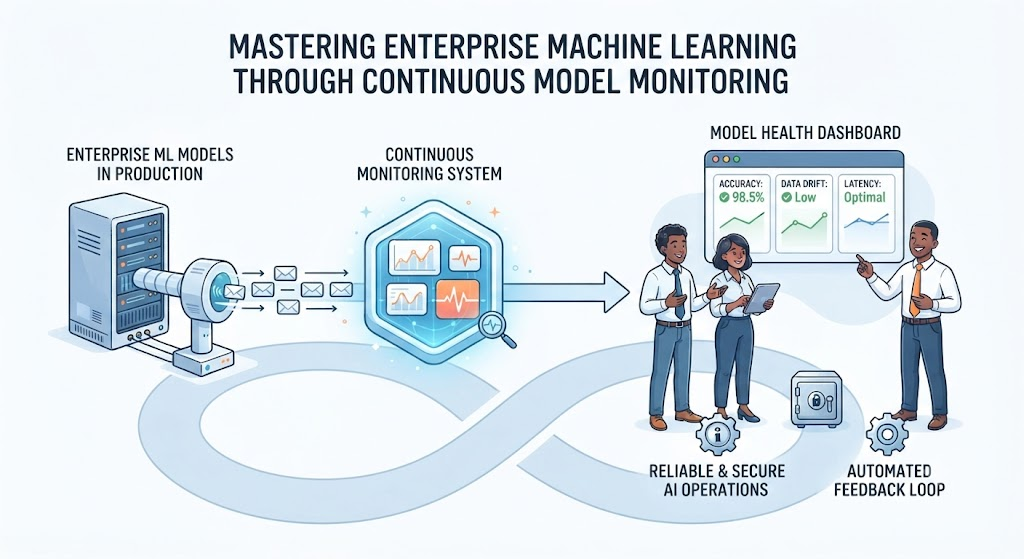
Model monitoring operates through a continuous feedback loop between the live application and the monitoring platform.
1. Data Collection
Every time a user makes a request, the system logs the incoming input features and the corresponding prediction output generated by the model.
2. Baseline Comparison
The monitoring system compares this live production data against a baseline dataset—usually the clean data used to train the model initially.
3. Metric Calculation
Specialized tools calculate statistical differences between the baseline and live data. They measure how much the inputs have changed and whether the model’s accuracy metrics are slipping.
4. Alerting and Triggers
If the difference crosses a pre-set threshold, the system sends an alert to the machine learning engineering team or automatically triggers a retraining pipeline.
Why Model Monitoring Matters
Machine learning models are not permanent fixtures; they are living systems exposed to changing environments. Ignoring them creates massive operational risks.
Silent Failures
Traditional software breaks visibly. A web server crashes, or an application throws a 504 error code. Machine learning models rarely crash. A fraud detection model might quietly start missing 40% of fraudulent transactions while still returning valid JSON responses. Without monitoring, no one knows an issue exists until customers complain.
Changing Realities
The world changes quickly. Consumer spending habits shift, supply chains break, and new slang enters language models. A model trained on 2024 data will face different economic realities in 2026. Monitoring helps teams spot when the real world has drifted too far from the training assumptions.
Financial and Legal Risk
If an automated loan approval model or a medical triage tool drifts without oversight, it can lead to heavy financial losses, regulatory fines, or unfair biases. Monitoring provides the transparency needed to maintain compliance and accountability.
Important Factors to Track in Production
Enterprise machine learning monitoring requires looking at more than just a single accuracy score. Effective strategies track three core pillars.
Data Drift
Data drift is a change in the statistical properties of the input data over time.
- Simple meaning: The information going into the model looks very different from what it was trained on.
- Why it matters: If a pricing model was trained during a period of low inflation, sudden high inflation changes the input values, making past patterns useless.
- Example: A retail forecasting model expects summer clothing purchase volumes to stay flat, but a sudden viral social media trend causes demand to spike tenfold.
Concept Drift
Concept drift occurs when the relationship between the input data and the target variable changes.
- Simple meaning: The rules of the game have changed, even if the inputs look similar.
- Why it matters: The model is receiving normal inputs, but the correct output for those inputs is now completely different.
- Example: A cybersecurity model identifies specific file access patterns as safe. Hackers adapt and use those exact same patterns for malware delivery. The inputs look identical, but the underlying concept of “safety” has shifted.
System Performance and Latency
Beyond statistical health, enterprise teams must track technical infrastructure metrics.
- Simple meaning: How fast and reliably the model responds to requests.
- Why it matters: A brilliant prediction is useless if it takes ten seconds to load on an e-commerce checkout page.
- Example: API response times jump from 50 milliseconds to 2 seconds because of server memory leaks, causing a drop in user conversions.
Practical Examples
Enterprise Retail Inventory
A large retail chain uses a machine learning model to predict how many winter coats to stock in various regional stores.
- The Problem: Unusually warm winter weather sweeps through a region. Customers stop buying heavy coats.
- The Monitoring Impact: The monitoring system detects a massive drop in prediction confidence and flags that the current sales rate is outside the expected baseline. The data team pauses automated inventory orders, preventing millions of dollars in wasted stock.
Financial Fraud Detection
A bank runs a real-time fraud detection model for credit card transactions.
- The Problem: Fraudsters introduce a brand-new scam technique that does not match historical fraud profiles.
- The Monitoring Impact: The system tracks ground-truth label feedback (transactions later confirmed as fraudulent by human review). It notices a spike in false negatives—fraudulent transactions slipping past the model. An alert fires, prompting engineers to update feature engineering rules.
Common Mistakes in Model Monitoring
Organizations new to enterprise machine learning often fall into predictable operational traps.
| Common Mistake | Why It Happens | Consequences | Correct Approach |
|---|---|---|---|
| Monitoring only accuracy | Assuming ground-truth labels are instantly available for all predictions. | Delayed detection because true outcomes take weeks or months to confirm. | Track input data drift and prediction distribution shifts as early warning indicators. |
| Setting static thresholds | Applying fixed alert rules across all models without context. | Alert fatigue from constant false alarms or missed critical failures. | Establish dynamic, data-driven thresholds based on historical volatility. |
| Ignoring infrastructure health | Focusing purely on data science metrics while ignoring server resources. | Hidden bottlenecks, slow response times, and unexpected API timeouts. | Monitor CPU, memory usage, and latency alongside statistical metrics. |
Risks and Limitations
While model monitoring is essential, it comes with practical challenges that enterprise teams must manage.
- Data Label Lag: For many business problems (like credit default or medical diagnosis), the actual outcome takes months to realize. You cannot calculate true model accuracy immediately.
- Alert Fatigue: If monitoring thresholds are set too sensitive, teams receive hundreds of false alarms daily and begin ignoring real warnings.
- Monitoring Overhead: Running continuous statistical checks on high-throughput data streams adds computing costs and system complexity.
A Simple Decision Framework for Enterprise Monitoring
Before rolling out a complex monitoring stack, enterprise teams can evaluate their needs using a step-by-step approach:
- Assess Business Impact: Determine what happens financially or operationally if the model makes a wrong prediction. High-stakes models (medical, financial, autonomous systems) require real-time monitoring; low-stakes models (content recommendations) can tolerate batch monitoring.
- Identify Failure Modes: Map out how the model is most likely to fail—is it sudden data drift, slow concept drift, or upstream data pipeline errors?
- Establish Baselines: Save the exact training dataset, feature distributions, and model performance metrics during deployment to use as your comparison reference.
- Choose the Right Metrics: Track input drift for immediate visibility, and lag-based accuracy metrics for long-term health.
- Automate Remediation: Define what happens when an alert triggers. Should it notify an engineer, fall back to a rule-based system, or trigger an automated retraining pipeline?
Checklist for Production Model Health
Use this practical checklist to verify your organization’s model monitoring readiness:
- Baseline datasets and training distributions are saved in a version-controlled registry.
- Automated logging captures both incoming input features and model prediction outputs.
- Data drift detection tools are active for critical high-dimensional input features.
- System latency and infrastructure resource usage (CPU/GPU/Memory) are monitored in real time.
- Alert channels (such as Slack or PagerDuty) are configured with sensible thresholds to prevent fatigue.
- A documented playbook exists outlining who responds when a model health alert triggers.
Key Terms
- Baseline Data: The original dataset used to train a machine learning model, serving as a reference point for future comparisons.
- Concept Drift: A change in the relationship between input features and the target outcome over time.
- Data Drift: A significant shift in the statistical properties or distributions of incoming production data compared to training data.
- False Negative: An instance where a model fails to detect a positive condition (such as missing a fraudulent transaction or a disease).
- Feature Store: A centralized repository that stores, manages, and serves machine learning features for training and inference.
- Inference: The process of running live input data through a trained machine learning model to calculate a prediction.
- Latency: The time delay between a user sending a request to a model and receiving the prediction response.
- Retraining Pipeline: An automated workflow that takes fresh production data and retrains the machine learning model to adapt to new patterns.
FAQs
Why do machine learning models degrade over time?
Models degrade because the real-world environment changes. Consumer behavior evolves, economic conditions shift, and data collection pipelines change. Because a model relies on historical patterns, it struggles when the present no longer resembles the past.
What is the difference between data drift and concept drift?
Data drift happens when the input data changes (e.g., users start buying different items). Concept drift happens when the meaning of the data changes (e.g., items that were once popular suddenly become unpopular, altering what the model should predict for the same inputs).
How often should enterprise machine learning models be monitored?
Monitoring frequency depends on the use case. High-frequency systems like real-time fraud detection or algorithmic trading require continuous, real-time monitoring. Stable batch systems like monthly inventory forecasts can be monitored on a daily or weekly schedule.
Can model monitoring be fully automated?
Yes, most enterprise monitoring platforms automate drift detection, metric calculations, and alerting. However, deciding why a model failed and adjusting business logic or retraining strategies usually requires human oversight.
What tools do teams use for model monitoring?
Engineering teams use a mix of open-source libraries (such as Evidently AI or WhyLabs) and enterprise observability platforms (such as Arize AI, Fiddler, or cloud-native monitoring tools) to track model health.
Conclusion
Enterprise machine learning is not a “deploy and forget” technology. Without active oversight, models degrade silently, leading to hidden financial losses and poor user experiences.
By tracking data drift, monitoring infrastructure latency, and setting up sensible alert thresholds, organizations protect their AI investments. Treating model monitoring as an essential part of the software lifecycle ensures that machine learning systems remain accurate, reliable, and valuable over the long term.