Introduction
Imagine running a busy digital store. One day, a huge sale begins, and thousands of shoppers flood your website at the same time. Suddenly, the server crashes. Customers see a blank error page, get angry, and leave to buy from your competitor.
For modern businesses, system crashes mean lost money and broken trust. When software systems grow large and complex, keeping them running smoothly becomes extremely difficult.
Many internal development teams focus so heavily on building new features that they lack the time or specialized skills to manage system stability at scale. This is where SRE consulting comes in. It brings outside experts to look at your infrastructure, spot hidden weaknesses, and set up modern reliability practices before a major disaster strikes.
What Is SRE Consulting?
SRE consulting is a professional service where experienced system reliability engineers analyze an organization’s IT infrastructure and software architecture. They work alongside your internal engineering teams to improve uptime, speed up deployments, and reduce manual operational labor.
The Core Goal
The main goal of SRE consulting is to bridge the gap between software development and IT operations. Developers want to ship new features fast. Operations teams want stability and zero crashes. SRE consultants use software engineering principles to solve operations problems, achieving both speed and stability.
Why Site Reliability Matters for Modern IT Systems
In the past, companies relied on traditional IT support teams to reboot crashed servers manually. Today, applications run across complex cloud environments with microservices, containers, and automated pipelines.
If a single service fails, it can trigger a domino effect across the entire platform.
The Cost of Downtime
Downtime is expensive. When critical systems go offline, businesses face:
- Immediate revenue loss from failed transactions.
- Damaged brand reputation and lost customer loyalty.
- High labor costs as engineers scramble through the night to fix the issue.
SRE consulting matters because it shifts your team from a reactive firefighting mode to a proactive reliability mindset. Instead of waiting for things to break, you build systems designed to withstand failures gracefully.
How SRE Consulting Works: Core Concepts and Metrics
To understand how consultants improve your systems, you need to understand the foundational metrics they introduce.
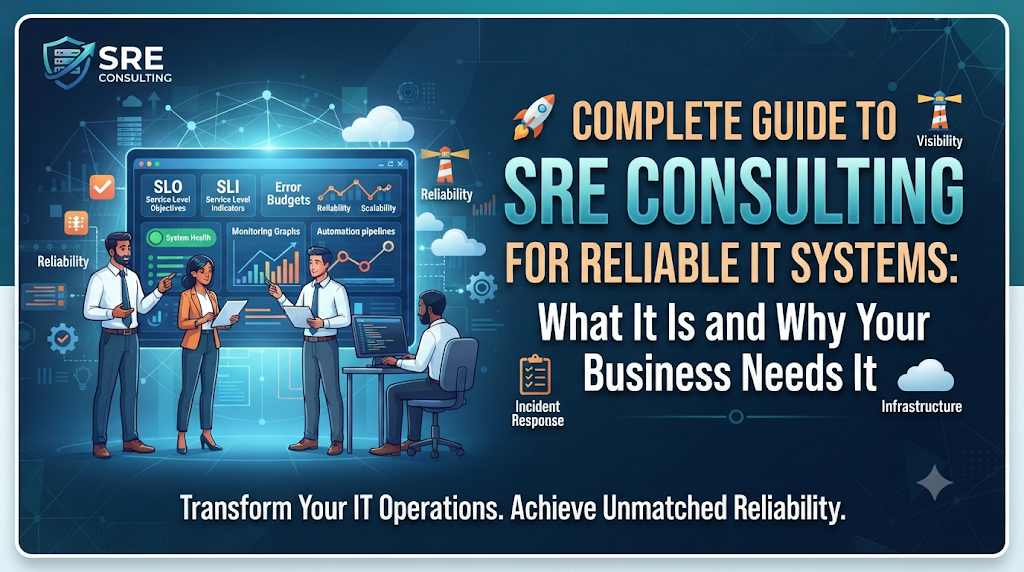
1. Service Level Objectives (SLOs) and Service Level Indicators (SLIs)
An SLI measures how well your system is performing (for example, server response time). An SLO is the target goal for that performance (for example, 99 percent of requests must load in under two seconds). Consultants help you define these metrics so you can measure reliability objectively.
2. Error Budgets
An error budget represents the amount of acceptable downtime or failure in a system over a given period. If your SLO is 99.9 percent uptime, your error budget is 0.1 percent.
Why it matters: It stops arguments between developers and operations. If you have remaining error budget, developers can release new features quickly. If the budget is exhausted, everyone pauses new features to fix stability issues.
3. Eliminating Toil
“Toil” refers to repetitive, manual operational work that offers no enduring value. For example, manually restarting crashed servers every morning is toil. SRE consultants help automate these tasks using custom scripts or configuration tools, freeing engineers to build product features.
When Should Your Business Hire an SRE Consultant?
Not every company needs an SRE consultant immediately. You should consider bringing in outside experts under specific conditions:
- Frequent Outages: Your application crashes regularly during traffic spikes or software updates.
- Slow Deployments: Moving new code from development to production takes days or weeks of manual work.
- Burnout: Your internal engineers spend all their time fixing broken servers instead of writing product code.
- Cloud Migration: You are moving your legacy applications to the cloud and want to ensure the architecture is scalable and secure from day one.
Common Mistakes Organizations Make Without SRE Guidance
Many companies attempt to build reliability practices without proper guidance and fall into predictable traps.
- Treating Monitoring Like Reliability: Installing dashboards to watch graphs is not enough. Without clear action plans or automated alerts, staring at graphs does not prevent crashes.
- Chasing 100 Percent Uptime: Trying to achieve zero downtime is wildly expensive and unnecessary. Consultants help businesses find the right balance based on user needs.
- Blaming Individuals: When an outage happens, poorly run teams blame the engineer who typed the command. SRE culture focuses on fixing the broken system or process, not punishing the human.
Risks, Limitations, and Trade-Offs
SRE consulting is powerful, but it is not a magic fix for every IT problem.
1. High Upfront Cost
Hiring specialized consultants requires a financial investment. Smaller startups with tight budgets might find full SRE consulting too expensive.
2. Cultural Resistance
Internal teams can be defensive. If consultants arrive and dictate changes without listening to existing engineers, staff may reject the new practices entirely.
3. Complexity Overload
Some organizations implement complex SRE frameworks when a simpler monitoring setup would suffice. Good consultants tailor solutions to match the actual size and maturity of the business.
Step-by-Step Decision Framework for Adopting SRE
If you are wondering whether to bring in external SRE help, follow this straightforward framework:
- Audit Current Pain Points: Track how many hours your team spends fixing outages each month and calculate the financial cost.
- Assess Internal Skill Gaps: Determine if your current staff has experience with modern cloud infrastructure, automation, and observability tools.
- Define Scope: Decide whether you need a full infrastructure overhaul or just guidance on setting up SLIs, SLOs, and incident response processes.
- Evaluate Vendors: Look for consultants with proven experience in your specific technology stack (such as Kubernetes, AWS, or GCP).
- Start Small: Run a pilot project with the consultants on a single non-critical application before rolling changes out to core business systems.
Key Terms
- Observability: The measure of how well you can infer the internal state of a system based on its external outputs, logs, metrics, and traces.
- Post-Mortem: A blameless review meeting held after an outage to analyze what went wrong and prevent it from happening again.
- Infrastructure as Code (IaC): Managing and provisioning computing infrastructure through machine-readable definition files rather than physical hardware configuration.
- CI/CD Pipeline: A set of automated steps that allows developers to build, test, and deploy code changes quickly and safely.
- Chaos Engineering: The practice of intentionally injecting failures into a test system to verify that the application can survive unexpected shocks.
FAQs
What is the difference between DevOps and SRE?
DevOps is a culture and set of practices focused on speeding up software delivery. SRE is a specific implementation of that philosophy focused heavily on reliability, uptime, and measuring system performance.
Do small startups need SRE consulting?
Usually no. Early-stage startups need to focus on building their product and finding customers. SRE consulting becomes valuable once user traffic scales up and downtime starts hurting revenue.
How long does an SRE consulting engagement last?
Engagements vary based on project scope. Short assessments can take two to four weeks, while full infrastructure transformations and team training programs can last several months.
Will SRE consultants replace our internal IT team?
No. Good consultants work alongside your existing engineers to upskill them, transfer knowledge, and leave your team capable of managing the systems independently.
How do we measure the success of SRE consulting?
Success is measured by a reduction in downtime frequency, faster incident recovery times, fewer manual operational tasks, and improved developer velocity.
Conclusion
System reliability is the invisible foundation of any successful digital business. When applications stay fast and online, customers remain happy and revenue flows smoothly.
SRE consulting bridges the gap between fast software development and stable operations. By introducing clear metrics, automation, and structured incident management, expert consultants help your team build resilient systems that scale securely into the future.