Introduction
The stability of digital platforms is no longer ensured by simple uptime checks. In the current era, the internal state of a system must be understood by analyzing the external data it produces. This concept, known as observability, is considered the backbone of reliable engineering. A journey toward becoming an expert in this domain is offered through the Master in Observability Engineering (MOE) program. This guide is written to assist professionals in understanding how this mastery can be achieved and utilized for global career growth.
What is Master in Observability Engineering (MOE)?
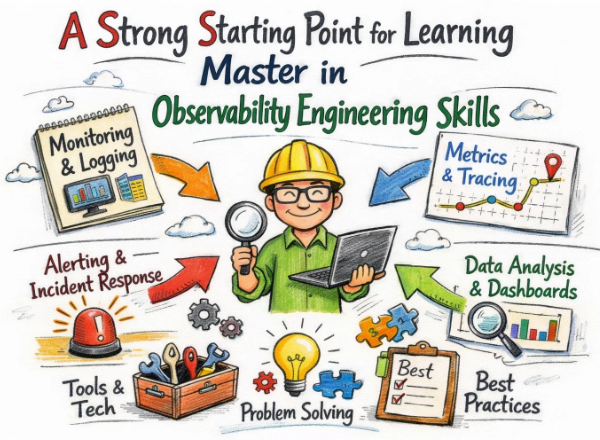
The Master in Observability Engineering (MOE) is a specialized professional program that focuses on the three main pillars of system visibility: metrics, logs, and traces. Through this program, the ability to diagnose complex issues before they impact the end user is developed. It is not merely a tool-based course; the core principles of telemetry, data correlation, and proactive system health are emphasized.
Why it Matters in Today’s Ecosystem
The cloud and automation ecosystem has become highly interconnected and abstract. When a failure occurs in a distributed environment, the root cause is often hidden behind multiple service layers. Observability is regarded as the “eyes and ears” of modern DevOps and SRE teams. By implementing these practices, the mean time to resolution (MTTR) is significantly reduced, business continuity is maintained, and customer trust is preserved through the identification of “unknown unknowns.”
Why Certifications are Important for Engineers and Managers
The value of a technical professional is often validated through recognized certifications. For engineers, a structured learning path is provided by these credentials, ensuring that knowledge gaps are eliminated. For managers, certifications serve as a reliable benchmark for hiring and team building. A commitment to continuous professional development is demonstrated when an industry-standard certification like MOE is achieved, providing a competitive edge in both the Indian and international job markets.
Why Choose DevOpsSchool?
The choice of a training provider is a critical factor in career success. DevOpsSchool is preferred by thousands of professionals for the following reasons:
- Practical Curriculum: A focus is kept on real-world scenarios rather than just theoretical concepts.
- Expert Mentorship: Guidance is provided by industry veterans who have managed large-scale production systems.
- Dedicated Lab Access: Hands-on experience is gained through virtual lab environments where tools are practiced in real-time.
- Community Support: A vast network of alumni and experts is made available to every learner for ongoing collaboration.
- Industry Alignment: The course content is updated regularly so that the latest trends and tool versions are always included.
Certification Deep-Dive: Master in Observability Engineering (MOE)
What is this certification?
A comprehensive mastery over the tools and techniques used to monitor, debug, and optimize distributed systems is provided by this certification. The focus is placed on creating a transparent view of software health through advanced telemetry.
Who should take this certification?
This program is recommended for software engineers, SREs, DevOps professionals, and technical managers who are responsible for maintaining system reliability and performance in production environments.
Certification Overview Table
| Track | Level | Who it’s for | Prerequisites | Skills Covered | Recommended Order |
| DevOps | Advanced | DevOps Engineers | Linux & Networking | Prometheus, Grafana, ELK | 1 |
| SRE | Expert | SRE Professionals | Cloud Fundamentals | Tracing, SLIs/SLOs, Error Budgets | 2 |
| DevSecOps | Advanced | Security Engineers | Security Basics | Security Observability, Runtime Security | 3 |
| AIOps/MLOps | Expert | Data/ML Engineers | Python & Data Basics | Predictive Monitoring, Model Drift | 4 |
| DataOps | Advanced | Data Engineers | SQL & Pipelines | Pipeline Observability, Data Quality | 5 |
| FinOps | Advanced | Financial Ops | Cloud Billing | Cost Observability, Unit Economics | 6 |
Skills You Will Gain
- Telemetry Collection: The methods for collecting data from various infrastructure layers are mastered.
- Querying & Visualization: Advanced dashboards are created using tools like Grafana and Kibana.
- Distributed Tracing: The flow of requests across multiple services is tracked to identify latency.
- Log Aggregation: High volumes of unstructured data are analyzed to find patterns and errors.
- Alerting Strategies: Meaningful alerting systems are designed to prevent notification fatigue.
- Incident Response: Data-driven insights are used to drive faster and more accurate investigations.
Real-World Projects
- Microservices Monitoring: A complete monitoring solution for a complex microservices application is built.
- Centralized Logging Pipeline: A system for collecting and searching logs from hundreds of servers is implemented.
- Tracing Implementation: Distributed tracing is added to a polyglot application to find bottlenecks.
- Custom Exporters: Custom Prometheus exporters are developed to monitor unique business-critical metrics.
Preparation Plan
7–14 Days Plan
- The core pillars of observability (Metrics, Logs, Traces) are reviewed.
- The official documentation for core tools like Prometheus is studied.
- Basic configuration labs are completed to understand data flow.
30 Days Plan
- One week is dedicated to each pillar of observability for deep study.
- Real-world failure scenarios are simulated in a dedicated test environment.
- Sample assessment questions are practiced daily to build confidence.
60 Days Plan
- In-depth study of both open-source and enterprise-grade tools is performed.
- Advanced concepts like service mesh observability are explored.
- A major capstone project is completed to demonstrate total mastery.
Common Mistakes to Avoid
- Over-focusing on tools: The underlying principles of data analysis are often ignored.
- Creating noisy alerts: Too many alerts are set up, leading to critical issues being missed.
- Manual configuration: Observability is not integrated into the automated CI/CD pipeline.
- Siloed data: Metrics, logs, and traces are kept separate instead of being correlated.
Best Next Certification After This
- Same Track: Advanced Prometheus Certified Associate.
- Cross-Track: Certified Kubernetes Administrator (CKA).
- Leadership: Engineering Management Professional.
Choose Your Learning Path
DevOps Path This path is best for those who wish to integrate observability into the software delivery cycle. The focus is on CI/CD monitoring and the health of the deployment pipeline.
DevSecOps Path Designed for security-minded professionals, this path focuses on detecting threats and vulnerabilities through real-time telemetry and runtime analysis.
Site Reliability Engineering (SRE) Path This is the preferred path for engineers focused on uptime. The management of SLIs, SLOs, and error budgets through observability is the primary focus.
AIOps / MLOps Path This path is chosen by those working with artificial intelligence. Observability is used to monitor machine learning models and automate incident responses with AI.
DataOps Path Intended for data engineers, this path ensures the health and quality of data pipelines. The flow and integrity of data are monitored across the entire lifecycle.
FinOps Path Suitable for those managing cloud budgets, this path uses observability tools to track and optimize cloud spending and resource utilization.
Role → Recommended Certifications Mapping
| Role | Recommended Certification |
| DevOps Engineer | Master in Observability Engineering (MOE) |
| Site Reliability Engineer (SRE) | Advanced SRE Certification |
| Platform Engineer | Kubernetes & Observability Master |
| Cloud Engineer | Multi-Cloud Observability Specialist |
| Security Engineer | DevSecOps & Security Observability |
| Data Engineer | Data Pipeline Observability Master |
| FinOps Practitioner | Cloud Cost Observability Expert |
| Engineering Manager | Strategic Observability for Leaders |
Next Certifications to Take
For each learner, the following additions are recommended:
- One same-track certification: E.g., Advanced Logging Specialist.
- One cross-track certification: E.g., Certified Kubernetes Security Specialist (CKS).
- One leadership-focused certification: E.g., Technical Team Lead Certification.
Training & Certification Support Institutions
DevOpsSchool Comprehensive training and certification support are provided by this global institution. A wide range of DevOps and SRE programs is offered to help professionals advance their careers.
Cotocus A focus is maintained on specialized technical training for modern IT roles. High standards are kept for both corporate training and individual skill development.
ScmGalaxy Knowledge regarding software configuration management and automation tools is shared here. Support for various technical certifications is provided to a large community of engineers.
BestDevOps The best practices of the DevOps industry are taught at this center. Practical, hands-on knowledge is emphasized to ensure learners are ready for the job market.
devsecopsschool.com The integration of security within the DevOps process is the primary focus. Specialized training is provided for engineers who want to specialize in secure operations.
sreschool.com The principles of site reliability engineering are taught here. Reliability, scalability, and system performance are the core pillars of the training provided.
aiopsschool.com The intersection of AI and system operations is explored. Professionals are trained to use AI and machine learning to improve automated system management.
dataopsschool.com Data management and pipeline optimization are the main focus areas. Training is provided to ensure that data is handled reliably and efficiently.
finopsschool.com Cloud financial management is taught to help organizations manage costs. The culture of financial accountability in cloud operations is promoted.
FAQs Section
- What is the difficulty level of the MOE certification??
The level is considered intermediate to advanced, as a basic understanding of system operations is needed. - How much time is typically required to complete the program?
A period of 4 to 8 weeks is usually required, depending on the learner’s prior experience. - Are there any prerequisites for this course?
Fundamental knowledge of Linux, networking, and cloud platforms is generally recommended. - What is the suggested certification sequence?
A basic DevOps certification is often suggested before pursuing Master in Observability Engineering. - What career value is added by this certification?
Marketability is significantly increased, as observability is now a core requirement for high-level engineering roles. - Which job roles can be applied for after completion?
Roles such as SRE, Observability Engineer, and Senior DevOps Engineer are commonly pursued. - Is the certification recognized in international markets?
Yes, the certification is respected by tech organizations across India and global markets. - How is observability different from traditional monitoring?
Monitoring tracks whether a system is working, while observability explains why it is not working. - What tools are included in the curriculum?
Popular tools such as Prometheus, Grafana, Jaeger, and the ELK stack are covered in detail. - Is hands-on project work included?
Multiple real-world projects are assigned to ensure that the skills are practically mastered. - Does this certification lead to salary growth?
A significant increase in compensation is often observed by professionals who gain this specialized knowledge. - Are online training options available?
Yes, flexible and interactive online training is provided by the supporting institutions.
Additional FAQs: Master in Observability Engineering (MOE)
- What is the primary goal of the MOE program?
The goal is to enable engineers to build systems that are inherently easy to monitor and debug. - How are the assessments conducted?
Assessments are conducted through a proctored online environment to ensure high standards. - Is study material provided to the participants?
Comprehensive digital guides, lab manuals, and video resources are provided to all learners. - Can manual testers take this course?
A transition is possible, but a foundational understanding of automation and cloud logic is required first. - Is there a renewal requirement for the MOE credential?
The credential remains valid, though staying updated with new tool versions is strongly encouraged. - What support is offered after the training is finished?
Access to alumni networks and ongoing community forums is provided for continued growth. - Are group discounts available for corporate teams?
Special pricing and customized training plans are often made available for corporate groups. - How does MOE help in managing Kubernetes environments?
Skills are provided to handle the high complexity and transient nature of containerized applications.
Testimonials
Ananya A complete change in my approach to system health was experienced. The ability to visualize complex data has made my daily work much more efficient.
Vikram The practical labs were the highlight of the program. Real confidence was gained in handling production-level incidents through the MOE curriculum.
Sarah Tracing and request tracking were areas where I struggled. After this certification, identifying latency in our microservices became a simple task.
Rajesh “A structured and professional path for mastering observability was finally found. The gap between theory and real-world insight was successfully bridged.”
Kavita Strategic thinking regarding reliability was improved. The benefits of observability were clearly demonstrated through the excellent mentorship provided.
Conclusion
The importance of the Master in Observability Engineering (MOE) certification is highlighted by the increasing complexity of modern software systems. Long-term career benefits are secured by those who choose to master these advanced telemetry and analysis techniques. Strategic learning and proactive certification planning are encouraged for every engineer who aims for excellence. By committing to this path, a future of system reliability and career success is ensured.