Introduction
Workplace Safety (EHS) Software refers to a suite of digital tools designed to help organizations manage their Environment, Health, and Safety (EHS) programs. These platforms act as a centralized hub for tracking regulatory compliance, managing risks, and ensuring that every employee returns home safely. In a modern industrial setting, EHS software replaces fragmented spreadsheets and paper logs with real-time data entry, automated workflows, and sophisticated analytics. By digitizing safety protocols, companies can move from being “reactive”—responding only after an accident occurs—to being “proactive,” identifying hazards before they lead to an injury.
The importance of these tools lies in their ability to mitigate high-stakes risks. Beyond the moral obligation to protect workers, EHS software is a critical component of financial and legal stability. A single workplace fatality or major environmental spill can result in catastrophic fines, soaring insurance premiums, and irreparable brand damage. EHS platforms streamline compliance with global standards such as OSHA, ISO 45001, and ISO 14001, ensuring that documentation is always audit-ready. Furthermore, they foster a “safety culture” by making it easy for frontline workers to report near-misses and hazards directly from their mobile devices, providing management with the visibility needed to prevent future incidents.
Key Real-World Use Cases
Workplace safety software is utilized across various scenarios to maintain operational integrity:
- Incident and Near-Miss Management: Standardizing how accidents are reported and investigated to find the root cause.
- Audit and Inspection Tracking: Conducting site walkthroughs using digital checklists that automatically generate corrective actions.
- Compliance Management: Tracking local, state, and federal regulatory requirements to ensure no deadlines or permits are missed.
- Occupational Health: Managing employee medical surveillance, vaccinations, and hearing tests in high-risk environments.
- Environmental Sustainability: Monitoring carbon emissions, waste disposal, and water usage for ESG (Environmental, Social, and Governance) reporting.
What to Look For (Evaluation Criteria)
When choosing an EHS platform, organizations should prioritize the following:
- Mobile Functionality: Can workers use the app offline in remote locations?
- Configurability: Can the forms be customized to fit specific industry workflows without coding?
- Reporting and Analytics: Does the tool provide visual dashboards that highlight high-risk trends?
- Integration Capability: Does it connect with HRIS (like Workday) or ERP systems (like SAP)?
- User Adoption: Is the interface simple enough for a busy foreman or floor worker to use without frustration?
Best for:
- Safety Directors and EHS Managers: In high-risk industries like construction, manufacturing, energy, and mining.
- Compliance Officers: Tasked with ensuring the company meets legal and insurance-mandated safety standards.
- Operations Leaders: Looking to reduce downtime caused by workplace accidents.
- Enterprise Corporations: With multiple global sites that need to standardize safety data and reporting.
Not ideal for:
- Small Professional Offices: Where the primary “safety” concern is ergonomic seating and fire drills; standard HR software usually suffices.
- Solopreneurs: Those working alone do not need the complex administrative overhead of an EHS suite.
- Companies with Zero Physical Footprint: Fully remote digital services companies likely won’t see a return on investment from specialized safety software.
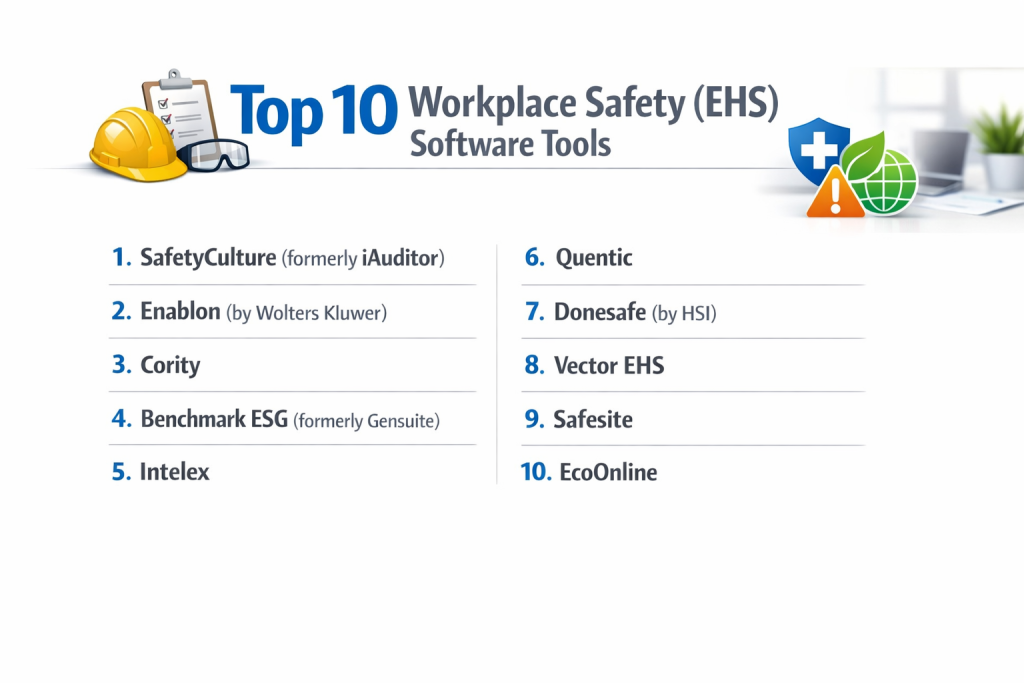
Top 10 Workplace Safety (EHS) Software Tools
1 — SafetyCulture (formerly iAuditor)
SafetyCulture is an industry-leading mobile-first platform designed for frontline workers to perform inspections, report incidents, and manage tasks. It is widely praised for its simplicity and the massive library of public templates available to users.
Key features:
- Robust mobile inspection app with offline capabilities and photo attachments.
- Public template library with thousands of industry-specific safety checklists.
- “Heads Up” feature for broadcasting instant safety messages to teams.
- Asset management integration to track equipment maintenance alongside safety checks.
- Sensors and IoT integration for real-time environmental monitoring.
Pros:
- The most intuitive user interface in the category, leading to very high worker adoption.
- Excellent free-tier option for small teams or individual sites to get started.
Cons:
- Advanced data analytics and organizational permissions require premium subscriptions.
- Lacks some of the “deep” environmental and medical surveillance modules found in enterprise suites.
Security & compliance: SOC 2 Type II, GDPR, ISO 27001 compliant, and SSO support.
Support & community: 24/5 global support, a large online knowledge base, and a very active user community.
2 — Enablon (by Wolters Kluwer)
Enablon is a high-end enterprise EHS platform that focuses heavily on sustainability and risk management. It is designed for the world’s largest companies in the most heavily regulated industries.
Key features:
- Comprehensive environmental management including air, water, and waste tracking.
- Advanced Risk Management modules that link safety incidents to financial impact.
- Regulatory compliance content for over 100 jurisdictions worldwide.
- Centralized “Action Plan” tracking to ensure every safety gap is closed.
- Deep ESG (Environmental, Social, and Governance) reporting tools.
Pros:
- The most powerful platform for global firms needing to meet diverse international laws.
- Highly customizable reporting engine that satisfies board-level data requirements.
Cons:
- Requires significant investment in time and money for implementation and training.
- The interface is dense and can feel overwhelming for non-technical users.
Security & compliance: ISO 27001, SOC 1 & 2, HIPAA, and GDPR compliant.
Support & community: Dedicated enterprise account managers and specialized professional services for deployment.
3 — Cority
Cority is an EHSQ (Quality) platform known for its exceptional focus on “Occupational Health.” It is the preferred choice for organizations where worker wellness and medical surveillance are as critical as physical safety.
Key features:
- Industry-leading Occupational Health module for tracking medical records and clinic visits.
- Industrial Hygiene tools for monitoring noise, dust, and chemical exposure.
- Predictive analytics that identify which employees are at the highest risk of injury.
- Safety management for incident investigation and root-cause analysis.
- Quality management integration to ensure safety and product standards align.
Pros:
- Strongest choice for healthcare, pharmaceuticals, and manufacturing with high chemical exposure.
- Exceptional data privacy controls for sensitive medical information.
Cons:
- The modular pricing model means the cost can rise quickly as you add features.
- The mobile app is functional but not quite as “slick” as consumer-grade apps.
Security & compliance: ISO 27001, SOC 2 Type II, HIPAA, and GDPR compliant.
Support & community: Strong professional services team and a robust annual user conference.
4 — Benchmark ESG (formerly Gensuite)
Benchmark ESG offers a cloud-based suite that is highly modular and designed for rapid scaling. It has a strong reputation for staying ahead of technological trends, such as AI and voice-to-text reporting.
Key features:
- More than 65 specialized modules covering EHS, ESG, and Product Stewardship.
- AI-powered “Data Assistant” for quick insights and pattern recognition.
- Mobile “Scan-In” features for equipment and chemical inventory.
- Automated regulatory alerts to keep safety teams informed of legal changes.
- Integrated contractor management to track the safety of third-party workers.
Pros:
- One of the fastest enterprise tools to deploy due to its modular architecture.
- Highly reliable customer service and a history of consistent software updates.
Cons:
- The visual design of some older modules can feel a bit dated compared to modern startups.
- The sheer number of modules can make the initial selection process confusing.
Security & compliance: SOC 2 Type II, ISO 27001, and GDPR compliant.
Support & community: 24/7 global support and a proactive user community that helps guide the product roadmap.
5 — Intelex
Intelex is a global leader in EHSQ software that focuses on the “Quality” side of the house as much as the “Safety” side. It is known for its highly flexible “Application Builder” that allows companies to build their own forms.
Key features:
- Modular system covering Environment, Health, Safety, and Quality (EHSQ).
- Unique “Application Builder” for creating highly customized safety workflows.
- Robust compliance tracking for ISO 9001, 14001, and 45001.
- Supplier management to ensure your supply chain meets your safety standards.
- Advanced dashboarding with drill-down capabilities for site-specific data.
Pros:
- Excellent for companies that want a “tailor-made” feel without building software from scratch.
- A “one-stop-shop” for organizations that view quality and safety as the same mission.
Cons:
- Extensive customization can lead to long implementation timelines.
- Requires a more dedicated admin to manage the custom-built applications.
Security & compliance: SOC 2 Type II, ISO 27001, and GDPR compliant.
Support & community: Extensive library of training videos and a dedicated customer success portal.
6 — Quentic
Quentic is a leading European EHS software provider that excels in making safety data highly visual and easy to digest. It is particularly strong in legal compliance for European markets.
Key features:
- Centralized “Legal Registry” that tracks specific laws and obligations.
- Hazardous materials management including Safety Data Sheet (SDS) tracking.
- Visual “Health & Safety” map to identify risk zones within a facility.
- Incident and audit management with automated notification workflows.
- Integrated environmental and energy management modules.
Pros:
- Superb user experience with a clean, modern, and very organized layout.
- The best choice for firms with a large European presence due to its focus on EU law.
Cons:
- Its presence and support network in North America are smaller than competitors.
- Some advanced reporting features may require a learning curve for the admin.
Security & compliance: ISO 27001, GDPR, and TISAX (automotive industry) compliant.
Support & community: High-quality local support in Europe and specialized regulatory training.
7 — Donesafe (by HSI)
Donesafe describes itself as the “People’s Safety Software.” It is a cloud-native platform that focuses on ease of use and mobile accessibility, aiming to make safety reporting as simple as using a social media app.
Key features:
- “No-code” platform allowing admins to build and edit forms with drag-and-drop tools.
- Integration with Slack and Microsoft Teams for instant safety alerts.
- Automated “Nudges” to remind managers of overdue safety tasks.
- Comprehensive contractor management and visitor sign-in.
- Safety “Gamification” to encourage workers to participate in hazard reporting.
Pros:
- The fastest “time-to-value” for mid-sized companies looking to digitize quickly.
- An exceptionally modern and friendly interface that workers actually enjoy using.
Cons:
- Lacks some of the “industrial-strength” environmental calculation depth of Enablon.
- The reporting engine is great but may feel less powerful than specialized BI (Business Intelligence) tools.
Security & compliance: SOC 2 Type II, ISO 27001, and HIPAA compliant.
Support & community: Very responsive digital support and a growing ecosystem of safety training partners.
8 — Vector EHS (formerly IndustrySafe)
Vector EHS is a straightforward, reliable, and highly functional safety tool that focuses on the core needs of US-based safety managers, such as OSHA recordkeeping.
Key features:
- Direct integration with OSHA 300, 300A, and 301 reporting.
- Integrated Training Management to track employee safety certifications.
- Vehicle and Fleet management module for transportation safety.
- Mobile app specifically designed for rapid “hazard ID” on job sites.
- Corrective action tracking with automated email reminders.
Pros:
- Extremely reliable for US regulatory compliance; it “just works” for OSHA audits.
- Very cost-effective for mid-market companies that don’t need a hundred extra bells and whistles.
Cons:
- The user interface is functional but feels a bit like an older database compared to Donesafe.
- Limited focus on ESG and “Deep Green” environmental tracking.
Security & compliance: SOC 2 Type II and standard data encryption.
Support & community: High marks for US-based customer service and live training sessions.
9 — Safesite
Safesite is a specialized safety platform that uses data to help companies lower their insurance premiums. It focuses on engagement and “active” safety behaviors rather than just passive reporting.
Key features:
- “Safesite Score” that gives every site a real-time safety grade.
- Digital “Tailgate Meetings” and safety briefings.
- Automated weekly safety reports sent directly to management.
- Simplified hazard and incident reporting for non-technical workers.
- Verification of equipment inspections via QR codes.
Pros:
- One of the few tools that can show a direct link between software use and insurance savings.
- Extremely lightweight and easy to roll out to a construction or field team in hours.
Cons:
- It is not a full-scale EHS suite; it doesn’t handle complex environmental or chemical tracking.
- The focus is primarily on physical safety, leaving out occupational health or sustainability.
Security & compliance: SOC 2 and GDPR compliant.
Support & community: Very proactive support aimed at getting teams into the app and using it daily.
10 — EcoOnline
EcoOnline is a comprehensive EHS platform that specialized in “Chemical Management” before expanding into a full safety suite. It is perfect for organizations that handle a lot of hazardous materials.
Key features:
- Market-leading Chemical Safety and SDS (Safety Data Sheet) management.
- Risk assessment tools that help calculate “Exposure Limits” for workers.
- Mobile incident reporting and audit tools.
- Environmental tracking for CO2 emissions and waste.
- Learning management integration for chemical-specific training.
Pros:
- The absolute best tool for labs, manufacturing, and chemical plants.
- The mobile “SDS lookup” is a lifesaver for workers in the field.
Cons:
- If your company doesn’t handle chemicals, many of the best features are irrelevant.
- The interface is efficient but can feel a bit “utilitarian.”
Security & compliance: ISO 27001 and fully GDPR compliant.
Support & community: Strong European roots with a growing presence in the UK and Ireland.
Comparison Table
| Tool Name | Best For | Platform(s) Supported | Standout Feature | Rating |
| SafetyCulture | Frontline Adoption | Web / iOS / Android | Massive Checklist Library | N/A |
| Enablon | Global Enterprises | Web / Mobile | Enterprise ESG Depth | N/A |
| Cority | Occupational Health | Web / Mobile | Medical Surveillance | N/A |
| Benchmark ESG | Rapid Scaling | Web / Mobile | AI Data Assistant | N/A |
| Intelex | Custom Workflows | Web / Mobile | App Builder Tool | N/A |
| Quentic | European Compliance | Web / Mobile | Legal Registry Tracking | N/A |
| Donesafe | Modern SMB/Mid-Mkt | Web / Mobile | “No-Code” Configuration | N/A |
| Vector EHS | OSHA/US Compliance | Web / Mobile | Automated OSHA Logs | N/A |
| Safesite | Insurance Savings | iOS / Android | Safesite Safety Score | N/A |
| EcoOnline | Chemical Safety | Web / Mobile | SDS Management | N/A |
Evaluation & Scoring of Workplace Safety (EHS) Software
| Criterion | Weight | Scoring Focus |
| Core Features | 25% | Incident reporting, audit tools, and compliance tracking. |
| Ease of Use | 15% | Mobile UI, navigation, and worker-facing simplicity. |
| Integrations | 15% | Connection to HRIS, ERP, and IoT devices. |
| Security & Compliance | 10% | SOC 2, ISO 27001, HIPAA, and audit readiness. |
| Performance | 10% | Offline sync reliability and cloud uptime. |
| Support | 10% | Onboarding, community, and tech support response. |
| Price / Value | 15% | Feature depth vs. total cost of ownership. |
Which Workplace Safety (EHS) Software Tool Is Right for You?
Solo Users vs SMB vs Mid-Market vs Enterprise
Small businesses (SMBs) or contractors should look for tools that require zero IT setup. Safesite or SafetyCulture are the winners here. Mid-Market firms (200-1,000 employees) that need to professionalize their safety culture will find Donesafe or Vector EHS to be the best balance of power and simplicity. Enterprise organizations with thousands of employees and global sites must choose the industrial-strength capabilities of Enablon, Cority, or Benchmark ESG to handle the immense data and legal complexity.
Budget-Conscious vs Premium Solutions
If budget is the primary driver, Vector EHS and Safesite offer transparent, affordable pricing. If you are looking for a “premium” solution that acts as a true risk management partner, Enablon and Cority are the top choices. These platforms are expensive but can save millions by preventing a single catastrophic incident.
Feature Depth vs Ease of Use
For those who need “Feature Depth”—meaning you want to track air emissions, chemical runoff, and nurse clinic visits—Enablon and EcoOnline are the leaders. However, if your main goal is “Ease of Use” so your workers actually want to report incidents, Donesafe and SafetyCulture are significantly more approachable for the average employee.
Integration and Scalability Needs
If your safety data needs to flow into an SAP or Workday environment, prioritize Benchmark ESG or Intelex, which have decades of experience with enterprise-grade APIs. If you are a smaller company that uses Slack or Microsoft Teams, Donesafe has the best modern integrations to keep safety in the daily conversation.
Security and Compliance Requirements
Companies in healthcare or with on-site clinics should prioritize Cority for its HIPAA compliance. For firms operating heavily in Europe, Quentic and EcoOnline offer the best peace of mind for GDPR and local EU environmental laws. US firms strictly worried about OSHA should lean toward Vector EHS.
Frequently Asked Questions (FAQs)
What is EHS software?
It is a digital platform that helps companies manage Environment, Health, and Safety programs, including incident reporting, audits, and compliance tracking.
Can it work without an internet connection?
Yes, top-tier mobile apps like SafetyCulture and Safesite allow workers to fill out reports offline and sync them once they reach Wi-Fi.
How does it improve safety?
By making it easy to report hazards, management can see trends (like a specific site having many near-misses) and fix them before an injury occurs.
Does it help with OSHA reporting?
Many platforms, specifically Vector EHS and Benchmark ESG, can automatically generate your OSHA 300, 300A, and 301 logs based on your data.
Is it expensive?
Pricing varies wildly. Simple apps can cost $20/month per user, while enterprise systems can cost six figures for full global implementation.
How long does implementation take?
Simple tools can be ready in a day. Enterprise systems usually take 3 to 6 months of configuration and training before they are fully live.
Can I track chemical safety?
Yes, tools like EcoOnline are designed specifically for this, allowing you to scan and track Safety Data Sheets (SDS) on your phone.
What is ‘Predictive Safety’?
This uses AI to look at your data and warn you which sites or tasks are statistically “due” for an accident, allowing you to intervene early.
Will it integrate with my HR software?
Most enterprise tools (Cority, Enablon) have APIs to connect with Workday, ADP, and other HRIS systems to keep employee lists up to date.
What is the ROI of EHS software?
ROI comes from lower insurance premiums, fewer worker compensation claims, avoided government fines, and reduced administrative time.
Conclusion
The “best” workplace safety software is the one that your employees will actually use. A complex system with every feature imaginable is useless if it is so difficult to navigate that workers go back to using paper notes. If you are looking for maximum engagement and simplicity, SafetyCulture and Donesafe are excellent choices. If you are a global giant managing immense environmental and chemical risks, the power of Enablon or Cority is essential.
Ultimately, choosing an EHS platform is about moving your organization from a reactive state to a proactive safety culture. By putting safety data into a centralized, digital system, you gain the visibility needed to protect your people and your business. Start by identifying your “must-have” features, run a pilot program with a small team, and choose the partner that helps you send every worker home safe at the end of the day.