Introduction
Voice AI Agent Platforms represent the next evolution in automated communication, moving beyond simple IVR menus to fully autonomous, conversational entities that can hear, understand, and respond in real-time. These platforms provide the infrastructure to build agents that handle both inbound and outbound calls with human-like prosody and sub-second latency. They typically combine three core technologies: Automatic Speech Recognition (ASR) to “hear,” Large Language Models (LLMs) to “think,” and Text-to-Speech (TTS) to “speak.” Unlike traditional phone systems that rely on keypad inputs, these agents process natural language, allowing customers to speak freely as if they were talking to a human representative.
The importance of these platforms is underscored by the global shift toward 24/7, on-demand customer service. In a world where minutes matter, voice agents can handle nuances in tone, manage interruptions, and execute complex tasks like booking appointments or qualifying sales leads while a customer is driving or multitasking. When evaluating these tools, organizations should prioritize latency (sub-500ms is the gold standard), voice realism, telephony integration flexibility, and robust security guardrails to prevent “hallucinations” during sensitive customer interactions.
Best for: Customer Support Directors, Sales Operations Managers, and Product Engineers at mid-market to enterprise companies. They are transformative for high-volume sectors like Healthcare, Insurance, Real Estate, and Travel where rapid response is a competitive advantage.
Not ideal for: Small businesses with extremely low call volumes where a simple answering service suffices, or highly specialized creative consulting where the interaction requires deep subjective empathy and non-standard problem-solving.
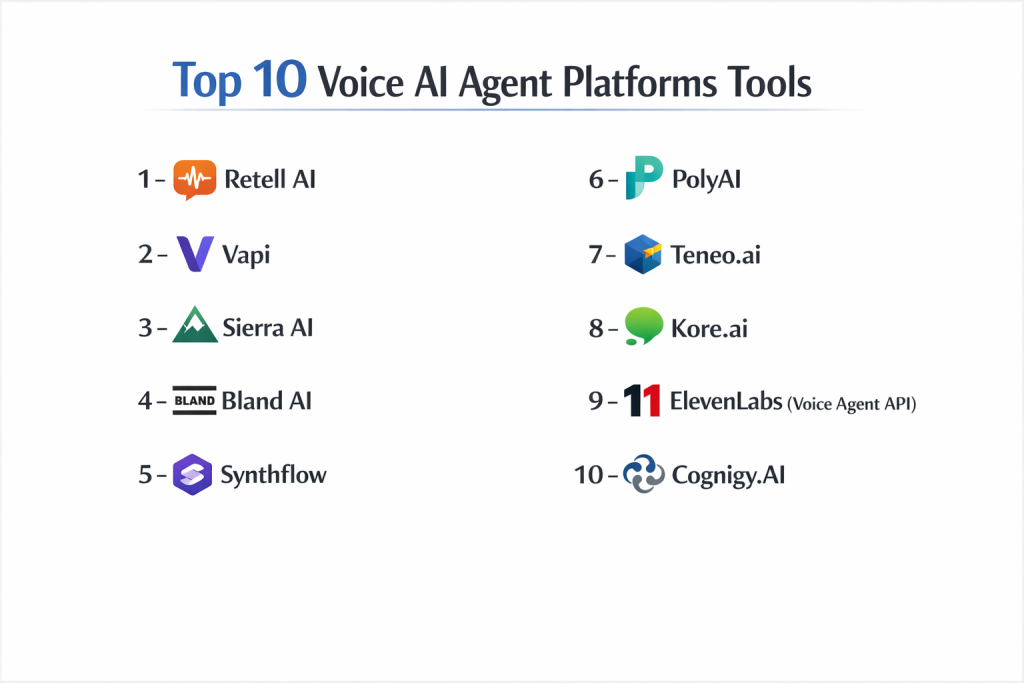
Top 10 Voice AI Agent Platforms Tools
1 — Thoughtly
Thoughtly is a production-ready AI voice platform designed for teams that need voice agents to run in live enterprise environments. It’s built for outbound sales and operations use cases where callers need to qualify intent, follow-up on warm leads, book meetings, update systems, and escalate cleanly to humans when needed.
Thoughtly focuses on reliability, control, and system connectivity, making it well suited for revenue and ops teams running voice agents for high volume use cases.
Key features:
- Built for Non-Technical Teams: Drag-and-drop configuration lets customer experience, customer success, and sales teams design call flows, qualification logic, and handoffs without needing to write code
- Broad System Integrations: Create, update, and enrich records across tools like HubSpot, Zendesk, Airtable, and internal systems during live calls.
- Live Scheduling and Booking: Book meetings in real time on calls using calendar availability and routing rules.
- Human Handoff and Guardrails: Deterministic escalation rules ensure calls get transferred to human agents when threshold or edge cases are hit.
- Centralized Monitoring: Track call outcomes, qualification rates, bookings, and agent performance from a single dashboard.
Pros:
- Built for Outcomes: Strong fit for teams that prioritize meetings booked, leads qualified, or tasks completed.
- Operational Control: Clear rules, guardrails, and visibility, making it easier to deploy voice agents in production environments.
Cons:
- Less Developer-Focused: Not optimized for teams that want to manually code every edge case or build a bespoke voice stack.
- Workflow-Design Required: Teams get the most value when they clearly define qualification logic and success criteria prior to deployment.
Security & Compliance: SOC 2 and HIPAA compliant.Support & Community: White-glove onboarding and implementation through Thoughtly’s Agent Accelerator
2 — Retell AI
Retell AI is a developer-first platform designed to create hyper-realistic conversational agents with industry-leading low latency. It is particularly popular for businesses that need high-performance outbound and inbound automation with a focus on human-like pacing and natural back-and-forth flow.
- Key features:
- Sub-600ms Latency: Optimized engine for near-instantaneous verbal responses that prevent awkward silences.
- Dynamic Interruption Handling: Allows users to speak over the AI naturally without breaking the agent’s logic.
- Knowledge Base Sync: Directly connects to company documents or URLs for accurate, grounded answers.
- Native Telephony: Built-in support for purchasing phone numbers and managing SIP trunks directly.
- Post-Call Analytics: Automatic sentiment analysis and call summarization generated immediately after hanging up.
- Multi-LLM Support: Compatible with GPT-4o, Claude 3.5, and specialized custom models for specific tasks.
- Pros:
- Seamless Conversation: One of the most natural “back-and-forth” flows in the industry, making it hard to tell it’s an AI.
- Ease of Use: Provides a low-code playground for rapid prototyping alongside robust APIs for deep integration.
- Cons:
- Scaling Costs: While starting costs are fair, advanced features and high concurrency can become expensive for startups.
- Customization Limits: While flexible, highly specific niche regional accents may require significant manual tuning.
- Security & compliance: SOC 2 Type II, HIPAA, and GDPR compliant. Features automatic PII redaction from transcripts.
- Support & community: High-quality documentation, active Slack developer community, and 24/7 enterprise support tiers.
3 — Vapi
Vapi operates as a sophisticated “orchestration layer” that allows developers to swap out STT, LLM, and TTS providers. It is the go-to platform for engineering teams who want total control over every individual component of the voice stack.
- Key features:
- Provider Agility: Switch between ElevenLabs, Deepgram, and OpenAI at the click of a button within the dashboard.
- Function Calling: Agents can execute real-time actions like updating a CRM or booking a calendar slot during the call.
- Bring Your Own (BYO) Telephony: Deep integrations with major carriers like Twilio, Vonage, and SignalWire.
- Global Scalability: Capable of handling over a million concurrent calls via globally distributed infrastructure.
- Web-to-Voice: Native SDKs to embed high-quality voice agents directly into web browsers and mobile apps.
- Pros:
- Maximum Flexibility: You aren’t locked into a single voice or transcription provider as technology evolves.
- Developer Experience: Highly praised for its clean API, comprehensive technical logs, and debugging tools.
- Cons:
- Technical Overhead: Not suitable for non-technical users; requires engineering resources to build and maintain.
- Cost Complexity: Pricing is “stack-based,” meaning you pay Vapi plus the separate costs of underlying providers.
- Security & compliance: SOC 2 Type II, GDPR, and HIPAA compliant. Offers secure end-to-end encrypted streaming.
- Support & community: Extremely active Discord community and rapid-response technical support for enterprise partners.
4 — Sierra AI
Co-founded by industry veteran Bret Taylor, Sierra AI is an enterprise-grade platform that focuses on “agentic” behavior, where the AI doesn’t just talk but follows complex business policies and performs end-to-end tasks like a human employee.
- Key features:
- Policy-Driven AI: Ensures agents stay within strict brand and legal guardrails using deterministic logic.
- Multi-Surface Continuity: Seamlessly moves a conversation from web chat to a voice call without losing context.
- Deep System Integration: Connects with enterprise ERPs and custom backends for real-time task execution.
- Reasoning Framework: Uses advanced logic to handle ambiguous customer requests that standard bots fail at.
- Supervision Layer: A specialized dashboard for humans to monitor and audit AI decisions in real-time.
- Pros:
- Brand Consistency: Excellent for enterprises that fear AI “hallucinations” or off-brand remarks.
- Outcome Focus: Moves beyond simple Q&A to actually resolving customer issues from start to finish.
- Cons:
- Opaque Pricing: Typically requires custom enterprise quotes based on outcomes or volume rather than per-minute.
- Implementation Time: Much more complex to set up compared to “plug-and-play” platforms.
- Security & compliance: ISO 27001, SOC 2 Type II, GDPR, and HIPAA compliant.
- Support & community: Dedicated white-glove onboarding and 24/7 premium enterprise account management.
5 — Bland AI
Bland AI markets itself as a high-speed, scalable “phone agent” platform designed for businesses that need to send or receive thousands of calls simultaneously for sales, marketing, and operational tasks.
- Key features:
- Hyper-Scalable API: Designed for high-volume outbound lead qualification and massive appointment-setting campaigns.
- Voice Cloning: Allows businesses to use their own proprietary voices or celebrity voices for brand recognition.
- Live Monitoring: Admins can “listen in” on AI calls as they happen through a live dashboard.
- Zapier Integration: Easily connects to thousands of apps for non-technical lead management workflows.
- Custom Pathway Builder: A visual editor to map out exactly how a call should progress based on user input.
- Pros:
- Speed to Market: Can go from account creation to your first 1,000 automated calls in minutes.
- Cost-Effectiveness: Highly competitive per-minute pricing for high-volume users.
- Cons:
- Conversational Nuance: Occasionally less fluid than Retell or Vapi during rapid, complex interruptions.
- Telephony Restrictions: Strict anti-spam policies can sometimes flag legitimate outbound campaigns by mistake.
- Security & compliance: SOC 2 Type II and GDPR compliant. HIPAA compliance is available on specialized plans.
- Support & community: Fast-growing developer community and robust video tutorials for self-onboarding.
6 — Synthflow
Synthflow is a no-code Voice AI platform that allows business owners and agencies to build sophisticated voice assistants without writing code. It is highly optimized for local businesses like medical clinics and law firms.
- Key features:
- One-Click Deployment: Quickly launch bots for booking, customer intake, or basic front-desk support.
- Real-Time Calendar Sync: Native, two-way integrations with Google Calendar and Calendly.
- Pre-Built Templates: Industry-specific agents for Real Estate, MedSpas, and professional services.
- Inbound/Outbound Capabilities: Handles both incoming customer calls and automated outbound follow-ups.
- Sentiment Tracking: Gauges the mood of the caller to prioritize high-priority follow-up actions for humans.
- Pros:
- Agency-Friendly: Excellent “white-label” options for marketing agencies to resell voice AI services to clients.
- Simplicity: The most accessible platform for non-technical users who need an “AI receptionist” today.
- Cons:
- Customization Depth: Developers may find the “no-code” nature limiting for complex backend logic.
- Integration Breadth: Lacks some of the niche enterprise connectors found in larger platforms.
- Security & compliance: GDPR and SOC 2 Type II compliant. HIPAA-ready for healthcare-specific plans.
- Support & community: Strong emphasis on customer success, with live workshops and a helpful knowledge base.
7 — PolyAI
PolyAI specializes in “Enterprise-Grade Voice Assistants” for massive contact centers. They focus on replacing old IVR systems with voices that sound indistinguishable from human agents, even in noisy environments.
- Key features:
- Branded Voice Experience: High-fidelity custom voices that embody a brand’s unique personality and tone.
- Accurate Intent Recognition: Exceptional at understanding thick regional accents, slang, and context.
- Seamless Human Handoff: Transfers calls to live agents with a full transcript and context when needed.
- Multilingual Fluency: Supports over 50 languages with native-level proficiency and automatic detection.
- High Containment Rates: Specifically designed to resolve over 80% of calls without human intervention.
- Pros:
- Quality of Interaction: Offers some of the most sophisticated “small talk” and empathy-building features.
- Enterprise Reliability: Proven track record with Fortune 500 companies in travel, hospitality, and banking.
- Cons:
- Entry Cost: Typically involves a significant initial setup fee and longer-term contracts.
- Development Cycle: Not a “self-serve” tool; usually requires a collaborative deployment with PolyAI engineers.
- Security & compliance: PCI DSS, ISO 27001, GDPR, and SOC 2 Type II compliant.
- Support & community: Full-service professional support and dedicated technical account managers for every client.
8 — Teneo.ai
Teneo.ai is a hybrid AI leader that focuses on accuracy and deterministic control. It is built for industries where “close enough” isn’t good enough, such as banking, government, and clinical healthcare.
- Key features:
- Hybrid NLU Engine: Combines LLMs with deterministic logic to achieve 99% accuracy.
- NLU Accuracy Booster: Specifically designed to eliminate hallucinations in highly regulated sectors.
- Linguistic Modeling Language (TLML): Allows for granular control over how the AI interprets language.
- No Vendor Lock-In: Easily swap between different LLM providers like Azure, Google, or OpenAI.
- High-Volume Throughput: Handles nearly a million calls per month for large global telecom providers.
- Pros:
- Precision: The safest choice for mission-critical deployments where errors have legal consequences.
- Data Sovereignty: Allows for highly flexible data residency and private cloud configurations.
- Cons:
- Technical Complexity: Requires specialized knowledge to fully leverage the hybrid linguistic engine.
- Learning Curve: Not a tool for casual users or simple, non-critical use cases.
- Security & compliance: SOC 2, HIPAA, GDPR, and ISO 27001 compliant.
- Support & community: Strong enterprise support and a specialized linguistic developer community.
9 — Kore.ai
Kore.ai is a comprehensive conversational AI platform that provides an “Experience Optimization (XO)” layer for large organizations. It excels in omnichannel orchestration, ensuring voice and chat work together.
- Key features:
- SmartAssist: A specialized voice bot that integrates with legacy contact center technology (Genesys, Cisco).
- Low-Code Designer: A visual bot builder that manages both chat and voice flows in a single view.
- Predictive AI: Anticipates customer needs based on historical interaction data and CRM history.
- Knowledge Graph: Uses structured data to ensure highly accurate, fact-based responses during calls.
- Advanced Transcription: Proprietary STT engine optimized for low-bandwidth and noisy environments.
- Pros:
- Unified Platform: Great for companies that want one platform for chat, voice, and internal employee bots.
- Ecosystem Ready: Extensive pre-built connectors for thousands of enterprise applications like Salesforce.
- Cons:
- UI Density: The platform is incredibly powerful but can be visually overwhelming for new users.
- Setup Speed: Enterprise-scale deployments can take several months to fully mature and integrate.
- Security & compliance: FedRAMP, HIPAA, SOC 2, and GDPR compliant.
- Support & community: Massive global partner network and 24/7 global support infrastructure.
10 — ElevenLabs (Voice Agent API)
While primarily known as the king of AI speech synthesis, ElevenLabs recently released a dedicated Voice Agent API that simplifies the entire voice pipeline into a single developer-centric tool focused on realism.
- Key features:
- World-Class TTS: Access the industry’s most realistic and expressive AI voices natively.
- Contextual Awareness: Built-in logic to manage conversation states without a complex backend.
- Emotional Prosody: The AI can sound happy, serious, or empathetic based on the call’s context.
- Low-Latency Streaming: Optimized for real-time web and telephony applications with zero lag.
- Voice Design Tool: Create entirely new, unique voices from scratch to match a brand’s identity.
- Pros:
- Unmatched Realism: If your primary goal is to sound human and empathetic, this is the top contender.
- Developer Simplicity: Abstracts away the complexity of managing separate transcription and voice providers.
- Cons:
- Telephony Native: While it has an API, it requires more manual work to connect to traditional phone lines.
- Feature Stage: Newer compared to established platforms like Vapi or Retell for complex telephony.
- Security & compliance: GDPR and SOC 2 Type II compliant.
- Support & community: Excellent API documentation and a huge community of creative developers.
11 — Cognigy.AI
Cognigy is a leader in “Agentic AI” for the enterprise contact center. It is designed to empower human agents with AI “co-pilots” while providing autonomous voice bots for self-service automation.
- Key features:
- Cognigy Voice Gateway: Connects your AI directly to any telephony provider or existing PBX system.
- Agent Assist: Provides real-time suggestions and customer data to human agents during live calls.
- Live Interaction Blueprints: Pre-made flows for common scenarios like shipping updates or password resets.
- Context Management: Remembers data from previous months to personalize the current conversation.
- Robust Analytics: Detailed dashboards on call deflection rates and customer satisfaction (CSAT).
- Pros:
- Hybrid Workflow: Best-in-class at helping human agents and AI agents work together seamlessly.
- Global Scalability: Trusted by global brands like Lufthansa and Toyota for massive call volumes.
- Cons:
- Enterprise Only: Not designed for small teams, startups, or solo entrepreneurs.
- Customization Overhead: Fine-tuning the voice gateway requires specific networking and telecom knowledge.
- Security & compliance: ISO 27001, SOC 2, GDPR, and HIPAA compliant.
- Support & community: Comprehensive Cognigy Academy and dedicated technical success managers.
Comparison Table
| Tool Name | Best For | Platform(s) Supported | Standout Feature | Rating |
| Retell AI | Developer speed | Web, Telephony | Sub-600ms latency engine | 4.8/5 |
| Vapi | Engineering teams | Web, Telephony | Component-swappable stack | 4.7/5 |
| Sierra AI | High-compliance Ent. | Web, Telephony | Policy-driven reasoning | N/A |
| Bland AI | High-volume sales | Telephony | 10 lines of code deployment | 4.5/5 |
| Synthflow | SMBs & Agencies | Web, Telephony | No-code agency white-labeling | 4.6/5 |
| PolyAI | Branded customer exp. | Telephony | Indistinguishable “Human” voice | 4.8/5 |
| Teneo.ai | Regulated industries | Cloud, On-Prem | Hybrid AI for 99% accuracy | 4.9/5 |
| Kore.ai | Omnichannel Ent. | Web, Mobile, Ph. | Massive enterprise app ecosystem | 4.6/5 |
| ElevenLabs | Realistic voice quality | API, Web | Emotion-aware speech synthesis | 4.7/5 |
| Cognigy.AI | Contact Centers | Telephony, App | AI-to-Human Agent Assist | 4.8/5 |
Evaluation & Scoring of Voice AI Agent Platforms
The following table evaluates these tools based on the weighted criteria essential for professional voice automation.
| Category | Weight | Evaluation Criteria |
| Core Features | 25% | Conversational fluidness, interruption handling, and voice quality. |
| Ease of Use | 15% | Quality of the UI/No-code builder and developer documentation. |
| Integrations | 15% | Native CRM, calendar, and telephony provider connectors. |
| Security & Compliance | 10% | SOC 2, HIPAA, GDPR, and data redaction capabilities. |
| Performance | 10% | Latency (ms), uptime, and concurrent call capacity. |
| Support & Community | 10% | Availability of technical support and an active user community. |
| Price / Value | 15% | Predictability of pricing and ROI for the target market. |
Which Voice AI Agent Platform Is Right for You?
Solo Users vs. SMB vs. Mid-Market vs. Enterprise
For Solo Users and SMBs, the focus should be on ease of setup. Synthflow is the clear winner here, offering a no-code experience that allows you to be live in an hour. Mid-Market companies usually have some technical resources and should look toward Retell AI or Bland AI for a balance of power and speed. Enterprises require governance and reliability, making PolyAI, Teneo.ai, or Kore.ai the only viable choices for handling millions of interactions safely across global regions.
Budget-Conscious vs. Premium Solutions
If you are Budget-Conscious, Bland AI offers a highly competitive per-minute rate that is hard to beat for high-volume outbound calling. However, if you are looking for a Premium Solution where every interaction represents your brand’s reputation, PolyAI and ElevenLabs provide a level of vocal realism that justifies their higher cost through better customer satisfaction scores.
Feature Depth vs. Ease of Use
Vapi offers the most Feature Depth for developers, allowing you to manually tune every piece of the pipeline. On the flip side, Synthflow prioritizes Ease of Use, sacrificing some low-level control for a smooth, graphical interface that anyone can manage without a computer science degree.
Integration and Scalability Needs
If you need to connect to a legacy contact center system like Genesys, Avaya, or Cisco, Cognigy.AI and Kore.ai have the best “old-world to new-world” bridges. If you are a high-growth startup needing to scale from 10 to 10,000 concurrent calls overnight, Vapi and Bland AI have the cloud-native infrastructure built for that extreme elasticity.
Security and Compliance Requirements
For Healthcare and Finance, compliance is non-negotiable. Teneo.ai and Sierra AI offer the most robust guardrails against hallucinations, which is a major legal risk in regulated fields. Always ensure your provider offers a Business Associate Agreement (BAA) if you are handling patient data under HIPAA, which is usually found in the enterprise tiers of these tools.
Frequently Asked Questions (FAQs)
1. What is the average latency of a Voice AI agent?
Most modern platforms aim for sub-second latency. Top-tier providers like Retell AI and Vapi often hit 500ms–800ms. This is critical because anything over 1 second feels like an awkward international call with a delay.
2. Can these agents handle thick accents or slang?
Advanced platforms like PolyAI and Teneo.ai use specialized NLU engines that are pre-trained on diverse global dialects. They are significantly more effective than standard speech-to-text models at understanding intent regardless of pronunciation.
3. Do I need to buy a separate phone number?
Most platforms (like Retell and Synthflow) allow you to purchase numbers directly within the tool. Others allow you to “Bring Your Own Carrier” (BYOC) if you want to use your existing business landline.
4. Is it obvious to the caller that they are talking to an AI?
Legally, many jurisdictions require you to disclose that the caller is speaking with an AI. However, technologically, agents from ElevenLabs or PolyAI are so realistic they are frequently mistaken for human operators.
5. How do I prevent the AI from making things up (hallucinating)?
Platforms like Sierra and Teneo use “grounding,” where the AI is only allowed to pull information from a verified knowledge base. If the answer isn’t in the provided documents, the AI is programmed to say it doesn’t know.
6. Can the AI transfer the call to a real person?
Yes, “Human Handoff” is a standard feature. The AI can trigger a transfer to a specific phone number or a call center queue while passing along a live transcript so the human agent has the full context.
7. How much does a Voice AI agent cost?
Pricing usually ranges from $0.05 to $0.20 per minute for usage. Enterprise solutions often have an additional monthly platform fee or a one-time setup cost for custom brand voices.
8. Is my data safe with these platforms?
Top providers use AES-256 encryption and are SOC 2 compliant. Many also offer “Zero-Retention” modes for regulated industries where recordings and transcripts are deleted the moment the call ends.
9. Can I use these agents for outbound sales?
Yes, but you must strictly comply with TCPA and local “Do Not Call” regulations. Some platforms have built-in compliance checks to ensure you aren’t calling restricted numbers.
10. How long does implementation take?
A simple no-code receptionist bot can be ready in 30 minutes. A fully integrated enterprise system with custom business logic and CRM sync typically takes 4 to 12 weeks of development and testing.
Conclusion
The transition from “Press 1 for Support” to “Hello, how can I help you today?” is moving faster than most businesses realize. Voice AI Agent Platforms are no longer a futuristic concept—they are a current requirement for staying competitive in a 24/7 global economy. These tools not only reduce costs but also eliminate the most common customer complaint: waiting on hold.
Choosing the right platform is a matter of matching your technical capabilities with your specific business goals. For a developer-led startup, the flexibility and API-first nature of Vapi or Retell AI is unbeatable. For a small business looking to save time on administrative tasks, Synthflow is the perfect partner. And for the Global Enterprise, tools like PolyAI and Teneo.ai provide the security and linguistic sophistication needed to represent a multi-billion dollar brand safely.
Ultimately, the goal of Voice AI isn’t to replace the human touch, but to remove the mechanical parts of communication. By automating routine inquiries, you free up your human team to handle the interactions that truly require empathy, creativity, and complex problem-solving.
This blog gives a clear and honest look at different voice AI agent platforms, which was really helpful for me. I liked how you explained the features and the pros and cons, so I didn’t have to guess what each platform is good at. The comparison parts are easy to follow and make it simpler to choose the right one for different needs. It feels practical, like advice from someone who understands the tools, not just a list of names. I also appreciated the simple language, because it makes this topic less confusing for readers who are new to voice AI. Overall, this was a well-organized and valuable guide to refer back to.