Introduction
A Vendor Management System (VMS) is a specialized software platform designed to manage an organization’s entire relationship with its third-party suppliers, contractors, and service providers. It serves as a centralized hub for finding, hiring, onboarding, managing, and paying external talent and vendors. Think of it as the command center for your extended workforce, moving beyond spreadsheets and emails to create a controlled, efficient, and data-driven process.
This software is critically important because modern businesses rely heavily on a complex ecosystem of external partners. Without a VMS, companies face significant risks: compliance gaps, rogue spending, inconsistent onboarding, poor performance visibility, and inefficient payment cycles. A VMS brings order, reduces costs by optimizing rates and terms, ensures legal and regulatory compliance, mitigates risk through centralized oversight, and provides strategic data on vendor performance and spend.
Key real-world use cases include: A hospital system managing hundreds of temporary nurses and medical staff from multiple agencies. A financial services firm onboarding and monitoring IT consultants with strict security clearance requirements. A manufacturing company sourcing, qualifying, and managing a global network of parts suppliers. A retail chain streamlining the process of hiring seasonal in-store merchandisers. Any organization that regularly engages contingent labor, professional services, or a diverse set of suppliers needs a VMS.
When choosing a VMS, users should prioritize several key criteria. Core workflow automation is essential—does it handle requisition, sourcing, onboarding, time tracking, and invoicing seamlessly? Compliance and risk management features, like automated background checks, insurance verification, and contract adherence, are non-negotiable for many industries. Spend and performance analytics should provide clear insights into costs, utilization, and vendor quality. Integration capability with your ERP, HRIS, and accounting systems determines practical utility. Finally, consider ease of use for hiring managers and vendors, scalability, and the vendor’s industry expertise.
Best for: These systems deliver the most value to Procurement Managers, HR and Talent Acquisition leaders, Chief Financial Officers, and department heads who manage large external workforces or supplier networks. They are indispensable for industries with heavy use of contingent labor (healthcare, technology, finance) or complex supply chains (manufacturing, retail, logistics). Mid-market and large enterprises with significant annual spend on external resources see the highest return on investment.
Not ideal for: Very small businesses or startups that engage only a handful of familiar, long-term vendors through simple contracts. A solo entrepreneur hiring an occasional freelancer or a local shop using the same suppliers for years may find the cost and complexity of a full VMS unnecessary. For these users, a capable procurement module within their accounting software or a simple project management tool might be sufficient.
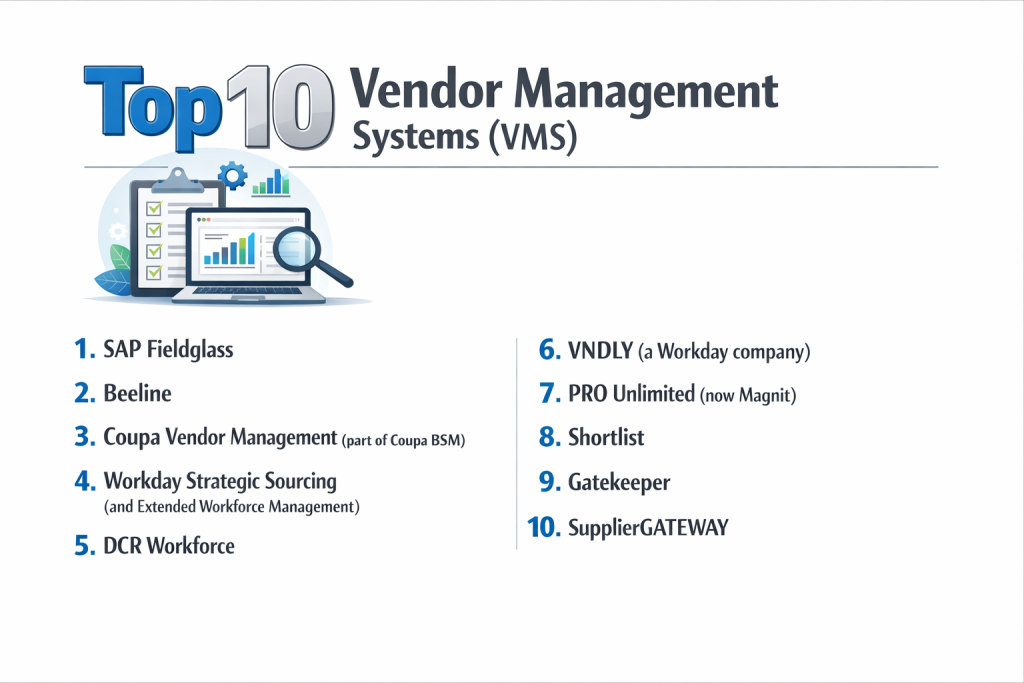
Top 10 Vendor Management Systems (VMS)
1 — SAP Fieldglass
SAP Fieldglass is a leading, enterprise-grade VMS focused on managing the external workforce and services procurement. It is part of the SAP ecosystem and is designed for large, global organizations that need to manage complex contingent labor and statement-of-work (SOW) projects at scale.
Key features:
- External Workforce & Services Management: Comprehensive management of temporary labor, independent contractors, and SOW-based service projects in one platform.
- Advanced Sourcing & Candidate Matching: Tools for posting jobs to multiple agencies, running reverse auctions, and using AI for candidate ranking and matching.
- Robust Rate & Program Management: Enforces rate cards, manages tiered supplier programs, and ensures spending compliance with corporate policies.
- Deep Compliance & Risk Mitigation: Automated workflows for worker classification (1099/W2), background checks, right-to-work verification, and other regulatory requirements.
- Integrated Time & Expense Capture: Tools for workers to submit time and expenses, with manager approval workflows integrated into the invoicing process.
- Powerful Analytics & Reporting: Pre-built and customizable dashboards for tracking spend, supplier performance, utilization, and program ROI.
Pros:
- Enterprise Powerhouse: The go-to solution for large multinationals needing to manage a massive, global external workforce with stringent compliance needs.
- Strategic Sourcing & Cost Control: Excellent tools for optimizing supplier rates and ensuring all engagements follow predefined procurement strategies.
Cons:
- High Cost & Complexity: A significant investment requiring executive buy-in, lengthy implementation, and dedicated internal administration.
- Can Be Inflexible: The platform’s strength in enforcing process can sometimes feel rigid for business units seeking speed and agility.
Security & compliance: Enterprise-grade security as part of SAP. Complies with global data protection regulations (GDPR) and holds relevant ISO and SOC certifications.
Support & community: Supported by SAP’s global network and a large ecosystem of implementation partners. Has an established user community, particularly among Fortune 500 companies.
2 — Beeline
Beeline is a major independent VMS provider known for its flexibility and deep focus on extended workforce management. It caters to large enterprises across various industries, offering a highly configurable platform to manage contingent labor, SOW projects, and direct sourcing initiatives.
Key features:
- Extended Workforce Platform: Manages all non-employee talent types (temporary, SOW, independent contractor) through a unified system.
- Direct Sourcing & Talent Pools: Tools to build and engage private talent pools (alumni, silver medalists, freelancers) directly, reducing agency reliance and costs.
- Highly Configurable Workflows: Allows organizations to tailor the requisition, approval, and onboarding processes to their specific business rules.
- Comprehensive Supplier Management: Functions to onboard, tier, rate, and measure the performance of staffing suppliers and agencies.
- Advanced Analytics & Intelligence: Provides deep insights into workforce composition, spend, quality of hire, and market rate benchmarking.
- Global Capabilities: Supports multiple currencies, languages, and localized compliance requirements.
Pros:
- Configurability & Flexibility: Adapts well to complex and unique organizational processes without requiring heavy customization.
- Innovation in Direct Sourcing: A leader in providing tools to help companies build and leverage their own direct talent networks.
Cons:
- Implementation Scope: Achieving a tailored setup requires careful planning and can be a substantial project.
- User Experience Variability: The interface can feel dense or less modern compared to some newer, more consumer-friendly platforms.
Security & compliance: Maintains robust security standards with ISO 27001 certification and compliance with data privacy laws. Offers detailed audit trails.
Support & community: Provides strategic customer success management and 24/7 support. Hosts a large user conference and has an active client community.
3 — Coupa Vendor Management (part of Coupa BSM)
Coupa Vendor Management is a module within the Coupa Business Spend Management (BSM) suite. It is designed for companies that want to manage vendors and suppliers within the same platform they use for procurement, invoicing, and expense management, creating a unified source-to-pay process.
Key features:
- Unified Spend Management: Seamless integration with Coupa Procurement, Invoicing, and Expense for end-to-end visibility and control over all third-party spend.
- Vendor Risk & Performance Management: Centralized vendor information, risk scoring (via integrated risk intelligence), and performance review tracking.
- Self-Service Vendor Portal: Allows vendors to update their own information, view purchase orders, submit invoices, and check payment status.
- Automated Onboarding & Compliance: Streamlines vendor registration, collects W-9/W-8 forms, and verifies insurance certificates automatically.
- Simplified Sourcing: Integrated RFx and bidding tools to source new vendors directly within the platform.
- Holistic Spend Analytics: Analyzes vendor spend alongside all other corporate spending for comprehensive insights.
Pros:
- Part of a Cohesive Spend Ecosystem: Ideal for companies committed to the Coupa BSM suite, eliminating data silos between procurement, vendors, and AP.
- Strong Focus on Risk & Compliance: Excellent for organizations that need to proactively monitor and mitigate vendor-related risks.
Cons:
- Part of a Larger Suite: Its value is maximized as part of the full Coupa platform; it may not be as compelling as a standalone VMS for companies not using Couba.
- Less Focused on Contingent Labor: While it manages suppliers, its depth for managing complex temporary workforce programs is not its primary strength compared to Beeline or SAP Fieldglass.
Security & compliance: As part of the Coupa cloud platform, it is SOC 1 and SOC 2 Type II certified, with strong data encryption and access controls.
Support & community: Backed by Coupa’s customer success and support organization. Benefits from the large Coupa user community.
4 — Workday Strategic Sourcing (and Extended Workforce Management)
Workday Strategic Sourcing, combined with its growing capabilities for extended workforce management, is the native solution for companies running on the Workday Human Capital and Financial Management platform. It focuses on unifying internal and external talent and supplier processes.
Key features:
- Unified Worker View: Manages full-time employees, contingent workers, and service providers within a single Workday interface, providing a holistic view of total talent.
- Integrated Sourcing & Procurement: Links talent requisitions and services procurement directly to financial planning and budgeting within Workday.
- Supplier & Contingent Worker Management: Onboards, manages, and pays suppliers and temporary workers, with some capabilities for time tracking and SOW management.
- Direct Sourcing & Talent Marketplace: Emerging features to source candidates directly and match internal employees to project work.
- Inherent Data Consistency: Leverages Workday’s single data model, ensuring vendor and worker data is consistent with HR, finance, and procurement records.
- Analytics & Reporting: Uses Workday’s powerful embedded analytics to report on total workforce cost, supplier spend, and program efficiency.
Pros:
- Seamless for Workday Customers: For organizations deep in the Workday ecosystem, it provides unmatched integration, eliminating data reconciliation and offering a unified user experience.
- Total Talent Insight: The ability to analyze internal and external workforce data together is a unique and powerful strategic advantage.
Cons:
- Evolving Functionality: Its extended workforce features are still developing and may not yet match the maturity and depth of best-of-breed VMS leaders for highly complex contingent labor programs.
- Workday Ecosystem Lock-in: Only a viable option for companies that have standardized on Workday HCM and Financials.
Security & compliance: Inherits Workday’s industry-leading security, privacy, and compliance certifications (SOC 1, SOC 2, ISO 27001).
Support & community: Supported through Workday’s customer success channels. Part of the vast Workday user community.
5 — DCR Workforce
DCR Workforce is a VMS that strongly emphasizes compliance, risk mitigation, and back-office financial management for the contingent workforce. It is particularly noted for its robust independent contractor compliance and payrolling services.
Key features:
- Independent Contractor Compliance: Specialized tools and services for IC engagement, classification analysis (audits for 1099 vs. W2), and mitigation of co-employment risk.
- Comprehensive Payrolling & Invoicing: Handles the complete financial flow, including consolidated invoicing from suppliers, timesheet validation, and payment processing.
- Supplier Management: Manages staffing supplier relationships, performance, and fee structures.
- Candidate Sourcing & Requisition Management: Streamlines the process of requesting and filling contingent labor positions.
- Reporting & Analytics: Provides detailed reporting on spend, supplier performance, and compliance metrics.
- Services Procurement (SOW) Management: Tools for managing and tracking statement-of-work projects.
Pros:
- Compliance Expertise: A top choice for organizations highly concerned with the legal and financial risks of misclassifying independent contractors.
- Strong Financial & Back-Office Focus: Excels at managing the complex invoicing and payment workflows associated with a large contingent workforce.
Cons:
- User Interface: Can be perceived as more functional than modern, potentially impacting hiring manager adoption.
- Niche Strengths: Its standout features are most valuable for companies with specific, high-risk compliance needs around independent contractors.
Security & compliance: Prioritizes data security and compliance, with measures in place to protect sensitive worker and financial information.
Support & community: Known for responsive customer service and support tailored to its clients’ compliance and operational needs.
6 — VNDLY (a Workday company)
VNDLY is a modern, user-friendly VMS built with a focus on the candidate and hiring manager experience. Acquired by Workday, it is often deployed by companies seeking an agile, intuitive platform to manage their external workforce, sometimes in conjunction with Workday’s own strategic sourcing tools.
Key features:
- Candidate-Centric Experience: A streamlined, mobile-friendly process for candidates and contractors, improving engagement and conversion.
- Intuitive Hiring Manager Portal: A simple, consumer-grade interface for managers to requisition, review candidates, and approve timesheets.
- Supplier Management & Marketplace: Curates and manages a network of staffing suppliers, providing managers with choice and competition.
- Full-Platform Functionality: Handles the entire lifecycle from requisition to onboarding, time tracking, and offboarding.
- Configurable Workflows: Allows for customization of approval chains and business rules without complex coding.
- Integrated with Workday: Following its acquisition, offers deepening integration with the Workday suite.
Pros:
- Superior User Experience: Renowned for its modern, intuitive design that drives high adoption among hiring managers and contractors.
- Agile and Configurable: Easier and faster to implement and adapt than some legacy enterprise VMS platforms.
Cons:
- Acquisition Integration: As a relatively new part of Workday, long-term product roadmaps and integration paths are still fully crystallizing.
- Enterprise Feature Depth: May lack some of the ultra-advanced, granular configuration and sourcing features of established enterprise leaders.
Security & compliance: As part of Workday, it adheres to high security and compliance standards. Specific certifications are aligned with Workday’s framework.
Support & community: Supported by VNDLY/Workday teams. Its modern approach has attracted a growing user base among mid-market and enterprise companies.
7 — PRO Unlimited (now Magnit)
PRO Unlimited, operating under the brand Magnit, is a integrated workforce management (IWM) platform that combines VMS software with managed services (MSP). It is a solution for companies that want to outsource the operational management of their contingent workforce program alongside the technology.
Key features:
- Managed Services Program (MSP) + VMS: Offers a combined service where Magnit experts manage supplier relationships, candidate sourcing, compliance, and program administration on the client’s behalf.
- Direct Sourcing & Talent Curration: Tools and services to build direct talent channels and reduce agency spend.
- Total Talent Intelligence: Provides data and insights on market rates, talent availability, and workforce trends.
- Comprehensive Compliance Suite: Addresses worker classification, co-employment risk, and other regulatory requirements.
- Services Procurement: Manages SOW and project-based engagements.
- Analytics & Benchmarking: Offers detailed reporting and benchmarking against industry peers.
Pros:
- Combined Tech & Service Model: Ideal for organizations that lack internal resources or expertise and prefer a fully outsourced program management model.
- Market Intelligence: Strong capabilities in providing data-driven insights on talent markets and competitive rates.
Cons:
- Managed Service Dependency: The full value proposition is tied to using their managed services, which may not suit companies wanting pure technology.
- Cost Structure: The combined service model represents a different (and often significant) cost structure compared to software-only licenses.
Security & compliance: As a large provider handling sensitive workforce data, it maintains robust security protocols and compliance certifications.
Support & community: Support is intrinsically linked to its managed service delivery model, providing a dedicated program team.
8 — Shortlist
Shortlist is a VMS designed with simplicity and ease of use as primary goals. It targets small to mid-sized businesses that need to professionalize their vendor and contractor management without the complexity and cost of enterprise systems.
Key features:
- Streamlined Vendor Onboarding: A quick and simple process to collect vendor information, contracts, and compliance documents.
- Centralized Vendor Directory: A single source of truth for all vendor details, contacts, and contract documents.
- Basic Risk & Performance Tracking: Tools to track insurance expiration, add performance reviews, and flag at-risk vendors.
- Task & Workflow Management: Assign and track tasks related to vendors (e.g., renewal reminders, audit requests).
- Simple Reporting: Generate reports on vendor spend, diversity, or status.
- User-Friendly Interface: Clean, intuitive design focused on getting the job done without unnecessary complexity.
Pros:
- Affordability & Simplicity: An excellent, cost-effective entry point for SMBs looking to move away from spreadsheets and email chaos.
- Fast Implementation & Adoption: Designed to be set up quickly and adopted easily by teams without formal procurement training.
Cons:
- Limited Advanced Features: Lacks deep sourcing, contingent labor time tracking, complex hierarchical approvals, and advanced analytics.
- Scalability Constraints: May not support the needs of a large, global enterprise with thousands of vendors and complex processes.
Security & compliance: Employs standard cloud security practices. Businesses with stringent regulatory needs should verify specific compliance certifications.
Support & community: Known for responsive, direct customer support. Caters to the SMB and mid-market segment.
9 — Gatekeeper
Gatekeeper is a vendor and contract lifecycle management platform. While it covers the full contract journey, its vendor management capabilities are robust, making it a great fit for companies where vendor relationships are governed by complex, ongoing contracts.
Key features:
- Contract Lifecycle Management (CLM) Focus: Manages vendor contracts from request and authoring through signing, obligation tracking, renewal, and archive.
- Vendor Performance & Risk Monitoring: Tracks KPIs, SLAs, and risk scores against each vendor contract.
- Centralized Vendor Portal: A self-service hub for vendors to access contracts, submit documents, and communicate.
- Obligation Management: Automatically tracks key dates, deliverables, and payment milestones from contracts to ensure compliance.
- Spend Visibility: Links contracts to invoices and purchase orders to track committed vs. actual spend per vendor.
- AI-Powered Insights: Uses AI to extract key data from contracts and highlight risks or opportunities.
Pros:
- Contract-Centric Vendor Management: Perfect for organizations where managing the contract is synonymous with managing the vendor relationship.
- Proactive Risk Management: Excels at monitoring contractual obligations and compliance, reducing legal and operational risk.
Cons:
- Less Focus on Contingent Labor: Not designed for the day-to-day management of temporary workers, timesheets, or shift scheduling.
- Broader CLM Scope: Its primary identity is as a CLM; companies seeking a pure-play VMS for workforce management may find it has different priorities.
Security & compliance: A modern cloud platform with a focus on security, holding SOC 2 Type II certification and complying with data privacy regulations.
Support & community: Provides strong customer support and success resources. Popular among companies looking to unify contract and vendor management.
10 — SupplierGATEWAY
SupplierGATEWAY is a supplier information and risk management platform. It specializes in the onboarding, validation, and ongoing risk monitoring of suppliers, making it a powerful tool for managing supply chain risk and compliance.
Key features:
- Automated Supplier Onboarding: Streamlines data collection, validation, and document gathering (certs, insurance, W-9) from new suppliers.
- Continuous Risk Monitoring: Integrates with third-party risk intelligence feeds to monitor suppliers’ financial health, cybersecurity, ESG scores, and news for red flags.
- Supplier Diversity Management: Tracks and reports on diverse-owned business spend and certifications.
- Unified Supplier Profile: Creates a single, validated record for each supplier across the enterprise.
- Performance & Compliance Tracking: Allows for scorecarding and tracking of supplier performance against SLAs and compliance requirements.
- Integration with P2P Systems: Connects with procurement and accounts payable systems to ensure only approved, compliant suppliers are used.
Pros:
- Best-in-Class Supplier Risk Intelligence: Outstanding for companies that need to proactively manage third-party risk in their supply chain.
- Efficiency in Onboarding: Dramatically reduces the time and effort required to onboard and validate new suppliers.
Cons:
- Niche Focus: Primarily a supplier risk and onboarding solution; lacks the full requisition-to-pay and contingent labor management of a comprehensive VMS.
- Part of a Broader Strategy: Often used in conjunction with a P2P or VMS tool, not necessarily as a standalone system of record for all vendor interactions.
Security & compliance: Handles sensitive supplier data and thus employs strong security measures. Specific certifications should be confirmed with the vendor.
Support & community: Focuses on customer success in the risk and procurement space. Used by many large organizations with complex supply chains.
Comparison Table
| Tool Name | Best For | Platform(s) Supported | Standout Feature |
|---|---|---|---|
| SAP Fieldglass | Large global enterprises managing complex contingent labor & SOW projects. | Cloud | Enterprise-scale program enforcement & strategic sourcing. |
| Beeline | Large enterprises wanting a flexible, configurable extended workforce platform. | Cloud | Direct sourcing tools & high configurability. |
| Coupa Vendor Management | Companies using Coupa BSM for unified spend management & vendor risk. | Cloud | Deep integration with source-to-pay suite & risk intelligence. |
| Workday Strategic Sourcing | Organizations on Workday seeking unified internal/external talent & vendor data. | Cloud | Native integration for total talent & financial insights. |
| DCR Workforce | Companies with high compliance risks, especially around independent contractors. | Cloud | Independent contractor compliance & payrolling expertise. |
| VNDLY (Workday) | Companies wanting a modern, user-friendly VMS for hiring managers & contractors. | Cloud | Superior candidate & hiring manager user experience. |
| PRO Unlimited (Magnit) | Organizations wanting a fully outsourced MSP program alongside VMS technology. | Cloud + Services | Combined Managed Service Provider (MSP) & software model. |
| Shortlist | Small to mid-sized businesses needing simple, affordable vendor management. | Cloud | Simplicity, ease of use, & fast implementation for SMBs. |
| Gatekeeper | Companies where vendor management is deeply tied to contract lifecycle management. | Cloud | AI-powered contract insights & obligation tracking. |
| SupplierGATEWAY | Enterprises needing robust supplier onboarding and continuous risk monitoring. | Cloud | Automated supplier risk intelligence & compliance. |
Evaluation & Scoring of Vendor Management Systems (VMS)
To make an objective comparison, use this weighted scoring rubric. Score each tool from 1 (Poor) to 5 (Excellent) for each criterion. Multiply the score by the weight to get the weighted score. The tool with the highest final score represents the best overall fit for your program needs.
| Criteria | Weight | What to Look For | Score (1-5) | Weighted Score |
|---|---|---|---|---|
| Core Features | 25% | Requisition management, sourcing, onboarding, time/expense tracking, invoicing, supplier management, contract/SOW management. | ||
| Ease of Use | 15% | Intuitiveness for hiring managers, suppliers/contractors, and program administrators. Quality of the user interface. | ||
| Integrations & Ecosystem | 15% | Pre-built connectors to your ERP, HRIS, accounting, and background check systems. API capabilities for custom needs. | ||
| Security & Compliance | 10% | Data security certifications (SOC 2), support for compliance workflows (worker classification, right-to-work), and audit trails. | ||
| Performance & Reliability | 10% | System uptime, speed, and ability to handle your organization’s transaction volume and user load. | ||
| Support & Community | 10% | Quality of implementation help, customer success management, and ongoing technical support. Existence of a user community. | ||
| Price / Value | 15% | Total cost (license, implementation, services) relative to the cost savings, risk reduction, and efficiency gains provided. | ||
| TOTAL | 100% | FINAL SCORE |
Which Vendor Management System (VMS) Tool Is Right for You?
Your ideal VMS depends on your workforce composition, primary goals, and organizational maturity. Follow this guide to narrow your focus.
- By Primary Need & Program Type:
- Complex Contingent Labor & SOW Management: If you have a large temp/contractor workforce and service projects, focus on SAP Fieldglass, Beeline, or VNDLY.
- Unified Spend & Procurement: If you want vendors managed within your procurement workflow, Coupa Vendor Management is a top choice.
- Total Talent & HR Integration: If you run Workday, its native tools or VNDLY are natural fits. Beeline also offers strong HRIS connections.
- High-Risk Compliance (ICs): Prioritize DCR Workforce for its specialized expertise in independent contractor compliance.
- Supplier Risk & Onboarding: If your focus is supply chain risk, SupplierGATEWAY is a leader. Gatekeeper excels for contract-led risk.
- Simplicity & SMB Focus: Start with Shortlist to get organized without complexity.
- By Company Size & Resources:
- SMBs / Growing Companies: You need value and ease. Shortlist, VNDLY, or the vendor modules in your existing accounting/ERP software are good starting points.
- Mid-Market: Need scalability and more features. Beeline, VNDLY, Coupa, and Gatekeeper are strong contenders.
- Enterprises / Global: Require depth, security, and global support. SAP Fieldglass, Beeline, Workday, and Magnit are enterprise leaders.
- By Operational Model:
- Self-Managed Program: You have internal staff to run the program. Choose a robust software platform like SAP Fieldglass, Beeline, or Coupa.
- Fully Outsourced (MSP): You want to hand off operations. A combined solution like Magnit (PRO Unlimited) is built for this model.
- By Budget Priority:
- Budget-Conscious: Shortlist offers an affordable entry point. Consider modules within existing systems.
- Value-Oriented (Mid-Range): VNDLY, Gatekeeper, and Coupa (as part of the suite) offer strong features for the price.
- Premium/Enterprise Investment: SAP Fieldglass, Beeline, and Workday represent significant investments for maximum capability and support.
- By Integration Need: Your core systems are key. SAP ERP shops should evaluate SAP Fieldglass. Workday HCM/Financials users should look at Workday Strategic Sourcing and VNDLY. Couba BSM users should evaluate Coupa Vendor Management. For others, API strength and pre-built connectors are critical.
- By Security & Compliance Requirement: Highly regulated industries (finance, healthcare, pharma) must prioritize vendors with robust security certifications (SOC 2, ISO 27001) and built-in compliance workflows. SAP Fieldglass, Beeline, DCR, and Workday are strong here.
Frequently Asked Questions (FAQs)
1. What’s the difference between a VMS and an MSP?
A VMS is the technology platform. A Managed Service Provider (MSP) is a company that uses a VMS (theirs or yours) to operate your contingent workforce program for you, handling supplier management, candidate sourcing, and compliance. Some vendors, like Magnit, offer both.
2. Do we need a VMS if we only use a few staffing agencies?
It depends on spend and risk. If you have high spend, compliance concerns, or no visibility into rates and performance, a lightweight VMS can add control. For very low volume, a well-managed master service agreement (MSA) might suffice.
3. How does a VMS handle independent contractor compliance?
Advanced VMS tools (DCR Workforce is a specialist) guide users through classification questionnaires (like IRS criteria), recommend engagement models, track certifications, and ensure proper contracts are in place to mitigate co-employment risk.
4. What are typical implementation timelines?
For a mid-market company, 3-6 months is common. For a complex global enterprise rollout, 6-12 months or more. Simpler SMB tools like Shortlist can be live in weeks.
5. How is pricing usually structured?
Common models include: per-transaction fees (e.g., per worker/hour), a percentage of spend under management, or annual subscription licenses based on users/workforce size. Implementation services are typically separate.
6. Can a VMS help with supplier diversity goals?
Yes. Most systems allow you to tag diverse-owned suppliers (MBE, WBE, etc.) and run reports to track and report on spend with these vendors, helping to meet corporate diversity objectives.
7. What’s the biggest hurdle to adoption?
Getting hiring managers to use the system instead of going directly to their favorite supplier (“maverick spending”). Choosing a user-friendly tool (VNDLY) and having strong executive support for policy enforcement are key to overcoming this.
8. How do we measure the ROI of a VMS?
Track metrics like: reduction in agency markup/rates, decreased time-to-fill, lower invoice processing costs, reduction in compliance incidents/penalties, and improved visibility into total spend.
9. Should we integrate it with our accounting system?
Absolutely. Integrating with your ERP/accounting system (like NetSuite, SAP, Oracle) ensures approved timesheets and invoices flow directly for payment, eliminating manual data entry and errors.
10. What’s the first step in selecting a VMS?
Conduct an internal audit: How many vendors/contractors do we use? What’s our total annual spend? What are our biggest pain points (cost, compliance, time)? This data will frame your requirements and demo discussions.
Conclusion
Selecting the right Vendor Management System is a strategic decision that transforms how you engage with and derive value from your extended workforce and supplier network. The landscape offers solutions for every need, from managing global contingent labor programs and mitigating supply chain risk to simply organizing vendor information for a growing business. The critical insight is that the “best” VMS is the one that aligns with your specific mix of external resources, your tolerance for risk, and your operational maturity.
For enterprises, control, compliance, and strategic insight are non-negotiable. For mid-market companies, balancing functionality with agility is key. For SMBs, simplicity and clear ROI drive the choice. Your decision must be grounded in a clear understanding of what you need to manage: is it temporary nurses, IT consultants, raw material suppliers, or all of the above?
Ultimately, a well-chosen VMS moves your organization from reactive, transactional relationships to proactive, strategic partnership management. It turns vendor data into actionable intelligence, compliance from a burden into a streamlined process, and cost from a variable into a controlled investment. By taking a structured approach to evaluation—assessing features, usability, integration, and total cost—you can select a platform that not only solves today’s operational headaches but also provides the foundation for a more resilient, efficient, and innovative extended enterprise. Start by mapping your vendor ecosystem, then find the tool built to manage it.