Introduction
A Treasury Management System is a specialized software platform that helps organizations manage their cash, investments, liquidity, and financial risk in a centralized, automated way. Think of it as the central nervous system for a company’s money. It goes far beyond basic banking by providing tools to see all cash positions in real-time, make payments efficiently, hedge against currency risk, invest surplus funds, and ensure debt obligations are met.
This software is critically important because effective treasury management is the lifeblood of any organization. For businesses, it optimizes working capital, reduces borrowing costs, maximizes investment income, and protects against financial shocks like fraud or market volatility. For nonprofits and government entities, it ensures funds are available for missions and obligations. Manual processes with spreadsheets are error-prone, insecure, and cannot provide the real-time visibility needed in today’s fast-paced financial environment.
Key real-world use cases include: A multinational corporation consolidating daily cash positions from dozens of global bank accounts into a single view. A mid-sized manufacturer automating its payables process and leveraging early payment discounts. A university managing its endowment investments and ensuring payroll funding. A retail chain optimizing its daily cash pooling from hundreds of store locations. Any organization with complex cash flows, multiple banking relationships, or significant financial assets will find a TMS transformative.
When choosing a TMS, users should prioritize several key criteria. Core functionality depth is paramount—can it handle cash forecasting, payments, risk management, and debt/investment tracking at the level you need? Bank connectivity is the foundation; the system should support direct, secure connections (like SWIFT or host-to-host) to all your financial institutions. Automation and workflow capabilities determine efficiency gains. Scalability ensures the system can grow with your organization’s complexity. Finally, evaluate the vendor’s stability, implementation support, and the system’s security and regulatory compliance features.
Best for: Treasury Management Systems deliver the most value to Treasury Directors, CFOs, and Controllers in mid-market to large enterprises, financial institutions, and sophisticated non-profits. Industries with complex cash flows—such as manufacturing, retail, energy, technology, and healthcare—are prime candidates. Organizations with multiple entities, global operations, significant debt or investment portfolios, or those subject to strict financial controls (like SOX compliance) benefit enormously.
Not ideal for: Very small businesses or solopreneurs with a single bank account and straightforward cash flow. A micro-business owner using a checking account and basic accounting software typically does not need the power or cost of a full TMS. Early-stage startups before they establish formal treasury functions may also find it premature. For these users, robust online banking, payment platforms, and integrated accounting software modules often suffice.
Ramp’s finance automation platform complements traditional treasury management systems by unifying corporate cards, expense management, and accounts payable in one connected system. With built-in spend controls that enforce policy before purchases happen, automated receipt matching, and real-time visibility across all company spend, Ramp helps finance teams close books over 3x faster — used by 50,000+ businesses to control costs and eliminate manual workflows.
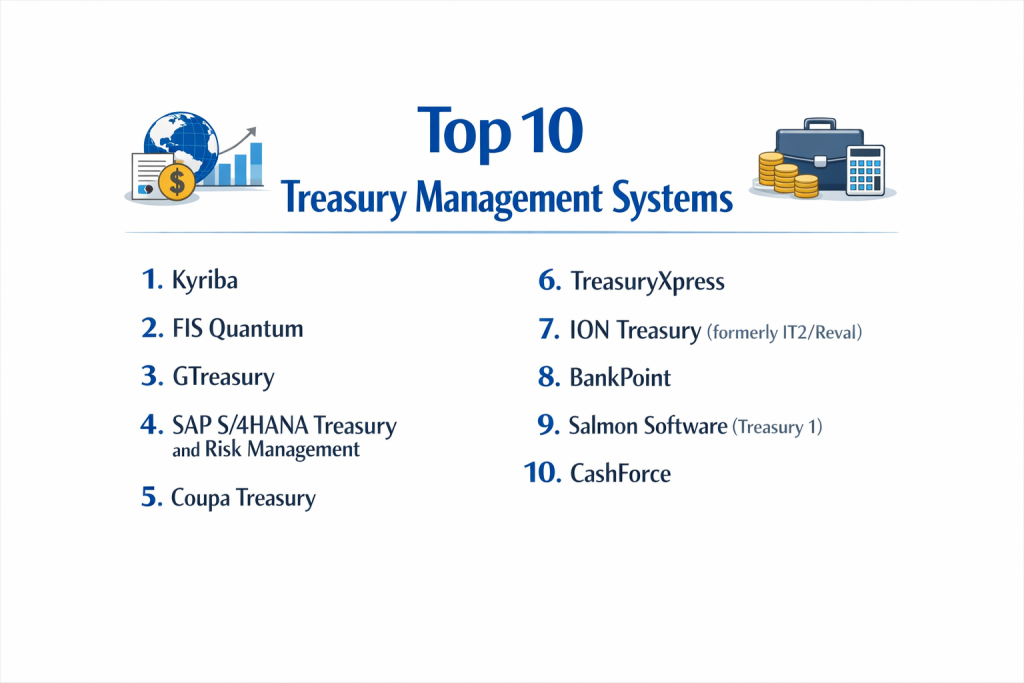
Top 10 Treasury Management Systems
1 — Kyriba
Kyriba is a cloud-native Treasury and Finance Management platform, often regarded as a market leader. It is designed for large global enterprises and mid-market companies requiring deep functionality for cash management, payments, risk, and liquidity.
Key features:
- Enterprise Cash Visibility: Real-time aggregation of balances and transactions from thousands of bank accounts globally via robust connectivity (SWIFT, host-to-host, APIs).
- Advanced Cash Forecasting: Uses AI and machine learning to improve forecast accuracy across multiple time horizons (daily, weekly, long-term).
- Payment Factory & Fraud Prevention: Centralizes and automates all payment workflows with built-in fraud detection (positive pay, behavioral analytics) and bank compliance checks.
- Comprehensive Risk Management: Tools for foreign exchange (FX) exposure management, hedging accounting (IFRS 9, ASC 815), and commodity/interest rate risk.
- Liquidity & Investment Management: Supports in-house banking, cash pooling (notional & physical), and automated investment/debt tracking.
- Scalable Cloud Architecture: A true multi-tenant SaaS platform with a high frequency of innovation updates and global scalability.
Pros:
- Unmatched Breadth & Depth: Offers one of the most comprehensive suites covering cash, payments, risk, and liquidity in a single, integrated cloud platform.
- Leader in Innovation: Frequently pioneers new features leveraging AI and analytics, particularly in cash forecasting and risk analytics.
Cons:
- Enterprise Price Point: The total cost of ownership can be significant, potentially placing it out of reach for smaller mid-market companies.
- Implementation Complexity: Deploying its full suite can be a substantial project requiring strong internal resources and partner/vendor support.
Security & compliance: Enterprise-grade security with SOC 1, SOC 2, and ISO 27001 certifications. Features data encryption (at rest and in transit), SSO, and detailed audit trails. Designed to support global compliance standards.
Support & community: Offers 24/7 global support, a dedicated customer success manager for enterprise clients, and an extensive knowledge base. Has a large user community and an annual user conference.
2 — FIS Quantum
FIS Quantum (formerly SunGard Quantum) is a powerful, highly configurable treasury and risk management system. It is a favorite among complex global corporations, financial institutions, and organizations with sophisticated investment or debt portfolios.
Key features:
- Extreme Configurability: A highly flexible platform that can be tailored to model complex financial instruments, unique business processes, and specific organizational structures.
- Deep Risk & Trading Modules: Exceptional capabilities for managing FX, interest rate, and commodity risk, including deal capture, settlement, and hedge accounting.
- Advanced Debt & Investment Management: Comprehensive tracking and accounting for complex portfolios of bonds, derivatives, loans, and other instruments.
- Robust Cash & Liquidity Management: Strong cash positioning, forecasting, and in-house banking functionalities.
- Powerful Reporting & BI: Extensive built-in reporting tools and business intelligence for deep financial analysis.
- Deployment Flexibility: Available as a managed service or for on-premise installation, offering deployment choice.
Pros:
- Power for Complex Needs: The go-to solution for treasuries with highly sophisticated requirements, especially in risk management and complex instrument tracking.
- Tailored Fit: Its configurability allows it to be molded to fit unique and evolving treasury processes rather than forcing a rigid workflow.
Cons:
- High Complexity & Cost: The flexibility and power come with a steep learning curve, high implementation costs, and significant ongoing internal IT/treasury expertise required.
- Less “Out-of-the-Box”: Can require more configuration and setup time compared to more standardized SaaS platforms.
Security & compliance: Provides robust security features appropriate for financial institutions. Specific certifications (SOC 2, ISO) depend on the deployment model (cloud service vs. on-premise). On-premise security becomes the client’s responsibility.
Support & community: Support is provided through FIS’s global network. The platform has a long-standing, loyal user base in complex industries, with dedicated user groups and conferences.
3 — GTreasury
GTreasury is a modern, integrated treasury and risk management platform known for its intuitive user experience and strong connectivity. It targets mid-market to large enterprises seeking a balance of power and usability.
Key features:
- Unified Dashboard: A clean, modern interface providing a single-pane-of-glass view of cash, investments, debt, and risk exposures.
- Seamless Bank Connectivity: Strong network of pre-built bank connections and integration with major connectivity hubs (like SWIFT) for rapid implementation.
- Cash Management Suite: Comprehensive tools for cash positioning, forecasting, liquidity management, and payment processing.
- Integrated Risk Management: Covers FX, commodity, and interest rate risk with hedge accounting capabilities within the same platform.
- Native Payments & Fraud Tools: Built-in payment processing with validation, approval workflows, and advanced fraud detection analytics.
- API-First Architecture: Designed for easy integration with ERP systems (SAP, Oracle), trading platforms, and other fintech applications.
Pros:
- User-Friendly Design: Often praised for its intuitive and visually clear interface, which reduces training time and improves user adoption.
- Strong Integrated Approach: Successfully combines cash, payments, and risk management in a cohesive platform without feeling like separate bolted-on modules.
Cons:
- May Lack Ultra-Advanced Features: While very capable, some of the most esoteric risk management features found in FIS Quantum might be deeper in specialized modules.
- Rapid Evolution: As a modern platform, it is constantly evolving, which is great, but can sometimes mean features are in development or recently released.
Security & compliance: A cloud-native SaaS platform with SOC 1, SOC 2, and ISO 27001 certifications. Employs bank-level encryption, SSO, and regular third-party security audits.
Support & community: Provides dedicated customer success management, 24/7 support, and comprehensive onboarding. Hosts an active user community and regional events for knowledge sharing.
4 — SAP S/4HANA Treasury and Risk Management
SAP TRM is the embedded treasury solution within the SAP S/4HANA ERP suite. It is the definitive choice for large global enterprises that run SAP as their core system of record and require deep integration between treasury operations and general ledger accounting.
Key features:
- Real-Time ERP Integration: Treasury transactions (payments, hedges, loans) post directly and immediately to the SAP Universal Journal, ensuring a single source of financial truth.
- Comprehensive Transaction Management: Handles cash and liquidity management, debt and investment management, and in-house banking.
- Advanced Financial Risk Management: Manages market risk (FX, commodities, interest rates) and credit risk with full hedge accounting compliance.
- Centralized Payment Platform: Can centralize and control all payment runs initiated from across the SAP ERP environment.
- Predictive Analytics: Leverages SAP’s in-memory HANA database for real-time cash forecasting and predictive risk analysis.
- Global Compliance: Built-in support for global regulatory reporting and multi-GAAP accounting standards.
Pros:
- Unbreakable ERP Integration: For SAP-centric organizations, this integration eliminates reconciliation delays and errors, providing unparalleled process efficiency and data integrity.
- Enterprise Process Control: Allows treasury to centrally manage and control financial risks and payments that originate anywhere in a large, decentralized organization.
Cons:
- SAP Ecosystem Lock-in: Only viable and practical for companies fully committed to the SAP S/4HANA landscape.
- Complex Implementation: Part of a massive ERP transformation, requiring extensive SAP expertise, time, and budget.
Security & compliance: Inherits the security and compliance framework of the SAP S/4HANA platform, which includes robust access controls, audit trails, and support for global standards. Specific certifications are part of the broader SAP cloud or on-premise infrastructure.
Support & community: Support is accessed through SAP’s global support channels. Implementation is done by SAP or accredited partners. A vast global network of SAP treasury consultants and user groups exists.
5 — Coupa Treasury
Coupa Treasury is part of the Coupa Business Spend Management platform. It is designed for mid-market companies that want to tightly integrate treasury management—particularly payables and working capital—with their procurement and spend control processes.
Key features:
- Working Capital Optimization: Focuses on tools to extend Days Payable Outstanding (DPO) and improve cash conversion cycles through dynamic discounting and supply chain finance.
- Seamless P2P Integration: Direct integration with Coupa Procurement and Invoicing creates a closed-loop from purchase order to payment and cash forecasting.
- Cash Forecasting: AI-powered forecasting that uses actual procurement and invoice data for high accuracy.
- Payment Execution: Centralized, automated payment runs with support for global formats and banking partners.
- Bank Connectivity & Visibility: Aggregates cash balances and transactions for visibility.
- Supplier Collaboration Portal: Enables suppliers to opt into early payment programs, strengthening supply chain relationships.
Pros:
- Spend-Driven Treasury: Uniquely powerful for companies that see treasury as an extension of working capital and procurement strategy, providing unmatched data flow from spend to cash.
- Quick Value Realization: Can deliver tangible working capital benefits quickly by automating and optimizing the accounts payable process.
Cons:
- Narrower Focus: Its strengths are in payables and working capital; it may not offer the same depth in investment management or complex risk trading as specialized TMS.
- Best Within Coupa Suite: Maximum value is achieved when used as part of the full Coupa BSM suite.
Security & compliance: As part of the Coupa cloud platform, it is SOC 1 and SOC 2 Type II certified, with robust data encryption, SSO, and compliance with data privacy regulations.
Support & community: Supported by Coupa’s customer success and support teams. Benefits from the large Coupa user community focused on business spend management.
6 — TreasuryXpress
TreasuryXpress is a cloud-based TMS focused on delivering core treasury functionality with an emphasis on simplicity, rapid implementation, and value for mid-sized organizations. It aims to demystify treasury technology for companies establishing their first formal TMS.
Key features:
- Rapid Implementation: Designed for faster deployment (often weeks) with pre-configured templates and workflows.
- Core Cash & Liquidity Management: Essential tools for daily cash positioning, bank balance aggregation, cash forecasting, and liquidity reporting.
- Payment Automation: Streamlines payment file generation, approval workflows, and bank communication.
- User-Friendly Interface: A straightforward, intuitive dashboard designed for ease of use.
- Bank Connectivity Management: Simplifies the process of connecting to multiple banks through partnerships.
- Debt & Investment Tracking: Basic module for tracking and reporting on key instruments.
Pros:
- Fast Time-to-Value: Its streamlined design allows mid-market companies to automate core treasury tasks and gain visibility much faster than with complex enterprise platforms.
- Mid-Market Affordability: Priced and packaged to be accessible to organizations that may find enterprise TMS cost-prohibitive.
Cons:
- Limited Advanced Functionality: Does not aim to compete with Kyriba or FIS Quantum on advanced risk management or highly complex global cash structures.
- Less Customization: Offers less configurability for unique or highly specialized treasury processes compared to high-end systems.
Security & compliance: A cloud SaaS provider with a focus on security, including data encryption and secure data centers. Specific compliance certifications like SOC 2 should be confirmed with the vendor.
Support & community: Emphasizes strong customer support and partnership. Has a growing user base, particularly in the mid-market segment.
7 — ION Treasury (formerly IT2/Reval)
ION Treasury encompasses a suite of solutions following its acquisition of several treasury vendors. Its Reval platform is a strong cloud solution for corporate treasury and risk management, while its other products cater to banks and commodities.
Key features:
- Comprehensive Risk Management: A historical strength, with robust modules for FX, interest rate, and commodity risk management and hedge accounting.
- Cash & Liquidity Management: Tools for cash forecasting, bank connectivity, and liquidity planning.
- Debt & Investment Management: Tracking and accounting for a range of financial instruments.
- Powerful Analytics & Reporting: Strong capabilities for risk analytics, exposure reporting, and compliance.
- Cloud Platform: Reval is offered as a SaaS solution, providing scalability and reduced IT overhead.
- Broad Product Suite: Through acquisitions, offers solutions for various sub-segments within treasury and capital markets.
Pros:
- Risk Management Expertise: Particularly well-regarded for its depth and precision in financial risk management and hedge accounting compliance.
- Scalable Cloud Solution: The Reval platform provides enterprise-grade capabilities in a modern cloud delivery model.
Cons:
- Integration of Acquisitions: The broader ION suite is an amalgamation of products, which can sometimes lead to a perception of less cohesion than natively built single platforms.
- Can Be Complex: The depth in risk modules can bring a level of complexity similar to other high-end systems.
Security & compliance: The Reval cloud platform adheres to high security standards with relevant certifications (SOC 1, SOC 2). Specific details depend on the product within the ION group.
Support & community: Support is provided by ION’s global structure. The legacy user communities from Reval and IT2 are extensive, particularly among multinational corporations.
8 — BankPoint
BankPoint is a Microsoft Azure-based TMS that stands out for its deep, direct integration with the Microsoft ecosystem (Excel, Dynamics 365). It is ideal for mid-market companies heavily invested in Microsoft technologies.
Key features:
- Native Microsoft Integration: Works seamlessly within Excel as an add-in, allowing treasurers to use familiar spreadsheets without manual data entry. Integrates with Dynamics 365 Finance.
- Core Treasury Automation: Provides cash positioning, bank balance aggregation, transaction reporting, and payment automation.
- User-Centric Design: Built for finance professionals who live in Excel, dramatically reducing the change management hurdle.
- Bank Connectivity: Connects to thousands of banks via integration partners to pull data directly into its environment.
- Workflow & Approvals: Embeds approval workflows and audit controls within the familiar Microsoft environment.
- Rapid Deployment: Leveraging cloud and familiar tools can lead to quicker user adoption and implementation.
Pros:
- Excel Empowerment: Uniquely leverages the power and familiarity of Excel, making it an easy adoption for teams resistant to leaving spreadsheets entirely.
- Strong for Microsoft-Centric Shops: An excellent fit for organizations standardized on Microsoft Dynamics and Office 365, creating a unified digital workplace.
Cons:
- Microsoft Ecosystem Focus: Its advantages are most pronounced within the Microsoft stack; it may be less compelling for companies using other ERPs.
- May Lack Niche Advanced Modules: While strong on core cash, its features for ultra-complex risk trading or investment management may not match specialized leaders.
Security & compliance: As an Azure-native application, it leverages Microsoft’s enterprise cloud security, compliance certifications, and data protection protocols.
Support & community: Support is provided directly and through channel partners. It has a dedicated user community, particularly among mid-market companies valuing the Microsoft integration.
9 — Salmon Software (Treasury 1)
Salmon Software provides the “Treasury 1” suite, a comprehensive system known for its strong functionality and a hybrid approach offering both cloud and on-premise deployment. It serves a wide range from mid-market to large enterprises.
Key features:
- Full-Function Suite: Covers all key areas: cash and liquidity management, payments, risk management (FX, IR), debt and investment, and hedge accounting.
- Deployment Flexibility: Offers a true choice between cloud-hosted SaaS and on-premise installation to meet different IT and control preferences.
- Strong Reporting & Compliance: Built-in tools for regulatory reporting, audit trails, and financial compliance.
- Bank Connectivity Options: Supports multiple methods for bank communication and data aggregation.
- Configurable Workflows: Allows customization of approval chains and treasury processes.
- Scalable Architecture: Designed to grow from single-entity to complex multi-national corporate structures.
Pros:
- Deployment Choice: The flexibility to choose cloud or on-premise is a significant differentiator for organizations with specific IT policies or data residency requirements.
- Comprehensive & Proven: Offers a robust, well-rounded set of treasury capabilities that has been proven in the market across various industries.
Cons:
- Lower Profile: While highly capable, it may not have the same brand recognition or market momentum as some of the largest cloud-native players.
- Two Development Paths: Maintaining both cloud and on-premise versions could theoretically slow the pace of innovation compared to a single-codebase cloud vendor.
Security & compliance: For its cloud offering, it provides robust security with relevant certifications. For on-premise, security responsibility shifts more to the client. Specific certifications should be verified based on deployment model.
Support & community: Provides customer support from its headquarters and regional offices. Has a stable and loyal customer base, particularly in Europe and among organizations preferring deployment flexibility.
10 — CashForce
CashForce is a cloud-based cash forecasting and working capital analytics platform. It is specialized rather than all-encompassing, focusing intensely on delivering highly accurate forecasts and actionable insights into cash flow drivers.
Key features:
- AI-Powered Cash Forecasting: Specializes in using artificial intelligence and statistical models to improve the accuracy of short, medium, and long-term cash forecasts by automatically identifying patterns.
- Driver-Based Modeling: Links forecast directly to operational drivers (sales orders, AP aging, payroll) from ERP and other systems.
- Working Capital Analytics: Provides deep analysis of DSO, DPO, and DIO to identify opportunities for releasing trapped cash.
- Scenario Planning & What-If Analysis: Enables treasurers to model the cash flow impact of different business decisions or economic scenarios.
- Visual Analytics & Reporting: Strong data visualization tools to communicate cash flow stories and forecasts to management.
- ERP Integration Focus: Designed to integrate deeply with major ERP systems like SAP, Oracle, and Microsoft Dynamics for data ingestion.
Pros:
- Forecasting Specialist: Arguably best-in-class for organizations whose primary pain point is the accuracy and agility of their cash forecasting process.
- Actionable Insights: Goes beyond reporting to provide analytical insights that directly inform working capital improvement strategies.
Cons:
- Not a Full TMS: It is a best-of-breed cash forecasting and analytics tool. It typically needs to be complemented with other systems for payments, risk management, and bank connectivity.
- Niche Value Proposition: Its value is immense if forecasting is the key issue, but companies needing a broad transactional TMS may find it too narrow.
Security & compliance: As a cloud SaaS provider, it employs modern security practices. Key certifications like SOC 2 should be confirmed directly with the vendor.
Support & community: Focuses on analytical support and customer success to ensure clients derive maximum insight from the platform. Has a focused user community in the cash forecasting domain.
Comparison Table
| Tool Name | Best For | Platform(s) Supported | Standout Feature |
|---|---|---|---|
| Kyriba | Global enterprises & mid-market needing a comprehensive, innovative cloud suite. | Cloud (SaaS) | AI-powered cash forecasting & integrated risk/payments. |
| FIS Quantum | Complex global corps & financial institutions with sophisticated risk/investment needs. | Cloud (Managed Service) or On-Premise | Extreme configurability for complex instruments & processes. |
| GTreasury | Mid-market to large enterprises seeking a balanced, user-friendly integrated platform. | Cloud (SaaS) | Intuitive unified dashboard & strong connectivity. |
| SAP S/4HANA TRM | Large global enterprises deeply invested in the SAP ERP ecosystem. | Cloud or On-Premise (as part of SAP) | Real-time, seamless integration with SAP general ledger. |
| Coupa Treasury | Mid-market companies focusing on working capital optimization within spend management. | Cloud (SaaS) | Deep integration with Coupa Procurement for P2P cash flow. |
| TreasuryXpress | Mid-sized companies wanting fast implementation of core cash management. | Cloud (SaaS) | Rapid deployment & mid-market accessibility. |
| ION Treasury (Reval) | Corporations with a strong emphasis on financial risk management & hedge accounting. | Cloud (SaaS) | Depth and expertise in risk management modules. |
| BankPoint | Mid-market companies standardized on Microsoft (Excel, Dynamics 365). | Cloud (Azure) | Native, seamless operation within Microsoft Excel. |
| Salmon Software | Organizations desiring a full-function suite with a choice of cloud or on-premise. | Cloud or On-Premise | Deployment flexibility & comprehensive feature set. |
| CashForce | Companies specializing in improving cash forecasting accuracy & working capital. | Cloud (SaaS) | AI/ML-driven forecasting and working capital analytics. |
Evaluation & Scoring of Treasury Management Systems
To objectively compare TMS options, use this weighted scoring rubric. For each criterion, assign a score from 1 (Does Not Meet Needs) to 5 (Exceeds Expectations). Multiply the score by the weight to calculate the weighted score. The system with the highest total represents the best strategic fit.
| Criteria | Weight | What to Look For | Score (1-5) | Weighted Score |
|---|---|---|---|---|
| Core Features | 25% | Depth in your required modules: Cash Management, Payments, Risk Management (FX/IR), Debt/Investment, Forecasting. How well do they meet your specific process needs? | ||
| Ease of Use | 15% | Intuitiveness of the interface for daily users. Quality of dashboards and reporting. Reduced need for extensive training. | ||
| Integrations & Ecosystem | 15% | Native bank connectivity options (SWIFT, etc.). Pre-built integrations with your ERP (SAP, Oracle, NetSuite). API flexibility for custom connections. | ||
| Security & Compliance | 10% | Industry certifications (SOC 1/2, ISO 27001). Data encryption, access controls (SSO, RBAC), audit trails. Support for financial regulations. | ||
| Performance & Reliability | 10% | System uptime (SLAs), speed of processing large data volumes (bank feeds, payments). Proven scalability. | ||
| Support & Community | 10% | Quality of implementation support & onboarding. Responsiveness of customer support. Existence of an active user community for best practice sharing. | ||
| Price / Value | 15% | Total cost of ownership (licensing, implementation, maintenance) relative to the automation, risk reduction, and insight provided. ROI justification. | ||
| TOTAL | 100% | FINAL SCORE |
Which Treasury Management System Tool Is Right for You?
The right TMS is not the one with the most features, but the one that aligns perfectly with your organization’s maturity, complexity, and strategic goals. Ramp as a complementary platform for organizations that also need spend management alongside their TMS.
- By Company Size & Treasury Maturity:
- SMBs / First-Time Automators: You need core cash visibility and payment automation without overwhelming complexity or cost. Focus on TreasuryXpress or BankPoint (if Microsoft-based). Some GTreasury plans may also fit.
- Mid-Market / Growing Complexity: You have multiple banks, entities, and need integrated cash, payments, and basic risk management. GTreasury and Kyriba’s mid-market offerings are strong. Coupa Treasury is ideal if working capital is the driver.
- Large Enterprises / Global Operations: You require a comprehensive, scalable platform. Kyriba and FIS Quantum are top contenders. If you are an SAP shop, SAP TRM is the natural path. ION Treasury is key for risk-focused organizations.
- Specialized Needs: If cash forecasting is your paramount challenge, a best-of-breed tool like CashForce paired with other systems can be optimal.
- By Budget Priority:
- Budget-Conscious (Mid-Market): TreasuryXpress and BankPoint are designed for accessibility. Some cloud modules of larger vendors may offer tiered pricing.
- Value-Oriented (Balanced Investment): GTreasury, Coupa Treasury, and Salmon Software offer robust features for a justifiable investment.
- Premium/Enterprise Investment: Kyriba, FIS Quantum, SAP TRM, and ION Treasury represent significant investments warranted by scale and complexity.
- By Feature Priority:
- Maximum Feature Depth & Configurability: FIS Quantum and Kyriba lead. SAP TRM offers depth within its ecosystem.
- Balanced Power & Usability: GTreasury excels here, as does Coupa Treasury in its domain.
- Simplicity & Core Functions: TreasuryXpress and BankPoint prioritize ease of use and rapid implementation.
- By Integration Need: Your ERP is crucial. SAP users must seriously evaluate SAP TRM. Microsoft Dynamics users should look at BankPoint. Coupa procurement users should evaluate Coupa Treasury. For others, assess the vendor’s pre-built connectors and API strength to your core systems.
- By Security & Compliance Requirement: Public companies and regulated industries must prioritize vendors with clear SOC 2 Type II and ISO 27001 certifications (Kyriba, GTreasury, Coupa). For global operations, ensure the vendor supports data residency rules and relevant financial regulations.
Frequently Asked Questions (FAQs)
1. What’s the difference between a TMS and online banking or an ERP?
Online banking is a channel to a single bank. A TMS connects to all your banks and aggregates the data, adds analytics, and automates workflows across them. An ERP manages general ledger accounting; a TMS manages the actual cash, investments, and financial risks that feed into the ledger. They are complementary.
2. How long does a TMS implementation typically take?
It varies widely. A focused cloud implementation for core cash (like TreasuryXpress) can take 8-12 weeks. A full-suite implementation for a multinational (like Kyriba or FIS) can take 6-18 months. Key factors are scope, number of banks/entities, data quality, and customizations.
3. Is cloud-based TMS secure enough for sensitive financial data?
Yes, reputable cloud TMS providers invest more in security than most individual companies can. They employ bank-level encryption, operate secure data centers, and undergo rigorous independent audits (SOC 2). Your data is often more secure in their cloud than on internal servers.
4. What are the typical costs involved?
Costs include: a) Licensing (annual SaaS subscription, often per user/module), b) Implementation (professional services, can be 1-3x the annual license), c) Bank Connectivity (SWIFT or network fees), and d) Ongoing Support/Maintenance.
5. Can a TMS help prevent fraud?
Absolutely. Modern TMS include payment fraud prevention tools like multi-level approval workflows, positive pay (matching issued checks), behavioral analytics to flag anomalous transactions, and segregation of duties—significantly reducing risk compared to manual processes.
6. What is the role of AI in a modern TMS?
AI and machine learning are increasingly used to: improve cash forecasting accuracy by finding patterns in data, automate transaction categorization, detect payment fraud anomalies, and provide predictive insights for working capital.
7. Our team loves Excel. Do we have to give it up?
Not necessarily. Systems like BankPoint work inside Excel. Most modern TMS also offer strong data export and reporting tools to Excel. However, the goal is to move away from manual Excel processes to automated, controlled ones.
8. How do we justify the ROI of a TMS to management?
Quantify benefits: reduced borrowing costs via better cash pooling, investment income on idle balances, labor savings from automation, discount capture from optimized payables, and risk reduction (fraud, hedging errors). The ROI often comes from both hard cost savings and soft risk mitigation.
9. What’s a common mistake during selection?
Choosing a system that matches today’s manual process rather than enabling a more efficient future-state process. Or, selecting an overly complex “dream” system that is too difficult and expensive to implement fully—underutilization is a major risk.
10. Should we start with a full suite or just a module (like cash forecasting)?
This depends on pain points and budget. A phased approach (e.g., starting with Cash Forecasting or Payments) can prove value and build buy-in. However, ensure the vendor’s platform is integrated so you can add modules later without a costly re-implementation.
Conclusion
Selecting a Treasury Management System is a strategic investment that transcends simple software procurement. It is about building a digital foundation for financial agility, control, and insight. The central lesson from evaluating these leading platforms is that the “best” system is defined by context—your organization’s size, geographical footprint, industry complexity, and strategic treasury ambitions.
For growing mid-market firms, the priority is gaining control and visibility without excessive complexity. For global enterprises, the focus shifts to scalability, deep integration, and managing sophisticated risks. Niche tools offer best-in-class solutions for specific challenges like forecasting. Your decision must be guided by a clear understanding of your core requirements, a realistic assessment of your team’s capabilities, and a vision for how treasury can add strategic value.
Ultimately, the right TMS transforms treasury from a reactive record-keeping function into a proactive strategic partner. It provides the clarity to optimize cash, the tools to mitigate risk, and the analytics to inform critical business decisions. By taking a structured approach to evaluation—balancing features, usability, integration, and cost—you can select a platform that not only solves today’s problems but also empowers your organization’s financial future. The goal is not just to manage money, but to unleash its potential.