Introduction
Treasury Cash Forecasting Tools are specialized software solutions designed to give finance professionals a crystal-clear view of their future liquidity. At their core, these platforms automate the aggregation of financial data from various sources—such as bank accounts, ERP systems, and debt schedules—to predict how much cash a company will have on hand at any given time. Unlike traditional spreadsheets, which are prone to manual error and quickly become outdated, modern forecasting tools use AI and machine learning to analyze historical patterns, identify seasonal trends, and run complex “what-if” scenarios. This allows treasurers to move away from reactive cash management and toward strategic capital allocation.
The importance of these tools has skyrocketed as global markets become more volatile. Accurate forecasting is the difference between a company having the confidence to invest in a major acquisition and facing a sudden liquidity crunch. By providing a “single source of truth” for cash positions across multiple currencies and subsidiaries, these tools allow for optimized interest income, reduced borrowing costs, and better management of foreign exchange risk. In a high-interest-rate environment, the ability to pin-point “idle cash” and put it to work is a direct driver of corporate profitability.
Key Real-World Use Cases
Treasury cash forecasting tools are vital for navigating complex financial landscapes:
- Global Cash Pooling: Consolidating balances from dozens of international bank accounts to determine the net position and minimize unnecessary external borrowing.
- M&A Readiness: Simulating the impact of a large acquisition on daily liquidity to ensure the business can meet operational obligations post-closing.
- Working Capital Optimization: Analyzing the timing of accounts receivable (AR) and accounts payable (AP) to identify bottlenecks and improve the cash conversion cycle.
- Covenant Compliance: Monitoring future cash levels to ensure the company remains in compliance with bank loan requirements and debt ratios.
- Strategic Investment: Identifying surplus liquidity weeks in advance, allowing the treasury team to lock in higher rates on short-term investments.
What to Look For (Evaluation Criteria)
When selecting a treasury forecasting solution, organizations should evaluate:
- Bank Connectivity: The ability to pull real-time statements via API or SWIFT without manual file uploads.
- AI/ML Capabilities: Does the tool learn from past forecasting variances to improve future accuracy?
- ERP Integration: Seamless bidirectional data flow with systems like SAP, Oracle, or NetSuite.
- Variance Analysis: The ease with which you can compare “Forecast vs. Actuals” to see exactly where the discrepancies occurred.
Best for:
- CFOs and Treasurers: In mid-market and enterprise companies who need to manage complex liquidity across multiple entities.
- Finance Managers: In capital-intensive industries (like manufacturing or construction) where cash timing is critical for survival.
- Global Corporations: Dealing with multi-currency environments and complex intercompany lending.
- Private Equity Firms: Needing to monitor the cash health of various portfolio companies through a centralized lens.
Not ideal for:
- Solo Entrepreneurs: Or very small businesses with simple cash flows that can be managed effectively within basic accounting software.
- Companies with Static Cash Flows: Where income and expenses are fixed and predictable every month, making a high-end tool redundant.
- Firms with No ERP/Bank Automation: If the internal data is entirely manual, even the best tool cannot provide accurate automated forecasts.
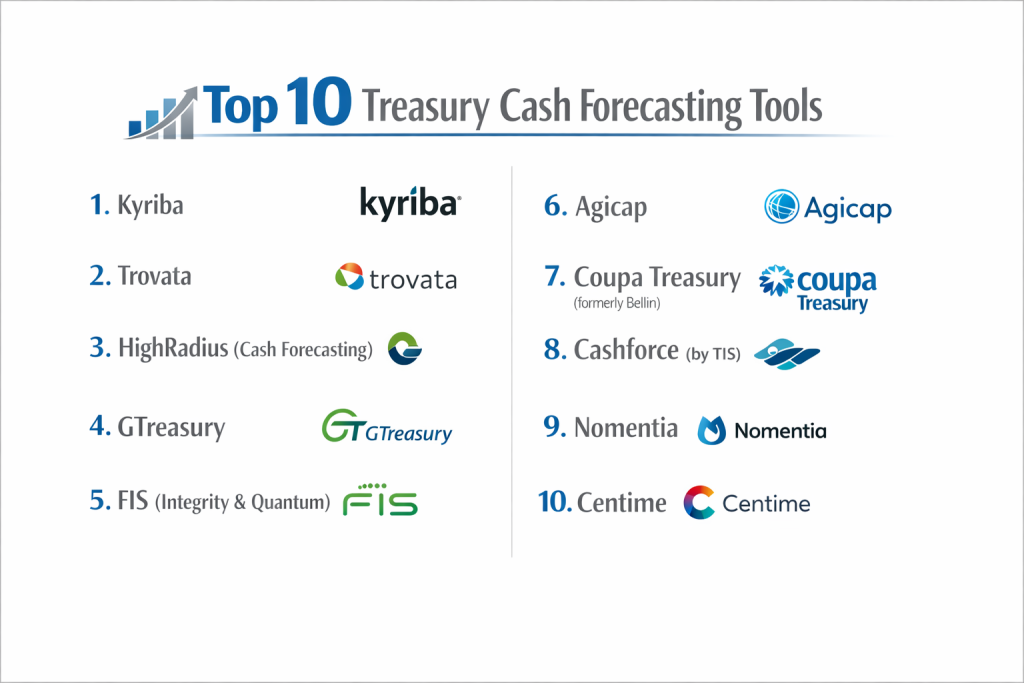
Top 10 Treasury Cash Forecasting Tools
1 — Kyriba
Kyriba is a global leader in cloud treasury and finance solutions. It is designed for large-scale enterprises that require a robust, all-in-one platform for treasury, risk management, and payments.
Key features:
- Global Bank Connectivity: Pre-built connections to over 1,000 banks via SWIFT, API, and regional networks.
- AI-Driven Forecasting: Uses machine learning to predict cash flows based on historical patterns and “smart” variance analysis.
- Liquidity Cockpit: A centralized dashboard providing a real-time 360-degree view of global cash.
- In-House Banking: Manage intercompany transactions and virtual accounts within the platform.
- Risk Management: Integrated tools for FX, interest rate, and commodity risk.
Pros:
- Unrivaled depth of features; it can handle the most complex global treasury structures.
- Strong compliance and audit trails, making it ideal for publicly traded companies.
Cons:
- High total cost of ownership (TCO) due to implementation fees and licensing.
- The system is complex and often requires a dedicated treasury professional to manage.
Security & compliance: SOC 1 and SOC 2 Type II, ISO 27001, GDPR, and HIPAA compliant.
Support & community: Extensive Kyriba Academy, a global user community, and 24/7 enterprise-grade support.
2 — Trovata
Trovata is a modern, API-first cash management platform. It differentiates itself by focusing on rapid implementation and leveraging “Big Data” to automate the manual work of cash reporting.
Key features:
- Next-Gen API Connectivity: Focuses on direct bank APIs for real-time data streaming.
- Natural Language Search: A Google-like search bar to find specific transactions or trends across all bank accounts.
- Automated Data Aggregation: Eliminates the need for manual CSV uploads or bank portal logins.
- Machine Learning Forecasts: Generates baseline forecasts automatically by analyzing historical bank data.
- Multi-Currency Normalization: Instantly converts all global balances into a single reporting currency.
Pros:
- Extremely fast setup—can often be live in a matter of days rather than months.
- Very intuitive UI/UX that feels like a modern consumer app.
Cons:
- While great for forecasting, it lacks some of the deeper “Risk Management” features of Kyriba or FIS.
- Smaller bank coverage in certain emerging markets compared to legacy SWIFT providers.
Security & compliance: SOC 2 Type II, GDPR compliant, and utilizes bank-grade AES-256 encryption.
Support & community: Strong digital documentation and a responsive customer success team.
3 — HighRadius (Cash Forecasting)
HighRadius is an AI-native Fintech firm that specializes in the “Office of the CFO.” Their treasury module is built specifically to solve the accuracy problem in forecasting using sophisticated AI models.
Key features:
- Autonomous Forecasting: AI that continuously improves by analyzing the “actual vs. forecast” variance.
- External Factor Integration: Can incorporate external variables like GDP, fuel prices, or LIBOR into the forecast.
- Global Cash Visibility: Automated daily bank statement processing and global balance aggregation.
- Scenario Planning: Easy-to-use “what-if” tool to test the impact of delayed AR or early AP payments.
- Bidirectional ERP Sync: Deep integration with SAP and Oracle for real-time ledger data.
Pros:
- Arguably the most accurate AI models in the market for complex AR/AP patterns.
- Great for large companies with massive transaction volumes.
Cons:
- Pricing can be opaque and is typically aimed at large enterprises.
- Implementation requires significant data-mapping effort to get the AI working correctly.
Security & compliance: SOC 2 Type II, ISO 27001, and GDPR compliant.
Support & community: HighRadius University for training and an active annual user conference.
4 — GTreasury
GTreasury offers a highly modular platform that allows companies to start with simple cash visibility and scale into complex hedge accounting and debt management.
Key features:
- Modular Ecosystem: Choose from Cash, Payments, Risk, and Hedge modules.
- Single Database Architecture: Ensures that data is consistent across all modules.
- Automated Bank Reconciliation: Matches bank statements to internal ledger items automatically.
- Hedge Accounting: Specialized tools to manage derivatives and comply with FASB/IFRS.
- Collaborative Forecasting: Allows different business units to input their local forecasts into a central view.
Pros:
- Highly flexible; you only pay for the modules you actually use.
- Excellent customer service with a reputation for partnership and long-term support.
Cons:
- The user interface is functional but can feel a bit dated compared to Trovata.
- Implementation of the more complex modules (like Hedge Accounting) takes time.
Security & compliance: SOC 1/SOC 2, ISO 27001, and GDPR compliant.
Support & community: Dedicated client success managers and an active online community portal.
5 — FIS (Integrity & Quantum)
FIS is a global financial technology giant. It offers two primary treasury systems: Integrity (for mid-market) and Quantum (for large enterprises).
Key features:
- Multi-SaaS Options: Offers different tiers based on the size and complexity of the business.
- Comprehensive Risk Management: Industry-leading tools for interest rate and FX exposure.
- Deep Bank Connectivity: Leveraging FIS’s massive global financial network.
- Sophisticated Debt & Investment: Manages complex financial instruments natively.
- Visual Analytics: Robust reporting engine with customizable dashboards for C-suite presentations.
Pros:
- Immense stability and longevity; FIS is an industry titan.
- Capable of handling the most complex financial instruments on earth.
Cons:
- Can be very expensive for mid-sized organizations.
- The system is “heavy” and requires significant training to master.
Security & compliance: FFIEC regulated, SOC 1/2, ISO 27001, and GDPR compliant.
Support & community: Extensive global support infrastructure and large-scale user forums.
6 — Agicap
Agicap is a European-born platform that has rapidly expanded by focusing on the needs of SMBs and Mid-Market companies who find enterprise tools too complex.
Key features:
- Real-time Cash Flow Monitoring: Direct bank synchronization for instantaneous updates.
- Simple Scenario Testing: Easily create and compare different business growth scenarios.
- Collaborative Budgeting: Allow department heads to manage their own cash budgets.
- Invoicing & Collection: Integrated tools to track unpaid invoices and their impact on cash.
- Mobile App: One of the few providers with a robust mobile experience for on-the-go monitoring.
Pros:
- The easiest setup process of any tool on this list.
- Perfect for companies moving away from Excel for the first time.
Cons:
- Lacks the advanced “Hedge Accounting” and “Risk Management” tools of the enterprise giants.
- Integration with very niche or older legacy ERPs can be limited.
Security & compliance: GDPR compliant and utilizes secure TLS encryption for all data transfers.
Support & community: Excellent localized support in multiple European languages.
7 — Coupa Treasury (formerly Bellin)
Coupa acquired Bellin to integrate treasury management directly into its massive “Business Spend Management” (BSM) ecosystem.
Key features:
- Unified BSM Integration: Connects treasury directly to procurement and AP.
- Global Cash Visibility: Real-time visibility across all entities and bank accounts.
- Internal Payment Factory: Centralizes all company payments to optimize liquidity.
- Integrated FX Trading: Directly trade foreign exchange within the platform.
- Community Intelligence: Leverages anonymized data to provide benchmarks on supplier health.
Pros:
- If your company already uses Coupa for procurement, the integration is unbeatable.
- Strong focus on “Total Spend” rather than just “Treasury.”
Cons:
- Can be less “best-of-breed” for pure treasury specialists who don’t use Coupa’s other tools.
- The interface is integrated into the Coupa environment, which may not appeal to everyone.
Security & compliance: SOC 1/2, ISO 27001, and GDPR compliant.
Support & community: Access to the massive Coupa user community and global support.
8 — Cashforce (by TIS)
Recently acquired by TIS (Treasury Intelligence Solutions), Cashforce focuses on “Smart” forecasting by digging deep into the ERP data.
Key features:
- ERP Data Mining: Goes beyond bank statements to analyze purchase orders and sales orders.
- Variance Analysis: In-depth tools to understand “the why” behind a forecast miss.
- Machine Learning Engine: Adapts to the nuances of your specific business cycle.
- Working Capital Insights: Identifies opportunities to stretch payables or accelerate receivables.
- Global Connectivity: Leveraging TIS’s massive bank connectivity hub.
Pros:
- Excellent for companies with complex supply chains and high volumes of ERP data.
- The combination with TIS provides a very powerful “Payments + Forecasting” stack.
Cons:
- Integration can be a heavy lift if your ERP data is messy or unorganized.
- The focus is more on data analysis than on risk/hedge management.
Security & compliance: SOC 1/2, ISO 27001, and GDPR compliant.
Support & community: Strong technical support and deep expertise in ERP-to-Treasury connectivity.
9 — Nomentia
Nomentia is a Nordic-based leader that offers a “Best-of-Breed” cash management solution with a focus on flexibility and modularity.
Key features:
- Cash Visibility: Automated bank statement collection and consolidation.
- Predictive Forecasting: Combines historical data with manual inputs from local controllers.
- In-House Bank: Manage internal loans and cash pooling effortlessly.
- Payment Hub: A centralized portal for all outgoing company payments.
- Bank Fee Analysis: Specialized tool to ensure your banks aren’t overcharging you.
Pros:
- Highly customizable; you can build a treasury stack that fits like a glove.
- Very strong European bank connectivity and compliance.
Cons:
- Less brand recognition in the North American market compared to Kyriba.
- The modular nature means you have to be careful about what you are buying to avoid price creep.
Security & compliance: ISAE 3402, SOC 2, and GDPR compliant.
Support & community: High-touch customer service and specialized onboarding.
10 — Centime
Centime is a specialized solution designed for mid-market businesses using NetSuite, Sage Intacct, or QuickBooks Online. It focuses on the “Cash Flow Lifecycle.”
Key features:
- Cash Flow Forecasting: Automated rolling 13-week forecasts.
- AR & AP Management: Integrated tools to help you get paid faster and pay smarter.
- Credit Facilities: Built-in access to working capital if the forecast shows a dip.
- Key Performance Indicators (KPIs): Dashboards focused on Days Sales Outstanding (DSO) and Burn Rate.
- Direct Ledger Sync: Updates the forecast every time a bill is entered or an invoice is sent.
Pros:
- Perfect for mid-market firms that don’t have a dedicated “Treasurer” role.
- Provides “Actionable” forecasting (e.g., “The forecast looks low; send these 5 reminders to customers”).
Cons:
- Not designed for multi-billion dollar global conglomerates.
- Limited to specific ERP ecosystems (NetSuite/Sage/QuickBooks).
Security & compliance: SOC 2 Type II compliant and PCI DSS compliant.
Support & community: Excellent onboarding and “Cash Flow Advisor” support.
Comparison Table
| Tool Name | Best For | Platform(s) Supported | Standout Feature | Rating |
| Kyriba | Global Enterprises | Cloud (SaaS) | All-in-one Treasury | 4.6 |
| Trovata | API-First Automation | Cloud (SaaS) | Natural Language Search | 4.8 |
| HighRadius | AI-Native Forecasts | Cloud (SaaS) | Autonomous Learning | 4.7 |
| GTreasury | Modular Scaling | Cloud (SaaS) | Hedge Accounting | 4.3 |
| FIS | High Complexity | Cloud / Hybrid | Global Financial Reach | N/A |
| Agicap | SMB & Mid-Market | Cloud (SaaS) | Ease of Use / Mobile | 4.5 |
| Coupa Treasury | Coupa BSM Users | Cloud (SaaS) | Total Spend Integration | N/A |
| Cashforce | ERP-Deep Analysis | Cloud (SaaS) | Variance Root-Cause | N/A |
| Nomentia | Nordic/European Market | Cloud (SaaS) | Bank Fee Analysis | N/A |
| Centime | NetSuite/Sage Users | Cloud (SaaS) | Actionable AR/AP | 4.2 |
Evaluation & Scoring of Treasury Cash Forecasting Tools
| Criterion | Weight | Evaluation Focus |
| Core Features | 25% | Multi-currency, bank connectivity, and scenario planning. |
| Ease of Use | 15% | Dashboard UI, search functionality, and report creation. |
| Integrations | 15% | Depth of ERP connectivity and API/SWIFT support. |
| Security & Compliance | 10% | SOC 2 status, encryption, and audit logs. |
| Performance | 10% | Forecast accuracy and system uptime. |
| Support | 10% | Documentation, training, and 24/7 availability. |
| Price / Value | 15% | ROI through reduced borrowing and interest income. |
Which Treasury Cash Forecasting Tool Is Right for You?
Solo Users vs SMB vs Mid-Market vs Enterprise
Solo users and very small startups should stick to their accounting software (like Xero or QuickBooks). SMBs with growing complexity will find Agicap or Centime to be the most practical step up from Excel. Mid-Market firms requiring real-time visibility without enterprise bloat should look at Trovata. Large Enterprises with global subsidiaries and complex risk profiles must consider Kyriba, FIS, or HighRadius.
Budget-Conscious vs Premium Solutions
For Budget-Conscious teams, Agicap offers a very reasonable entry price for the value provided. If you have a Premium Budget and need to protect billions of dollars in liquidity, the high cost of Kyriba or FIS is an insurance policy worth paying for, as they offer the most comprehensive security and risk modules.
Feature Depth vs Ease of Use
If you prioritize Ease of Use, Trovata is the clear winner with its API-first, search-centric interface. If you require Feature Depth—meaning you need to manage complex debt tranches, hedge your euro-denominated revenue, and manage a payment factory—GTreasury or Kyriba provide the specialized tools necessary for those tasks.
Integration and Scalability Needs
For companies that plan to grow through M&A, a scalable tool like GTreasury is ideal because you can add modules as you get larger. If your data is messy and spread across multiple Legacy ERPs, Cashforce (by TIS) is particularly strong at mining that data to create a coherent forecast.
Security and Compliance Requirements
Publicly traded companies or those in highly regulated sectors (like Banking or Healthcare) should prioritize Kyriba or FIS, as they hold the most extensive list of international security certifications and provide the most granular audit logs for SOX compliance.
Frequently Asked Questions (FAQs)
What is the “Direct” vs. “Indirect” method of forecasting?
The Direct method looks at specific cash flows (bank transactions). The Indirect method starts with net income and adjusts for non-cash items. Most modern tools use the Direct method for short-term accuracy.
How does AI improve cash forecasting?
AI analyzes thousands of historical data points to identify “hidden” patterns, such as a specific customer always paying 4 days late, which a human analyst might miss.
Can these tools connect to any bank?
Most can connect to major banks via API or SWIFT. For smaller, local banks in emerging markets, you may still need to use “host-to-host” or secure FTP file transfers.
How long does implementation take?
API-based tools (like Trovata) can be live in days. Full Enterprise Treasury Management Systems (TMS) like Kyriba can take 6 to 12 months for a global rollout.
Do I still need Excel if I have a treasury tool?
Most treasurers still use Excel for niche, one-off analyses, but the core “daily cash position” and “liquidity forecast” should live entirely within the tool for data integrity.
What is “Variance Analysis” in treasury?
It is the process of comparing what you thought would happen to what actually happened. Good tools highlight these differences so you can improve the next forecast.
Can these tools help with FX risk?
Enterprise-level tools (Kyriba, GTreasury, FIS) have built-in FX modules that track exposure and help you manage hedging contracts.
What is a “13-Week Forecast”?
It is the industry standard for short-term liquidity, covering exactly one quarter. It provides enough detail for operational decisions without being too speculative.
Do these tools manage debt and investments?
The “Best-of-breed” treasury tools (Quantum, GTreasury) have specialized modules to track interest payments on debt and the yield on your investment portfolio.
Is my financial data safe in the cloud?
Yes. Modern treasury tools use the same level of encryption as global banks and are subject to rigorous SOC 2 audits to ensure your data is protected.
Conclusion
The era of “guessing” your cash position using fragmented spreadsheets is over. In 2026, the speed of business requires a real-time, automated approach to liquidity. A high-quality Treasury Cash Forecasting Tool is no longer a luxury for the Fortune 500—it is a foundational requirement for any business that wants to optimize its capital and navigate market volatility with confidence.
When making your choice, remember that the “best” tool is the one that your team will actually use. Whether you choose the API-first simplicity of Trovata, the AI-powered precision of HighRadius, or the enterprise-grade power of Kyriba, focus on bank connectivity and data integrity. By automating the “collecting” of data, you free up your finance team to do what they do best: “analyzing” data and making strategic decisions that drive growth.