Introduction
A Transportation Management System (TMS) is a specialized subset of supply chain management software focused on moving freight efficiently, reliably, and cost-effectively. It serves as a digital logistics platform that allows businesses to plan, execute, and optimize the physical movement of goods. By acting as a central hub for carrier communication, a TMS enables users to compare freight rates, automate documentation, and track shipments in real-time. Whether a company is moving goods via land, air, sea, or rail, the TMS provides the visibility needed to ensure that cargo reaches its destination while staying compliant with global trade regulations.
The importance of a TMS has grown exponentially as global supply chains face increasing volatility and rising fuel costs. For modern businesses, a TMS is no longer a luxury but a strategic necessity to maintain healthy margins. Key real-world use cases include “freight auditing” to ensure carriers aren’t overcharging, “load consolidation” where multiple small shipments are combined into a single truckload to save money, and “multi-modal routing” to find the fastest path across different transport types. When evaluating tools, users should look for carrier network breadth, real-time visibility (RTTV), automated freight settlement, and advanced analytics for route optimization.
Best for: Logistics managers, freight forwarders, and supply chain directors in mid-market to enterprise-level organizations. It is essential for manufacturers, distributors, and 3PL providers managing high shipping volumes across diverse geographical regions.
Not ideal for: Small local businesses that deliver goods using their own single van, or companies with very low shipping volumes (e.g., fewer than 10 shipments a month) that can be managed through basic carrier websites or manual spreadsheets.
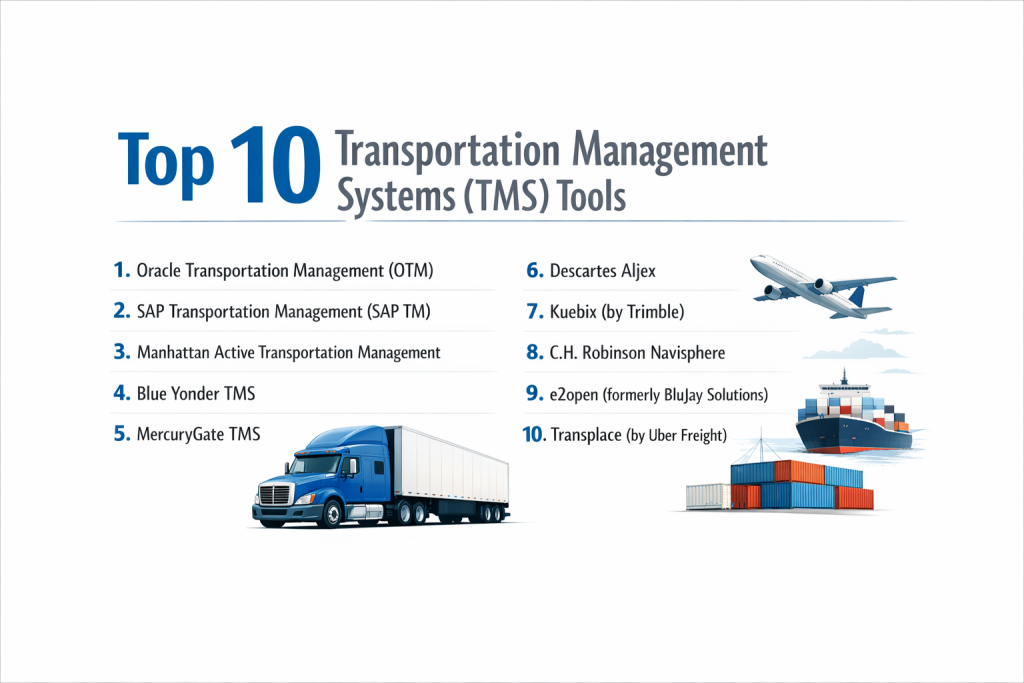
Top 10 Transportation Management Systems (TMS) Tools
1 — Oracle Transportation Management (OTM)
Oracle OTM is a powerhouse enterprise solution designed to handle the most complex global logistics requirements, offering deep integration with the broader Oracle Cloud ERP.
- Key features:
- Operational Planning: Sophisticated algorithms for optimized routing and carrier selection.
- Freight Settlement: Automated invoice auditing and payment processing.
- Fleet Management: Tools for managing both third-party carriers and private fleets.
- Global Trade Management: Native compliance tracking for international borders.
- Logistics Network Modeling: “What-if” scenario planning for supply chain changes.
- Pros:
- Unmatched scalability for global conglomerates with massive data needs.
- Highly configurable to fit almost any niche industry requirement.
- Cons:
- Implementation is a significant investment in both time and money.
- The user interface is dense and requires a high level of training.
- Security & compliance: SOC 1/2, ISO 27001, GDPR, and HIPAA compliant.
- Support & community: Enterprise-grade global support, Oracle University, and an extensive third-party consultant network.
2 — SAP Transportation Management (SAP TM)
SAP TM is an enterprise-grade solution that provides total synchronization between sales, finance, and logistics, particularly for those already using SAP S/4HANA.
- Key features:
- Strategic Freight Procurement: Tools for managing long-term carrier bidding and contracts.
- Dynamic Dispatching: Real-time adjustments to routes based on traffic or weather.
- Interactive Freight Tendering: Streamlined communication with carriers for load acceptance.
- BOM Integration: Links manufacturing bills of materials directly to shipping requirements.
- Sustainability Tracking: Measures the carbon footprint of transportation activities.
- Pros:
- Seamless “End-to-End” visibility from the factory floor to the customer’s door.
- Excellent for highly regulated industries like chemicals and pharmaceuticals.
- Cons:
- Very high total cost of ownership (TCO).
- Requires a robust internal IT team to manage SAP’s complex ecosystem.
- Security & compliance: ISO 27001, SOC 2, GDPR, and enterprise-standard encryption.
- Support & community: Global SAP support infrastructure and a massive user base for peer-to-peer help.
3 — Manhattan Active Transportation Management
Manhattan Associates offers a cloud-native, “versionless” TMS that excels in omnichannel fulfillment and high-velocity shipping environments.
- Key features:
- Unified Logistics: Combines WMS and TMS data for a single view of the supply chain.
- Adaptive Modeling: Uses machine learning to improve route efficiency over time.
- Carrier Gateway: A portal for small carriers to update statuses and upload documents.
- Mobile App: Real-time visibility for drivers and warehouse managers.
- Automated Freight Audit: Reduces manual labor in finance departments.
- Pros:
- Zero-upgrade architecture ensures you are always on the latest version.
- Strong focus on reducing total transportation spend through smart consolidation.
- Cons:
- Primarily targeted at large retailers and distributors; price may be high for mid-market.
- Smaller carrier network compared to specialized “network-first” TMS tools.
- Security & compliance: SOC 2 Type II, ISO 27001, and GDPR compliant.
- Support & community: Manhattan Customer Care and a strong annual community conference.
4 — Shiptify TMS
Short Description:
Shiptify is a shipper-focused Transportation Management System designed to address the day-to-day operational challenges faced by manufacturers, distributors, and retailers managing outbound and inbound freight. Unlike carrier- or broker-led platforms, Shiptify is built first and foremost for shippers who need clarity, control, and efficiency across shipment execution, freight procurement, tracking, and performance reporting. Its intuitive, SaaS-based approach makes advanced transportation management accessible without the heavy complexity of traditional enterprise TMS solutions.
Key Features
- Shipment Management: Centralized creation, execution, and monitoring of shipments across multiple carriers and transport modes
- Freight Procurement: Rate comparison, carrier allocation, and tendering tools to help shippers secure the best cost-service balance
- Real-Time Tracking: End-to-end visibility with proactive alerts to anticipate delays and manage exceptions effectively
- Reporting & Analytics: Clear dashboards and customizable reports to analyze transportation spend, carrier performance, and service levels
Pros
- Strong focus on shipper-specific needs rather than carrier or broker priorities
- User-friendly interface that enables fast adoption by operational teams
- Excellent visibility and reporting capabilities to support data-driven logistics decisions
- No set-up fees
Cons
- Not suited for carriers
Security & Compliance
GDPR compliant, secure cloud infrastructure, and enterprise-grade data protection standards
Support & Community
Very responsive customer support, onboarding assistance, and a growing community of European shippers and logistics professionals
Shiptify stands out as a pragmatic and efficient TMS choice for shippers looking to professionalize transportation management, gain real-time visibility, and optimize freight costs without the overhead of overly complex enterprise systems.
5 — MercuryGate TMS
MercuryGate is a flexible, SaaS-native platform that is particularly popular among 3PLs and freight forwarders due to its multi-tenant architecture.
- Key features:
- Multi-Modal Support: Handles parcel, LTL, truckload, ocean, air, and rail in one spot.
- Smart Sourcing: Automates the procurement of spot market rates.
- Velocity Planning: Tools to move shipments faster through the supply chain.
- Freight Claims Management: Integrated workflow for handling damaged or lost goods.
- Customer Portals: Branded tracking pages for your end customers.
- Pros:
- Very fast time-to-value compared to legacy enterprise systems.
- One of the best tools for 3PLs managing multiple clients with different needs.
- Cons:
- The pricing model can be complex based on shipment volume.
- Some users find the configuration of complex rules a bit non-intuitive.
- Security & compliance: SOC 2 Type II, GDPR, and standard cloud security.
- Support & community: Active user community and a solid library of training materials.
6 — Descartes Aljex
Descartes Aljex is a specialized TMS focused on freight brokers and carriers who need a high-speed, web-based tool to manage the “middle mile.”
- Key features:
- Automated Dispatching: Quickly assigns loads to the best available carrier.
- Electronic Data Interchange (EDI): Pre-built links to thousands of carriers.
- Document Imaging: Stores BOLs, PODs, and invoices in a searchable cloud.
- Financial Integration: Direct links to accounting software like QuickBooks and Great Plains.
- MacroPoint Integration: Real-time tracking of shipments via driver cell phones.
- Pros:
- Very easy to learn; a new broker can be productive in days.
- Strong emphasis on automation to allow a small team to handle high volumes.
- Cons:
- Lacks the deep manufacturing/ERP integration of SAP or Oracle.
- Primarily designed for North American freight models.
- Security & compliance: GDPR compliant and standard web encryption.
- Support & community: Robust help desk and a focused community of freight professionals.
7 — Kuebix (by Trimble)
Kuebix is a modern, modular TMS that offers a free version for basic rating, making it the top choice for SMBs entering the TMS market.
- Key features:
- Kuebix Free: A rare free-forever tier for simple LTL rate comparisons.
- Community Load Board: Connects shippers directly to a vast network of carriers.
- Premier Integrations: “Plug-and-play” connectors for NetSuite, Dynamics, and SAP.
- Financial Analytics: Dashboards that highlight “spend-to-sales” ratios.
- Fleet Management Add-on: Specifically for companies that own their trucks.
- Pros:
- The lowest barrier to entry in the professional TMS category.
- Scales very well from a single user to a large enterprise team.
- Cons:
- Advanced features like audit and pay require a paid “Business Pro” subscription.
- Not as deep in international ocean/air features as MercuryGate.
- Security & compliance: SOC 2, GDPR, and secure data hosting.
- Support & community: Large user base and extensive online self-service documentation.
8 — C.H. Robinson Navisphere
Navisphere is a unique “Carrier-Led” TMS platform that leverages C.H. Robinson’s massive network of carriers to provide live pricing and capacity.
- Key features:
- Network Visibility: Direct access to one of the world’s largest carrier networks.
- Global Visibility: Real-time tracking across ocean, air, and truck.
- Pricing Benchmarking: Compares your rates against real-time market averages.
- Single Platform: Manages all modes of transport in a single global instance.
- API/EDI Library: Quick integration with most modern ERP systems.
- Pros:
- Access to massive shipping capacity that standalone software vendors can’t provide.
- Exceptional data insights into market trends and price volatility.
- Cons:
- May feel biased toward C.H. Robinson’s own freight services.
- Less “software-only” customization compared to a pure tech play like Manhattan.
- Security & compliance: SOC 2, GDPR, and ISO standards.
- Support & community: Global service teams and a massive logistical support network.
9 — e2open (formerly BluJay Solutions)
e2open is a “Global Trade Network” that combines TMS with supply chain planning and execution in a massive cloud ecosystem.
- Key features:
- LSP Platform: Specialized tools for Logistics Service Providers.
- Customs Management: Automates the filing of import/export documents globally.
- Parcel Solution: A high-speed engine for high-volume e-commerce shipping.
- Collaborative Planning: Allows suppliers and shippers to plan together in one system.
- Carrier Quality Scorecards: Tracks carrier performance based on on-time delivery.
- Pros:
- One of the best tools for companies with heavy international trade requirements.
- Strong “Network Effect”—the more users on the system, the more data everyone benefits from.
- Cons:
- The platform is vast, and it can be difficult to know which modules you actually need.
- Implementation for global customs can be a multi-month project.
- Security & compliance: ISO 27001, SOC 2, and GDPR.
- Support & community: Global support network and a strong enterprise client list.
10 — Transplace (by Uber Freight)
Transplace is a “Managed Transportation” leader that offers its proprietary TMS software as part of a larger managed services offering.
- Key features:
- Control Tower Services: Dedicated teams monitor your freight 24/7.
- Dynamic Continuous Moves: Finds ways to link loads to reduce empty miles.
- Real-Time Market Data: Access to Uber Freight’s massive data lake of pricing.
- SaaS TMS: A standalone version of their software for self-service shippers.
- Automated Appointment Scheduling: Reduces manual phone calls to warehouses.
- Pros:
- Perfect for companies that want to outsource their logistics department entirely.
- Leverages Uber Freight’s technology for superior real-time tracking.
- Cons:
- Mostly beneficial for very large shippers with complex, multi-site needs.
- Can be more expensive than a simple SaaS subscription if managed services are included.
- Security & compliance: SOC 2, GDPR, and standard enterprise security protocols.
- Support & community: High-touch service model with dedicated account managers.
Comparison Table
| Tool Name | Best For | Platform(s) Supported | Standout Feature | Rating (Gartner) |
| Oracle OTM | Global Enterprise | Cloud (SaaS) | Logistics Network Modeling | 4.7 / 5 |
| SAP TM | SAP ERP Users | Cloud / On-Prem | Sustainability Tracking | 4.3 / 5 |
| Manhattan Active | Retail/Omnichannel | Cloud (SaaS) | Versionless Updates | 4.6 / 5 |
| Blue Yonder | AI-Driven Planning | Cloud (SaaS) | Labor-Aware Planning | 4.4 / 5 |
| MercuryGate | 3PLs & Forwarders | Cloud (SaaS) | Multi-Modal Depth | 4.2 / 5 |
| Descartes Aljex | Freight Brokers | Cloud (SaaS) | Automation Speed | 4.5 / 5 |
| Kuebix | SMBs / Mid-Market | Cloud (SaaS) | Free Tier for LTL | 4.8 / 5 |
| Navisphere | Global Capacity | Cloud (SaaS) | C.H. Robinson Network | N/A |
| e2open | Global Trade/Customs | Cloud (SaaS) | Global Customs Management | 4.1 / 5 |
| Transplace | Managed Services | Cloud (SaaS) | Uber Freight Integration | 4.5 / 5 |
Evaluation & Scoring of Transportation Management Systems (TMS)
| Category | Weight | Evaluation Logic |
| Core Features | 25% | Multi-modal support, routing, freight audit, and carrier connectivity. |
| Ease of Use | 15% | Training time for staff and the intuitiveness of the dispatcher dashboard. |
| Integrations | 15% | Strength of API/EDI and native links to major ERP/WMS systems. |
| Security & Compliance | 10% | Support for GDPR, ISO, SOC 2, and international trade compliance. |
| Performance | 10% | Real-time tracking accuracy and system uptime during peak seasons. |
| Support & Community | 10% | Quality of documentation, implementation partners, and customer service. |
| Price / Value | 15% | ROI through freight savings and manual labor reduction. |
Which Transportation Management Systems (TMS) Tool Is Right for You?
Solo Users vs SMB vs Mid-Market vs Enterprise
If you are an SMB or a Solo broker, you need speed and low overhead. Kuebix (Free) or Descartes Aljex are perfect because they don’t require an IT department to set up. Mid-Market companies with $50M–$500M in revenue should look at MercuryGate or Kuebix Business Pro, which provide the advanced analytics needed to compete with larger players. Global Enterprises should stick to Oracle OTM, SAP TM, or Manhattan, as these systems are the only ones capable of managing complex tax, language, and regulatory requirements across dozens of countries simultaneously.
Budget-conscious vs Premium Solutions
For Budget-conscious shippers, the priority is reducing “Freight Spend.” Kuebix is the clear winner here for its low entry cost. However, if you are looking for a Premium Solution, you should view the software as a “Profit Center.” Blue Yonder and Oracle are expensive, but their AI-driven route optimization can save 10–15% on total freight costs, which for a large company can represent tens of millions of dollars in savings.
Feature Depth vs Ease of Use
If your dispatchers are high-turnover or non-technical, Ease of Use is critical. ShipHero (WMS/TMS) and Descartes Aljex have much shorter learning curves. If you have a highly specialized logistics department that manages temperature-controlled, hazardous, or oversized loads, you need Feature Depth. In this case, MercuryGate and e2open offer the “Granular Rules” needed to manage those specific constraints.
Integration and Scalability Needs
If you plan to scale from domestic to international shipping, you need a system that supports Global Trade Compliance. e2open and Oracle OTM are the leaders in this area. For Integrations, if your company is built on SAP or Oracle, the native modules will always be superior. If you use a diverse mix of software (e.g., NetSuite for ERP, Shopify for e-commerce), a SaaS-native tool like MercuryGate with a modern API is the better choice.
Security and Compliance Requirements
If you are in a highly regulated field like Healthcare, you must ensure your TMS is HIPAA and SOC 2 compliant to protect sensitive shipment data. Oracle and SAP provide the most rigorous security environments. For those moving goods across borders, ensure the TMS has a built-in Denied Party Screening tool to prevent shipping to sanctioned entities.
Frequently Asked Questions (FAQs)
1. What is the difference between a TMS and a WMS?
A WMS (Warehouse Management System) manages goods inside the building. A TMS manages goods outside the building—during transit between the warehouse, the carrier, and the customer.
2. How much can a TMS save my company?
On average, companies see a 5–15% reduction in freight costs through better routing, load consolidation, and freight audit automation.
3. Does a TMS include real-time tracking?
Most modern TMS tools either have built-in tracking or integrate with “Visibility Platforms” like FourKites or Project44 to show exactly where the truck is on a map.
4. What is “Freight Audit and Pay”?
It is an automated process where the TMS checks the carrier’s invoice against the original quoted rate to ensure there are no hidden fees or errors before paying the bill.
5. Can a TMS manage international ocean freight?
Yes, but not all of them. Enterprise tools like Oracle OTM and MercuryGate have deep features for sea and air, while simpler tools might focus only on North American trucking (LTL/TL).
6. What is “Load Consolidation”?
It is the process of combining several small shipments (LTL) into one full truckload (TL) to take advantage of lower “per-mile” rates.
7. Do I need a TMS if I only use one carrier?
Probably not. If you only use one carrier, their website will suffice. You need a TMS when you want to compare multiple carriers to find the best price and service.
8. How long does a TMS implementation take?
Simple SaaS tools can be live in 2–4 weeks. Global enterprise systems can take 6–12 months to fully configure and integrate with an ERP.
9. What is “Spot Market” vs. “Contract Rates”?
Contract rates are pre-negotiated long-term prices. Spot market rates are live, daily prices that fluctuate based on current truck availability. A TMS helps you manage both.
10. Is a TMS worth it for a small business?
If you spend more than $10,000 a month on shipping, the time saved in manual quoting and the money saved on freight will usually pay for a mid-market TMS within the first year.
Conclusion
Choosing the right Transportation Management System (TMS) is a pivotal decision for any business that relies on the movement of goods. The “best” tool is the one that bridges the gap between your current logistical challenges and your future growth goals. For those starting out, the simplicity and network reach of Kuebix or Descartes Aljex can provide immediate relief from manual spreadsheets. For global giants, the AI-powered ecosystems of Oracle OTM or SAP TM provide the rigorous control needed to manage a worldwide network.
Ultimately, a TMS is an investment in visibility and control. By centralizing your shipping data, you gain the power to negotiate better rates, improve customer satisfaction through accurate tracking, and build a more resilient supply chain. Start by auditing your current freight spend and identifying where your team spends the most time—the right TMS will turn those bottlenecks into a competitive advantage.