Introduction
Trade Finance Platforms are digital ecosystems designed to facilitate, manage, and secure international commerce transactions between buyers, sellers, and financial institutions. In the traditional world of trade, processes were notoriously paper-heavy, involving physical Letters of Credit (LCs), bills of lading, and manual document verification that could take weeks to clear. Modern trade finance platforms digitize these instruments, providing a “single source of truth” where all parties—including importers, exporters, banks, and insurers—can interact in real-time. By utilizing technologies like blockchain and smart contracts, these platforms automate the execution of trade agreements, ensuring that funds are only released when specific shipping or quality milestones are met and verified digitally.
The importance of these platforms cannot be overstated for global supply chains. They mitigate the “trust gap” inherent in cross-border trade, where the seller fears non-payment and the buyer fears non-delivery. By providing liquidity through invoice factoring, supply chain finance, and bank guarantees, these tools ensure that businesses have the working capital needed to fulfill large orders. Furthermore, as regulatory scrutiny increases, these platforms offer automated compliance screening for Anti-Money Laundering (AML) and Sanctions, reducing the risk of costly legal errors. In an era of volatile markets, having a centralized digital hub for trade operations is the difference between a resilient supply chain and a stagnant one.
Key Real-World Use Cases
Trade finance platforms serve as the backbone for various high-stakes commercial scenarios:
- Export-Import Facilitation: Coordinating complex Letters of Credit between a manufacturer in Asia and a retailer in Europe to ensure secure payment upon shipment.
- Supply Chain Finance (SCF): Allowing large buyers to “reverse factor” their payables, enabling smaller suppliers to receive early payment based on the buyer’s credit rating.
- Dynamic Discounting: Enabling cash-rich buyers to offer early payments to suppliers in exchange for a discount, optimizing the internal rate of return for the buyer.
- Inventory and Warehouse Finance: Securing loans against physical goods stored in third-party warehouses, providing liquidity while goods are in transit or storage.
- Digital Document Title Transfer: Using MLETR-compliant tools to transfer the legal ownership of goods via electronic Bills of Lading (eBLs) instantly.
What to Look For (Evaluation Criteria)
When selecting a trade finance platform, organizations should prioritize the following criteria:
- Network Reach: Does the platform have a pre-existing network of global banks and insurers? A tool is only as powerful as the institutions connected to it.
- Compliance and Regulatory Support: Does the system offer automated screening for sanctions, AML, and “Know Your Customer” (KYC) protocols across different jurisdictions?
- Interoperability: Can the platform integrate with your existing Enterprise Resource Planning (ERP) systems like SAP or Oracle, as well as with shipping and logistics trackers?
- Security Standards: Is the platform built on secure, tamper-proof architecture (such as DLT or blockchain) with robust encryption and SOC 2 certification?
Best for:
- Multinational Corporations (MNCs): Managing thousands of suppliers across different continents and needing centralized visibility of trade risk.
- Global Banks: Looking to digitize their trade desks and offer more competitive SCF products to their corporate clients.
- MSMEs and Startups: Small businesses that traditionally struggled to get bank credit but can now use digital footprints to secure invoice financing.
- Logistics and Shipping Firms: Who need to sync document titles with financial triggers for faster port clearance.
Not ideal for:
- Domestic-Only Businesses: Companies that do not deal with cross-border regulations, foreign exchange, or complex payment instruments.
- Low-Volume Traders: Firms with only a handful of annual transactions where the setup cost of a platform might outweigh the benefits of manual processing.
- Cash-on-Delivery (COD) Operations: Simple retail models where credit terms and financial intermediaries are not part of the transaction flow.
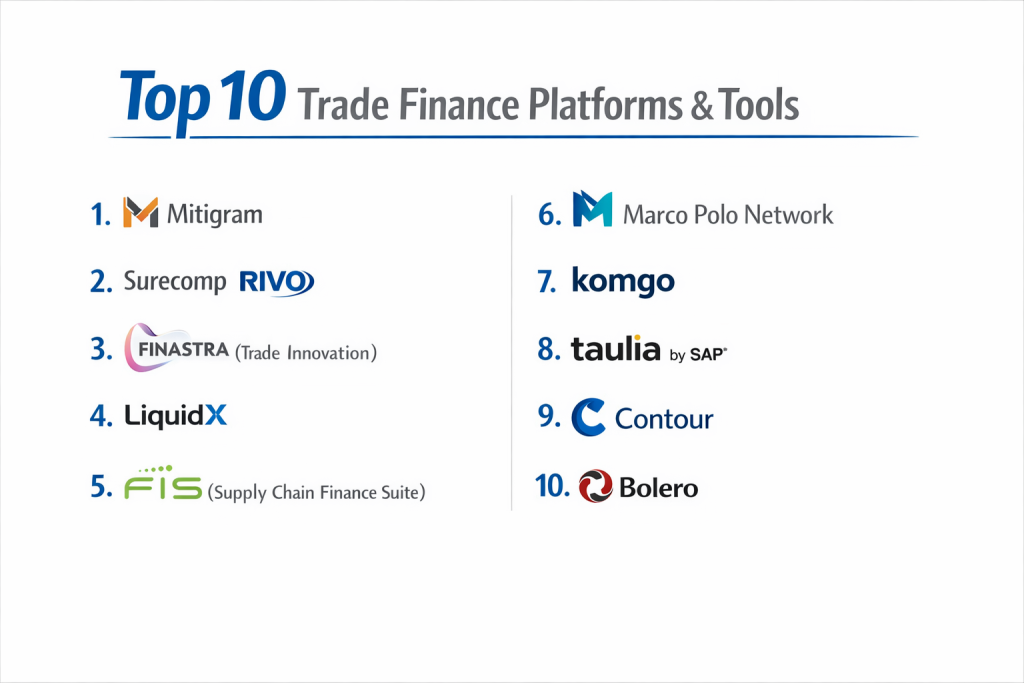
Top 10 Trade Finance Platforms Tools
1 — Mitigram
Mitigram is a premier digital marketplace for global trade finance, providing a multi-bank, multi-instrument ecosystem. It is designed to streamline the way corporations communicate with their banks to get the best pricing and capacity for trade risks.
Key features:
- Multi-Bank Quotation: Allows corporations to send requests for quotes (RFQs) to multiple banks simultaneously.
- Universal Market Network: Access to risk capacity in over 100 markets through a single interface.
- Automated Transaction Execution: Digitizes the process of issuing Letters of Credit and Bank Guarantees.
- Real-Time Risk Assessment: Provides instant visibility into bank appetite and country-specific risks.
- Data-Driven Insights: Comprehensive analytics on bank performance and transaction costs.
Pros:
- Exceptional at driving down transaction costs through competitive bidding between banks.
- Very fast implementation compared to traditional core banking upgrades.
Cons:
- Primarily focused on the corporate-to-bank relationship rather than deep supply chain logistics.
- Pricing may be steep for very small businesses with limited bank relationships.
Security & compliance: ISO 27001 certified, GDPR compliant, and uses advanced end-to-end encryption for all RFQ data.
Support & community: High-end enterprise support, dedicated success managers, and a strong community of global treasury leaders.
2 — Surecomp (Rivo)
Surecomp is a long-standing leader in trade finance, and its Rivo platform is a cloud-native solution designed to bridge the gap between corporates and financial institutions for seamless trade automation.
Key features:
- End-to-End Digitization: Handles everything from guarantees and SBLCs to digital document exchange.
- ESG Tracking: Unique ability to track and score the sustainability of specific trade transactions.
- API-First Architecture: Easy integration with ERPs and external data providers.
- Limit Management: Real-time tracking of credit lines across multiple banks and subsidiaries.
- MLETR Compliance: Supports the legal transfer of electronic documents of title.
Pros:
- The ESG scoring feature is world-class for companies focused on green trade.
- Very modular; you can start with just one instrument (like Guarantees) and scale up.
Cons:
- The interface can be complex for users who are not already familiar with trade finance terminology.
- Enterprise-level pricing structure.
Security & compliance: SOC 2 Type II, GDPR, and ISO 27001 compliant.
Support & community: Extensive training academy, knowledge center, and a dedicated partner design session for enterprise clients.
3 — Finastra (Trade Innovation)
Finastra’s Trade Innovation platform is built for the “open banking” era, providing a highly scalable environment for banks to offer sophisticated trade and supply chain finance services.
Key features:
- Open APIs: Connects to a vast ecosystem of fintech apps through the FusionFabric.cloud.
- Intelligent Automation: Uses AI to automate document checking under Letters of Credit.
- Conversational Banking: Features to enhance the corporate-to-bank interaction through modern UI.
- Negotioable Instrument Management: Digitally manages title documents without a central registry.
- Scalable Back-Office: Built to handle the massive transaction volumes of Tier 1 global banks.
Pros:
- The most flexible platform for banks that want to build custom trade products.
- Strong integration with other Finastra banking modules.
Cons:
- Heavy implementation process that often requires significant professional services.
- Not a direct-to-corporate platform; it is primarily a tool for banks.
Security & compliance: FFIEC regulated, SOC 1/2 compliant, and follows strict global banking security standards.
Support & community: Massive global user group and extensive enterprise support network.
4 — LiquidX
LiquidX is a technology company that provides a global network for illiquid assets, specifically focusing on trade finance, working capital, and insurance.
Key features:
- Asset Digitization: Converts invoices and trade assets into digital formats for easier trading.
- Insurance Integration: Direct access to credit insurance markets to protect trade receivables.
- In-Platform Funding: A diverse pool of funders including banks, asset managers, and hedge funds.
- Automated Cash Application: Uses AI to match payments to invoices and resolve discrepancies.
- Advanced Reporting: Real-time visibility into liquidity and counterparty exposure.
Pros:
- Excellent for companies looking to diversify their funding beyond traditional banks.
- Very strong at managing “Accounts Receivable” programs.
Cons:
- The “marketplace” model depends on funder appetite, which can vary by industry.
- Less focused on traditional “Documentary Trade” like LCs.
Security & compliance: SOC 2 Type II compliant and utilizes military-grade encryption for data in transit.
Support & community: High-touch client service team and proactive account management.
5 — FIS (Supply Chain Finance Suite)
FIS is a global leader in financial technology, and its Supply Chain Finance suite is designed for large corporates looking to optimize their working capital.
Key features:
- Reverse Factoring: Robust tools for buyer-led supply chain finance programs.
- Dynamic Discounting: Allows buyers to fund their own supply chain using excess cash.
- Global Funder Network: Access to over 250 funders globally.
- Treasury Integration: Seamlessly connects with FIS treasury management systems.
- Supplier Onboarding: Automated tools to bring thousands of suppliers onto the platform quickly.
Pros:
- The scale of the funder network is unmatched for large global programs.
- Exceptional at managing “Off-Balance Sheet” financing structures.
Cons:
- Can be “overkill” for companies that only need basic trade finance tools.
- Implementation is a significant enterprise undertaking.
Security & compliance: Highly regulated global provider; SOC 1/2, PCI DSS, and ISO 27001 compliant.
Support & community: Global 24/7 support and comprehensive professional services.
6 — Marco Polo Network
The Marco Polo Network is a prominent blockchain-based trade finance network that focuses on transparency and automated settlement between trading partners.
Key features:
- Distributed Ledger Technology (DLT): Ensures that all parties see the same data at the same time.
- Payment Commitment: Automated triggers for payment based on digital data matching.
- Receivables Discounting: Fast access to cash for suppliers based on validated trade data.
- ERP-Embedded: Works directly within the user’s ERP system for a seamless experience.
- Secure Data Exchange: Eliminates the need for traditional paper-based document sharing.
Pros:
- Virtually eliminates the “reconciliation” errors that plague traditional trade.
- High level of trust and transparency due to the blockchain architecture.
Cons:
- Requires all parties (Buyer, Seller, Bank) to be on the network for maximum benefit.
- Blockchain technology still faces adoption hurdles in some emerging markets.
Security & compliance: Built on R3 Corda, which is designed for highly regulated financial environments; GDPR compliant.
Support & community: Active member community and collaborative governance model.
7 — Komgo
Komgo is a Swiss-based venture that specializes in the commodity trade finance sector, providing a secure ecosystem for the high-value energy and metals industries.
Key features:
- Trakk: A digital tool to track and verify the authenticity of trade documents.
- Konsole: A standardized communication tool for banks and corporates.
- Structured Trade Finance: Specific modules for commodity-backed lending.
- KYC Repository: Centralized storage for compliance documents to speed up onboarding.
- Secure Messaging: Replaces unsecure emails with an encrypted, auditable thread.
Pros:
- The “industry standard” for the global commodity trading sector.
- Incredible focus on fraud prevention and document authenticity.
Cons:
- Very niche focus; not ideal for general retail or service-based trade.
- Higher barrier to entry for smaller, non-commodity firms.
Security & compliance: SOC 2 Type II and GDPR compliant; uses decentralized storage for sensitive data.
Support & community: Backed by the world’s largest commodity banks and trading houses.
8 — Taulia (by SAP)
Taulia is a leading provider of working capital management solutions, now integrated deeply into the SAP ecosystem, focusing on the “Financial Supply Chain.”
Key features:
- SAP Native Integration: The most seamless experience for companies already running SAP S/4HANA.
- Flexible Funding: Switch between using bank capital or the company’s own cash for SCF.
- AI-Powered Cash Forecasting: Predicts when suppliers are likely to take early payments.
- Self-Service Supplier Portal: Easy-to-use interface for suppliers to manage their invoices.
- Inventory Financing: Newer modules to fund goods before they are even invoiced.
Pros:
- If you use SAP, the “Ease of Use” and integration are unbeatable.
- Very high supplier adoption rates due to the intuitive portal.
Cons:
- Less effective for companies using non-SAP ERP systems.
- Heavy focus on payables rather than traditional documentary trade.
Security & compliance: SOC 1/2 Type II and GDPR compliant; rigorous SAP security standards.
Support & community: Massive user community and enterprise-grade global support.
9 — Contour
Contour is a digital trade finance network that focuses specifically on the digitization of Letters of Credit using blockchain technology.
Key features:
- LC Digitization: Reduces the LC processing time from 10 days to under 24 hours.
- Real-Time Collaboration: Buyers and sellers can draft and amend LCs in a shared space.
- Global Bank Network: Includes many of the largest trade banks in Asia and Europe.
- Reduced Discrepancies: Automated checks ensure data consistency before submission.
- Paperless Workflow: Fully digital issuance, advising, and presentation of documents.
Pros:
- Specifically solves the “Documentary Credit” bottleneck better than almost anyone else.
- Significant reduction in bank fees associated with manual document handling.
Cons:
- Newer than some legacy providers, so the bank network is still growing.
- Focused primarily on LCs rather than broader supply chain finance.
Security & compliance: ISO 27001 and GDPR compliant; built on secure DLT architecture.
Support & community: Dedicated onboarding team and an active network of innovative trade banks.
10 — Bolero
Bolero is a pioneer in electronic trade documentation, providing a secure platform for the exchange of e-bills of lading and other critical trade documents.
Key features:
- eBL (Electronic Bill of Lading): Market-leading solution for digital document title transfer.
- Galileo Platform: A modern, cloud-native interface for managing trade transactions.
- Multi-Banking Connectivity: Connects to a wide range of global trade banks.
- Document Digitization: Tools to convert physical documents into secure digital assets.
- Audit Trail: Comprehensive, unalterable log of every document movement.
Pros:
- The most “trusted” name for digital bills of lading in the shipping industry.
- Deeply understood by customs authorities and port operators globally.
Cons:
- The user interface has been modernized recently but can still feel technical.
- Focused more on the “Document” side than the “Financing/Funding” side.
Security & compliance: ISO 27001 and MLETR compliant; robust legal framework for digital titles.
Support & community: Global support teams and decades of experience in maritime and trade law.
Comparison Table
| Tool Name | Best For | Platform(s) Supported | Standout Feature | Rating |
| Mitigram | Price Discovery | Cloud (SaaS) | Multi-Bank RFQ Engine | N/A |
| Surecomp | ESG & Corporates | Cloud / Hybrid | Transactional ESG Scoring | N/A |
| Finastra | Global Banks | Cloud / On-Prem | Open API Ecosystem | N/A |
| LiquidX | Receivable Finance | Cloud (SaaS) | Credit Insurance Integration | N/A |
| FIS | Enterprise SCF | Cloud / Hybrid | 250+ Funder Network | N/A |
| Marco Polo | DLT Transparency | Blockchain (DLT) | Automated Settlement | N/A |
| Komgo | Commodities | Cloud / DLT | Document Authenticity (Trakk) | N/A |
| Taulia | SAP Users | Cloud / SAP Native | AI Cash Forecasting | N/A |
| Contour | Digital LCs | Blockchain (DLT) | LC Processing Speed | N/A |
| Bolero | Digital Documents | Cloud (SaaS) | e-Bill of Lading Leadership | N/A |
Evaluation & Scoring of Trade Finance Platforms
| Criterion | Weight | Evaluation Focus |
| Core Features | 25% | LC automation, eBL support, SCF, and risk mitigation tools. |
| Ease of Use | 15% | Supplier portal UX, dashboard clarity, and onboarding speed. |
| Integrations | 15% | Native ERP support (SAP/Oracle), API depth, and logistics sync. |
| Security & Compliance | 10% | SOC 2 status, AML/KYC screening, and MLETR compliance. |
| Performance | 10% | Transaction throughput, cloud uptime, and document processing speed. |
| Support | 10% | 24/7 global availability, training academy, and account management. |
| Price / Value | 15% | ROI through fee reduction and working capital optimization. |
Which Trade Finance Platform Is Right for You?
Solo Users vs SMB vs Mid-Market vs Enterprise
Solo traders and very small SMBs might find enterprise platforms too heavy; they are often best served by the “lite” versions of Chaser for simple receivables or the Bolero portal for basic document management. Mid-Market firms looking for the best financing rates should prioritize Mitigram, as it empowers them to shop their risk to multiple banks. Large Enterprises with thousands of suppliers require the heavy-duty automation of FIS or Taulia (if using SAP) to manage working capital at scale.
Budget-Conscious vs Premium Solutions
If you are budget-conscious, look for platforms that offer a “pay-per-use” or transactional pricing model, such as certain modules within Surecomp. Premium solutions like Finastra or LiquidX require significant investment but offer massive ROI through the reduction of “Days Sales Outstanding” (DSO) and the unlocking of millions in trapped cash.
Feature Depth vs Ease of Use
For Feature Depth in specific niches—like commodities—Komgo is unrivaled, though it requires specialized knowledge. For Ease of Use, Taulia and Mitigram have the most modern, consumer-grade interfaces that require minimal training for treasury teams.
Integration and Scalability Needs
If your primary need is to scale a global supply chain finance program across 20 countries, FIS and LiquidX provide the necessary funder breadth. For integration with a modern tech stack, the API-first approach of Surecomp (Rivo) or Finastra is the most future-proof choice.
Security and Compliance Requirements
Companies operating in high-risk jurisdictions or industries must prioritize Security. Komgo and Marco Polo provide the highest levels of data integrity through decentralized technology. For those selling to government or major banking entities, the SOC 2 Type II and ISO 27001 certifications of Surecomp and FIS are mandatory.
Frequently Asked Questions (FAQs)
What is a Letter of Credit (LC)?
An LC is a bank’s guarantee that a seller will receive payment as long as certain delivery conditions are met. If the buyer cannot pay, the bank covers the cost.
How does a platform speed up trade?
By replacing physical couriers with digital document transfers (eBLs), platforms reduce the time to clear a trade from weeks to hours.
What is “Reverse Factoring”?
It is a form of Supply Chain Finance where a buyer allows their suppliers to get paid early by a bank, using the buyer’s (usually higher) credit rating.
What is MLETR?
The Model Law on Electronic Transferable Records (MLETR) is a legal framework that allows electronic documents to have the same legal standing as paper titles.
Can these platforms help with ESG goals?
Yes, platforms like Surecomp allow you to track the environmental and social impact of your suppliers directly within the trade transaction.
Is blockchain necessary for trade finance?
No, but it is highly effective at ensuring “non-repudiation”—meaning no one can change a document or a transaction record once it is logged.
What is a Bill of Lading?
It is a legal document between a shipper and a carrier that serves as a receipt of goods and a document of title (ownership).
Do these platforms integrate with QuickBooks?
Smaller-market tools like Taulia or various middleware can connect trade finance to QuickBooks, though most are built for enterprise ERPs like SAP.
How do platforms prevent fraud?
By using AI to spot “double financing” (trying to get a loan for the same invoice twice) and verifying document authenticity through digital signatures.
What is the “Trust Gap” in trade?
It refers to the risk where an exporter doesn’t want to ship without payment, and an importer doesn’t want to pay without receiving the goods.
Conclusion
Global trade is transitioning from an era of “paper and patience” to one of “data and speed.” As we navigate the complexities of 2026, the adoption of a Trade Finance Platform is no longer a luxury for the elite—it is a survival requirement for any firm involved in international commerce. Whether you prioritize the competitive bidding of Mitigram, the blockchain transparency of Marco Polo, or the SAP-native simplicity of Taulia, the goal remains to unlock liquidity and minimize risk.
When making your final choice, remember that the “best” tool is the one that your suppliers and your banks will actually use. A platform with 1,000 features is useless if your core banking partners aren’t connected. Focus on network reach and compliance automation, and you will build a trade operation that is as resilient as it is profitable.