Introduction
Test Data Management (TDM) tools are specialized software solutions designed to plan, create, mask, and deliver data to non-production environments for the purposes of testing, development, and training. Unlike standard database management, TDM focuses on ensuring that data is “fit for purpose”—meaning it is syntactically correct, contains the necessary edge cases for testing logic, and is sanitized of any Personally Identifiable Information (PII) to ensure compliance with global privacy laws.
The importance of TDM lies in its ability to solve the “data bottleneck.” Without these tools, QA teams often spend up to 40% of their time simply waiting for data or manually creating it. TDM tools automate the provision of realistic datasets, which is critical for the success of CI/CD pipelines.
Key Real-World Use Cases
- Privacy Compliance: Automatically masking sensitive customer info (names, SSNs, credit cards) so developers can work with realistic data without seeing actual private details.
- Subsetting: Extracting a small, referentially intact slice of a massive production database (e.g., just 5% of customers) to save on storage and speed up test execution.
- Synthetic Data Generation: Creating entirely fake data that mimics real-world patterns for scenarios where production data doesn’t exist yet or is too sensitive to use.
- Gold Copy Management: Creating a “clean” baseline of data that can be “reset” after every test run, ensuring consistency.
Evaluation Criteria
When choosing a tool, users should look for referential integrity (ensuring relationships between tables remain intact after masking or subsetting), data refresh speed, and compliance automation. The ability to integrate with diverse data sources—from legacy mainframes to modern NoSQL clouds—is also a major differentiator.
Best for: Data engineers, QA leads, and DevOps architects in mid-to-large enterprises, specifically in highly regulated sectors like Finance, Healthcare, and E-commerce where data privacy is legally mandated.
Not ideal for: Early-stage startups with very simple data structures or teams that do not handle PII and can get by with basic open-source scripts or manual database dumps.
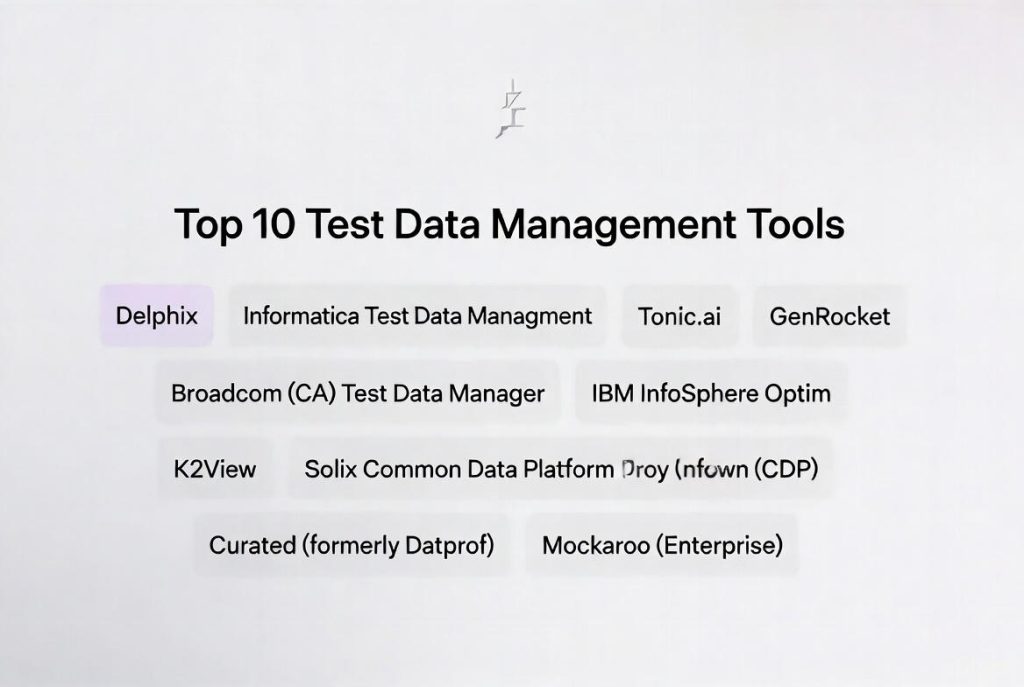
Top 10 Test Data Management Tools
1 — Delphix
Delphix is a heavy hitter in the “Data as Code” space. It focuses on data virtualization, allowing teams to create virtual copies of massive databases in minutes rather than days, while providing integrated masking and compliance features.
- Key Features:
- Data Virtualization that reduces storage footprint by up to 90%.
- “Self-service” data portals for developers to bookmark and reset data.
- Integrated data masking (compliant with GDPR/PCI).
- Time-travel capabilities to roll back datasets to a specific point in time.
- Support for heterogeneous environments (Oracle, SQL Server, SAP, etc.).
- Pros:
- Drastically reduces the time required to provision data for large teams.
- Unique “version control” for data that works like Git.
- Cons:
- Significant enterprise-level pricing that may be prohibitive for smaller companies.
- Steep learning curve for initial configuration and infrastructure setup.
- Security & Compliance: SOC 2, HIPAA, GDPR, and PCI DSS compliant; features robust audit logs and SSO integration.
- Support & Community: High-quality enterprise support, dedicated account managers, and a professional training university.
2 — Informatica Test Data Management
Informatica is a long-standing leader in the data integration space. Their TDM module is part of a broader data governance suite, making it a favorite for large-scale corporate data architectures.
- Key Features:
- Advanced data masking with a massive library of pre-built rules.
- Intelligent data subsetting to create smaller, manageable test beds.
- Automated sensitive data discovery (AI-driven).
- Connectivity to virtually any legacy or modern data source.
- Integration with Informatica’s wider Data Quality and Governance tools.
- Pros:
- Unmatched at handling extremely complex, multi-platform enterprise data.
- Excellent at identifying PII hidden in “forgotten” columns.
- Cons:
- The interface can feel cumbersome and “legacy” compared to modern SaaS tools.
- Requires a highly specialized skillset to manage and maintain.
- Security & Compliance: Global standards compliance (ISO 27001, GDPR, HIPAA); uses advanced encryption and masking.
- Support & Community: Global 24/7 support network and an extensive community of certified professionals.
3 — Tonic.ai
Tonic.ai has quickly become the “modern favorite” for TDM, focusing heavily on synthetic data generation and developer experience. It is built to feel like a modern SaaS tool rather than a legacy enterprise platform.
- Key Features:
- Advanced synthetic data generation that preserves mathematical properties.
- “Differential Privacy” to ensure data cannot be re-identified.
- Native integrations with modern cloud warehouses like Snowflake and BigQuery.
- Collaborative workspaces for team-based data modeling.
- Seamless API for integration into CI/CD pipelines.
- Pros:
- Extremely user-friendly UI that developers actually enjoy using.
- Best-in-class synthetic data quality that stays “in sync” with schema changes.
- Cons:
- While growing, it has fewer legacy connectors (like mainframes) than Informatica.
- Pricing is based on data volume, which can scale rapidly.
- Security & Compliance: SOC 2 Type II, GDPR, HIPAA compliant; SSO and granular RBAC (Role-Based Access Control).
- Support & Community: Rapid response via Slack/email and a very modern, searchable documentation site.
4 — GenRocket
GenRocket takes a unique approach by focusing almost exclusively on “Real-time Synthetic Data Generation” rather than masking production data. It is designed for high-velocity Agile and DevOps teams.
- Key Features:
- Ability to generate millions of rows of data in seconds.
- “G-Cases” which allow testers to define specific data scenarios.
- Self-service modules for testers to generate their own data.
- Support for over 100 different data formats (SQL, NoSQL, JSON, XML).
- Lightweight architecture that fits into any automation framework.
- Pros:
- Eliminates the risk of using production data entirely.
- Incredibly fast and scales well for load/performance testing.
- Cons:
- Requires a shift in mindset (learning to “model” data rather than copy it).
- Initial setup of complex data relationships can be time-consuming.
- Security & Compliance: Secure by design (it doesn’t touch production data); SOC 2 and GDPR compliant.
- Support & Community: Excellent training via “GenRocket University” and responsive technical support.
5 — Broadcom (CA) Test Data Manager
Formerly CA Test Data Manager, this tool is a comprehensive platform for the entire data lifecycle. It is particularly strong in environments that require high levels of automation and integration with Rally or Jira.
- Key Features:
- Visual data modeling to map out complex relationships.
- “Test Data On-Demand” portal for self-service provisioning.
- Integrated data reservation to prevent two testers from using the same data.
- High-performance masking and subsetting engines.
- Deep integration with the Broadcom (CA) DevOps suite.
- Pros:
- Very powerful at managing “stateful” data across long-running tests.
- Excellent for large-scale industrial or financial applications.
- Cons:
- Heavy footprint; requires significant server resources.
- The licensing model can be complex and expensive.
- Security & Compliance: Enterprise-grade; SOC 2, ISO, and GDPR ready with extensive audit trails.
- Support & Community: Professional enterprise support and a large user base within the Atlassian/Broadcom ecosystem.
6 — IBM InfoSphere Optim
IBM Optim is a stalwart in the TDM industry, offering specialized solutions for data growth, privacy, and decommissioning. It is a go-to for organizations heavily invested in IBM infrastructure (DB2, Mainframes).
- Key Features:
- Superior handling of mainframe and non-relational data.
- Data growth management through archiving and subsetting.
- Broad support for SAP, Oracle, and Salesforce applications.
- Policy-driven data masking and redaction.
- Strong “de-identification” features for regulatory compliance.
- Pros:
- Rock-solid reliability; used by the world’s largest banks.
- Capable of handling data structures that modern SaaS tools can’t touch.
- Cons:
- The learning curve is very steep; requires IBM-specific expertise.
- Not as agile or “DevOps-friendly” as newer cloud-native tools.
- Security & Compliance: HIPAA, GDPR, and FIPS compliant; utilizes advanced encryption and audit logs.
- Support & Community: IBM’s massive global support infrastructure and professional services.
7 — K2View
K2View approaches TDM through a “Business Entity” lens. Instead of moving tables, it moves “entities” (like a Customer, a Loan, or an Order), which ensures perfect referential integrity across disparate systems.
- Key Features:
- Patented Micro-Database technology for each business entity.
- Real-time data movement and masking.
- Support for complex, multi-source environments (Legacy + Cloud).
- Self-service portal with “Shop for Data” functionality.
- Dynamic masking that changes based on user roles.
- Pros:
- Solves the “referential integrity” problem better than almost any other tool.
- Very fast provisioning of specific, cross-functional datasets.
- Cons:
- Deployment can be complex as it requires defining the “entity” model first.
- Higher price point targeted at the upper-enterprise market.
- Security & Compliance: SOC 2, HIPAA, GDPR compliant; features 256-bit encryption and SSO.
- Support & Community: High-touch enterprise support and dedicated implementation partners.
8 — Solix Common Data Platform (CDP)
Solix provides a unified platform for data management, archiving, and TDM. It is particularly well-suited for companies looking to combine TDM with data lake management.
- Key Features:
- Unified repository for production and non-production data.
- Enterprise-grade masking and subsetting for Big Data (Hadoop, etc.).
- Integrated data discovery and PII scanning.
- Low-cost storage options for archived test data.
- Support for multi-cloud deployments.
- Pros:
- Great “all-in-one” value for companies with massive data lakes.
- Excellent compliance reporting and data governance dashboards.
- Cons:
- May feel “overkill” if you only need simple test data masking.
- Integration with certain DevOps tools is not as mature as Delphix.
- Security & Compliance: GDPR, HIPAA, and Sarbanes-Oxley (SOX) compliant.
- Support & Community: Reliable professional support and a growing ecosystem of global partners.
9 — Curated (formerly Datprof)
Curated (by Datprof) is a European-based solution that has gained significant traction for its focus on simplicity and compliance. It is designed to be lightweight and easy to implement in standard SQL environments.
- Key Features:
- Intuitive “Rules Designer” for data masking.
- Automated subsetting that maintains all foreign key constraints.
- Portal for managing and sharing test data versions.
- Native support for Oracle, SQL Server, Postgres, and MySQL.
- Compliance dashboards specifically tailored for GDPR.
- Pros:
- Much faster time-to-value than the “big” enterprise suites.
- Transparent, more accessible pricing for the mid-market.
- Cons:
- Fewer integrations with NoSQL or specialized Big Data platforms.
- Documentation is good but the community is smaller than Informatica’s.
- Security & Compliance: GDPR focused; SOC 2 and ISO 27001 compliant.
- Support & Community: Responsive direct support and an active user base in Europe and North America.
10 — Mockaroo (Enterprise)
While many know Mockaroo as a free website for generating random data, their Enterprise version is a powerful TDM tool used by many companies to generate high-volume synthetic data via API.
- Key Features:
- Extremely fast CSV/JSON/SQL data generation.
- Over 150 types of realistic data (addresses, VIN numbers, etc.).
- Ruby-based scripting for custom data logic.
- API-first design for automated testing workflows.
- On-premise deployment options for secure environments.
- Pros:
- The most affordable professional-grade synthetic data tool.
- Incredibly easy to use for developers; almost zero training required.
- Cons:
- Not built for “masking” production data; purely for synthetic generation.
- Lacks the deep data “discovery” features of IBM or Informatica.
- Security & Compliance: Enterprise version supports local hosting (data never leaves your network); GDPR compliant.
- Support & Community: Email support and a massive community of developers using the free tier.
Comparison Table
| Tool Name | Best For | Platform(s) | Standout Feature | Rating |
| Delphix | Virtualization/DevOps | Multi-Cloud/Hybrid | Data “Time Travel” | 4.7/5 |
| Informatica | Complex Governance | Multi-Cloud/Legacy | AI-Driven PII Discovery | 4.4/5 |
| Tonic.ai | Modern Cloud Tech | SaaS/Cloud | Differential Privacy | 4.8/5 |
| GenRocket | Synthetic Agile Data | All (Format-based) | Real-time Generation | 4.6/5 |
| Broadcom | Industrial Automation | On-Prem/Cloud | Data Reservation | 4.1/5 |
| IBM Optim | Mainframe/Legacy | Mainframe/Oracle | Legacy Reliability | 4.0/5 |
| K2View | Entity-Based Data | Hybrid Cloud | Micro-Database Entities | 4.5/5 |
| Solix | Big Data/Archiving | Cloud/Hadoop | Unified Data Platform | 4.2/5 |
| Curated | Mid-Market GDPR | SQL Databases | Easy Rule Design | 4.3/5 |
| Mockaroo | Low-Cost Synthetic | API/On-Prem | Speed/Ease of Use | 4.5/5 |
Evaluation & Scoring of Test Data Management Tools
| Criteria | Weight | Scoring Context |
| Core Features | 25% | Ability to mask, subset, and generate synthetic data accurately. |
| Ease of Use | 15% | UI/UX, self-service capabilities, and learning curve for teams. |
| Integrations | 15% | API availability and native connectors for CI/CD and cloud warehouses. |
| Security/Compliance | 10% | Certification (SOC 2), encryption standards, and masking quality. |
| Performance | 10% | Speed of data delivery and storage efficiency (virtualization). |
| Support | 10% | Quality of documentation, community, and technical response. |
| Price / Value | 15% | Transparency and ROI for the specific target market. |
Which Test Data Management Tool Is Right for You?
Selecting a TDM tool is a high-stakes decision because it sits at the intersection of developer productivity and legal risk.
By Organization Size
- Solo/Small Teams: If you just need a few thousand rows of fake data for a demo, Mockaroo or the free tier of Tonic.ai is plenty. Don’t overcomplicate it.
- Mid-Market: Look at Curated (Datprof) or GenRocket. These tools offer a professional feature set without the multi-million dollar price tag or the need for a dedicated team to manage the tool.
- Large Enterprise: Informatica, Delphix, and IBM are the standard. They can handle the “spaghetti” of legacy systems that modern startups don’t have.
By Technical Strategy
- “Production Data is Forbidden”: If your security policy says you cannot use production data under any circumstances, go with GenRocket or Tonic.ai for synthetic generation.
- “Speed is Everything”: If your developers are waiting days for DB refreshes, Delphix is the clear winner due to its virtualization technology.
- “Referential Integrity is the Nightmare”: If your data is spread across 20 different systems and a “Customer” must look the same in all of them, K2View‘s entity-based approach will save you months of manual work.
Security and Compliance Requirements
If you are in the European Union, prioritize tools with strong GDPR-specific dashboards like Curated. If you are in Healthcare (US), ensure the vendor provides a BAA (Business Associate Agreement) and has HIPAA-compliant masking rules pre-configured.
Frequently Asked Questions (FAQs)
1. What is the difference between Data Masking and Data Synthetic Generation?
Data masking takes real production data and obscures it (e.g., turning “John Doe” into “Xy7 Zq1”). Synthetic generation creates data from scratch based on mathematical models, meaning it was never “real” to begin with.
2. Does subsetting break database relationships?
It shouldn’t. Professional TDM tools use “referential integrity” algorithms to ensure that if you pull a specific customer, you also pull all their associated orders, addresses, and history across every table.
3. Why can’t I just use a script I wrote myself?
You can, but scripts are hard to maintain as schemas change, they often lack the sophisticated masking algorithms needed for true privacy, and they usually don’t provide the “audit logs” required by compliance officers.
4. How do TDM tools handle NoSQL or Big Data?
Modern tools like Tonic.ai and Solix have native connectors for Snowflake, MongoDB, and Hadoop. They treat these data structures as “schemas” and apply masking rules similar to relational databases.
5. What is “Self-Service” TDM?
It’s a feature where a developer can go to a portal, click a button, and get their own private copy of a database without having to open a ticket with the Database Administrator (DBA).
6. Is Delphix the same as a backup tool?
No. While it uses similar technology to capture data, its goal is to provision changeable copies for testing, not just to store data for recovery.
7. How much do these tools cost?
Enterprise tools (Informatica/Delphix) often start in the mid-five figures and can go into the millions. Mid-market tools (GenRocket/Tuskr) are generally more affordable, often starting at $10k–$25k/year.
8. Can TDM tools help with performance testing?
Yes. Tools like GenRocket and Mockaroo can generate “bulk data” (billions of rows) to see how an application performs under extreme load.
9. How long does implementation take?
Synthetic tools can be up in days. Virtualization and enterprise-wide masking (Delphix/IBM) usually take 3 to 6 months to fully integrate with all company systems.
10. Do I need a dedicated team to run a TDM tool?
For the large enterprise suites, yes—usually 1-2 data engineers. For modern SaaS tools, the DevOps team can usually manage it as part of their standard pipeline work.
Conclusion
The “best” Test Data Management tool isn’t necessarily the one with the most features; it’s the one that removes the friction from your specific development cycle. If your team is moving toward a pure cloud-native environment, Tonic.ai or GenRocket represent the future of data-on-demand. If you are a global bank maintaining decades of legacy code, IBM or Informatica remain the safest, most reliable choices.
Ultimately, TDM is about trust. Trust that your data is realistic enough to find bugs, and trust that it is secure enough to keep you out of the headlines. Choose the tool that best builds that trust for your stakeholders.