Introduction
A Supply Chain Control Tower Platform is a central, digital hub that provides end-to-end visibility and control over an entire supply chain network. It acts as a “brain,” integrating data from internal systems like ERPs (Enterprise Resource Planning) and external sources like suppliers, logistics providers, and even weather or traffic feeds. Rather than managing in silos, a control tower allows companies to see every moving part—from raw materials at a supplier’s factory to a finished product on a customer’s doorstep—in one unified dashboard.
This technology is vital in a global economy prone to volatility. It allows organizations to move from a reactive “firefighting” mode to a proactive, resilient stance. By leveraging Artificial Intelligence (AI) and Machine Learning (ML), these platforms can predict delays before they happen and suggest optimized solutions, such as rerouting a shipment to avoid a port strike. This leads to reduced logistics costs, optimized inventory levels, and significantly higher customer satisfaction.
Key Real-World Use Cases
- Disruption Mitigation: Identifying a natural disaster in a key sourcing region and instantly simulating the impact on production schedules.
- Inventory Optimization: Viewing stock levels across all global warehouses to prevent overstocking in one region and stockouts in another.
- Predictive ETAs: Using real-time GPS and carrier data to provide customers with accurate delivery times, even if there are delays in transit.
- Automated Exception Handling: Setting rules that automatically approve a change in shipping mode (e.g., from sea to air) if a high-priority order is at risk of being late.
What to Look For (Evaluation Criteria)
When selecting a platform, the most critical factor is E2E (End-to-End) Visibility. You need a system that doesn’t just show your data, but also data from your partners’ partners. Advanced Analytics and AI are also essential for turning that data into actionable insights. Look for Interoperability, ensuring the tool integrates seamlessly with your existing TMS (Transportation Management System) or WMS (Warehouse Management System). Finally, evaluate the platform’s User Interface (UI); it must be intuitive enough for cross-functional teams to use during a crisis without a steep learning curve.
Best for: Large, global enterprises, manufacturers, and retailers with complex, multi-tier supply chains. It is ideal for Supply Chain Directors, Logistics Managers, and Chief Operations Officers who need high-level oversight and the ability to drill down into granular shipment details.
Not ideal for: Small businesses with localized supply chains and a single supplier. These organizations can typically manage their needs with a standard ERP or a simple tracking spreadsheet, as the cost and complexity of a full-scale control tower would outweigh the benefits.
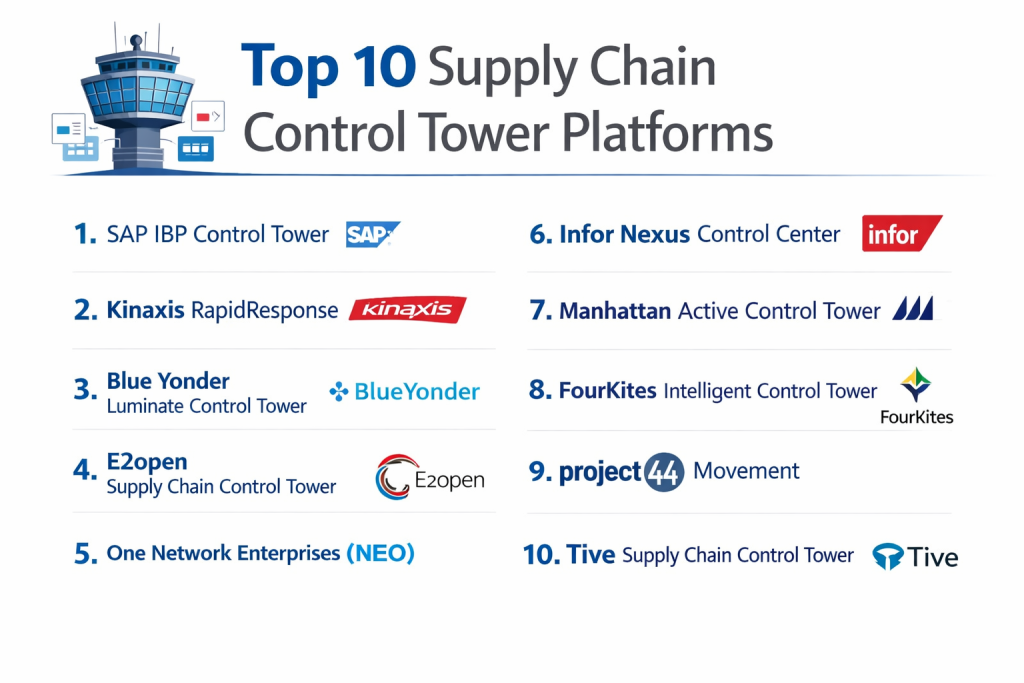
Top 10 Supply Chain Control Tower Platforms
1 — SAP IBP Control Tower
SAP Integrated Business Planning (IBP) for Supply Chain Control Tower is the gold standard for organizations already embedded in the SAP ecosystem. It focuses on providing a 360-degree view of the supply chain with deep planning and execution integration.
- Key features:
- Real-time monitoring of KPIs and supply chain alerts.
- Advanced “what-if” scenario planning and simulations.
- Deep integration with SAP S/4HANA and other SAP modules.
- AI-driven demand sensing and supply analytics.
- Interactive dashboards with drill-down capabilities.
- Collaborative exception management workflows.
- Pros:
- Unmatched data consistency for existing SAP users.
- Highly sophisticated predictive analytics.
- Cons:
- Extremely high implementation costs and long setup times.
- The interface can be overwhelming for non-technical users.
- Security & compliance: SOC 1, SOC 2, ISO 27001, and GDPR compliant; utilizes SAP’s world-class cloud security infrastructure.
- Support & community: Extensive global network of consultants, a massive online community (SAP Community), and premium enterprise support.
2 — Kinaxis RapidResponse
Kinaxis is renowned for its “concurrent planning” architecture, which ensures that if one data point changes, the entire supply chain plan is recalculated instantly across the network.
- Key features:
- Concurrent planning for demand, supply, and inventory.
- Real-time visibility into multi-tier supplier networks.
- AI-powered anomaly detection for early warning signals.
- Automated root-cause analysis for disruptions.
- Integrated “Playbooks” for standardized incident response.
- Rapid scenario modeling and comparison.
- Pros:
- The fastest scenario simulation speed in the industry.
- Excellent at breaking down silos between planning and execution.
- Cons:
- High barrier to entry for smaller organizations.
- Requires high-quality data inputs to work effectively.
- Security & compliance: SOC 2 Type II, ISO 27001, and HIPAA compliant where applicable.
- Support & community: High-touch customer success teams and a growing user base through the Kinaxis Knowledge Network.
3 — Blue Yonder Luminate Control Tower
Blue Yonder’s Luminate platform uses cognitive AI to sense, predict, and act. It is particularly strong in the retail and CPG (Consumer Packaged Goods) sectors.
- Key features:
- AI-powered orchestration of planning and execution.
- Dynamic exception management with prescriptive recommendations.
- End-to-end visibility across warehouses, transportation, and labor.
- Machine learning-guided “what-if” analysis.
- Real-time collaboration portals for suppliers and carriers.
- Integration with Microsoft Azure for high-speed processing.
- Pros:
- Exceptional at predicting retail-specific demand shifts.
- Offers very strong logistics and transportation integration.
- Cons:
- Implementation is often reported as a lengthy and complex process.
- Some legacy components in the UI can feel disjointed.
- Security & compliance: ISO 27001, GDPR, and FedRAMP authorized (for government sectors).
- Support & community: 24/7 global support and an extensive library of training through Blue Yonder University.
4 — E2open Supply Chain Control Tower
E2open is built on a “unified platform” approach, connecting hundreds of thousands of partners in a single network to provide true multi-enterprise visibility.
- Key features:
- Multi-tier visibility into N-tier suppliers and logistics.
- Automated sensing and response to shipment interruptions.
- Integrated modules for global trade and compliance.
- Collaborative workflows across a network of 400,000+ partners.
- AI-driven predictive insights and performance benchmarking.
- Digital twin technology for supply chain modeling.
- Pros:
- Access to one of the world’s largest pre-connected partner networks.
- Very strong on the trade compliance and regulatory side.
- Cons:
- The modular approach means the platform can get expensive as you add features.
- Onboarding specific partners not already in the E2net can take time.
- Security & compliance: SOC 2, ISO 27001, and robust data privacy controls for multi-tenant environments.
- Support & community: Enterprise-grade support with dedicated account managers for large clients.
5 — One Network Enterprises (NEO)
One Network’s NEO platform focuses on “autonomous” control, aiming to take the human out of the loop for routine decisions through advanced AI agents.
- Key features:
- Autonomous decision-making and automated problem-solving.
- Real-time “Single Version of the Truth” across all parties.
- Multi-party optimization of demand and supply.
- AI-driven prescriptive alerts for inventory and logistics.
- Integrated blockchain for secure, traceable transactions.
- “System of Engagement” that sits on top of existing ERPs.
- Pros:
- Leading-edge automation—best for organizations wanting “hands-off” management.
- Excellent at coordinating multi-enterprise execution.
- Cons:
- Requires a significant cultural shift to trust autonomous decisions.
- Implementation can be complex due to its deep network roots.
- Security & compliance: SOC 2, ISO 27001, and FedRAMP Moderate certification.
- Support & community: Global professional services and a strong developer network for customization.
6 — Infor Nexus Control Center
Infor Nexus is a leader in global trade management, offering a control tower that is specifically designed for the complexities of international logistics and finance.
- Key features:
- End-to-end visibility of international orders and shipments.
- Predictive ETAs using machine learning and historical data.
- Integrated supply chain finance and liquidity tools.
- Collaborative supplier and carrier management.
- ESG and sustainability tracking across the network.
- Real-time port and terminal visibility.
- Pros:
- The best choice for organizations with heavy reliance on ocean and air freight.
- Unique integration of financial visibility with physical logistics.
- Cons:
- Less focus on domestic-only warehouse or factory floor planning.
- User interface is functional but lacks the “polish” of some competitors.
- Security & compliance: ISO 27001, SOC 2, and rigorous data encryption for financial transactions.
- Support & community: Highly specialized support for global trade and logistics challenges.
7 — Manhattan Active Control Tower
Part of the Manhattan Active platform, this control tower is uniquely focused on the convergence of warehouse and transportation operations.
- Key features:
- Unified visibility into WMS and TMS operations.
- Real-time exception-based alerts for distribution.
- Advanced analytics for labor and warehouse performance.
- Seamless integration with Manhattan’s industry-leading WMS.
- Versionless architecture with continuous quarterly updates.
- Collaborative carrier and appointment management.
- Pros:
- Zero-downtime updates mean you are always on the latest version.
- Deepest integration between warehouse floors and the road.
- Cons:
- Best suited only for organizations already using Manhattan’s software.
- Less focus on multi-tier supplier planning compared to Kinaxis or E2open.
- Security & compliance: SOC 2, ISO 27001, and high-level cloud-native security protocols.
- Support & community: Manhattan Customer Care and a strong user group (WMUG) community.
8 — FourKites Intelligent Control Tower
FourKites began as a visibility platform for transportation and has evolved into an intelligent control tower that specializes in the “execution” phase of the supply chain.
- Key features:
- Real-time tracking across ocean, rail, air, and road.
- Predictive ETAs with industry-leading accuracy.
- AI-powered “Digital Worker” (Polly) for autonomous exception resolution.
- Yard and facility management integration.
- Sustainability dashboards for carbon emissions tracking.
- Network-wide carrier collaboration and benchmarking.
- Pros:
- Highly intuitive, modern interface that is very easy to use.
- Strongest predictive ETA engine for ground transportation.
- Cons:
- Not a replacement for deep demand or supply planning tools.
- Primarily focused on visibility and execution rather than N-tier manufacturing.
- Security & compliance: SOC 2 Type II, GDPR compliant, and ISO 27001 certified.
- Support & community: Exceptional customer success reputation and a very active “Innovation Partner” program.
9 — project44 Movement
project44 offers the “Movement” platform, which is a modern, high-speed visibility engine designed to connect every link in the global transportation chain.
- Key features:
- High-fidelity, real-time shipment tracking globally.
- AI-driven predictive ETAs and delay alerts.
- Integrated “Workflow” tool for managing carrier communication.
- Unified view of inventory in transit across all modes.
- Seamless API-first architecture for rapid integration.
- Comprehensive data quality and carrier connectivity scoring.
- Pros:
- Fastest carrier onboarding process in the market.
- Extremely high data quality and accuracy.
- Cons:
- Focused strictly on transportation and logistics, not supply planning.
- Can be viewed as a “data feed” rather than a full decision-making suite.
- Security & compliance: SOC 2, GDPR, and advanced encryption for data in transit.
- Support & community: Very responsive tech support and a robust developer portal for API users.
10 — Tive Supply Chain Control Tower
Tive takes a hardware-plus-software approach, using IoT (Internet of Things) trackers to provide real-time condition monitoring (temp, shock, light) alongside location.
- Key features:
- Real-time location and condition tracking (GPS + IoT).
- Instant alerts for light exposure, moisture, or impact.
- Predictive analytics for shipment arrival and damage risk.
- Collaborative platform for shippers and 3PLs.
- “Solo” 5G trackers that require no infrastructure.
- Integrated platform for managing high-value, sensitive cargo.
- Pros:
- The only choice for industries where “condition” is as important as “location” (e.g., Pharma, Food).
- Very easy to deploy; literally “stick and track.”
- Cons:
- Requires managing physical hardware (trackers).
- Less focus on broad network planning; highly tactical.
- Security & compliance: ISO 27001, SOC 2, and FDA-compliant reporting for sensitive shipments.
- Support & community: 24/7 shipment monitoring services and personalized onboarding.
Comparison Table
| Tool Name | Best For | Platform(s) Supported | Standout Feature | Rating |
| SAP IBP | SAP Ecosystem Users | Cloud/Web | Deep ERP Integration | 4.6 / 5 |
| Kinaxis | Scenario Planning | Cloud/Web | Concurrent Planning | 4.7 / 5 |
| Blue Yonder | Retail & CPG | Cloud/Web | Cognitive AI Sensing | 4.5 / 5 |
| E2open | Multi-Tier Networks | Cloud/Web | 400k+ Partner Network | 4.4 / 5 |
| One Network | Autonomous Control | Cloud/Web | Autonomous AI Agents | N/A |
| Infor Nexus | Global Trade/Finance | Cloud/Web | Trade Finance Integration | N/A |
| Manhattan | Distrubtion Centers | Cloud/Web | WMS-TMS Convergence | 4.5 / 5 |
| FourKites | Transportation visibility | Cloud/Web | Predictive ETA Accuracy | 4.8 / 5 |
| project44 | High-Fidelity Data | API/Cloud | Carrier Connectivity | 4.7 / 5 |
| Tive | Condition Monitoring | IoT/Cloud | Real-Time Sensor Data | N/A |
Evaluation & Scoring of Supply Chain Control Tower Platforms
We have evaluated these platforms based on their ability to handle modern, global supply chain disruptions.
| Category | Weight | Average Score | Evaluation Logic |
| Core Features | 25% | 9.0/10 | Visibility, alerts, and analytics are essential. |
| Ease of Use | 15% | 7.5/10 | Modern visibility tools excel; heavy ERP tools lag. |
| Integrations | 15% | 8.5/10 | The ability to talk to 3PLs and partners is critical. |
| Security & Compliance | 10% | 9.5/10 | Essential for global trade and proprietary data. |
| Performance | 10% | 9.0/10 | Systems must handle massive real-time data streams. |
| Support | 10% | 8.0/10 | High-touch support is needed for long deployments. |
| Price / Value | 15% | 7.0/10 | High cost, but ROI from reduced disruptions is massive. |
Which Supply Chain Control Tower Platform Is Right for You?
Solo Users vs SMB vs Mid-Market vs Enterprise
The control tower market is heavily skewed toward Enterprise users. If you are a solo user or a very small business, the overhead of a platform like SAP IBP or Kinaxis will be too much. For Mid-Market companies (revenue $100M – $1B), FourKites or Tive offer a great entry point into visibility without the multi-year implementation of a planning tower. For Large Enterprises ($1B+), you need the full-stack capability of E2open or One Network to manage the thousands of variables across your global footprint.
Budget-Conscious vs Premium Solutions
If you are budget-conscious, look for “Visibility-as-a-Service” providers like project44. You can pay for the data you need without buying a massive planning engine. However, if your company loses millions every time a ship is delayed or a port is congested, a Premium Solution like Blue Yonder or Kinaxis is an investment that pays for itself through “resilience insurance.”
Feature Depth vs Ease of Use
There is a clear divide here. FourKites and project44 are incredibly easy to use and can be rolled out to teams in weeks. They have beautiful, intuitive maps. On the other hand, SAP IBP and Hastus (in the transit space) or One Network have incredible feature depth—they can do things the easy tools can’t, like automatic financial reconciliation or complex multi-tier bill-of-material (BOM) tracking—but they require a dedicated team of experts to run them.
Integration and Scalability Needs
If your primary need is scaling a pre-existing partner network, E2open is the winner because their network is already “live.” If your need is technical scalability—adding millions of data points from IoT sensors—project44 or Infor Nexus are built on modern API-first architectures that scale seamlessly.
Security and Compliance Requirements
For companies in highly regulated industries (Aerospace, Defense, Pharma), security is the number one priority. One Network and Blue Yonder have high-level certifications like FedRAMP, making them suitable for government-level security. For food and pharma, Tive provides the specific compliance reporting (like temperature logs) required by the FDA.
Frequently Asked Questions (FAQs)
1. Is a Control Tower the same as a TMS?
No. A TMS (Transportation Management System) focuses on planning and executing shipments. A Control Tower sits above the TMS, viewing data from multiple TMSs, WMSs, and external partners to provide a holistic view.
2. How long does implementation take?
For visibility platforms (like FourKites), it can be 2–4 months. For full planning control towers (like SAP IBP), it can take 12–24 months.
3. Do I need to replace my ERP?
No. Control towers are “systems of engagement” designed to sit on top of your existing ERP and connect it to the outside world.
4. Can a control tower predict the future?
While not a crystal ball, modern AI can analyze millions of historical data points to predict things like the likelihood of a carrier being late or a supplier running out of stock weeks in advance.
5. How much data do I need?
The “garbage in, garbage out” rule applies. A control tower is only as good as the data fed into it. Many platforms now offer “data cleansing” services to help you fix your internal data first.
6. Does it help with sustainability (ESG)?
Yes. Most modern platforms (Infor Nexus, FourKites) now include carbon tracking modules that calculate the emissions of your shipments based on mode and distance.
7. Can it handle “on-demand” or last-mile delivery?
Yes, tools like Blue Yonder and project44 have specific modules for the high-velocity world of e-commerce and last-mile tracking.
8. What is a “Digital Twin” in this context?
A digital twin is a virtual model of your physical supply chain. It allows you to run “what-if” tests in a safe, digital environment before making changes in the real world.
9. Is the data secure from my competitors?
Yes. Platforms are “multi-tenant,” meaning data is siloed. Your suppliers only see their data, and you only see data related to your shipments.
10. Do I need a team of data scientists?
While helpful, many of these tools (especially those with “Autonomous AI”) are designed for supply chain planners to use without needing to write code or do manual math.
Conclusion
A Supply Chain Control Tower is the ultimate tool for navigating the complexity of the modern world. It transforms the supply chain from a cost center into a competitive advantage by providing the one thing every executive needs: Clarity. Choosing the right platform depends on where your “pain” is. If your struggle is in the warehouse and on the road, Manhattan is the answer. If your struggle is global trade and finance, Infor Nexus is the leader. If you need to plan for total network disruptions in real-time, Kinaxis is your best bet.
The “best” tool is the one that connects your specific network of partners and empowers your team to make decisions with confidence. In the age of disruption, visibility is no longer a luxury—it is a survival skill.